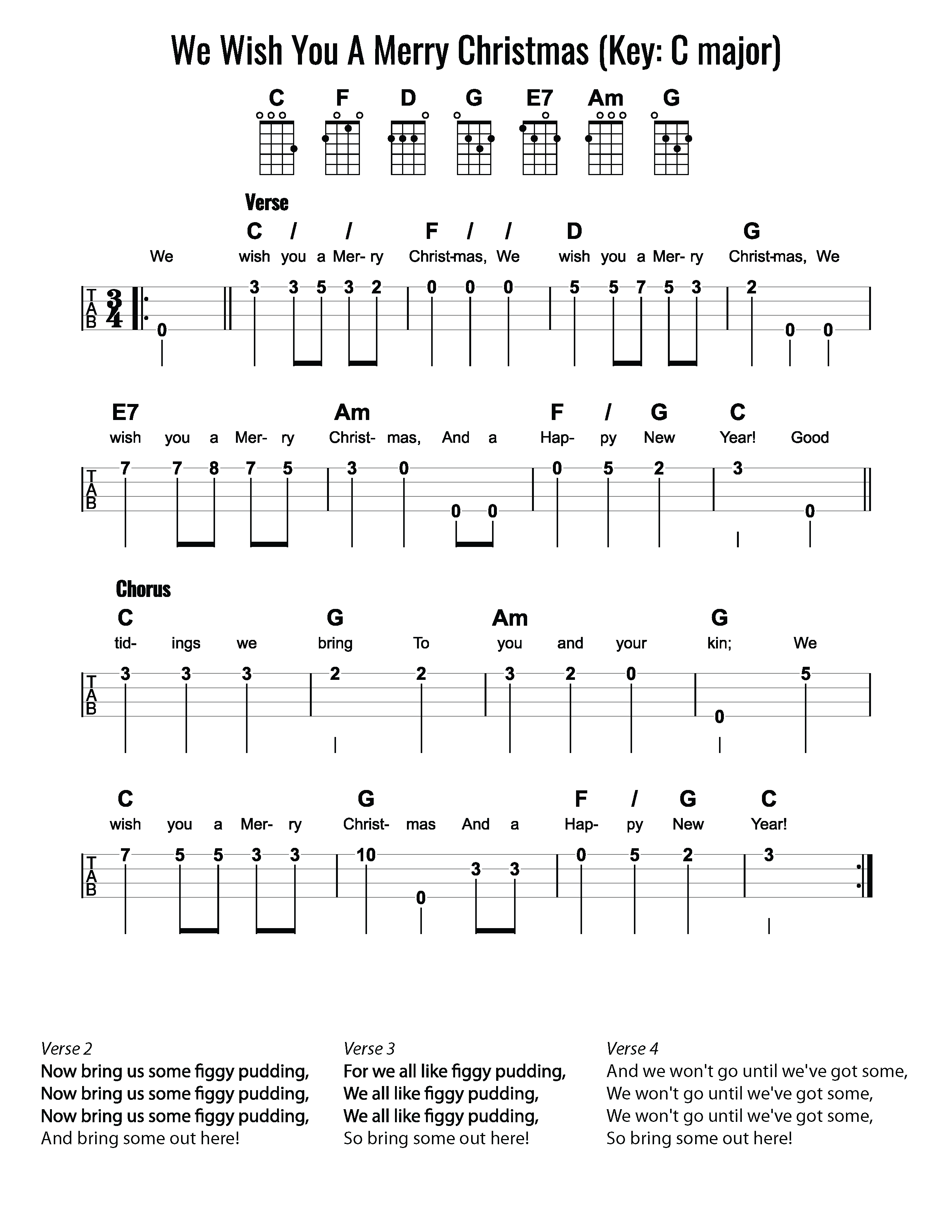
We Wish You a Merry Christmas – Chords and TAB for Ukulele

Each year I usually end up tweaking my Christmas music a bit for my lessons and we tend to do a few Christmas songs like this in the primary schools I teach at. For the older students I might teach them something more advanced but this is still quite fun to play through and is a good sight reading challenge at the least.

This is also available for Guitar, Piano, Bass, Drums and C instrument melody. Just follow the link below.

Free PDF Download – We Wish You a Merry Christmas

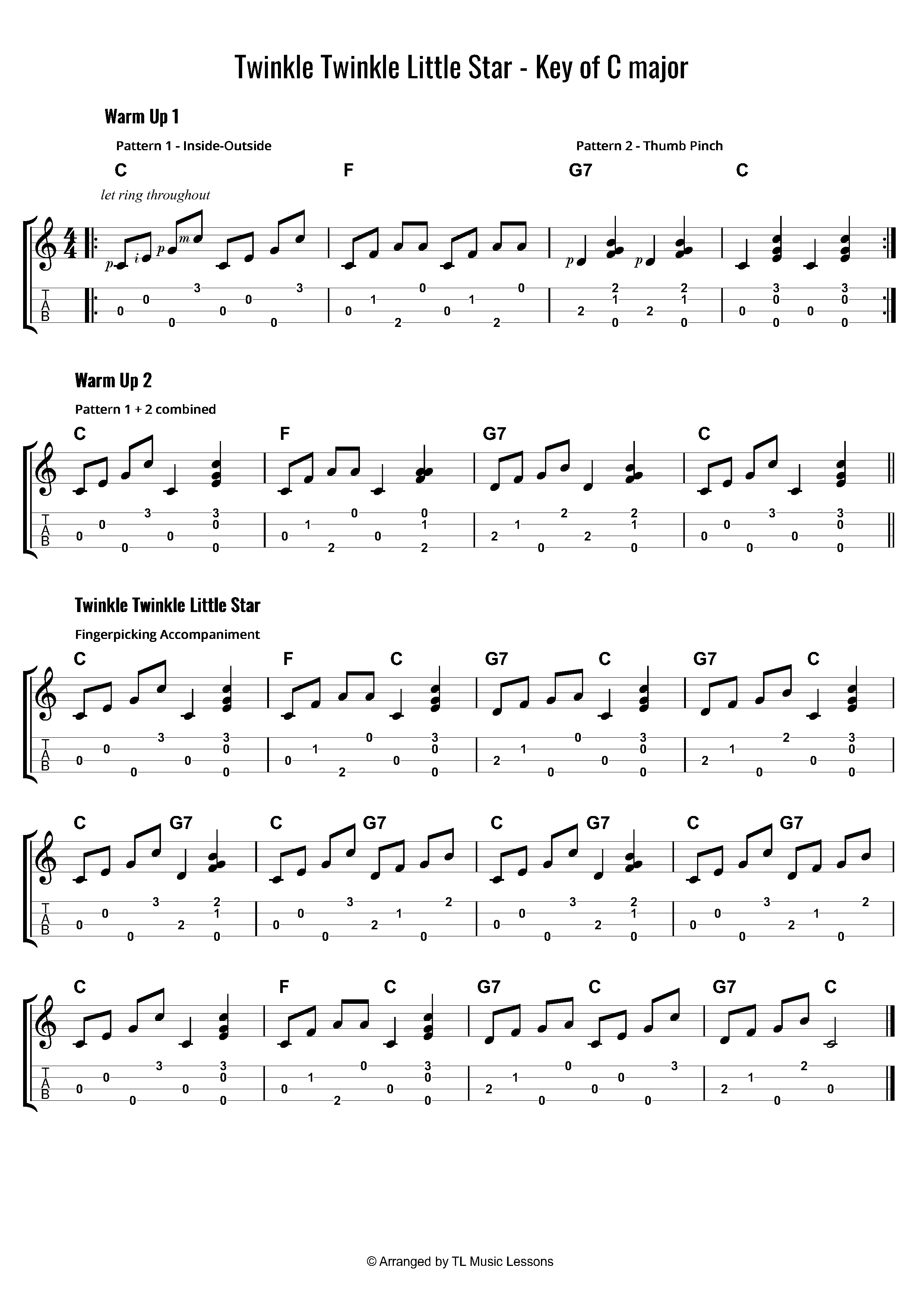
Ukulele Arrangements for Twinkle Twinkle Little Star

In this post we have lots of free PDFs for this song, including melody, chords, fingerpicking and fingerstyle. You can find more like this in my ebook Easy Songs in the Public Domain for Fingerstyle Ukulele.

Fingerpicking Accompaniments

Uke-Fingerpicking_Twinkle Twinkle Little Star
Uke-Thumb-Pinch-Finger-Pattern_Twinkle Twinkle Little Star

Fingerstyle Ukulele Arrangement

Uke-Fingerstyle_Twinkle Twinkle Little Star

Simple Melody and Chords Arrangements

Uke-Chords_Twinkle Twinkle Little Star
Uke-Melody_Twinkle Twinkle Little Star
Uke-Melody-and-chords_Twinkle Twinkle Little Star

These melody arrangements should also work for Violin, Sax, Clarinet and Flute.
Violin_Twinkle Twinkle Little Star
Alto Sax_Twinkle Twinkle Little Star
Clarinet_Twinkle Twinkle Little Star
Flute_Twinkle Twinkle Little Star

More Like This

Buy The Ebook →

Exercises 9-10 – Inside The Book: 50 Ukulele Chord Exercises for Beginners

These 2 ukulele chord exercises are featured in the book 50 Ukulele Chord Exercises

On this chords exercise sheet, we will be working with four chords: Em7, Edim7, F and Fadd9.

Exercise 9

Whilst we don’t usually play diminished chords at beginners level, this one is not very difficult because it is an open chord, and all you do is move the Em7 shape down one fret, from frets 2 to frets 1 with both fingers.

Counting:
1+2+3+4

Exercise 10

moving from F to Fadd9 is an esay change on ukulele; take your 2nd finger off to move from F to Fadd9. Incase you were wondering what an add9 chord is, it’s a full major chord with an added major 2nd or major 9th note added (major 9th and major 2nd are the same notes, but major 9th is an octave higher.

Counting:
1 2 3 4

Video Lesson for Exercises 9-10


Watch on YouTube

← Exercises 7-8
Exercises 11-12 →
Buy The Book →

Exercises 7-8 – Inside The Book: 50 Ukulele Chord Exercises for Beginners

These 2 ukulele chord exercises are featured in the book 50 Ukulele Chord Exercises

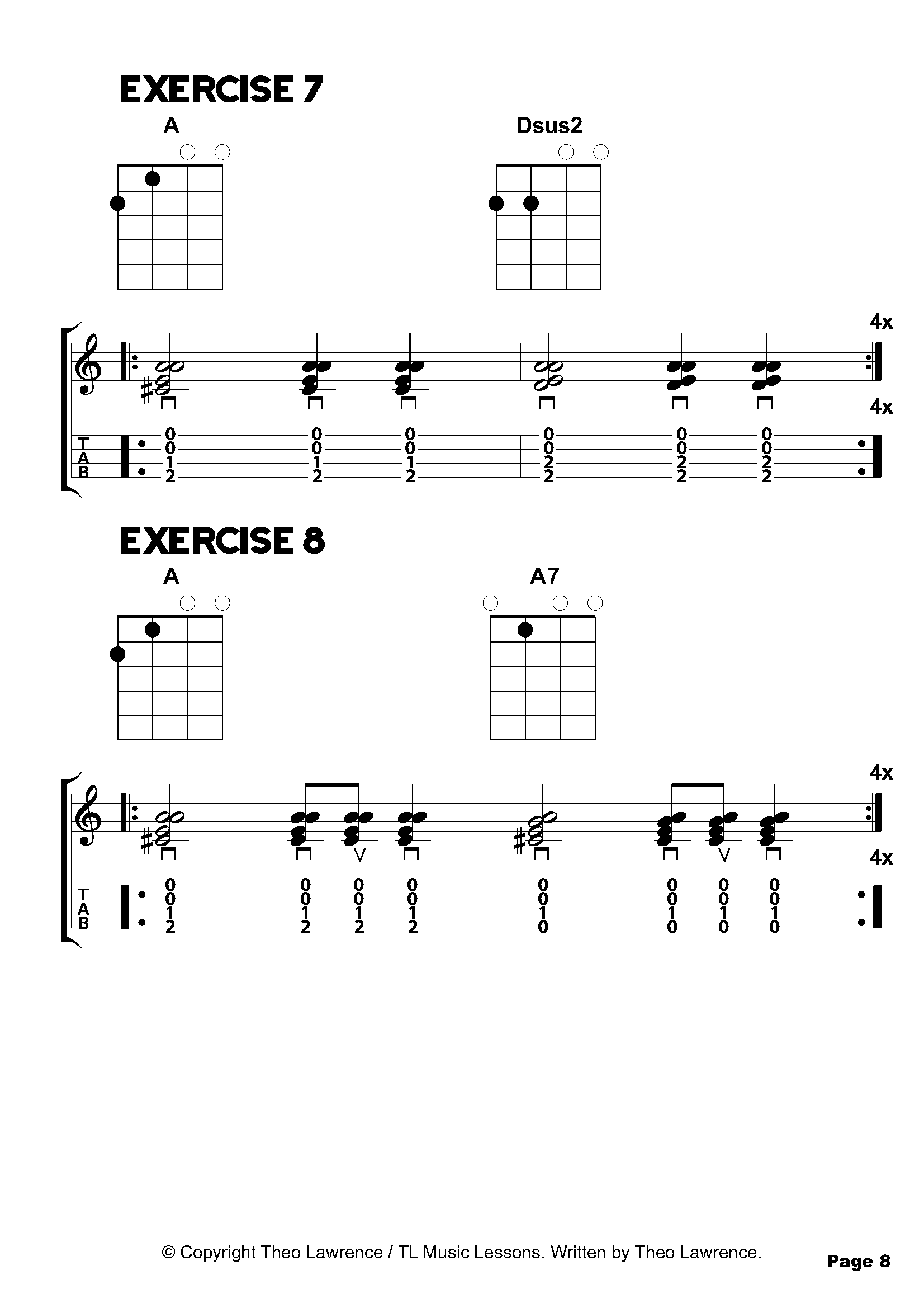
On this chords exercise sheet, we will be working with three chords: A, A7 and Dsus2.

Exercise 7

The first strum is worth 2 beats. You can see that the note is not coloured in and it has a stem, so that makes it a minim, worth 2 beats (also known as a half note because it lasts for half of the bar). This is followed by two cotchets, which are 1 beat each. Here is the counting that you should use for this exercise (strumming on the parts in bold font).

1 2 3 4

Exercise 8

The rhythm for this exercise is almost the same as exercise 7. All we do is add an up strum after beat 3. Here is the counting that you can use to help:

1 2 3 + 4

Video Lesson for Exercises 7-8

← Exercises 5-6
Exercises 9-10 →
Buy The Book →

Beginners Ukulele Chord Exercises 5-6 of 50

These 2 ukulele chord exercises are featured in the book 50 Ukulele Chord Exercises

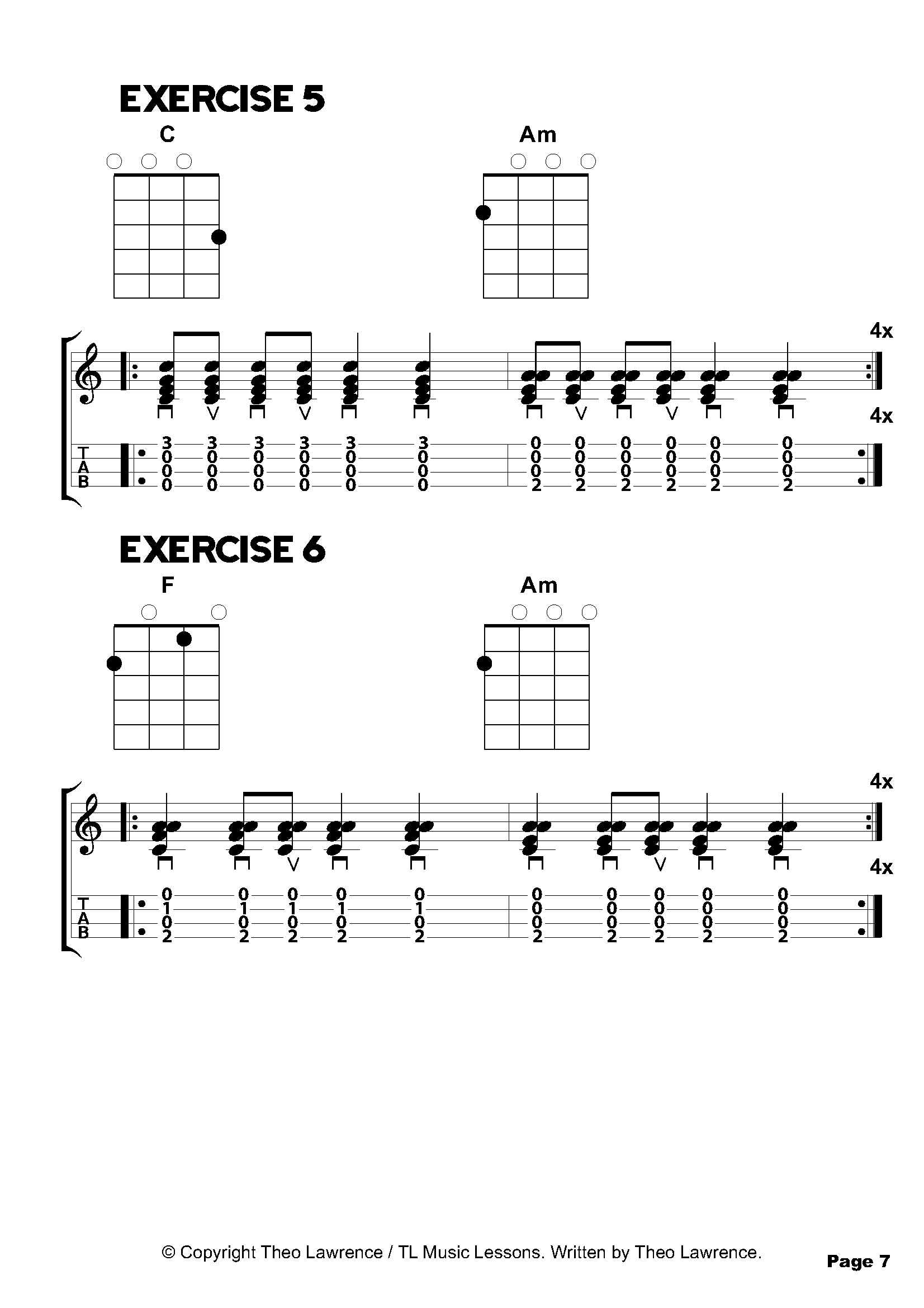
Here are 2 beginners ukulele chord exercises using C, am and F chords. On this sheet, we start to work on strumming rhythms. Exercise 5 uses C and Am chords and the rhythm is down up down up down down. Exercise 6 uses F and Am chords and the rhythm is down down up down down. On the video I show you how to practice these using a metronome. You could use this sheet and follow this video for a quick 10 minute lesson on practicing the C, Am and F chords, which are fundamental to learn and practice on the ukulele.

← Exercises 3-4
Exercises 7-8 →
Buy The Book →

Beginners Ukulele Chord Exercises 1-2 of 50

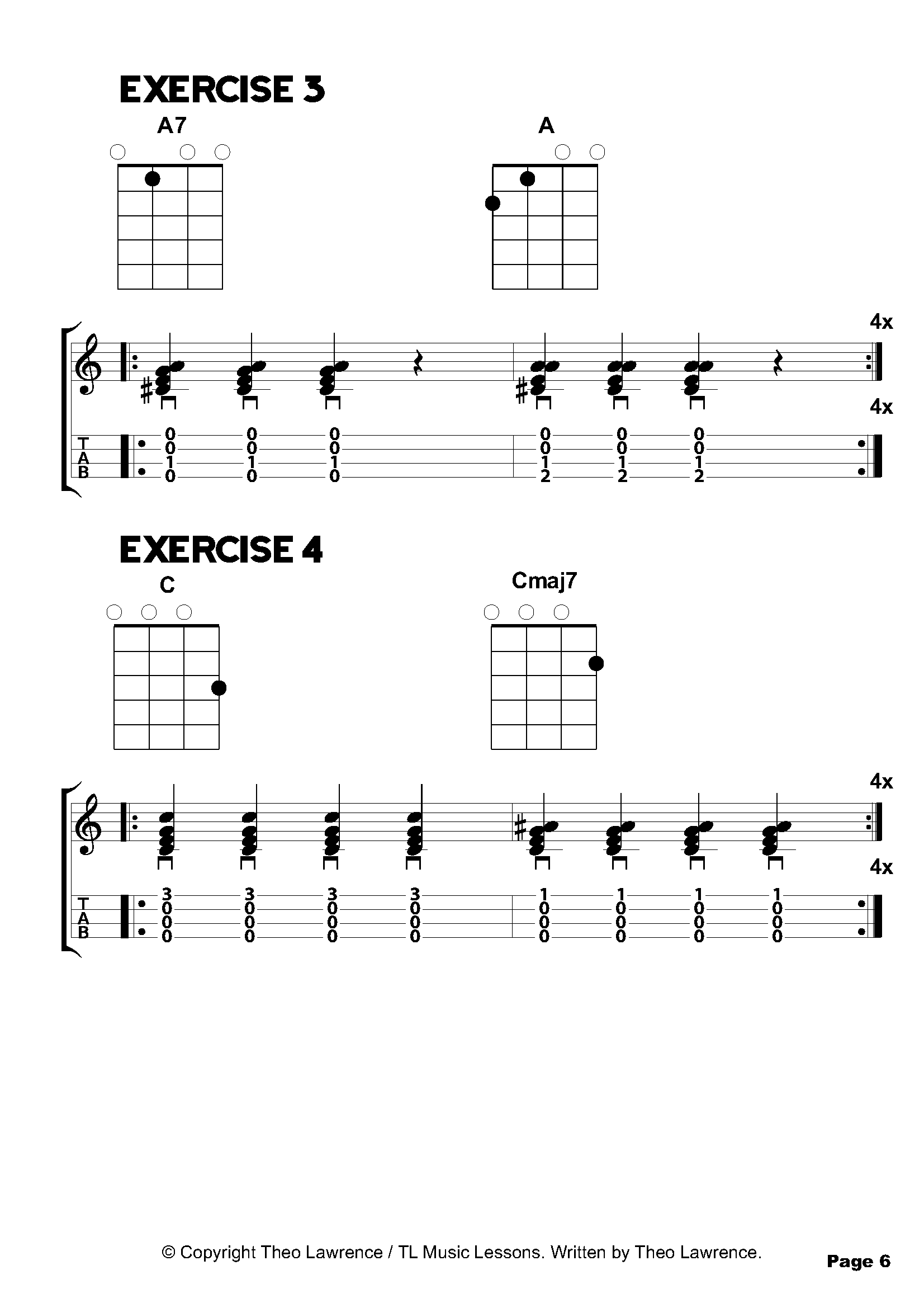
Here we have 2 ukulele chord exercises for beginners. The first exercise has single strums, lasting for 4 beats, and the second exercise has 2 strums per chord, each lasting for 2 beats.

These exercises are designed to be very easy for ukulele beginners. The chords are Cmaj7, Am7 and Am. Watch the video below for help with counting and playing the chords.

Exercises 3-4 →
Buy The Book →

Easy Reading Silent Night in C for Ukulele

December really crept up on us this year, but I will take comfort that this page will go on to be viewed for years to come when hopefully it’s a lot jollier than here in 2020!

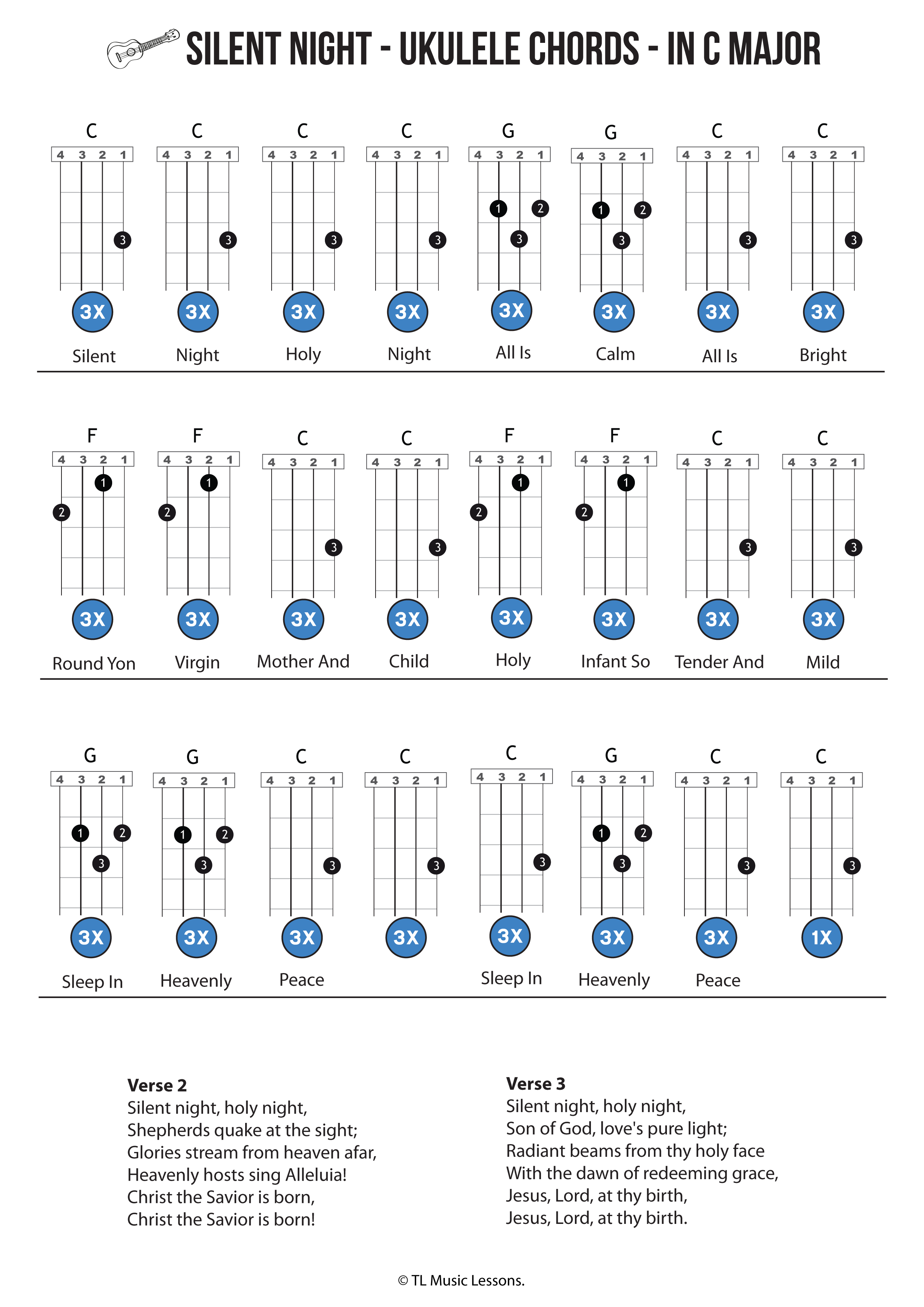
This sheet has been created so that beginner ukulele players can learn to play jingle bells using these easy to read chords. With it being digital, you might want to zoom in on the chords to learn them. If you are printing them off onto A4, the size of the chords won’t quite be as ‘easy reading’ but they still will be easier than some tiny chord boxes you might find on other sheets.

There are lyrics to go along with the chords, which should hopefully help with the first verse. Master that first and then you should find singing with verse 2 and 3 a bit easier.

Free PDF Download

PDF – Silent Night in C – ukulele chords easy reading

If you liked this free sheet, you can find easy reading ebooks like this in my ebook store, such as Beginners Ukulele Chords Book (Easy Reading) and First Ukulele Book – Easy Reading.

A Full Motion PC Monitor Arm can help you to read sheet music on your computer

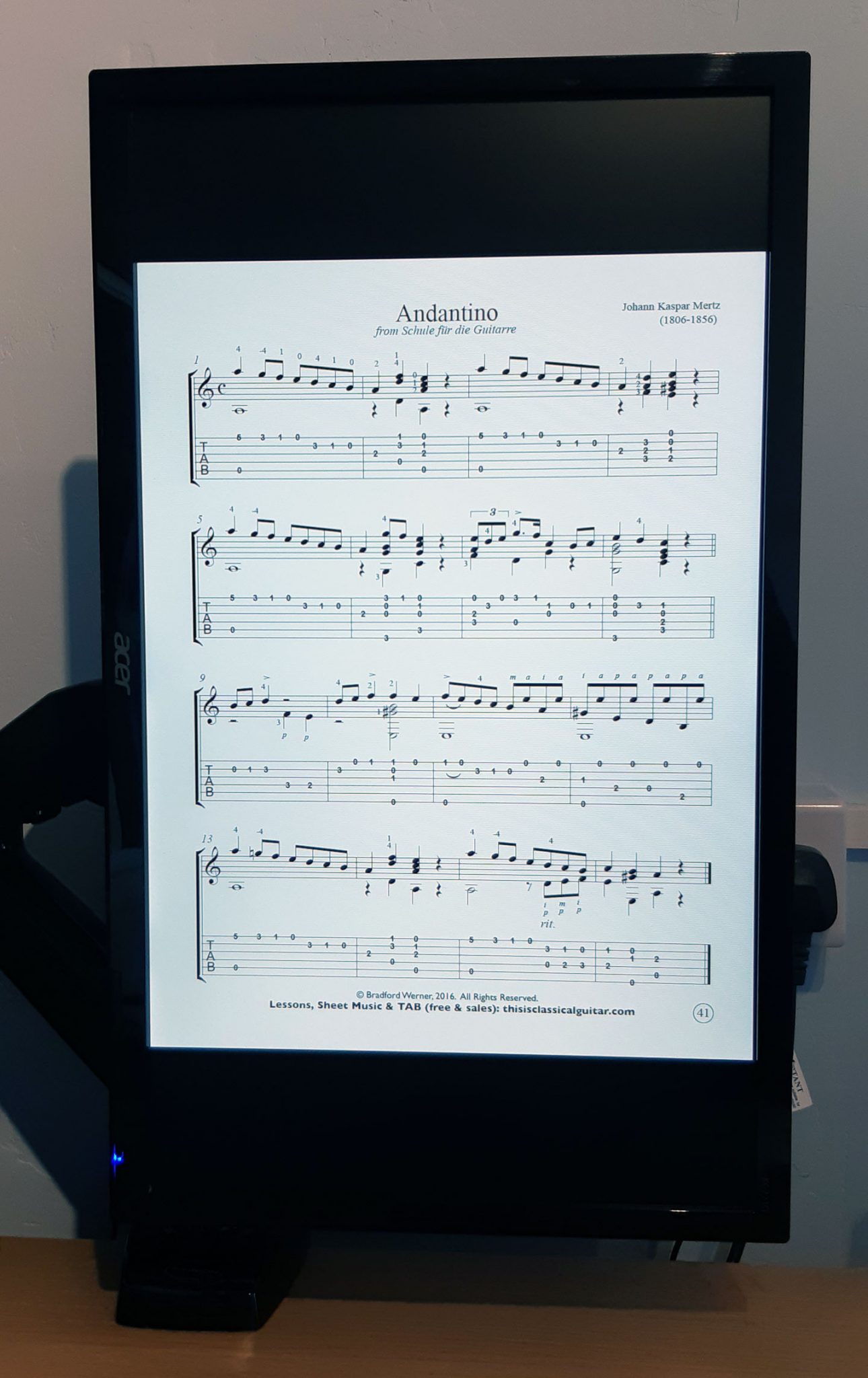
Today I installed a Full Motion PC Monitor Arm to my desk so that I can rotate my PC screen to read sheet music easily.

As I have been doing more teaching from home, and also have had more time to practice my instruments, I have been getting increasingly frustrated when reading music, because in Landscape mode it involves a lot of scrolling. You have to scroll much more frequenly than if the screen was in portrait mode.

I asked my techy gamer friend which one she has in her setup that I have seen, and she said to get this one, so I did.

Moving the monitor and benefits

I can now move the screen into portrait and load up a guitar book pdf and play away. You can go into full screen mode (Ctrl+L) and then press the down arrow key to move to the next page. Or you can use one of the other viewing methods without full screen mode and that way you can see a bit of the next sheet, and then press the down arrow to scroll or PgDn button to jump lower, or use the mouse.

To move the monitor, you can grab the screen and twist it around to make it portrait or landscape, or anything in between. You can also tilt it forwards and backwards and also move it left to right so that it can face someone to your left or right. This I think will come in very handy, because when I have been doing skype lessons on drums, I have been dragging my monitor around to face the drums, so this will be much easier, as you ust move it and then it stays in that position, so no screwing etc to move it.

How to change from Portrait to Landscape

To change the screen orientation to portrait in windows 10, you can right click on the desktop and click ‘Display Settings’ and change it there. My graphics card doesn’t allow the hotkey to change it annoyingly, but most people can change the screen orientation by clicking Ctrl+Alt+arrow keys.

Other Uses

The arm will help in lots of other ways too, like moving the screen so I can see it from the floor for workouts. I have been using the office to do home workouts from centr.com (unleashed and the da rulk masterclass have been enjoyable) and some others like Shona Virtue’s Fitness Programme after purchasing a cheap 8kg kettle bell from Aldi (was a rare find as weights were scarce).

I’m sure it will come in handy for positioning the monitor for gaming too, with a particular interest in F1 games.


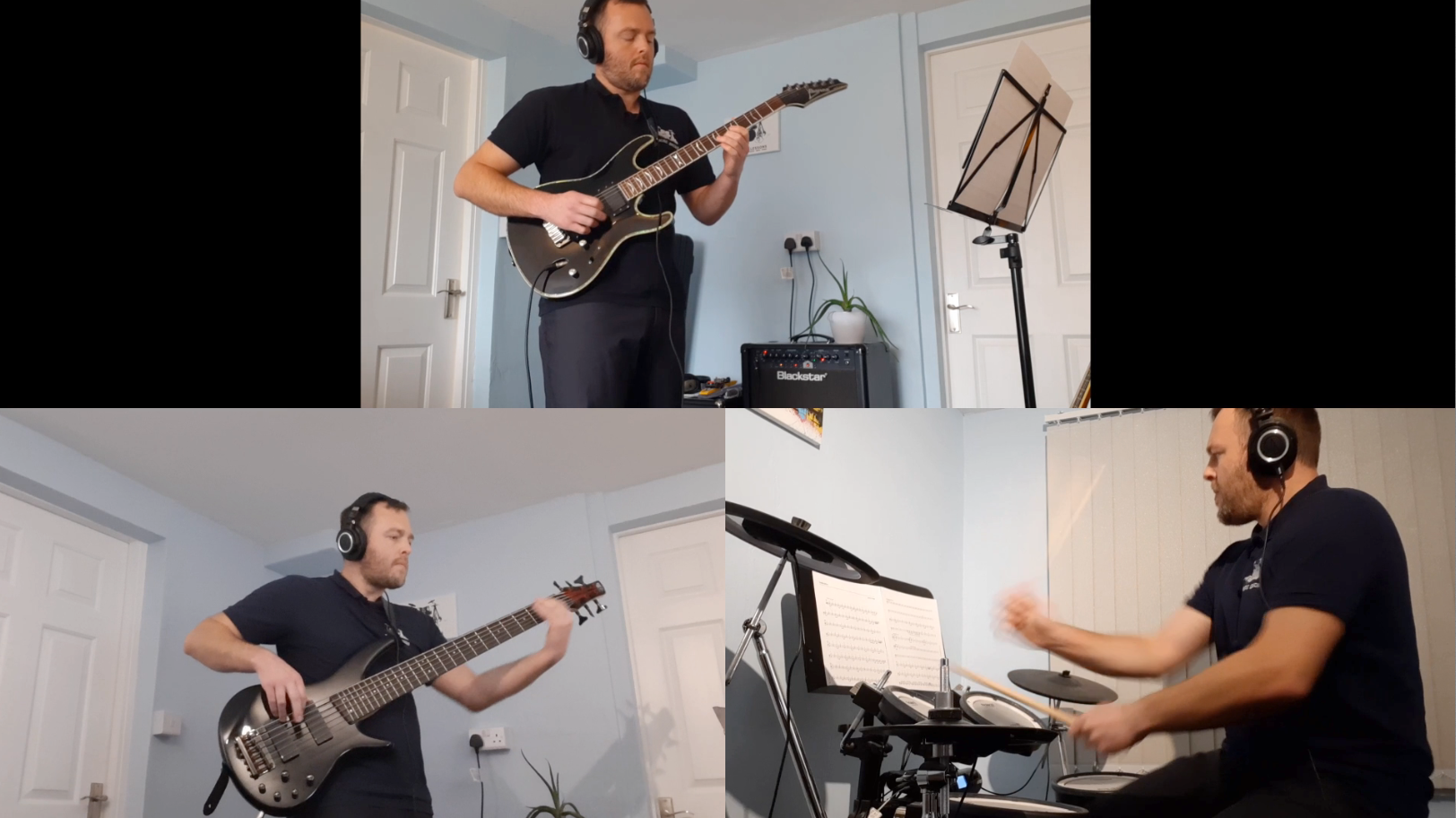
Guitar Drums and Bass performance of ‘Indecisive’ – Rockschool Grade 3 Piece

Many of my students have learned this piece and passed their exams. It’s an enjoyable piece to play with lots of energy and it’s deceptively hard to perform the whole song without mistakes.

The videos were recorded using a phone camera and a Zoom HD1 microphone.

I think these performances would get a fairly good mark out of 20 in an exam. Maybe 19 out of 20 each. I think the guitar performance was probably the strongest out of the 3, as there were small misakes in the others. But overall, I hope this is a good demo of the song and a good chance for students to see how the songs are played by each instrument, and give examples of the type of solos you could play in the song.

Video Lessons for 50 Chords Exercises Book – Guitar and Ukulele

After years of avoiding it, I have started making youtube videos for my lessons. I have focused on providing useful sheets, as I felt there was a gap in the market. Now the lesson sheets side of things is established, I have decided to add the extra layer of tuition with videos. You can either purchase the book or use the video lessons to play along for free.

50 Ukulele Chord Exercises Playlist:

50 Guitar Chord Exercises Playlist:

6 Rock & Blues Play Along Backing Tracks [Premium]

Contents

6 Rock & Blues Play Along Backing Tracks (with full sheet music)

★ Over 30 PDF Files of Sheet Music ★ Over 60 MP3 Tracks ★ 6 Guitar Pro Files ★

Buy Now ⟶

Listen to the 6 tracks here:

  1. Blues in A (Sun Shines Through The Window) – Play Along Track 1

Grade 3 Lead Guitar & Barre Chords
Grade 1 Guitar
Grade 1-2 Ukulele
Grade 3 Bass Guitar
Grade 1-2 Drums
Lyrics for the Verses

  1. Blues in E with swing – Play Along Track 2

Grade 3 Lead Guitar & Barre Chords
Grade 1-2 Guitar
Grade 1-2 Ukulele
Grade 3 Bass Guitar
Grade 1-2 Drums

  1. Slow Rock in A Minor – Play Along Track 3

Grade 3-6 Lead Guitar
Grade 2 Guitar
Grade 3 Guitar (Barre Chords)
Grade 2 Ukulele
Grade 4 Bass Guitar
Grade 1-3 Drums

  1. Alternative Rock in E Minor – Play Along Track 4

Grade 6 Lead Guitar
Grade 2-3 Guitar
Grade 2-3 Ukulele
Grade 3 Bass Guitar
Grade 3-4 Drums

  1. Indie Rock in C – Play Along Track 5

Grade 3-5 Lead Guitar
Grade 2 Guitar 1
Grade 2 Guitar 2
Grade 2 Ukulele
Grade 3-5 Bass Guitar
Grade 3-4 Drums
Grade 2 Easy Drums

  1. Funk Rock in A Minor – Play Along Track 6

Grade 5 Lead Guitar
Grade 2 Guitar
Grade 3 Guitar
Grade 2 Ukulele
Grade 5 Bass Guitar
Grade 6 Drums
Grade 2-3 Easy Drums

Written and self published in 2020 by Theo Lawrence / TL Music Lessons.

Introduction

When the UK went into lockdown in March 2020 due to Covid-19, I quickly moved many of my lessons onto Skype/Zoom online lessons. I decided to make some of my own songs for my students to play so that they had backing tracks to play along with when they had learned and practiced the songs. I wanted to make sure they were possible for them to play, whilst also being a challenge to learn them. By the end of June, I had written these 6 songs and they felt like they worked together as a set of pieces to share with the world.

My students are all at different levels. Many of my beginners pupils of primary school age have been having lessons for at least a year or several years, so I wrote the lowest ability parts at Grade 1-2, and sometimes elements of Grade 3. I also have some grade 4-6 pupils on Guitar, Drums and Bass, so I wanted to make parts for them too. With all those parts together, there is something for almost everyone in here – just not for complete beginners because they need to work on the basics before learning these pieces.

People that might find this book useful

  • Guitar, Ukulele, Bass and Drum teachers can use these resources in their teaching or for their student’s performances.
  • Guitar, Ukulele, Bass and Drum students can teach themselves to play the music if they are able to read the sheet music. The backing tracks can then be used to practice with.
  • The Backing Tracks could potentially be used for school performances, such as for GCSE (check with the music teacher at school for song choice suitability.


About the PDF Sheet Music

These are the overall ranges of grades that the instruments cover in this selection of 6 songs. There are separate PDF files for each instrument part.

Grade 3-6 Lead Guitar
Grade 1-2 Guitar
Grade 3 Guitar Barre Chords
Grade 1-3 Ukulele
Grade 3-5 Bass Guitar
Grade 3-6 Drums
Grade 1-3 Easy Drums

About the MP3 Audio Files and the Guitar Pro Files

There are at least 3 different speeds of backing tracks available for each song. With performances in mind (such as for school GCSE submissions, school performances, or Eisteddfod entries), I have also included mp3s for each song without Lead Guitar, without Drums and without Bass Guitar. There are also one or two extras in there, such as ‘Just the Ukulele Part’ for some songs where I felt they would be especially helpful. If you need backing tracks that aren’t in the download pack, I strongly suggest investing in a copy of Guitar Pro, because you can do so much with these files. You can make the pieces be any speed you want, you can edit the parts, you can change the sounds of the instruments, and you can make your own mp3s and pdf files with it. You can also turn on the metronome and loop sections.

Summary

During the last few months, I have noticed that my students that carried on with online lessons have seemed to progress more than usual. I’m not sure if it’s the extra time at home with less going on, or if it’s these songs with backing tracks. I’d like to think it’s a mixture of all of those things, and probably more. I can say for sure that these pieces have gone down well with all of my students and that the range of techniques and rhythms included in the songs have been beneficial for them. It’s also been a nice outlet for me – it’s been like songwriting again (I’ve had a substantial break from it), and even though I was purposely trying not to write things that were out of reach for my students to learn, I was also enjoying the creative flow, and at times really went for it. I got really into the lead parts and was quite creatively free with those mostly, and on the drum parts I added my own style and flair into them, especially on the last piece with adding in fast double strokes on the hi hats and fills.

I hope you enjoy learning / teaching with these pieces.

6 Rock and Blues Play Along Backing Tracks

Buy Now ⟶


Theo Lawrence

www.tlmusiclessons.com

www.learndrumsforfree.com

www.payhip.com/tlmusiclessonsdrums

www.learnguitarforfree.com

www.payhip.com/tlmusiclessons

https://www.pinterest.com/tlmusiclessons

https://facebook.com/tlmusiclessons

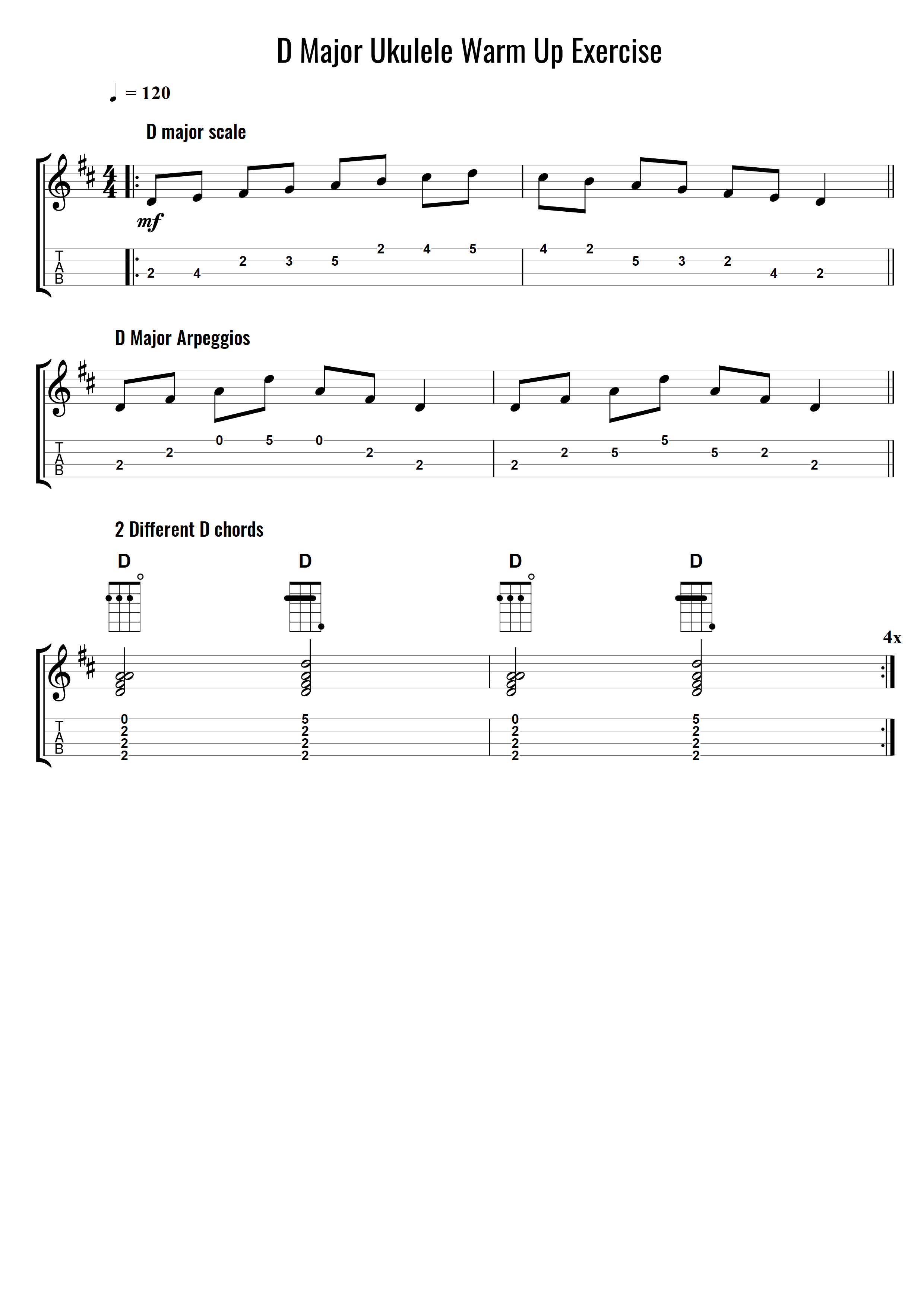
D Major Ukulele Warm Up Exercise

Here is a quick 1-2 mins warm up for you to try at the start of your ukulele practice.

You will play a D major scale, then 2 D major arpeggios, then 2 different D chords. Then you will repeat this until you have played it 4 times around.

File Downloads

Warm Up Tabs for Guitar, Bass & Ukulele – Scales & Arpeggios

We’re still in lockdown in Wales (UK), and we can only travel 5 miles. I’ve been busy teaching online lessons and also have done a lot of DIY projects around the house. I thought I would have had loads of time to update my blogs but I’ve been too busy! However, my students that have carried on have been burning through their grades and practicing more than ever. Here are a few scales warm ups I’ve been adding to their new practice plans, which I’ve been writing with google docs and sending the parents a link to so they can see updated practice notes whenever I add new things to it.

At the end of the post, there is also a bonus chord exercise challend for you to try.

These scales, arpeggios and chords exercises are good for any beginner or intermediate player that has been learning guitar for a while and has the ability to read tab. You might be used to reading proper sheet music, like on the rest of the website, but the tab is essentially the same. You have 6 lines (4 for ukulele), and the top line is the bottom string on the instrument. So the bottom line on the tab is the thickest string on the guitar. You’ll see tab elsewhere on the internet like on ultimate-guitar.com, so hopefully everyone will be able to read these.

Hopefully you can find these an enjoyable way to warm up whilst stuck at home. Run through all of these as a warm up so you’re not neglecting your scales, and then go and learn something else like you would in a guitar lesson. Perhaps learn a song or maybe some chord progression exercises or learn to play a guitar solo from a song you like.

Scales & Arpeggio Warm Ups – Guitar

4X forwards and backwards for each one

E Blues scale

———————————————–0–3–
—————————————0–3———-
—————————-0–2–3——————
———————0–2—————————-
———-0–1–2————————————
–0–3———————————————–

A minor pentatonic scale

Fret 5 = 1st finger, Fret 6 = 2nd Finger, Fret 7 = 3rd finger, Fret 8 = 4th finger

————————————–5–8——
——————————–5–8————
————————–5–7——————
——————5–7————————–
———-5–7———————————-
–5–8——————————————

G major scale

———————————————————5–7–8–
———————————————5–7–8————-
———————————-4–5–7————————
———————–4–5–7———————————–
————3–5–7———————————————-
-3–5–7———————————————————

A major arpeggio

Fret 4 = 1st finger, Fret 5 = 2nd Finger, Fret 6 = 3rd finger, Fret 7 = 4th finger

————————–5—-
———————-5——–
——————6————
————–7—————-
——4–7———————
–5—————————-

A minor arpeggio

Fret 5 = 1st finger, Fret 6 = 2nd Finger, Fret 7 = 3rd finger, Fret 8 = 4th finger

————————–5—–
———————-5———
——————5————-
————–7—————–
———-7———————
–5–8————————–


Scales & Arpeggio Warm Ups – Bass Guitar

4X forwards and backwards for each one

E Blues scale

——————————————————
———————0–2—————————-
———-0–1–2————————————
–0–3———————————————–

A minor pentatonic scale

Fret 5 = 1st finger, Fret 6 = 2nd Finger, Fret 7 = 3rd finger, Fret 8 = 4th finger

————————————————
——————5–7————————–
———-5–7———————————-
–5–8——————————————

G major scale

———————————-4–5–7—9—11–12—-
———————–4–5–7——————————–
————3–5–7——————————————-
-3–5–7——————————————————

A major arpeggio

Fret 4 = 1st finger, Fret 5 = 2nd Finger, Fret 6 = 3rd finger, Fret 7 = 4th finger

——————————-
————–7—————-
——4–7———————
–5—————————-

A minor arpeggio

Fret 5 = 1st finger, Fret 6 = 2nd Finger, Fret 7 = 3rd finger, Fret 8 = 4th finger

——————————–
————–7—————–
———-7———————
–5–8————————–

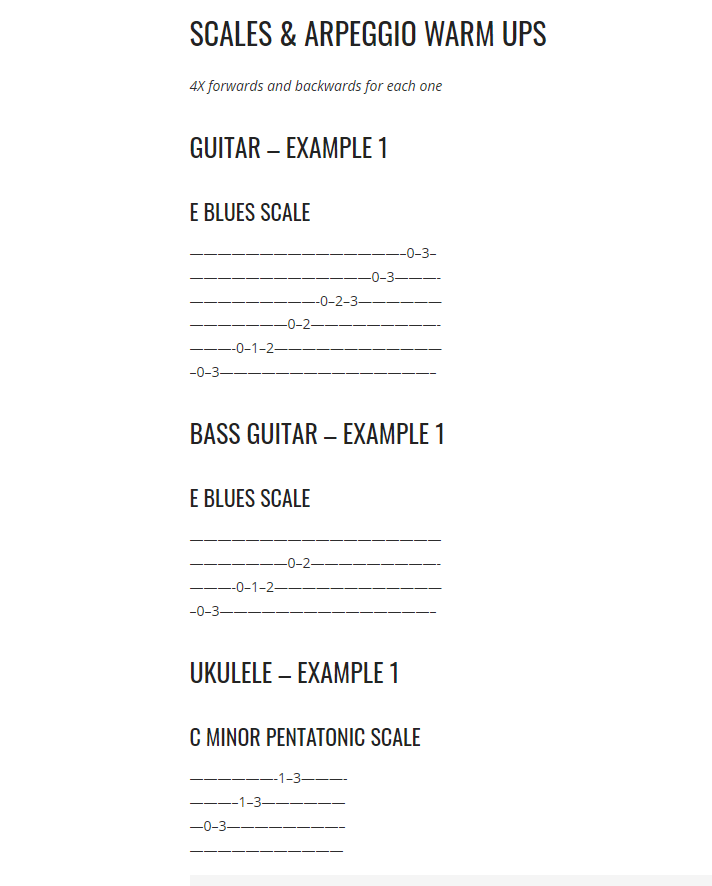
Scales & Arpeggio Warm Ups – Ukulele

4X forwards and backwards for each one

C minor pentatonic scale

——————-1–3———-
———–1–3——————
—0–3————————–
———————————

C major scale

———————-0–2–3—-
———–0–1–3—————
—0–2————————–
———————————

D minor scale

——————-3–5———-
———–3–5——————
—2–5————————–
———————————

D major scale

———————-2–4–5—-
———–2–3–5—————
—2–4————————–
———————————

E natural minor scale

—————————5–7——-
—————5–7–8—————-
—4–6–7—————————-
————————————–


Bonus Chord Exericse

How many times can you play these chords in 1 minute?

Set a countdown timer for 1 minute. Strum each chord once and then repeat when you have done all 3 chords. Count how many times you go around them in 1 minute.

Challenge 1: A, D, E.
Challenge 2: E, A7, B7.
Challenge 3: A7, D7, E7.
Challenge 4: Am Dm7 G.
Challenge 5: C F G.
How peripatetic music teachers can keep working if the schools close

Here in the UK the schools are still open and it’s business as usual but last night I sent out an email asking if parents would be up for skype lessons and the response has be overwhelmingly positive. I’ve made a rule that a parent or guardian must be there for the lessons.

I have been teaching skype lessons successfully for over 3 years, and I currently have a skype Drummer that has just taken her Grade 5 drum exam. All the parents need to do is download the Skype app on their smart phone for free and the calls are free.

If we don’t do the skype lessons, I have to refund the missed lessons on the next invoice, so it’s not worth relaxing at home when I could keep some of the work going for the ones that still want to keep the lessons going.

This gives me hope for when we have snow days, or flooded days, if this works.

It’s starting to be heart warming to see people respond in positive ways, like the italians singing in their balconies, and this morning seeing a singer who’s first european tour has been cancelled, doing a live social media tour, it is just inspiring.

Stay safe and stay positive 🙂

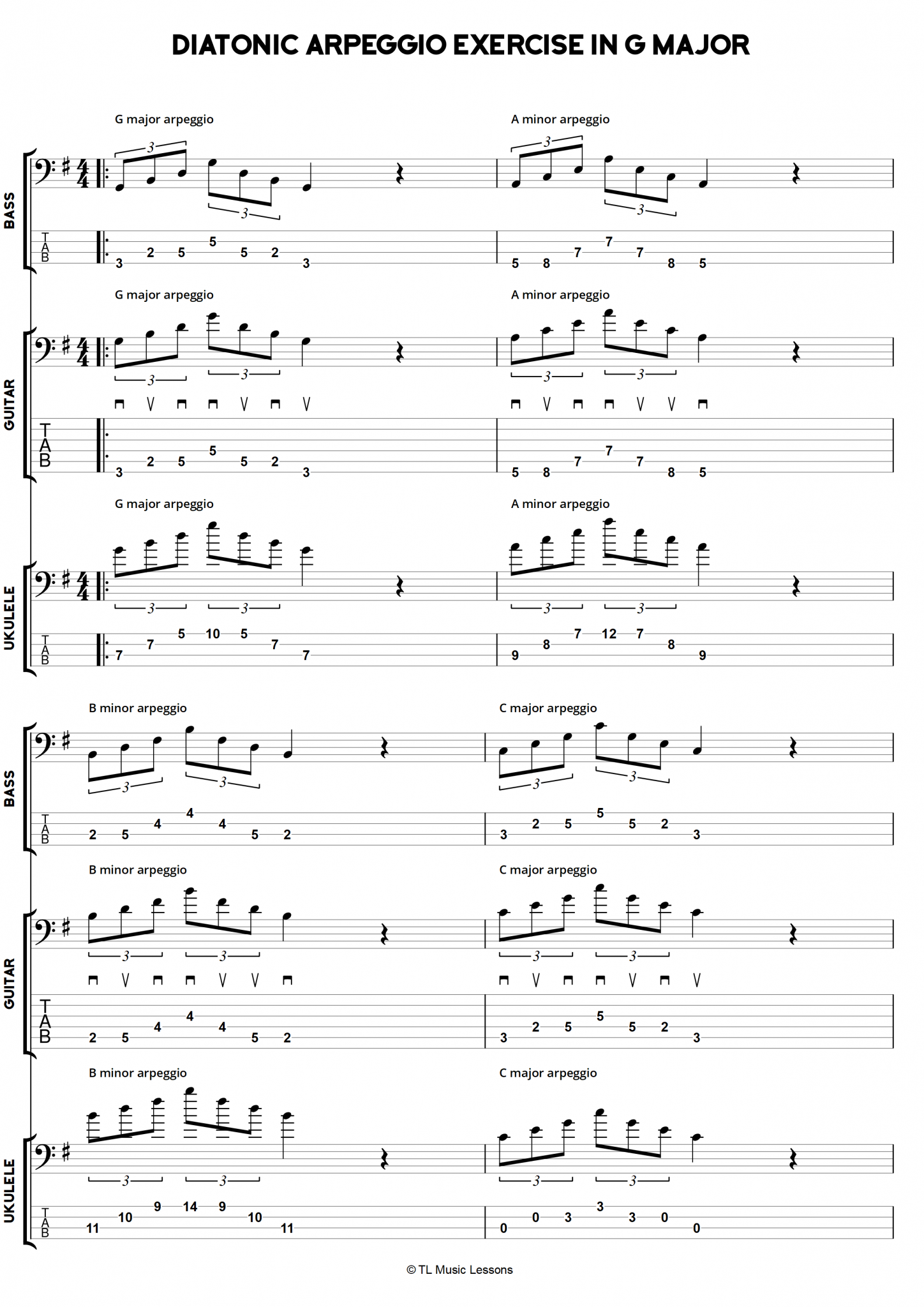
Diatonic Arpeggio Exercise in G Major

This arpeggios exercise has a sequence of 8 arpeggios and has sheets for Guitar, Bass and Ukulele.

The guitar and bass sheets are essentially the same, although the guitar part has picking instructions for downs and ups. For bass, you could probably use the guitar downs and ups. I use my fingers on the bass and I would play these with a walking right left right left of the first two fingers. I think most people start with their left finger (index finger) but I’ve always led with might right finger (middle finger), because following a RLRL pattern is more familiar as I play drums too.

The diatonic sequence is going up the G major scale and making each note into a chord that theoretically fits, and in this case turning them into an arpeggio.

With the repeat at the end, I have suggested to play through the sheet 2 times as a whole exercise. You may like to practice each arpeggio individually at first or if you are making mistakes.

Free File Downloads

Guitar PDF
Bass PDF
Ukulele PDF
Guitar Pro 7 File

(PREMIUM) – First Ukulele Book – Easy Reading Scales & Melodies

Buy Now →

A Guitar Version is also available.

This easy reading Ukulele book has been created using Adobe Illustrator so that the basics of song melodies, scales, arpeggios and warm up exercises can be taught, learned and read in the easiest and clearest way possible for beginners of all ages.

  • Songs, Scales, Arpeggios and Warm Up Exercises.
  • Easy to read for all ages
  • Printable PDF ebook.
  • 20 pages.
  • Also includes 3 blank templates for writing your own exercises.

Contents

4. How To Read The Music
5. Twinkle Twinkle Little Star (FREE)
6. Happy Birthday
7. Ukulele Warm Up 1
8. London Bridge
9. Sheet 1 – Scales (FREE)
10. Morning Has Broken
11. Ukulele Warm Up 2
12. Amazing Grace
13. Arpeggios & Chords
14. Can Can
15. Camptown Races
16. Frère Jacques
17. Sheet 2 – Scales
18. Sheet 3 – Scales
19. Sheet 5 – Scales
20. Sheet 6 – Scales

People that might find this book useful

  • Beginner Ukulele students of any age group.
  • Ukulele teachers can print the book or single sheets for their students.
  • Get used to the basics with this easy to read book before moving onto standard tab and notation.
  • Parents may be able to teach their children with this book.
  • Some may be able to teach themselves the basics with this book.

About the book

This easy reading ebook is a compilation of 3 and a half years of preparation work teaching ukulele to a wide range of abilities and also from 9 years of teaching guitar, which has influenced and helped my teaching and playing of the ukulele.

I tested some of these sheets over the last 6 months until I was ready to create the rest of the book. I have found that the format that I have created takes away any unnecessary distractions in order to teach the basics without distractions and confusion. I believe it solves problems with reading the music for beginners of any age, but particularly for young beginners.

I decided to create this range of sheets like this one to make both my life easier and to help my students get to grips with reading tab quicker for playing scales, public domain songs, traditional songs, arpeggios and warm up exercises. I have created the sheets using Adobe Illustrator.

The finger suggestions are a guide to what I recommend to my students. There are different ways of playing the scales so it’s ok to do what works for you. Just don’t use 1 finger for all of it! Younger players think it’s faster at first, but it’s really not in the long run.

Ukulele teachers can use this ebook in their own teaching and they are welcome to print physical copies for their students.

Buy Now →

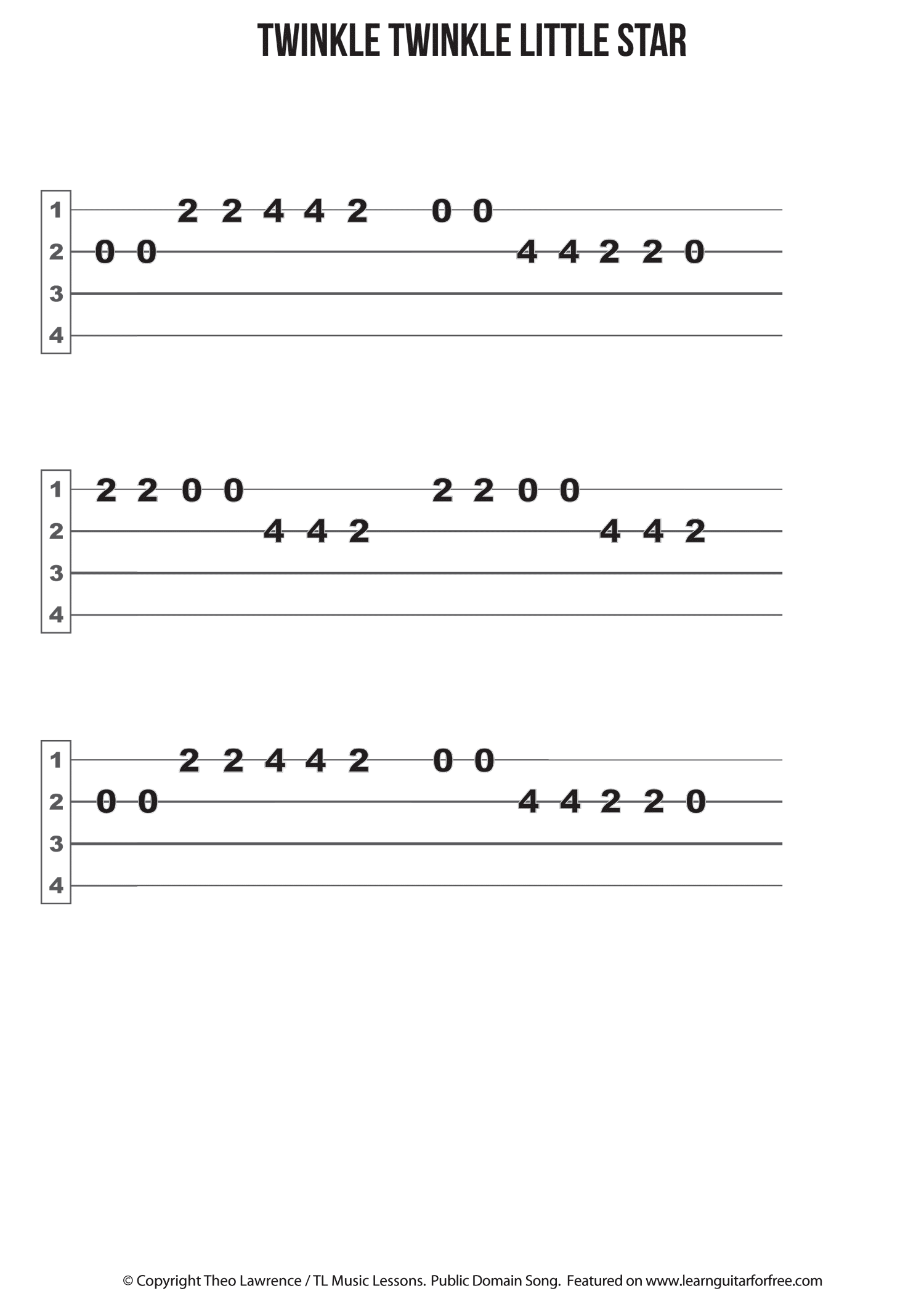
Twinkle Twinkle Little Star – Ukulele Easy Reading Tab

Here is an easy to read and play sheet of Twinkle Twinkle Little Star in ukulele tab. It’s been designed in Adobe Illustrator for a custom look and easy to read for young beginners. The sheet is ideal to use as teaching material for young ukulele students.


Related: This sheet is included in this premium PDF ebook: First Ukulele Book – Easy Reading (Scales and Melodies) →
Related: Twinkle Twinkle Little Star – Guitar Easy Reading Tab

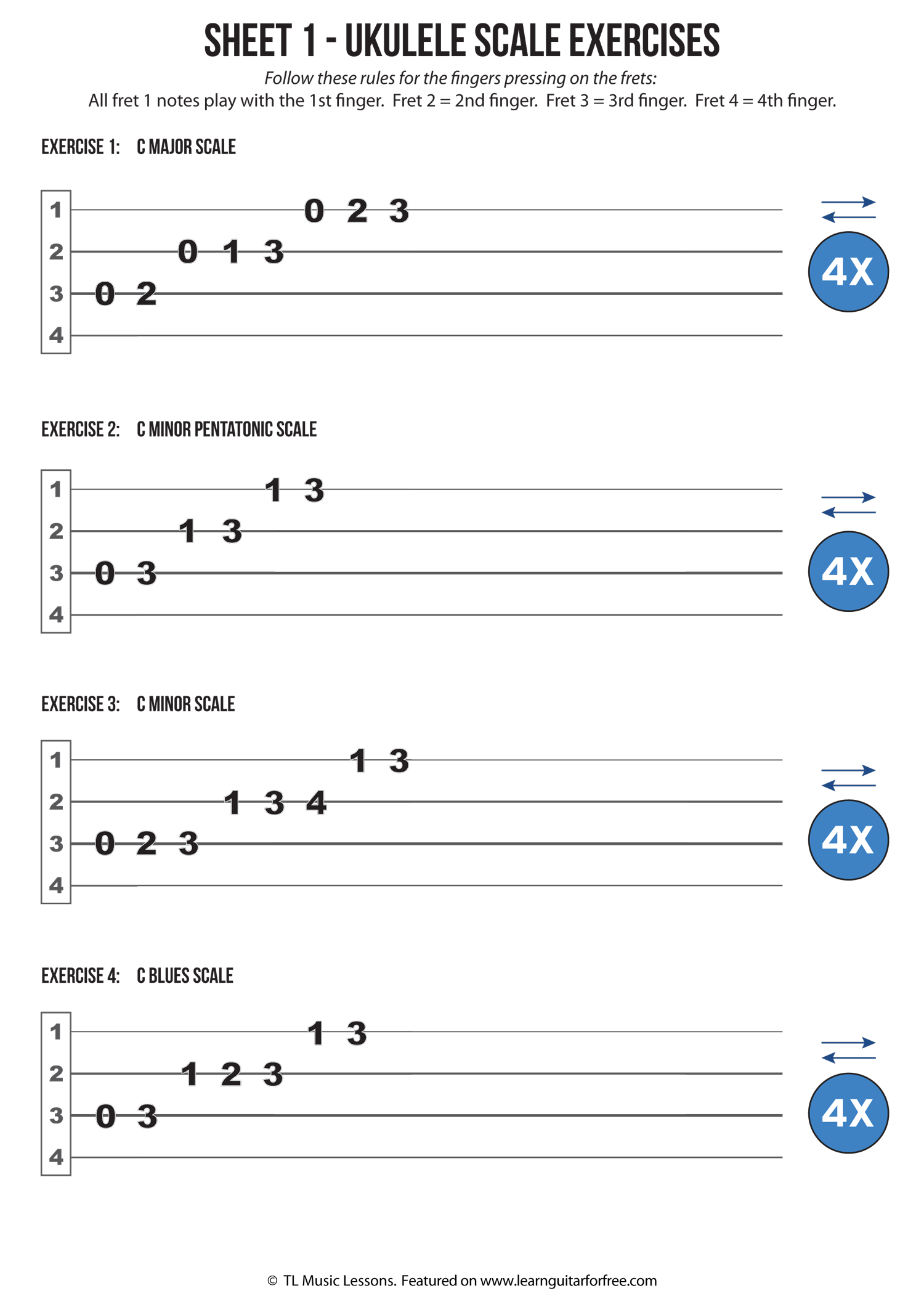
Sheet 1 – Easy Reading Ukulele Scale Exercises

Over the last few years of teaching ukulele (and 9 years of teaching guitar) I have noticed young beginners in particular struggle to get to grips with reading tab, but it’s sometimes any age. They get confused over which string the top line of the tab is. Usually they think it’s the 4th string at the top of the tab because it’s at the top of their ukulele when they look at it, and they find it hard to get over this being the other way around at first!

Also, students often get distracted by other things on the sheet music and often ask questions like; “what does TAB mean”, “do we play 4 4 at the start?”, “what do these notes mean? (pointing to the notes above the tab), or say things like “the numbers are too small”, “I keep getting lost” (again with regards to the numbers being small and getting lost because they have taken a while looking down at their instrument trying to find fret 2 on the 3rd string, for example).

So as a teacher I decided to create a range of sheets like this one to make both my life easier and to help my students get to grips with reading tab quicker for playing scales, melodies and exercises. I have created the sheet using Adobe Illustrator. I intend to post more of these sheets and similar ones for playing chord progressions, and I will release one or two ebooks based on these. There are also be guitar ones.

How to read the sheet

  • On exercise 1, read all 4 strings at once from left to right.
  • You will play in this order: Play the open string (that is the 0) on string 3 and then press down on fret 2 of the 3rd string and then play that string to make the note.
  • Then in a similar way play 0 1 3 on string 2, then 0 2 3 on string 1.
  • Next, do all of this in reverse.
  • Finally, repeat all of this a further 3 times so that you will have been around 4 times in total.
  • Play exercise 2 – 4 in the same way.


Related: This sheet is featured in the premium ebook First Ukulele Book – Easy Reading.
Related: Sheet 1 – Easy Reading Guitar Scale Exercises.