Tiberius Guitar Solo Unofficial Example – Grade 5 Rockschool


This grade 5 guitar solo is a transcript of a constructed solo used by a student for their grade 5 Rockschool exam. You are free to use this as a guide or for ideas for what to do at grade 5, but I recommend changing parts or making up your own too.

InĀ  the first 3 bars, we have a quick sextuplet legato pattern. You pick the first note and pull off the second and third notes, and then repeat this pattern throughout.

For the 2/4 bar there is a lead part that mimicks the backing guitar part.

For the next 3 bars, we bend the 3rd string using 2 fingers (second and third) to bend up, and keep the first finger in position on the second string without bending it. Play both strings together like a chord and bend up the 3rd string.

The final bar is a quick rundown using mostly alternate picking in 16th notes. There is a quick hamme on and pull off on the (12h13p12) using your first and second finger and for this you only pick the first note.

End on a slide down to knowhere, which means lift off and mute the slide before you get to fret 1.

Next there’s a pretty fast riff to get stuck into so be prepared to go straight into that.


PDF Download – Tiberius Guitar Solo Unofficial Example – Grade 5 Rockschool

Guitar Pro 7 Download – Tiberius Guitar Solo Unofficial Example – Grade 5 Rockschool
Download Audio

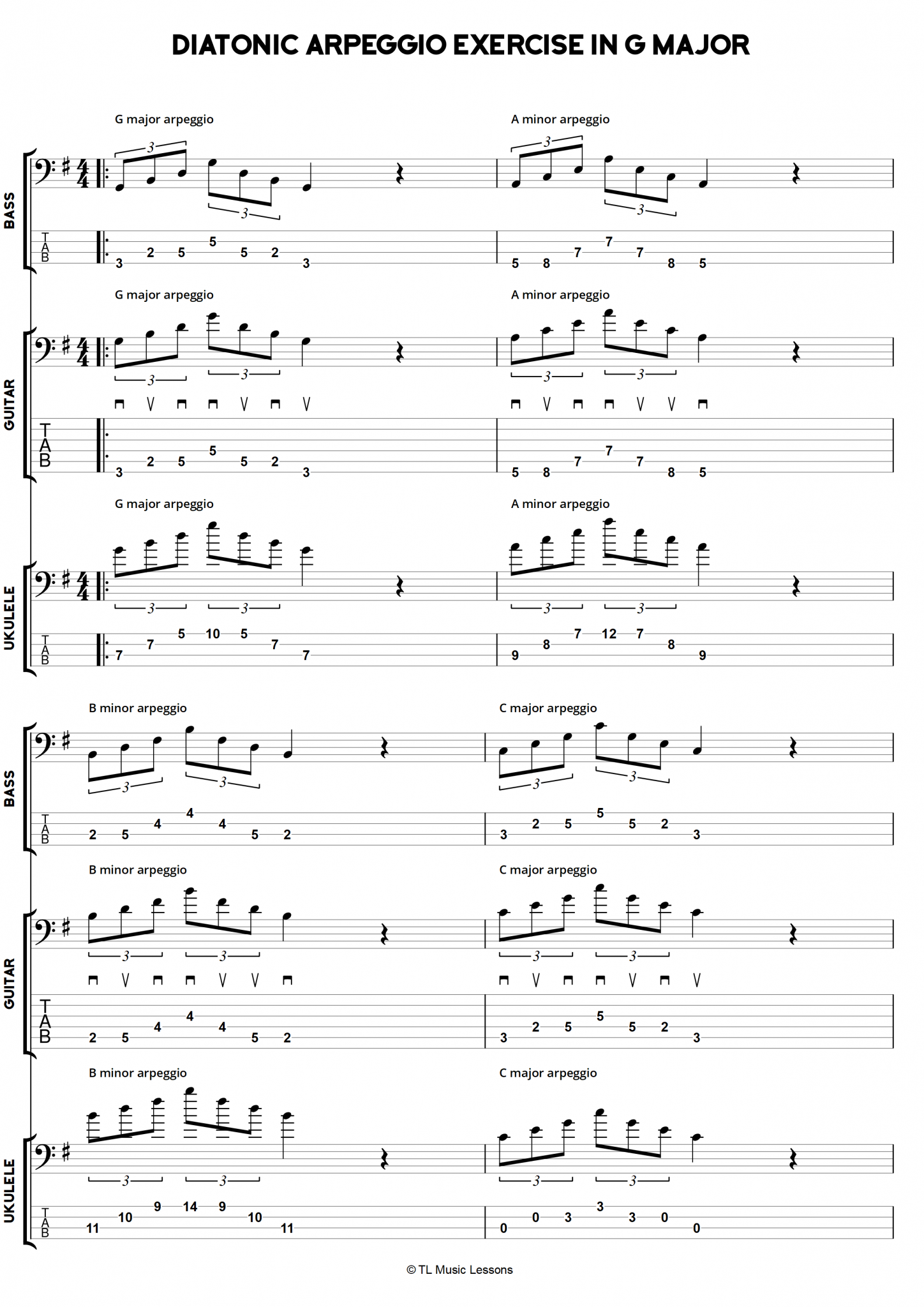
Diatonic Arpeggio Exercise in G Major

This arpeggios exercise has a sequence of 8 arpeggios and has sheets for Guitar, Bass and Ukulele.

The guitar and bass sheets are essentially the same, although the guitar part has picking instructions for downs and ups. For bass, you could probably use the guitar downs and ups. I use my fingers on the bass and I would play these with a walking right left right left of the first two fingers. I think most people start with their left finger (index finger) but I’ve always led with might right finger (middle finger), because following a RLRL pattern is more familiar as I play drums too.

The diatonic sequence is going up the G major scale and making each note into a chord that theoretically fits, and in this case turning them into an arpeggio.

With the repeat at the end, I have suggested to play through the sheet 2 times as a whole exercise. You may like to practice each arpeggio individually at first or if you are making mistakes.

Free File Downloads

Guitar PDF
Bass PDF
Ukulele PDF
Guitar Pro 7 File

2 Octave Major and Minor Scales in G

It’s another rainy day in the UK and for some reason I’ve woken up early and I have some time before work to post this. Blueberry porridge with honey, a cup of tea, rain, politics ruining another Christmas, yet we plod on with uncertainty debating on whether it’s too soon for Chirtmas songs. Neighbours are nailing up decs to their facia boards and wrecking them – it’s all very much go.

This half term I’ve been giving this sheet out to some of my beginners that have been doing easy scales and chords, and I’m aiming to get them into harder scales (some of these are from Grade 3) using one finger per fret (and therefore using all fingers for most scales) and eventually alternate picking (down, up, down, up) when they have got used to the scales. Along side any potential Chistmas songs and other things, I’m setting this as homework 1 or 2 times per week, and we’ll also go through some or all of them in the lessons.

Free Downloads

Here is a free printableĀ PDF download of this scales sheet.

Here is a free Guitar Pro 7 download if you have that program – you can play the scales along at any speed.