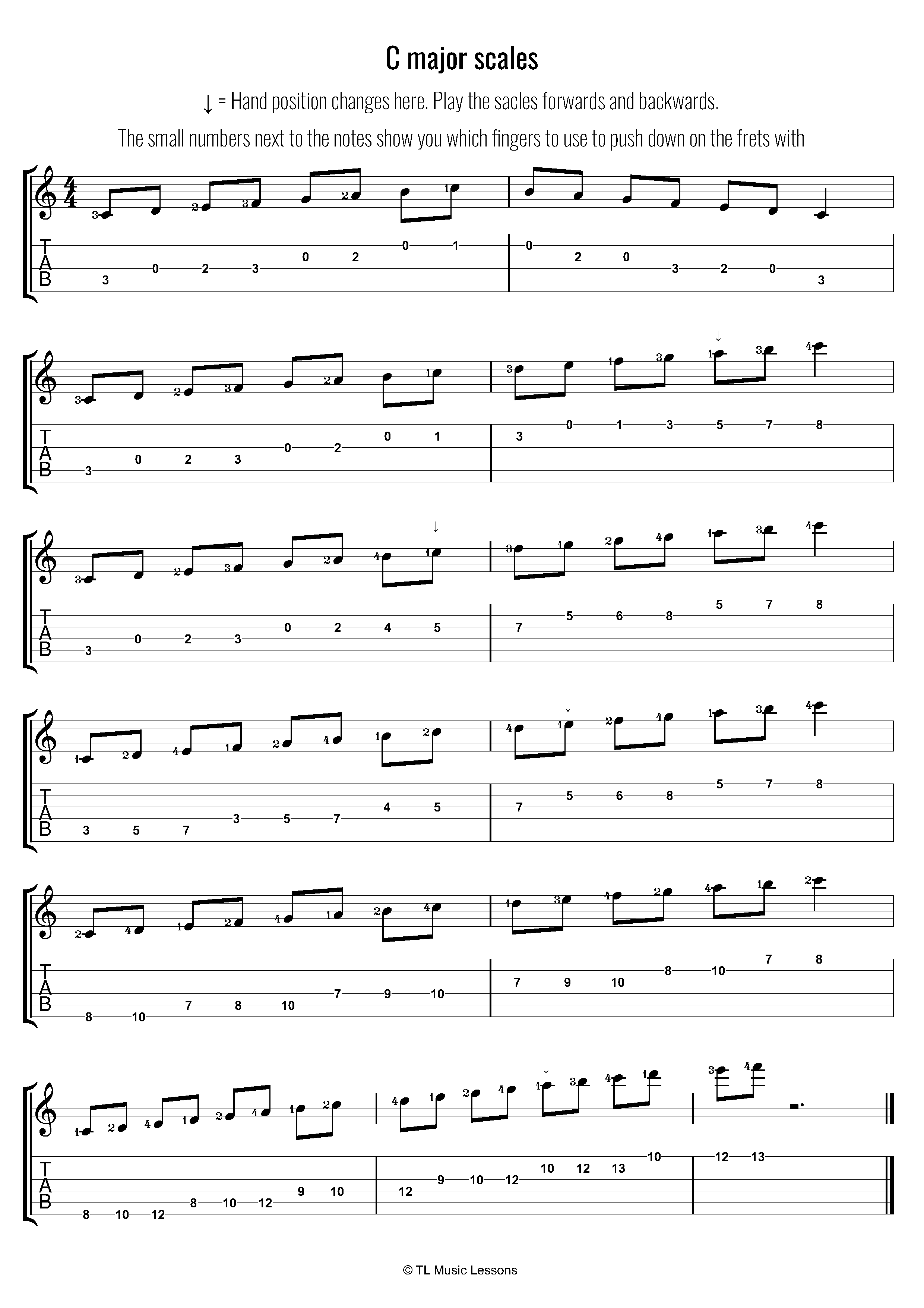
5 Movable 1 Octave Scale shapes in 5 keys – 25 Scales – PDF

Free PDF:
5 Moveable 1 Octave Guitar Scales in 5 different keys

Free Guitar Pro 7 File:
5 Moveable 1 Octave Guitar Scales in 5 different keys

All scales in 5 keys: G, A, B, C, D

5 Major scales
5 Major Pentatonic scales
5 Minor Pentatonic scales
5 Blues scales
5 Natural minor scales

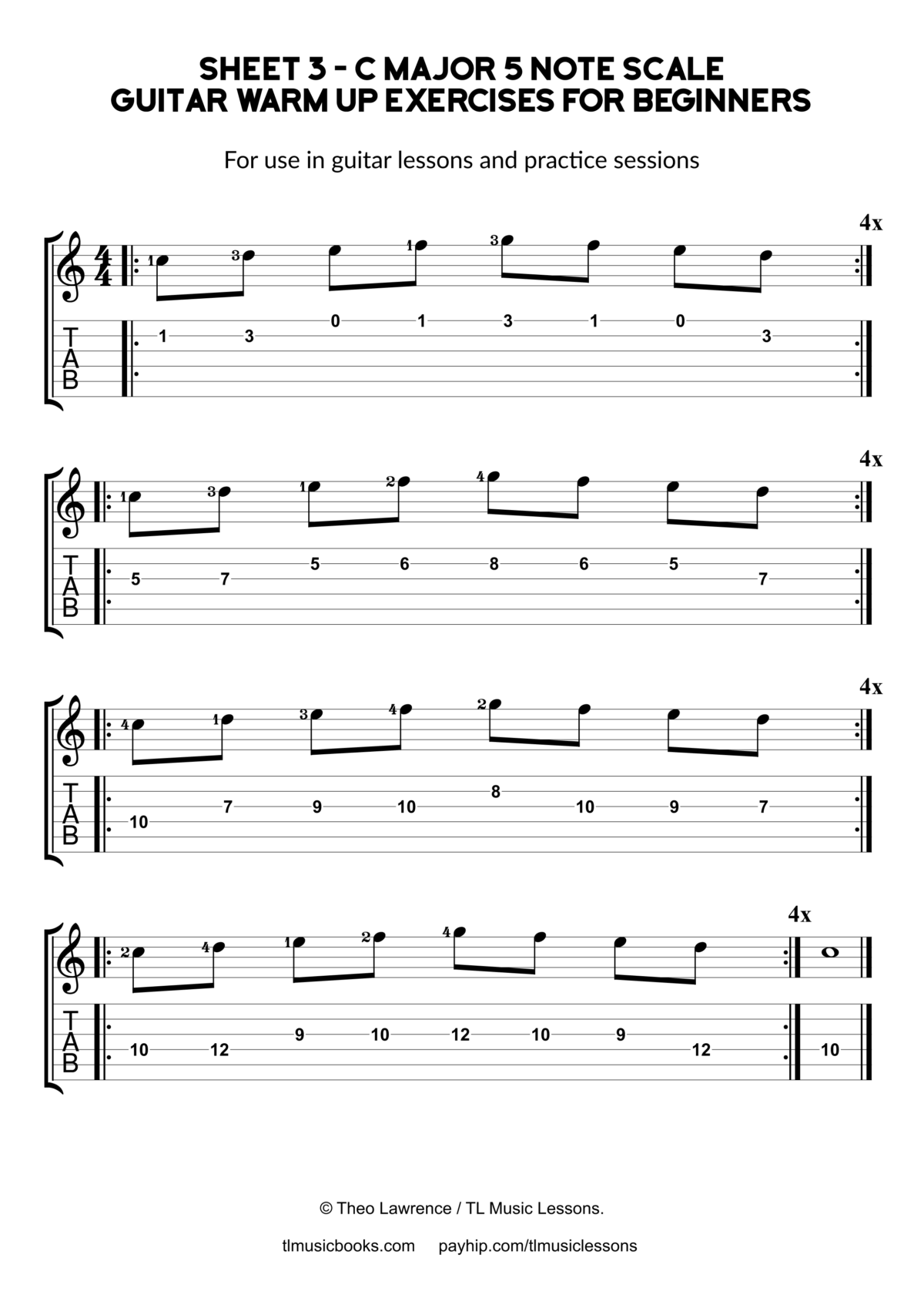
Warm Up Tabs for Guitar, Bass & Ukulele – Scales & Arpeggios

We’re still in lockdown in Wales (UK), and we can only travel 5 miles. I’ve been busy teaching online lessons and also have done a lot of DIY projects around the house. I thought I would have had loads of time to update my blogs but I’ve been too busy! However, my students that have carried on have been burning through their grades and practicing more than ever. Here are a few scales warm ups I’ve been adding to their new practice plans, which I’ve been writing with google docs and sending the parents a link to so they can see updated practice notes whenever I add new things to it.

At the end of the post, there is also a bonus chord exercise challend for you to try.

These scales, arpeggios and chords exercises are good for any beginner or intermediate player that has been learning guitar for a while and has the ability to read tab. You might be used to reading proper sheet music, like on the rest of the website, but the tab is essentially the same. You have 6 lines (4 for ukulele), and the top line is the bottom string on the instrument. So the bottom line on the tab is the thickest string on the guitar. You’ll see tab elsewhere on the internet like on ultimate-guitar.com, so hopefully everyone will be able to read these.

Hopefully you can find these an enjoyable way to warm up whilst stuck at home. Run through all of these as a warm up so you’re not neglecting your scales, and then go and learn something else like you would in a guitar lesson. Perhaps learn a song or maybe some chord progression exercises or learn to play a guitar solo from a song you like.

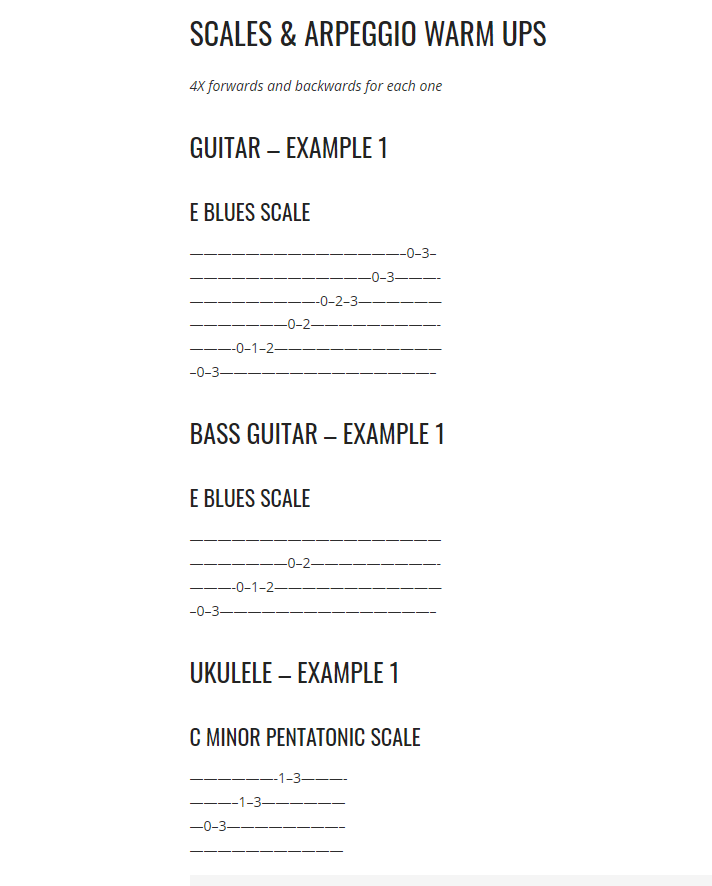
Scales & Arpeggio Warm Ups – Guitar

4X forwards and backwards for each one

E Blues scale

———————————————–0–3–
—————————————0–3———-
—————————-0–2–3——————
———————0–2—————————-
———-0–1–2————————————
–0–3———————————————–

A minor pentatonic scale

Fret 5 = 1st finger, Fret 6 = 2nd Finger, Fret 7 = 3rd finger, Fret 8 = 4th finger

————————————–5–8——
——————————–5–8————
————————–5–7——————
——————5–7————————–
———-5–7———————————-
–5–8——————————————

G major scale

———————————————————5–7–8–
———————————————5–7–8————-
———————————-4–5–7————————
———————–4–5–7———————————–
————3–5–7———————————————-
-3–5–7———————————————————

A major arpeggio

Fret 4 = 1st finger, Fret 5 = 2nd Finger, Fret 6 = 3rd finger, Fret 7 = 4th finger

————————–5—-
———————-5——–
——————6————
————–7—————-
——4–7———————
–5—————————-

A minor arpeggio

Fret 5 = 1st finger, Fret 6 = 2nd Finger, Fret 7 = 3rd finger, Fret 8 = 4th finger

————————–5—–
———————-5———
——————5————-
————–7—————–
———-7———————
–5–8————————–


Scales & Arpeggio Warm Ups – Bass Guitar

4X forwards and backwards for each one

E Blues scale

——————————————————
———————0–2—————————-
———-0–1–2————————————
–0–3———————————————–

A minor pentatonic scale

Fret 5 = 1st finger, Fret 6 = 2nd Finger, Fret 7 = 3rd finger, Fret 8 = 4th finger

————————————————
——————5–7————————–
———-5–7———————————-
–5–8——————————————

G major scale

———————————-4–5–7—9—11–12—-
———————–4–5–7——————————–
————3–5–7——————————————-
-3–5–7——————————————————

A major arpeggio

Fret 4 = 1st finger, Fret 5 = 2nd Finger, Fret 6 = 3rd finger, Fret 7 = 4th finger

——————————-
————–7—————-
——4–7———————
–5—————————-

A minor arpeggio

Fret 5 = 1st finger, Fret 6 = 2nd Finger, Fret 7 = 3rd finger, Fret 8 = 4th finger

——————————–
————–7—————–
———-7———————
–5–8————————–

Scales & Arpeggio Warm Ups – Ukulele

4X forwards and backwards for each one

C minor pentatonic scale

——————-1–3———-
———–1–3——————
—0–3————————–
———————————

C major scale

———————-0–2–3—-
———–0–1–3—————
—0–2————————–
———————————

D minor scale

——————-3–5———-
———–3–5——————
—2–5————————–
———————————

D major scale

———————-2–4–5—-
———–2–3–5—————
—2–4————————–
———————————

E natural minor scale

—————————5–7——-
—————5–7–8—————-
—4–6–7—————————-
————————————–


Bonus Chord Exericse

How many times can you play these chords in 1 minute?

Set a countdown timer for 1 minute. Strum each chord once and then repeat when you have done all 3 chords. Count how many times you go around them in 1 minute.

Challenge 1: A, D, E.
Challenge 2: E, A7, B7.
Challenge 3: A7, D7, E7.
Challenge 4: Am Dm7 G.
Challenge 5: C F G.
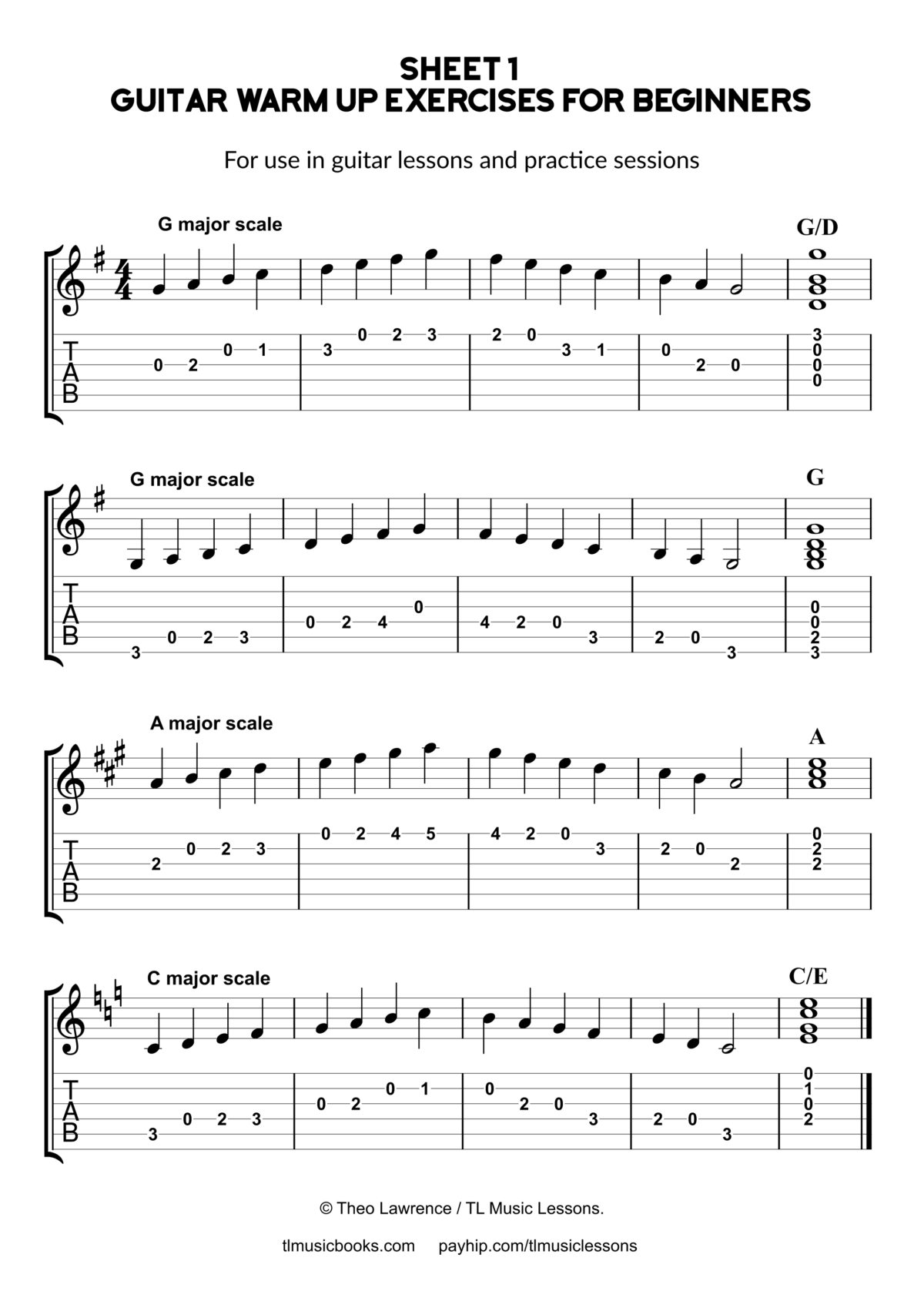
2 Octave Major and Minor Scales in G

It’s another rainy day in the UK and for some reason I’ve woken up early and I have some time before work to post this. Blueberry porridge with honey, a cup of tea, rain, politics ruining another Christmas, yet we plod on with uncertainty debating on whether it’s too soon for Chirtmas songs. Neighbours are nailing up decs to their facia boards and wrecking them – it’s all very much go.

This half term I’ve been giving this sheet out to some of my beginners that have been doing easy scales and chords, and I’m aiming to get them into harder scales (some of these are from Grade 3) using one finger per fret (and therefore using all fingers for most scales) and eventually alternate picking (down, up, down, up) when they have got used to the scales. Along side any potential Chistmas songs and other things, I’m setting this as homework 1 or 2 times per week, and we’ll also go through some or all of them in the lessons.

Free Downloads

Here is a free printable PDF download of this scales sheet.

Here is a free Guitar Pro 7 download if you have that program – you can play the scales along at any speed.

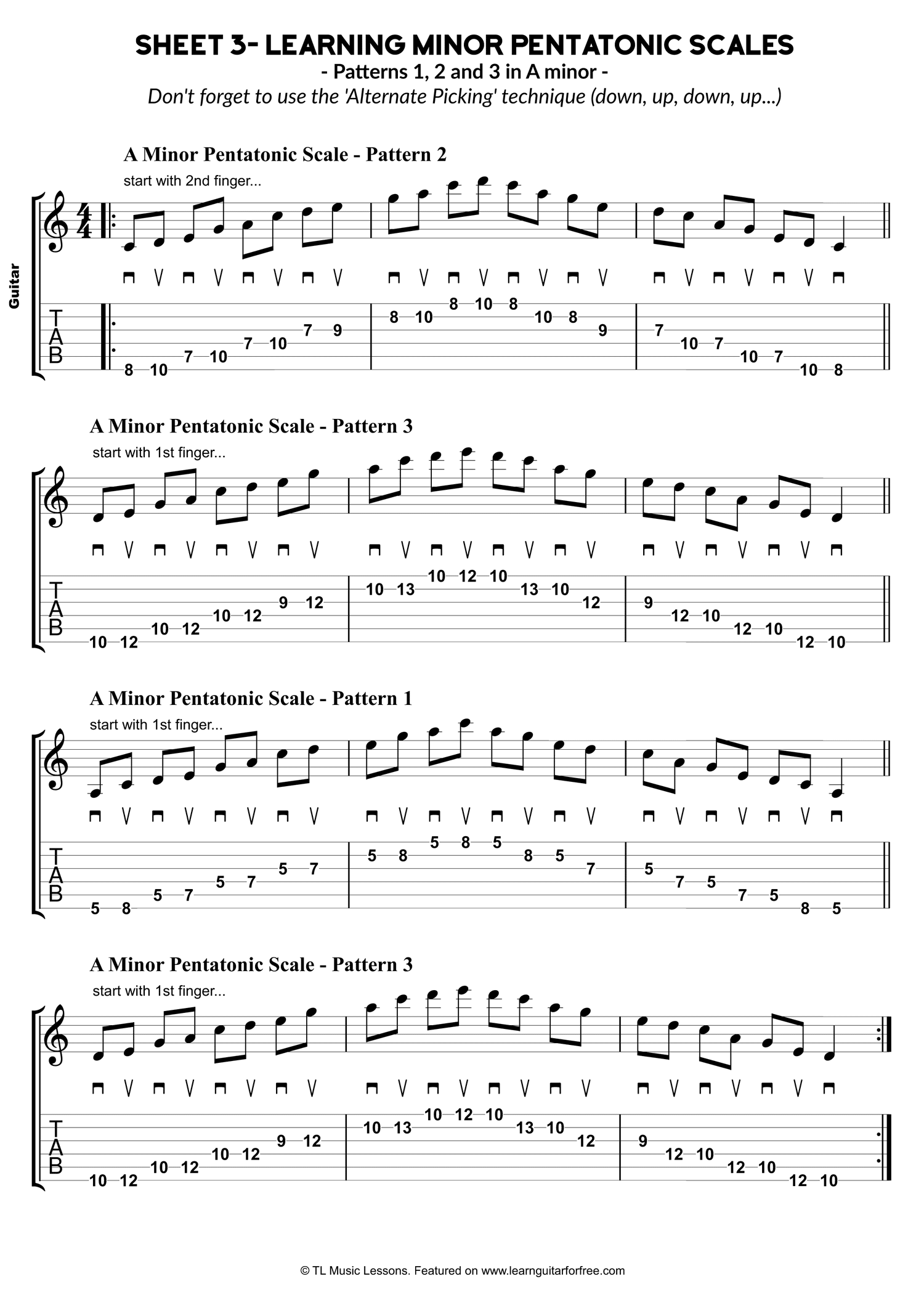
Sheet 3 – A Minor Pentatonic Scale Practice Exercises Grade 1-3

Welcome to the third sheet in a series of posts on the A minor pentatonic scale, which includes various exercises designed to build up your knowledge of the scales and also to give you ideas and memories of ideas for soloing and melody making.

There are 4 exercises based on the first position of the A minor pentatonic scale. You will need to pay attention to the down and up pick markings to be able to play them fluently and at speed eventually. The first two exercises are all down picks, because they are more like riffs, which sound stronger with all down picks. Exercises 3 and 4 are generally ‘alternate picking’ on the 8th note (quaver) beats, which means ‘down up down up’ continued. It feels wierd at first but keep at it until it starts to feel natural.

There are free downloads availabile for this sheet, a printable PDF file and an awesome Guitar Pro file. Guitar Pro is a program where you can press play on the sheet and it will play the audio of the music. You can slow it down, transpose it, loop sections. It’s really useful.

Free Downloads

Download PDF Download Guitar Pro File

More Sheets

Sheet 1 Sheet 2

Sheet 2 – A Minor Pentatonic Scale Practice Exercises Grade 1-2

Welcome to the second sheet in a series of posts on the A minor pentatonic scale, which includes various exercises designed to build up your knowledge of the scales and also to give you ideas and memories of ideas for soloing and melody making.

In this second sheet, we jump in straight to the exercises. Go back to sheet 1 to learn the A minor pentatonic scale that we will be working with.

Then there are 4 exercises based on the first position of the A minor pentatonic scale, which all finish with an A minor chord to finish off the exercise and practice changing from the exercises to the chord. You will need to pay attention to the down and up pick markings to be able to play them fluently and at speed eventually. The patterns are generally ‘alternate picking’ where possible, which means ‘down up down up’ continued. It feels wierd at first but keep at it until it starts to feel natural.

There are free downloads availabile for this sheet, a printable PDF file and an awesome Guitar Pro file. Guitar Pro is a program where you can press play on the sheet and it will play the audio of the music. You can slow it down, transpose it, loop sections. It’s really useful.

Free Downloads

Download PDF Download Guitar Pro File

More Sheets

Sheet 1 Sheet 3

Sheet 1 – A Minor Pentatonic Scale Practice Exercises Grade 1-2

Welcome to the start of a series of posts on the A minor pentatonic scale, which includes various exercises designed to build up your knowledge of the scales and also to give you ideas and memories of ideas for soloing and melody making.

In this first sheet, we will first play the A minor pentatonic scale that we will be working with.

Then there are 3 exercises based on this scale. You will need to pay attention to the down and up pick markings to be able to play them fluently and at speed eventually. It feels wierd at first but keep at it until it starts to feel natural.

There are free downloads availabile for this sheet, a printable PDF file and an awesome Guitar Pro file. Guitar Pro is a program where you can press play on the sheet and it will play the audio of the music. You can slow it down, transpose it, loop sections. It’s really useful.

Free Downloads

Download PDF Download Guitar Pro File

More Sheets

Sheet 2 Sheet 3

Sheet 3 – Learning Minor Pentatonic Scales – A minor – Patterns 1, 2 and 3

This sheet progresses on from Sheet 2 and is part of an ebook called Learning Minor Pentatonic Scales.

Just like we did in the last sheet, you will be working on patterns 1, 2 and 3 but this time, 2 frets higher in the key of A minor.

More Sheets in the series…

← Sheet 2


Related (Premium): The sheets in this series are from a 25 page PDF ebook: Learning Minor Pentatonic Scales

(PREMIUM) – First Guitar Book – Easy Reading Scales, Riffs & Melodies

Buy Now →

A Ukulele Version is also available.

  • PDF ebook
  • 20 pages
  • Easy to read design
  • Song melodies
  • Scales
  • Riffs
  • Useful for beginners of all ages.
  • Includes 3 blank template PDF files for writing your own scales and exercises

Contents

  1. Front Cover
  2. Contents
  3. Introduction
  4. How To Read The Music – Part 1
  5. How To Read The Music – Part 2
  6. Twinkle Twinkle Little Star (FREE)
  7. Happy Birthday
  8. Sheet 1 – Guitar Scale Exercises (FREE)
  9. Sheet 1 – Rock Riffs
  10. Camptown Races
  11. Sheet 2 – Rock Riffs
  12. Amazing Grace
  13. Sheet 2 – Guitar Scale Exercises
  14. Morning Has Broken
  15. Sheet 3 – Rock Riffs
  16. Sheet 3 – Guitar Scale Exercises
  17. Can Can
  18. Sheet 4 – Guitar Scale Exercises
  19. Sheet 4 – Rock Riffs
  20. Mexican Hat Dance

People that might find this book useful

  • Beginner Guitar students of any age group.
  • Guitar teachers can print the book or single sheets for their students and teach it to them.
  • Get used to the basics with this easy to read book before moving onto standard tab and notation.
  • Parents may be able to teach their children with this book.
  • Some may be able to teach themselves the basics with this book.

About The Book

This easy reading ebook is a compilation of 9 years teaching guitar and preparing lesson sheets for my students. I developed the easy reading design for complete beginners. It is based on normal guitar tab, but simplifies it so that there are no distractions, and it’s huge and easy to look at rather than the numbers being small.

I tested some of these sheets over the last 6 months until I was ready to create the rest of the book. I have found that the format that I have created takes away any unnecessary distractions in order to teach the basics without distractions and confusion. I believe it solves problems with reading the music for beginners of any age, but particularly for young beginners.

I decided to create this range of sheets like this one to make both my life easier and to help my students get to grips with reading tab quicker for playing scales, melodies, public domain songs, traditional songs and riffs. I have created the sheets using Adobe Illustrator.

There are different ways of playing the scales so it’s ok to do what works for you but don’t just use 1 finger for all of it! Younger players think it’s faster at first, but it’s really not in the long run. If you have frets 1 2 3 and 4 to play in an exercise, you could use all 4 fingers to play it (1st, 2nd, 3rd and 4th finger). Use this technique of ‘one finger per fret’ where it seems comfortable to do so. If a scale only has 0, 2 and 3 in it, then you could use just your strongest 2 fingers to play it (1st finger for the fret 2’s and 2nd finger for the fret 3’s).

Guitar teachers can use this ebook in their own teaching and they are welcome to print physical copies for their students.

Buy Now →

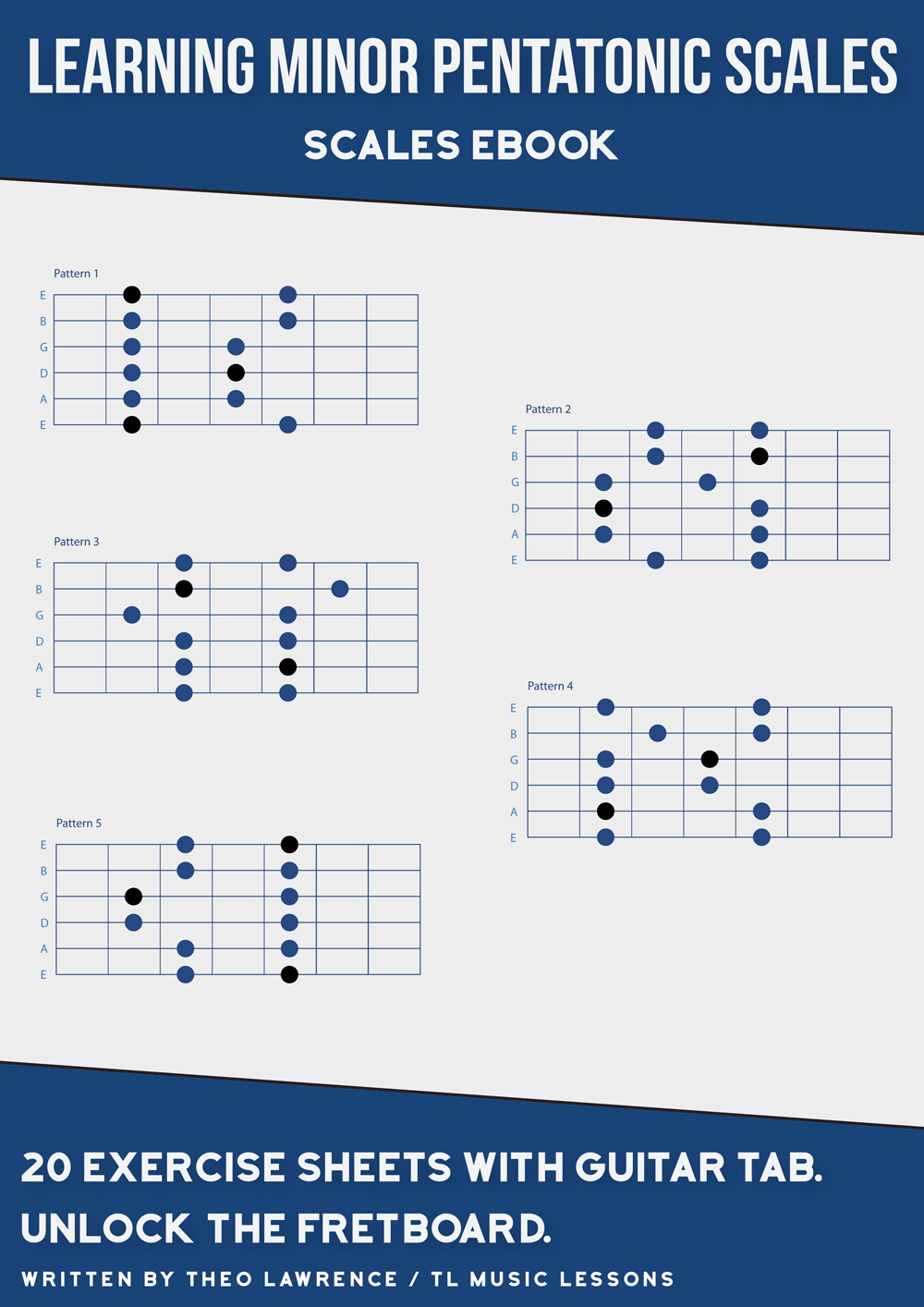
(PREMIUM) – Learning Minor Pentatonic Scales – PDF Ebook

Buy Now →

Contents

2 – Contents
3 – Introduction
4 – The 5 Moveable Scale Shapes
5 – Exercise Sheets 1 – 13
18 – Full run through of all 5 scale shapes in various keys
24 – All possible A minor pentatonic scale positions covering the whole neck

Self published in 2018 by TL Music Lessons.

Introduction

People that might find this book useful

  • Guitarists wanting to learn how to play guitar solos and improvise along with songs.
  • Guitar teachers can print the book or single sheets for their students.
  • Guitarists can teach themselves how to play the 5 minor pentatonic scales by following the book. The aim is to be able to do this from memory by the end of the book in various keys.
  • Guitarists on Grade 3 and above will find the scales useful for soloing. The 5 scale shapes are required for Grade 5, and for some syllabuses they are required for Grade 4.

About the book

This minor pentatonic scales ebook is a compilation of 9 years of preparation work teaching guitar to a wide range of abilities. After trying many ways of teaching scales to students and moving them on to improvising and soloing, I have developed this exercise ebook to really get to grips with these 5 scale shapes. If you follow the whole ebook and spend time on each sheet there is a strong chance of being able to use these scale shapes from memory for improvising and soloing.

I recommend spending about a week’s worth of practice on each sheet in the book. Really focus on that sheet for 3 or 4 practice sessions. It’s going to take you 20 weeks to do that, so you might want to move through it quicker, but I recommend doing that as you progress further through the book. Start out slow and then once it starts to click and you get used to the shapes then you can spend less time on each sheet. Make sure to follow the repeats on each sheet, which usually say to repeat the sheet twice. You are welcome to play more than twice though, or don’t do the repeat if you only have a short time to practice.

The finger suggestions are a guide to what I recommend to my students. There are different ways of playing the scales so it’s ok to do what works for you. Just don’t use 1 finger for all of it! Younger players think it’s faster at first, but it’s really not in the long run. I remember one student that I had to battle with for ages to agree to use more than 1 finger on her scales and then after a few weeks of practicing with all the fingers, she found it funny because it was much quicker and easier than using just one finger.

The guitar tab sheets have been created using Guitar Pro 7 and the scale shapes and cover were created using Adobe Illustrator.

Guitar teachers can use this ebook in their own teaching and they are welcome to print physical copies for their students.

Free Previews

  • Click the Buy Now button below and then click ‘Preview’ at the top right of the product image
  • There is also a series of free posts featuring some of the minor pentatonic scale exercise sheets.

Buy Now →

Sheet 2 – Learning Minor Pentatonic Scales – G minor – Patterns 1, 2 and 3

This sheet progresses on from Sheet 1.

In this sheet we introduce the 3rd minor pentatonic pattern. This pattern appears twice in the exercise. We are trying to learn it but at the same time we will try and build relationships between the 3rd shape and the 1st and 2nd shapes. Make sure to go around the sheet twice to complete the exercise. This can be revisited many more times. I would spend at least one week’s worth of practice time focusing on one sheet at a time in this series, rather than rinsing all the sheets in one go.

When learning the minor pentatonic scales (and most other scales too), it is important not to view them as boxes that you get stuck in when playing guitar solos. There are 5 shapes and the sooner you get used to linking them up and not lingering on one shape, the better. The scale shapes are a tool for navigating guitar neck and it’s useful to start linking up the shapes so that you can move from one shape to another seamlessly.

The ultimate aim is to be able and to be comfortable moving between shapes, regardless of how many notes you have played in the scale. The aim is not to play up and down each scale and seamlessly to the next, it’s to be so comfortable with moving between shapes that when you start playing guitar solos, you can move between the shapes without needing to follow the full scale. So, for example play a few notes of Shape 1, and slide up to shape 2 and play a couple more, and maybe quickly switch up to a combination of notes on shapes 4 and 5.

When you are comfortable, stick on a song in the given key and try playing the scales along. Then try improvising some melodies, or maybe some guitar solos if you are ready, using a combination of the 2 scale shapes. Try doing these along with some music. Use songs in the key of G minor to play along with.

More Sheets in the series…

← Sheet 1
Sheet 3 →


Related (Premium): The sheets in this series are from a 25 page PDF ebook: Learning Minor Pentatonic Scales

Sheet 1 – Learning Minor Pentatonic Scales – G minor and A minor – Patterns 1 and 2

When learning the minor pentatonic scales (and most other scales too), it is important not to view them as boxes that you get stuck in when playing guitar solos. There are 5 shapes and the sooner you get used to linking them up and not lingering on one shape, the better. The scale shapes are a tool for navigating the guitar neck and it’s useful to start linking up the shapes so that you can move from one shape to another seamlessly.

The ultimate aim is to be able and to be comfortable moving between shapes, regardless of how many notes you have played in the scale. The aim is not to play up and down each scale and seamlessly to the next, it’s to be so comfortable with moving between shapes that when you start playing guitar solos, you can move between the shapes without needing to follow the full scale. So, for example play a few notes of Shape 1, and slide up to shape 2 and play a couple more, and maybe quickly switch up to a combination of notes on shapes 4 and 5.

So, with this sheet, we are starting with Shape 1 and 2 in G minor and we hope to achieve the first goal of getting used to 2 scale shapes back to back and hopefully starting to remember the shapes as we move them both up 2 frets into the key of A minor. Repeat each exercise 2-4 times regularly until you are comfortable and fluent. You can revisit these exercises at any time – they will always be useful.

Make sure to use 1 finger per fret, because each scale shape only spans 4 frets. That way you will play them quicker in the long run. Don’t waste time thinking you will be faster with 1 finger only because you will soon be faster using all 4 fingers after a bit of practice. Also, use the ‘alternate picking’ technique (down, up, down, up) as written.

When you are comfortable, stick on a song in the given key and try playing the scales along. Then try improvising some melodies, or maybe some guitar solos if you are ready, using a combination of the 2 scale shapes. Try doing these along with some music. Use songs in the key of G minor for the first exercise (first 2 lines), and songs in the key of A minor for the second exercise (lines 3 and 4).

More Sheets in the series…

When you have spent at least few practices on this sheet and start to recognise the shapes a little bit, try moving onto Sheet 2:

Sheet 2 →


Related (Premium): The sheets in this series are from a 25 page PDF ebook: Learning Minor Pentatonic Scales

Sheet 1 – Easy Reading Guitar Scale Exercises

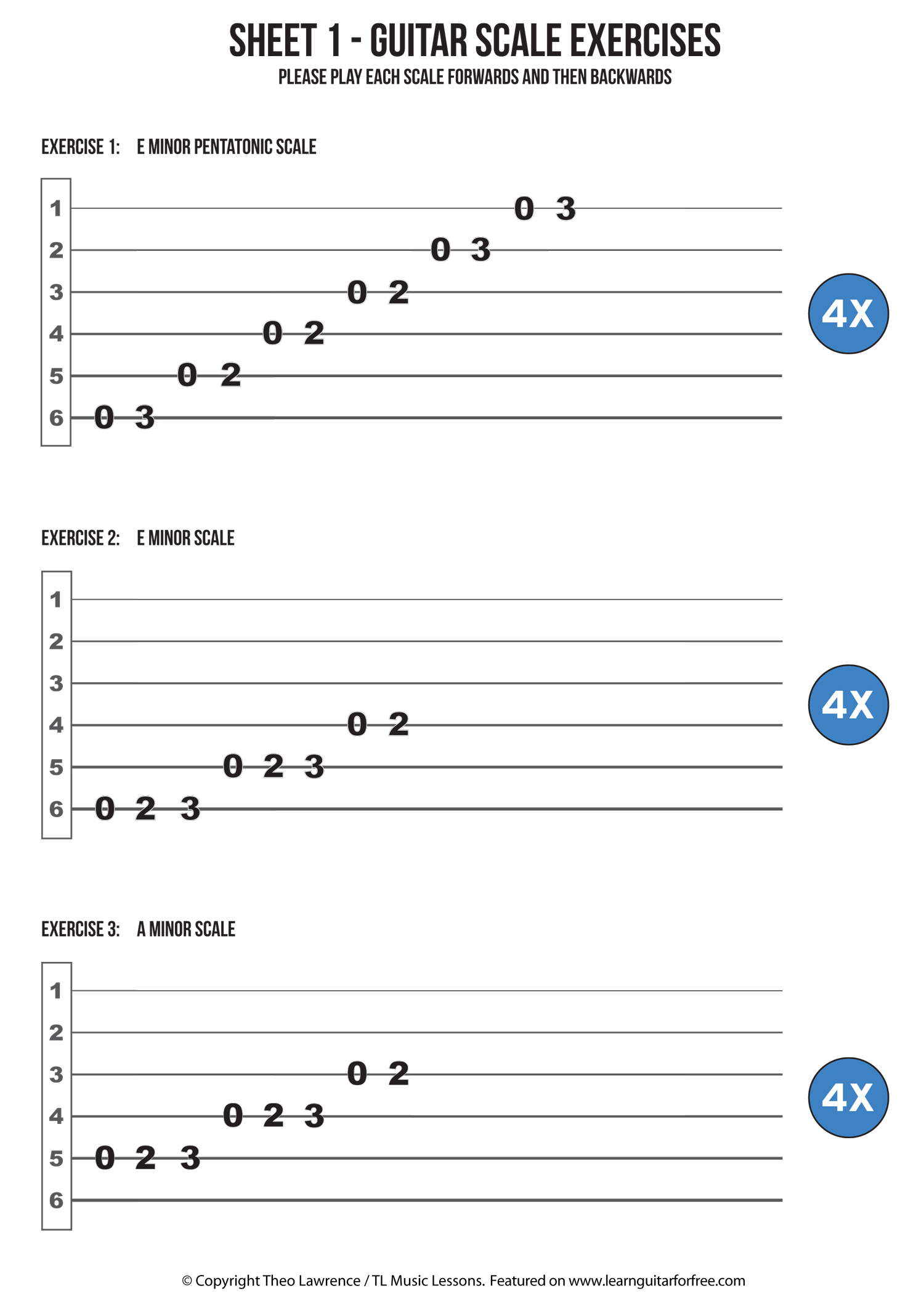
Over the last 9 years of teaching guitar I have noticed young beginners in particular struggle to get to grips with reading guitar tab, but it’s sometimes any age. They get confused over which string the top line of the tab is. Usually they think it’s the 6th string at the top because it’s at the top of their guitar when they look at it, and they find it hard to get over this being the other way around at first!

Also, students often get distracted by other things on the sheet music and often ask questions like; “what does TAB mean”, “do we play 4/4 at the start?”, “what do these notes mean? (pointing to the notes above the tab), or say things like “the numbers are too small”, “I keep getting lost” (again with regards to the numbers being small and getting lost because they have taken a while looking down at their instrument trying to find fret 3 on the 4th string, for example).

So as a teacher I decided to create a range of sheets like this one to make both my life easier and to help my students get to grips with reading tab quicker for playing scales, melodies and exercises. I have created the sheet using Adobe Illustrator. I intend to post more of these sheets and similar ones for playing chord progressions, and I will release one or two ebooks based on these. There will also be ukulele ones.

How to read the sheet

  • On exercise 1, read all 6 strings at once from left to right.
  • You will play in this order: Play the open string (that is the 0) on string 6 and then press down on fret 3 of the 6th string and then play that string to make the note.
  • Then in a similar way play 0 2 on string 5, then 0 2 string 4, 0 2 string 3, then 0 3 on string 2, then 0 3 on string 1.
  • Next, do all of this in reverse.
  • Finally, repeat all of this a further 3 times so that you will have been around 4 times in total.
  • Play exercise 2 and 3 in the same way.

Related: This sheet is featured in the premium ebook First Guitar Book – Easy Reading.
Related: Sheet 1 – Easy Reading Ukulele Scale Exercises.

(PREMIUM) – Grade 3-4 Ebook – Scales, Arpeggios, Barre Chords and Guitar Solo Exercises

Buy Now →

The Buy Now button will take you to the product page. There you can download a free 9 page preview by clicking the ‘Preview’ link at the top right of the cover image.


3. Contents
4. Introduction
5. Scales & Arpeggios: Grade 3 – Fretboard Shapes
6. Grade 3 Scales in G
7. Grade 3 Scales in A
8. Grade 3 Scales in B
9-10. B minor pentatonic scale exercises (8th notes)
11 . Grade 3 Arpeggios in A, B and G (major & minor)
12-13. Arpeggio Chord Progressions
14. Notes on the Fretboard for Grade 3+
15. Grade 3 barre chord shapes
16. Part 1 – grade 3 barre chord progression exercises
17. Part 2 – grade 3 barre chord progression exercises
18. 12 bar blues solo in G
19. Guitar Solo in Gm
20. 12 bar blues solo in A
21. Fallout Guitar Solo in Em
22-23. Grade 3 Chords, Scales and Arpeggios Exercises
24. Grade 4 barre chord shapes
25. Part 1 – grade 4 barre chord progression exercises
26. Part 2 – grade 4 barre chord progression exercises
27-29. B minor pentatonic scale exercises (8ths, triplets and 16th notes)
30-32. Grade 4 Chords, Scales and Arpeggios Exercises
33. Songwriting Cheat Sheet

Introduction

  • Guitar teachers can print the book or single sheets for their students.
  • Guitarists can teach themselves following on from a strong basic foundation in reading and playing
  • Guitarists that want to build up a foundation in the core aspects of Grade 3-4.

About the book

This Grade 3-4 ebook is a compilation of almost 9 years of preparation work teaching guitar. I have included guitar lesson sheets that I have prepared and revised many times over the 9 years to be the best they can be for use with my lessons.

To create the book I selected only the best sheets from my selection of many more that I created for teaching with. I printed them all out and arranged them into a coherent order. Finally, I created and modified a few more just to make the book run smoothly.

I have included only the sheets, rather than add lots of teaching text you might normally find in tuition books. This is partly to limit the amount of pages for those printing, and also to give teachers using the books freedom to put their own take on the lesson sheets. Personally when I get a tuition book for myself, I tend to go straight to the exercises. This will probably make it harder for self taught players, so to anyone getting stuck reading the book I would recommend giving it a go and if you get stuck, research how to read the parts you struggle with. There are plenty of youtube videos out there and help articles that you will find to help. Sometimes youtube videos lack sheet music and written parts, so you should be able to use this book alongside these popular methods of learning, if you are not learning with a teacher.

Guitar teachers can use this ebook as a guide for their own teaching. These are the core parts of grade 3-4 but it does not nearly cover every aspect of these levels, so you can dip in and out of this book with your teaching. Let the book provide a fundamental knowledge to the student and loosely give structure and a guide to your teaching and allow yourself to go off on tangents as you and the students move through the book. The key thing here is to tailor your teaching to the students, because they’re all different and will require different paths to explore their own style and learning experience.

Each topic in the book is briefly covered. There is much more depth you could go into, and this is encouraged. So far, I have already released another ebook that works more on rhythms with barre chords in chord progressions at grade 3-4 level called 10 Group Chord Exercise Sheets – Grades 1-4.

Free Preview / Buy Now →

(PREMIUM) – Guitar & Ukulele Basic Beginners Book 1

Since writing this ebook, I have developed some ‘Easy Reading’ guitar and ukulele scales and melodies ebooks, so although this page says ‘Book 1’, you might want to take a look at those easy reading books first, especially for younger players.


2 for 1: The premium download includes 1 book for guitar and 1 book for ukulele.

Buy Now →

People that might find these books useful

  • Guitar & Ukulele teachers can print the book or single sheets for their students
  • Students can teach themselves to learn the basics if they have some reading knowledge
  • Supplementary learning material for students that have guitar lessons
  • Beginner ukulele players and guitarists looking for some easy songs or exercises to get started with

Contents Highlights

17 topics of study for guitar and ukulele that is aimed at complete beginners. The book has a mixture of public domain songs, easy scales, easy melody exercises and easy chord exercises.

Teaching Notes

The books are designed so that even age 5 or 6 could play some of the pieces and exercises, so it starts off very easy with simple melodies such as Twinkle Twinkle Little Star, that almost everyone can play to some extent in their first lesson. There is however content for all ages in this book and the majority of content is designed to be played by all ages.

The book also takes a while to move onto chords. Like I said at the start of the post, I have developed some ‘Easy Reading’ books recently and at the time of updating this page for a new website launch (Jan 2019), I also have some ‘Easy Reading Chords’ ebooks in the pipeline, which have worked really well with my students. Check out the ebooks section and look for the Easy Reading Chords books – they’ll probably be available by the time you read this.

Example Page from the Guitar ebook:

Full Contents

3. Contents
4. Introduction
5. Twinkle Twinkle Little Star
6. Ice Cream
7. Canon in C – 2 sections
8. Silent Night in C – melody
9. 4 finger note / string / fret exercises
10. C major and A minor scales for beginners melodies
11. Canon in C – 3 sections
12. 2 melody exercises in C major
13. 2 melody exercises in A minor
14. Autumn Leaves
15. One Drop
16. Em and Am Chord Exercises 1-12
20. 5 Easy Chord Progressions with E, A, D, Em, Am, Dm (Free Preview)
21. Robin Reddocke – chords
22. C major scale practice with chords
23. Silent Night in C – chords + melody
24. Melody Exercises – A minor scale

About the book

The book is designed for use with teaching students with reading from as early as the first lesson if they are capable. All of the sheets are supposed to be achievable fairly quickly and easily by guitar and ukulele students of any age. Even students from the age of 5 or 6 could play some of these sheets. A teacher using this book would need to gauge the ability of the student. Often having something written down helps the student so even if they cannot read much of the music, they will be able to understand fret numbers and hopefully chord boxes too.

The best thing about these books is that the guitar and ukulele versions are compatible so if you happen to have beginner guitar and ukulele students in the same group, then you will be able to use these books to play along together. I don’t have many of these groups and they don’t always have a lesson together, but sometimes it works really well to have guitar and ukulele students playing together or learning in a group.

Final Thoughts

I hope that this book helps people get started quickly with learning guitar or ukulele and playing along to songs with others. The aim of this book is to progress quickly through it and to provide satisfaction through achieving. I hope to break down the barriers to getting started with learning guitar and ukulele with this book.

Buy Now →

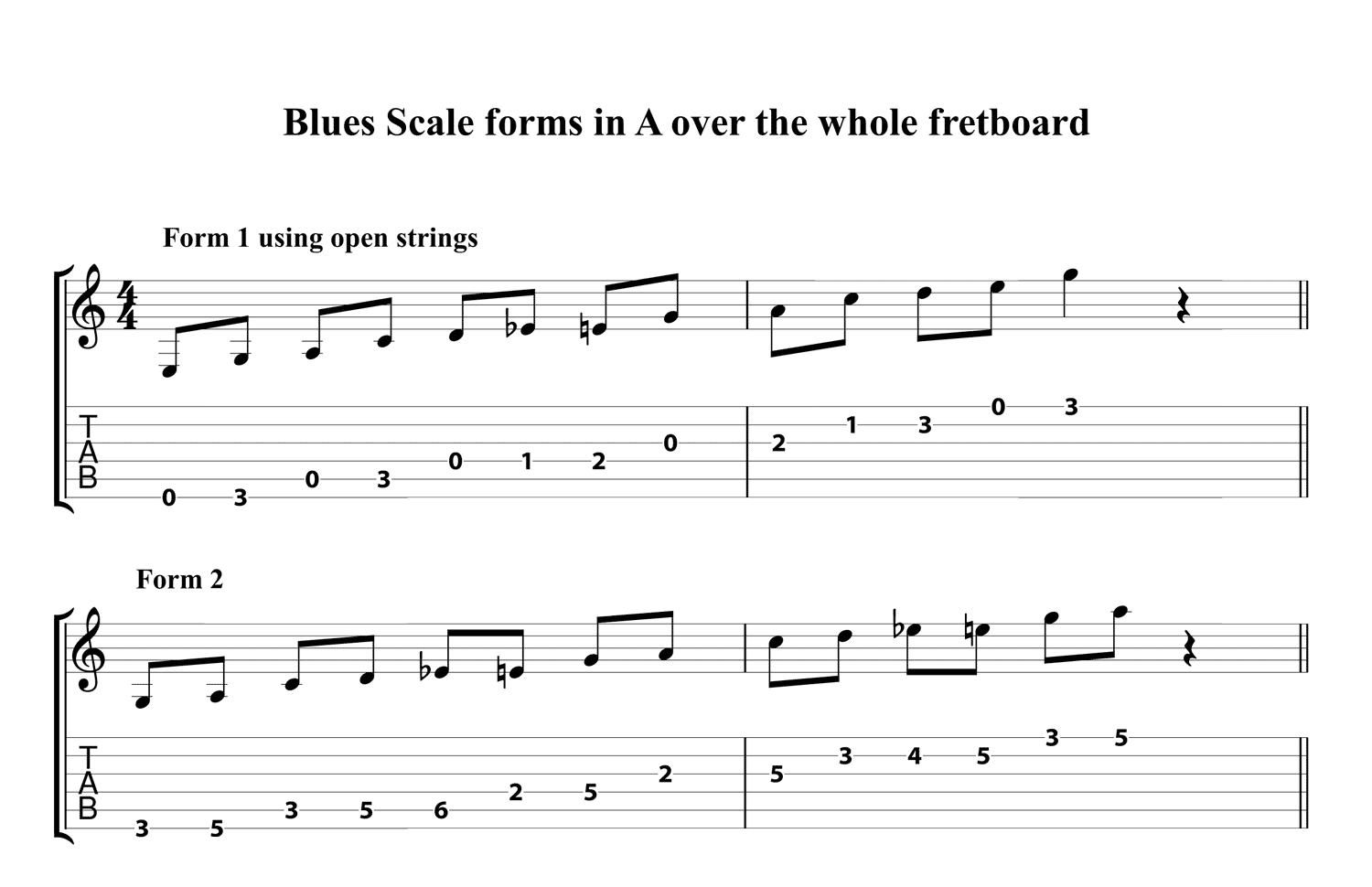
5 Blues Scale forms in A over the whole fretboard – Guitar TAB and Scale Boxes

Here is a selection of content for learning the blues scales all over the fretboard. There are tabs to follow and also scales boxes, which can help visualise and remember the shapes of the scales.

The Sheets

1. Guitar Tab for all blues scales on the fretboard.

2. Page 2 of Guitar Tab for all blues scales on the fretboard.

3. This sheet shows you the scale box shapes. It’s essentially the same information as the first 2 sheets, presented in a different way:

4. This sheet shows you recommended finger numbers:


Related: If you liked this page, you might also be interested in purchasing this: Learning Minor Pentatonic Scales Ebook.

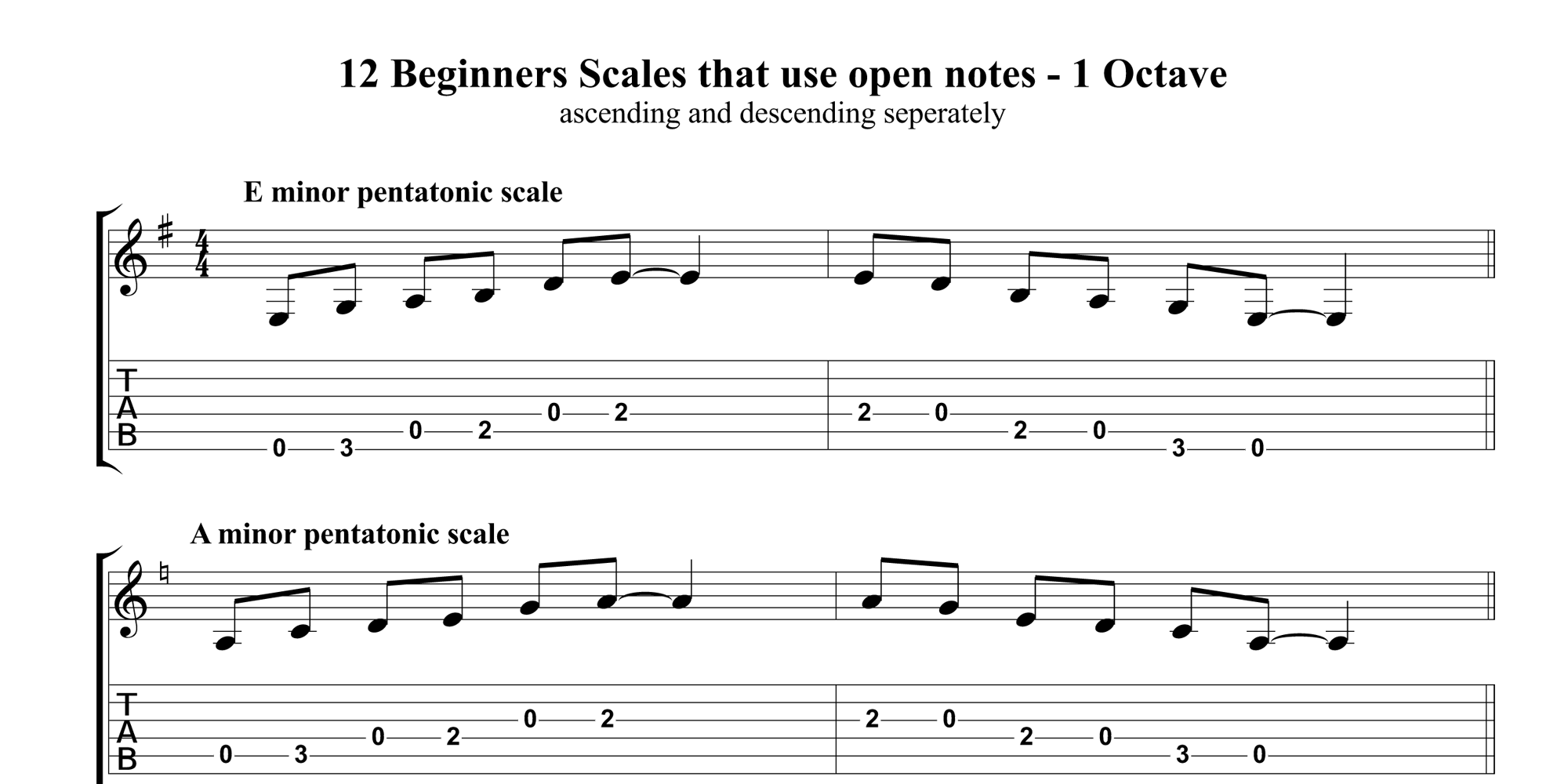
12 Beginners 1 Octave Open Scales – ascending and descending exercises

The following 1 octave open scales are to be played in ascending and descending pattern with a pause in between (the root note is held for a short time).

Here is a list of all the 1 octave open scales included in the 2 sheets:

  1. E minor pentatonic sclae
  2. A minor pentatonic scale
  3. E natural minor scale
  4. A natural minor scale
  5. E blues scale
  6. A blues scale
  7. G major pentatonic scale
  8. C major scale
  9. F major scale
  10. Bb major scale
  11. E major scale
  12. A major scale

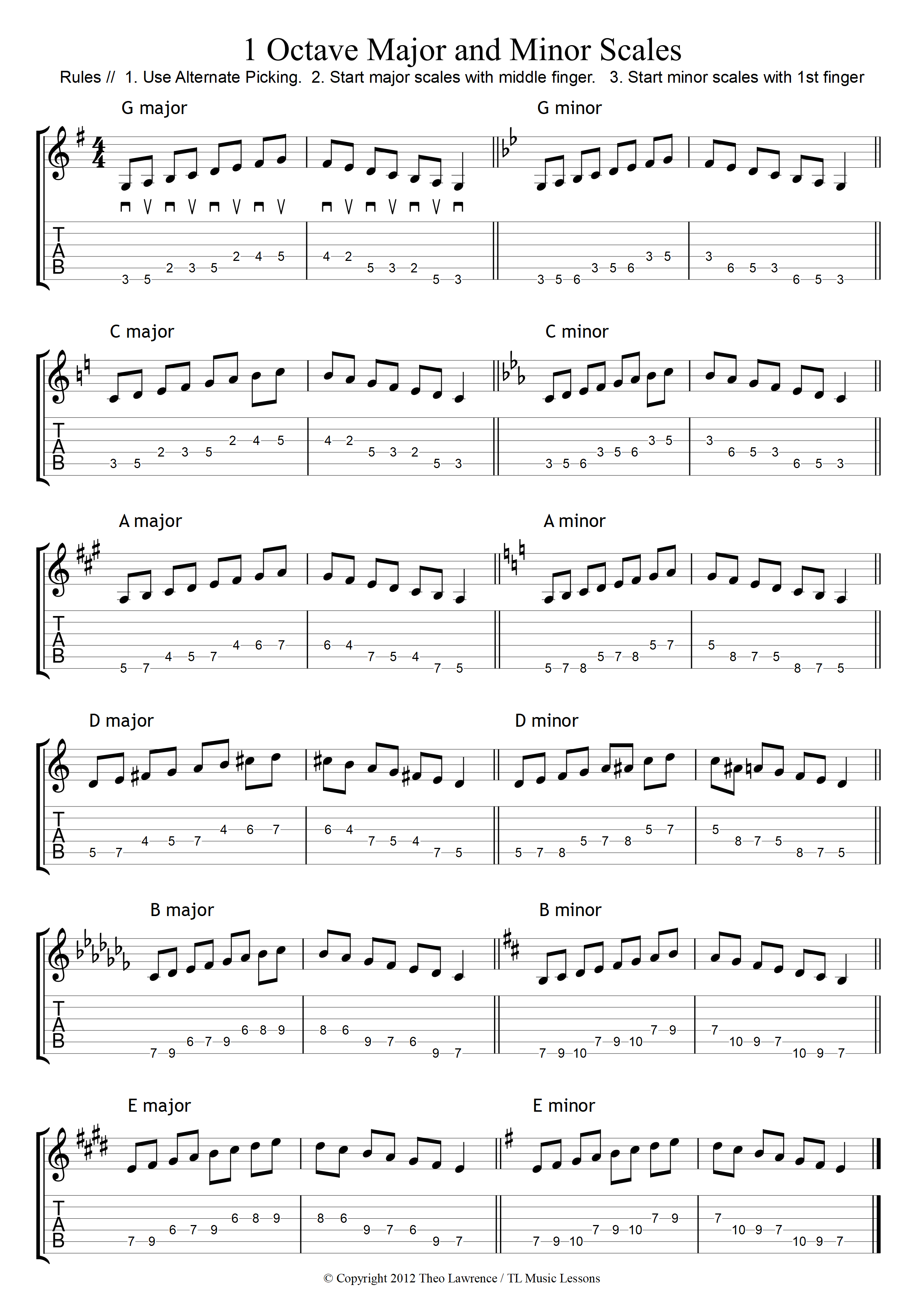
12 Beginners Major and Minor Guitar Scales (1 Octave)

Beginners should practice these scales regularly. Make sure to repeat each scale (at least 2x) when you get faster.

The symbols on the first bar are down, up, down, up etc (this continuous pattern is called Alternate Picking), to be played with a guitar pick if you are using one. See below key for which one is which. Make sure to do this for every scale. At first though, you can just do all down picks to make it easier if you prefer.


12 Minor Pentatonic Scale Exercises – Featured on the Guitar Pro Blog

This lesson has been published on the Guitar Pro Blog, so for the full article, click here.

The scale exercises are written for anyone that has learned (or is learning) the 2 octave minor pentatonic scale shape, and are ideal for anyone studying for grade 3 or grade 4 guitar. Those 12 concrete examples are aimed to widen your soloing chops and skills.

To read more and download the guitar pro file, use the following link:

http://blog.guitar-pro.com/2015/04/12-minor-pentatonic-scale-exercises/