(PREMIUM) – First Guitar Book – Easy Reading Scales, Riffs & Melodies

Buy Now →

A Ukulele Version is also available.

  • PDF ebook
  • 20 pages
  • Easy to read design
  • Song melodies
  • Scales
  • Riffs
  • Useful for beginners of all ages.
  • Includes 3 blank template PDF files for writing your own scales and exercises

Contents

  1. Front Cover
  2. Contents
  3. Introduction
  4. How To Read The Music – Part 1
  5. How To Read The Music – Part 2
  6. Twinkle Twinkle Little Star (FREE)
  7. Happy Birthday
  8. Sheet 1 – Guitar Scale Exercises (FREE)
  9. Sheet 1 – Rock Riffs
  10. Camptown Races
  11. Sheet 2 – Rock Riffs
  12. Amazing Grace
  13. Sheet 2 – Guitar Scale Exercises
  14. Morning Has Broken
  15. Sheet 3 – Rock Riffs
  16. Sheet 3 – Guitar Scale Exercises
  17. Can Can
  18. Sheet 4 – Guitar Scale Exercises
  19. Sheet 4 – Rock Riffs
  20. Mexican Hat Dance

People that might find this book useful

  • Beginner Guitar students of any age group.
  • Guitar teachers can print the book or single sheets for their students and teach it to them.
  • Get used to the basics with this easy to read book before moving onto standard tab and notation.
  • Parents may be able to teach their children with this book.
  • Some may be able to teach themselves the basics with this book.

About The Book

This easy reading ebook is a compilation of 9 years teaching guitar and preparing lesson sheets for my students. I developed the easy reading design for complete beginners. It is based on normal guitar tab, but simplifies it so that there are no distractions, and it’s huge and easy to look at rather than the numbers being small.

I tested some of these sheets over the last 6 months until I was ready to create the rest of the book. I have found that the format that I have created takes away any unnecessary distractions in order to teach the basics without distractions and confusion. I believe it solves problems with reading the music for beginners of any age, but particularly for young beginners.

I decided to create this range of sheets like this one to make both my life easier and to help my students get to grips with reading tab quicker for playing scales, melodies, public domain songs, traditional songs and riffs. I have created the sheets using Adobe Illustrator.

There are different ways of playing the scales so it’s ok to do what works for you but don’t just use 1 finger for all of it! Younger players think it’s faster at first, but it’s really not in the long run. If you have frets 1 2 3 and 4 to play in an exercise, you could use all 4 fingers to play it (1st, 2nd, 3rd and 4th finger). Use this technique of ‘one finger per fret’ where it seems comfortable to do so. If a scale only has 0, 2 and 3 in it, then you could use just your strongest 2 fingers to play it (1st finger for the fret 2’s and 2nd finger for the fret 3’s).

Guitar teachers can use this ebook in their own teaching and they are welcome to print physical copies for their students.

Buy Now →

(PREMIUM) – First Ukulele Book – Easy Reading Scales & Melodies

Buy Now →

A Guitar Version is also available.

This easy reading Ukulele book has been created using Adobe Illustrator so that the basics of song melodies, scales, arpeggios and warm up exercises can be taught, learned and read in the easiest and clearest way possible for beginners of all ages.

  • Songs, Scales, Arpeggios and Warm Up Exercises.
  • Easy to read for all ages
  • Printable PDF ebook.
  • 20 pages.
  • Also includes 3 blank templates for writing your own exercises.

Contents

4. How To Read The Music
5. Twinkle Twinkle Little Star (FREE)
6. Happy Birthday
7. Ukulele Warm Up 1
8. London Bridge
9. Sheet 1 – Scales (FREE)
10. Morning Has Broken
11. Ukulele Warm Up 2
12. Amazing Grace
13. Arpeggios & Chords
14. Can Can
15. Camptown Races
16. Frère Jacques
17. Sheet 2 – Scales
18. Sheet 3 – Scales
19. Sheet 5 – Scales
20. Sheet 6 – Scales

People that might find this book useful

  • Beginner Ukulele students of any age group.
  • Ukulele teachers can print the book or single sheets for their students.
  • Get used to the basics with this easy to read book before moving onto standard tab and notation.
  • Parents may be able to teach their children with this book.
  • Some may be able to teach themselves the basics with this book.

About the book

This easy reading ebook is a compilation of 3 and a half years of preparation work teaching ukulele to a wide range of abilities and also from 9 years of teaching guitar, which has influenced and helped my teaching and playing of the ukulele.

I tested some of these sheets over the last 6 months until I was ready to create the rest of the book. I have found that the format that I have created takes away any unnecessary distractions in order to teach the basics without distractions and confusion. I believe it solves problems with reading the music for beginners of any age, but particularly for young beginners.

I decided to create this range of sheets like this one to make both my life easier and to help my students get to grips with reading tab quicker for playing scales, public domain songs, traditional songs, arpeggios and warm up exercises. I have created the sheets using Adobe Illustrator.

The finger suggestions are a guide to what I recommend to my students. There are different ways of playing the scales so it’s ok to do what works for you. Just don’t use 1 finger for all of it! Younger players think it’s faster at first, but it’s really not in the long run.

Ukulele teachers can use this ebook in their own teaching and they are welcome to print physical copies for their students.

Buy Now →

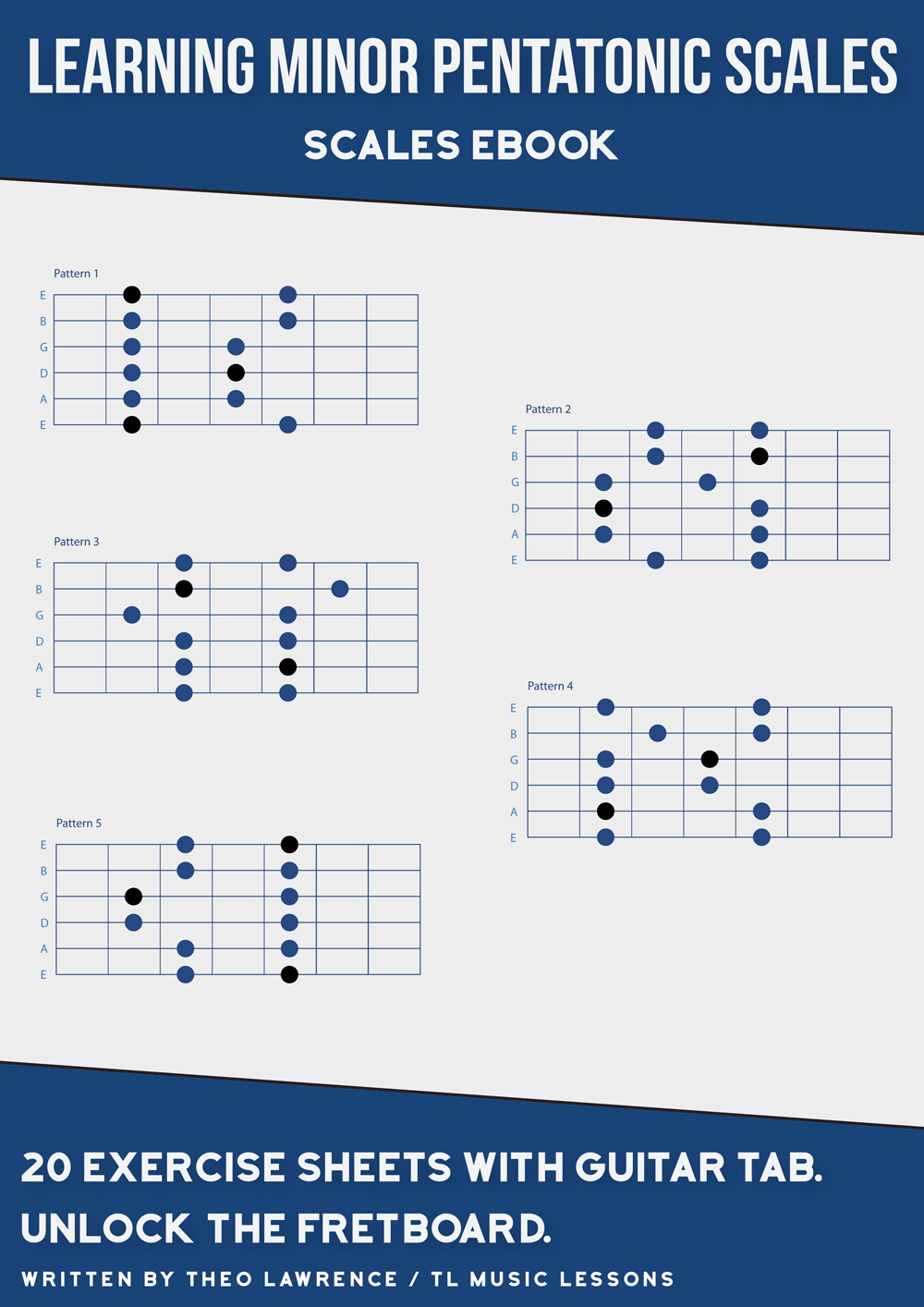
(PREMIUM) – Learning Minor Pentatonic Scales – PDF Ebook

Buy Now →

Contents

2 – Contents
3 – Introduction
4 – The 5 Moveable Scale Shapes
5 – Exercise Sheets 1 – 13
18 – Full run through of all 5 scale shapes in various keys
24 – All possible A minor pentatonic scale positions covering the whole neck

Self published in 2018 by TL Music Lessons.

Introduction

People that might find this book useful

  • Guitarists wanting to learn how to play guitar solos and improvise along with songs.
  • Guitar teachers can print the book or single sheets for their students.
  • Guitarists can teach themselves how to play the 5 minor pentatonic scales by following the book. The aim is to be able to do this from memory by the end of the book in various keys.
  • Guitarists on Grade 3 and above will find the scales useful for soloing. The 5 scale shapes are required for Grade 5, and for some syllabuses they are required for Grade 4.

About the book

This minor pentatonic scales ebook is a compilation of 9 years of preparation work teaching guitar to a wide range of abilities. After trying many ways of teaching scales to students and moving them on to improvising and soloing, I have developed this exercise ebook to really get to grips with these 5 scale shapes. If you follow the whole ebook and spend time on each sheet there is a strong chance of being able to use these scale shapes from memory for improvising and soloing.

I recommend spending about a week’s worth of practice on each sheet in the book. Really focus on that sheet for 3 or 4 practice sessions. It’s going to take you 20 weeks to do that, so you might want to move through it quicker, but I recommend doing that as you progress further through the book. Start out slow and then once it starts to click and you get used to the shapes then you can spend less time on each sheet. Make sure to follow the repeats on each sheet, which usually say to repeat the sheet twice. You are welcome to play more than twice though, or don’t do the repeat if you only have a short time to practice.

The finger suggestions are a guide to what I recommend to my students. There are different ways of playing the scales so it’s ok to do what works for you. Just don’t use 1 finger for all of it! Younger players think it’s faster at first, but it’s really not in the long run. I remember one student that I had to battle with for ages to agree to use more than 1 finger on her scales and then after a few weeks of practicing with all the fingers, she found it funny because it was much quicker and easier than using just one finger.

The guitar tab sheets have been created using Guitar Pro 7 and the scale shapes and cover were created using Adobe Illustrator.

Guitar teachers can use this ebook in their own teaching and they are welcome to print physical copies for their students.

Free Previews

  • Click the Buy Now button below and then click ‘Preview’ at the top right of the product image
  • There is also a series of free posts featuring some of the minor pentatonic scale exercise sheets.

Buy Now →

(PREMIUM) – Christmas Songs Ebook – Guitar, Ukulele and Lyrics

Buy Now →

9 years of preparing songs for teaching at Christmas later, and I have created this refined ebook for guitar and ukulele. It includes sheet music with TAB for both melody and chords parts. I have arranged the sheet music myself, so I could aim the ebook at beginners, but I have not changed melodies or structures. I have presented the sheet music in the most simplistic way whilst also aiming to provide a challenge to players that have been learning for a while.

Contains Sheet Music for both guitar and ukulele, and Lyrics Sheets, which can all be printed an unlimited amount of times by the purchaser. Ideal for guitar teachers and ukulele teachers.

The download contains 4 seperate ebooks. One with them all in, and then 3 seperate ebooks for easy printing of guitar, ukulele and lyrics.

  • Jingle Bells
  • Deck The Halls
  • We Wish You A Merry Christmas
  • We Three Kings
  • Silent Night
  • Christmas Is Here

There are both chords and melodies (including ukulele and guitar TAB) for the 5 public domain Christmas songs. There are also guitar and ukulele chords for the original Christmas song called ‘Christmas Is Here’.

Buy the ebook →

(PREMIUM) – Grade 3-4 Ebook – Scales, Arpeggios, Barre Chords and Guitar Solo Exercises

Buy Now →

The Buy Now button will take you to the product page. There you can download a free 9 page preview by clicking the ‘Preview’ link at the top right of the cover image.


3. Contents
4. Introduction
5. Scales & Arpeggios: Grade 3 – Fretboard Shapes
6. Grade 3 Scales in G
7. Grade 3 Scales in A
8. Grade 3 Scales in B
9-10. B minor pentatonic scale exercises (8th notes)
11 . Grade 3 Arpeggios in A, B and G (major & minor)
12-13. Arpeggio Chord Progressions
14. Notes on the Fretboard for Grade 3+
15. Grade 3 barre chord shapes
16. Part 1 – grade 3 barre chord progression exercises
17. Part 2 – grade 3 barre chord progression exercises
18. 12 bar blues solo in G
19. Guitar Solo in Gm
20. 12 bar blues solo in A
21. Fallout Guitar Solo in Em
22-23. Grade 3 Chords, Scales and Arpeggios Exercises
24. Grade 4 barre chord shapes
25. Part 1 – grade 4 barre chord progression exercises
26. Part 2 – grade 4 barre chord progression exercises
27-29. B minor pentatonic scale exercises (8ths, triplets and 16th notes)
30-32. Grade 4 Chords, Scales and Arpeggios Exercises
33. Songwriting Cheat Sheet

Introduction

  • Guitar teachers can print the book or single sheets for their students.
  • Guitarists can teach themselves following on from a strong basic foundation in reading and playing
  • Guitarists that want to build up a foundation in the core aspects of Grade 3-4.

About the book

This Grade 3-4 ebook is a compilation of almost 9 years of preparation work teaching guitar. I have included guitar lesson sheets that I have prepared and revised many times over the 9 years to be the best they can be for use with my lessons.

To create the book I selected only the best sheets from my selection of many more that I created for teaching with. I printed them all out and arranged them into a coherent order. Finally, I created and modified a few more just to make the book run smoothly.

I have included only the sheets, rather than add lots of teaching text you might normally find in tuition books. This is partly to limit the amount of pages for those printing, and also to give teachers using the books freedom to put their own take on the lesson sheets. Personally when I get a tuition book for myself, I tend to go straight to the exercises. This will probably make it harder for self taught players, so to anyone getting stuck reading the book I would recommend giving it a go and if you get stuck, research how to read the parts you struggle with. There are plenty of youtube videos out there and help articles that you will find to help. Sometimes youtube videos lack sheet music and written parts, so you should be able to use this book alongside these popular methods of learning, if you are not learning with a teacher.

Guitar teachers can use this ebook as a guide for their own teaching. These are the core parts of grade 3-4 but it does not nearly cover every aspect of these levels, so you can dip in and out of this book with your teaching. Let the book provide a fundamental knowledge to the student and loosely give structure and a guide to your teaching and allow yourself to go off on tangents as you and the students move through the book. The key thing here is to tailor your teaching to the students, because they’re all different and will require different paths to explore their own style and learning experience.

Each topic in the book is briefly covered. There is much more depth you could go into, and this is encouraged. So far, I have already released another ebook that works more on rhythms with barre chords in chord progressions at grade 3-4 level called 10 Group Chord Exercise Sheets – Grades 1-4.

Free Preview / Buy Now →

Computer Games Music – PDF Ebook – Ukulele, Guitar, Bass Sheet Music with TAB

GUITAR: Get The Free PDF ebook Download →
UKULELE: Get The Free PDF ebook Download →
BASS GUITAR: Get The Free PDF ebook Download →

Also available for Drums


Full Ukulele Tab sheet music for 11 computer music songs. ‘Computer Games Music’ uses the MIDI from songs written by TL Music Lessons for teaching purposes using ‘Guitar Pro’ software. The MIDI is run through various synths in Abelton Live and the songs have been made faster. Drums and Bass Guitar have also been added to the original 10 Acoustic Guitar & Ukulele Songs.

Audio

In addition to this free sheet music download, the 11 track album ‘Computer Games Music’ by TL Music Lessons is available on Spotify, Bandcamp and other stores.

About the Sheet Music

Most of the pieces have 3 difficulty levels, so therefore there are 60 pages in the guitar book and 49 pages in the ukulele book ebook to accommodate all of the versions. The fast pace of the songs pushes up the difficulty level quite high in places. A slower, acoustic version of the songs can be found here. The bass ebook has 15 pages and there is only 1 difficulty level.

These could potentially be used as performance pieces in schools, or maybe even exams as a free choice piece if you ask an exam board. Feel completely free to use the audio as a backing track by downloading it from itunes or bandcamp etc and using it to play along with.

About The Music

Last year I made an album of 10 songs to teach with, and created 6 ebooks for the instrument parts. This year, I made an album of 11 songs called ‘Computer Game Music’.

This year I exported the MIDI files from 8 of those songs, plus 3 new ones, and began adding synths to the MIDI in my music production software Abelton Live 9 to create music that I think would sound good in computer games. I found it quite easy, quick and enjoyable to do when I initially messed about with one of the songs for fun. I then decided to start the project, which only took about a month of spare time to create the new album of songs. I also added drums and bass guitar to the tracks to finish them off.

The drums were created by me in Abelton using the MIDI piano roll and a drum rack. I really enjoyed this! I then transcribed the drum loops into actual drum sheet music for people to learn to play along with the music if they wanted to.

The drum sheet music has a wide range of ability levels from complete beginner (Canon in C), right up to grade 8 with some complicated syncopation at high speeds. All of the drum loops were created specifically for these songs. I tried to make the majority of the beats playable by a real drummer. I was able to transcribe and transpose most of the beats without altering them, but there were some that would need extra hands, such as the hand claps and clave polyrhythms, so these have been left out or modified where I thought appropriate.

Music makers and music producers can feel free to use the drum loops audio and midi as they wish. You may freely use them in your own compositions. School pupils may also use the drum loops pack as they wish for school projects or coursework, if this is within the guidelines of the work.

I hope that the songs can be used by a range of abilities. I would say most or all ability levels would find challenges throughout the album, depending on which instrument you look at. They are all quite challenging in places.

I hope that the songs can be used by more advanced players. Initially the previous album of music was created for grades 1-3 (guitar and ukulele only), but now for this new one, I would say most or all ability levels would find challenges throughout the album, depending on which instrument you look at. They are all quite challenging in places.
I also hope that the songs can be used as backing tracks for performances, for example in schools, and possibly as part of marked school performances or maybe even as free choice pieces in grade exams.

I also hope that my students will enjoy listening to the album after getting to know the songs in their different style.

Whilst the songs have not been created for any particular computer game, I will try to get some of the music featured in actual games. I think they would work well with platform and retro type games.

(PREMIUM) – Guitar & Ukulele Basic Beginners Book 1

Since writing this ebook, I have developed some ‘Easy Reading’ guitar and ukulele scales and melodies ebooks, so although this page says ‘Book 1’, you might want to take a look at those easy reading books first, especially for younger players.


2 for 1: The premium download includes 1 book for guitar and 1 book for ukulele.

Buy Now →

People that might find these books useful

  • Guitar & Ukulele teachers can print the book or single sheets for their students
  • Students can teach themselves to learn the basics if they have some reading knowledge
  • Supplementary learning material for students that have guitar lessons
  • Beginner ukulele players and guitarists looking for some easy songs or exercises to get started with

Contents Highlights

17 topics of study for guitar and ukulele that is aimed at complete beginners. The book has a mixture of public domain songs, easy scales, easy melody exercises and easy chord exercises.

Teaching Notes

The books are designed so that even age 5 or 6 could play some of the pieces and exercises, so it starts off very easy with simple melodies such as Twinkle Twinkle Little Star, that almost everyone can play to some extent in their first lesson. There is however content for all ages in this book and the majority of content is designed to be played by all ages.

The book also takes a while to move onto chords. Like I said at the start of the post, I have developed some ‘Easy Reading’ books recently and at the time of updating this page for a new website launch (Jan 2019), I also have some ‘Easy Reading Chords’ ebooks in the pipeline, which have worked really well with my students. Check out the ebooks section and look for the Easy Reading Chords books – they’ll probably be available by the time you read this.

Example Page from the Guitar ebook:

Full Contents

3. Contents
4. Introduction
5. Twinkle Twinkle Little Star
6. Ice Cream
7. Canon in C – 2 sections
8. Silent Night in C – melody
9. 4 finger note / string / fret exercises
10. C major and A minor scales for beginners melodies
11. Canon in C – 3 sections
12. 2 melody exercises in C major
13. 2 melody exercises in A minor
14. Autumn Leaves
15. One Drop
16. Em and Am Chord Exercises 1-12
20. 5 Easy Chord Progressions with E, A, D, Em, Am, Dm (Free Preview)
21. Robin Reddocke – chords
22. C major scale practice with chords
23. Silent Night in C – chords + melody
24. Melody Exercises – A minor scale

About the book

The book is designed for use with teaching students with reading from as early as the first lesson if they are capable. All of the sheets are supposed to be achievable fairly quickly and easily by guitar and ukulele students of any age. Even students from the age of 5 or 6 could play some of these sheets. A teacher using this book would need to gauge the ability of the student. Often having something written down helps the student so even if they cannot read much of the music, they will be able to understand fret numbers and hopefully chord boxes too.

The best thing about these books is that the guitar and ukulele versions are compatible so if you happen to have beginner guitar and ukulele students in the same group, then you will be able to use these books to play along together. I don’t have many of these groups and they don’t always have a lesson together, but sometimes it works really well to have guitar and ukulele students playing together or learning in a group.

Final Thoughts

I hope that this book helps people get started quickly with learning guitar or ukulele and playing along to songs with others. The aim of this book is to progress quickly through it and to provide satisfaction through achieving. I hope to break down the barriers to getting started with learning guitar and ukulele with this book.

Buy Now →

(Premium) – 50 Guitar Chord Exercises ebook – Beginners & Grade 1-2

Buy Now →


Playlist with video lessons for this Guitar book

Contents (29 pages)

  • Page 4 – Brief help with reading notation regarding the strumming hand
  • Page 5 – Exercises 1-20 – Chord Exercises in 4/4
  • Page 15 – Exercises 21-25 – 3/4 Time Signature
  • Page 17 – Exercises 26-31 – 6/8 Time Signature
  • Page 20 – Exercises 32-40 – Picking exercises in Various Time Signatures
  • Page 25 – Exercises 41-45 – Finger Picking Only Exercises (no guitar pick)
  • Page 27 – Exercises 46-50 – Finger Picking and Chords

Introduction

People that might find this book useful

  • Guitar teachers can print the book for their students.
  • Beginner guitar players can work through the book with the help of a teacher
  • Some guitar players may be able to work through the book on their own (reading knowledge needed)

About the book

This book was written following my first two books (released as a set) called 100 Beginners Chord Progressions For Guitar + Struming Rhythms. This guitar version was written after the ukulele version and transferred over very well and therefore they are both compatible and suitable for groups or ensembles of guitar and ukulele.

I started out writing this book in order to solve two problems I found in the first book of chord progressions – which were mainly problems for early beginners. The first problem was that by the time we got through all 4 chords, sometimes it had taken a while to change between chords and we lost the flow of the exercise. The second problem was that the new beginners were not familiar with the chords yet, so we had 2 books and a chord sheet to look at. The third problem was that for young beginners, some struggled to remember the rhythms and therefore got lost flicking between the books, rather than remembering the rhythm and then just looking at the chord progression book.

So, this book aims to solve all of the problems in the above paragraph for basic beginners level, by having the chord diagram and rhythm and tab all in one place and also only focuses on 2 chords at a time so the player can really master those chord changes. I tend to teach this book first and then move onto the 100 chord progressions books, which then get progressed through faster.

The book includes a lot of new content not seen in the first two books, like finger picking exercises and different time signatures. Therefore those who have started with the first books, could also go through this book afterwards and still feel like they are progressing.

Final Thoughts

In conclusion, I think this book is best to start with out of the 2 releases so far. The overall aim is to improve those chord changes and build up your rhythm and finger picking skills, preparing you to be able to play songs, to help you progress in general, and it to give you some new concepts for constructing your own music.

I hope you find the book useful.

Theo Lawrence
www.tlmusiclessons.com

Buy Now →

View Ukulele Version →

(Premium) – 10 Acoustic Guitar & Ukulele Songs – Beginners to Intermediate – Audio & PDF Sheet Music Ebooks

***These are 10 original songs written by TL Music Lessons for teaching purposes, to get students using chords and melodies in real song scenarios, which have been written specifically for beginners from grade 1 to 3.***

Buy Now / Free Preview →


What’s in the download?

  • 10 audio tracks
  • 10 more audio tracks with count in (for playing along)
  • 3 x PDF sheet music ebooks for GUITAR (Level 1-3)
  • 3 x PDF sheet music ebooks for UKULELE (Level 1-3)
  • 10 ‘Guitar Pro’ master files containing all the music notation

About the 6 Individual Sheet Music ebooks

  • Guitar 1: Beginners Guitar focusing more on chords
  • Guitar 2: Advanced Beginners focusing more on melody
  • Guitar 3: Beginners to Intermediate focusing more on lead
  • Ukulele 1: Beginners Guitar focusing more on chords
  • Ukulele 2: Advanced Beginners focusing more on melody
  • Ukulele 3: Beginners to Intermediate focusing more on lead

Who is it for?

  • Grade 1-3 levels of guitar and ukulele
  • Guitar Teachers, Ukulele Teachers can print these for their students
  • Leaders of Guitar and/or Ukulele ensembles
  • Students looking to learn on their own

Audio (included in the premium download)


Useful Copyright Info: You are free to print copies of the sheet music for educational or performance purposes and you are also free to perform the songs in public.

(Premium) – Guitar Ebooks: 100 Beginners Chord Progressions + 100 Strumming Rhythms

Buy Now →


These ebooks have been created after 6 years of teaching guitar. They follow on nicely from the ebook ’50 Acoustic Guitar Exercises’.

I have used my knowledge of how students learn chords, where they struggle the most, and what is needed to develop with rhythm playing and chord playing. The combination of these sort of chord progressions along with different strumming patterns is one that I have tried and tested, and have now compiled into a range of printable ebooks that can be used side by side to help many beginner guitarists improve their chord changing and rhythm playing.

There are 10 chord progressions on each sheet, covering 9 different key signatures in total.

People that might find these books useful

  • Guitar teachers can print the book for their students.
  • Beginner guitar players can work through the book with the help of a teacher
  • Some guitar players may be able to work through the book on their own
  • The 100 strumming rhythms will be useable for all grades of guitar. The strumming rhythms get quite hard towards the end and can be challenging up to grade 3 or 4 at higher speeds.

Contents for 100 Beginners Chord Progressions

Page 2 – Contents
Page 3-5 – Introduction
Page 6 – 10 Chord Progressions in A major
Page 7 – 10 Chord Progressions in A using A7, D7 and E7 chords
Page 8 – 10 Chord Progressions in A minor
Page 9 – 10 Chord Progressions in C major
Page 10 – 10 Chord Progressions in D major
Page 11 – 10 Chord Progressions in D minor – [View Sheet]
Page 12 – 10 Chord Progressions in E major
Page 13 – 10 Chord Progressions in E minor
Page 14 – 10 Chord Progressions in F major
Page 15 – 10 Chord Progressions in G major
Additional Sheet – Beginners Chord Chart


Also Available for Ukulele

View the Ukulele version →

(Premium) – Ukulele Ebooks: 100 beginners chord progressions + 100 strumming rhythms

Buy Now →

These ebooks have been created after 6 years of teaching guitar and 1 year of ukulele. They follow on nicely from the premium ebook ’50 Ukulele Exercises’.

I have used my knowledge of how students learn chords, where they struggle the most, and what is needed to develop with rhythm playing and chord playing. The combination of these sort of chord progressions along with different strumming patterns is one that I have tried and tested, and have now compiled into a range of printable ebooks that can be used side by side to help many beginner guitarists and ukulele players improve their chord changing and rhythm playing.

People that might find these books useful

  • Ukulele teachers can print the book for their students.
  • Beginner ukulele players can work through the book with the help of a teacher
  • Some ukulele players may be able to work through the book on their own

Page 2 – Contents
Page 35 – Introduction
Page 6 – 10 Chord Progressions in A major
Page 7 – 10 Chord Progressions in A using A7, D7 and E7 chords
Page 8 – 10 Chord Progressions in A minor
Page 9 – 10 Chord Progressions in C major
Page 10-  10 Chord Progressions in D major
Page 11 – 10 Chord Progressions in D minor – [View Sheet]
Page 12 – 10 Chord Progressions in E major
Page 13 – 10 Chord Progressions in E minor
Page 14 – 10 Chord Progressions in F major
Page 15 – 10 Chord Progressions in G major
Additional Sheet Beginners
Ukulele Chord Chart (21 chords)


Also Available for Guitar

View the Guitar version →

(Free ebook) – 10 Grade 1-3 Guitar & Ukulele Chord Exercise Sheets – Build up Confidence & Skills with a Small Collection of Easy Chords

Originally posted as 10 seperate blog posts, they are now all contained here on this page. go ahead and download the free ebook, listen to the audio examples below (or from the download) and read the description of each exercise below as you go through it.

Get Free Downloads (PDF, MP3, Guitar Pro) →

The 7 chords in this ebook are heavily used in pop and alternative music and are a fundamental set of chords to learn and be comfortable playing together in various sequences and with different strumming rhythms. They are also often used in different Capo positions on the Guitar. Some of the chords are more used than others out of the 7, but I think they are all very useful to learn.

This course of 10 exercise sheets will take you from grade 1 to grade 3 quite quickly and is primarily aimed at those around the grade 2 or 3 level, especially those on the brink of being able to play along with some popular songs.

Listen to exercises 1-10


About the exercise sheets

Sheet 1

Welcome to the first in the series of Chord Changing Rhythms with G, Cadd9, Dsus4, G/F#, and Em7 chords for Guitar and Ukulele.

These 5 chords are heavily used in pop and alternative music and are a fundamental set of chords to learn and be comfortable playing together in various sequences and with different strumming rhythms. They are also often used in different Capo positions on the Guitar.

In Exercise Sheet 1, we stick to the first 3 chords, G, Cadd9, and Dsus4. Let’s master these first.

In the next exercise sheet we introduce the Em7 chord and work on some new strumming rhythms.

Sheet 2

Welcome to the second in the series of Chord Changing Rhythms with G, Cadd9, Dsus4, G/F#, and Em7 chords for Guitar and Ukulele.

These 5 chords are heavily used in pop and alternative music and are a fundamental set of chords to learn and be comfortable playing together in various sequences and with different strumming rhythms. They are also often used in different Capo positions on the Guitar.

In Exercise Sheet 2, we introduce a 4th chord, Em7 to add to the G, Cadd9, and Dsus4 chords we started with in Exercise Sheet 1.

As with the other three guitar chords, you still don’t need to move your 3rd and 4th fingers. Whilst keeping your 3rd and 4th fingers on fret 3 of the the first two strings, all you need to do with Em7 is move the 1st and 2nd fingers into an Em position and you will now have Em7.

On the Ukulele, the Em7 is the same as the G6 chord. Both chords share the same notes. You can get away with this more on the ukulele as all the strings are quite high sounding so the root notes are not as prominent as the guitar.

By the way, if you are wondering what the symbols in bar 3 and 4 and again in 5 and 6 are, they mean to ‘repeat the previous two bars’. So, basically play the first line 3 times, then the 4th line, and then repeat it all again before playing the final bar.

Sheet 3

Welcome to the third in the series of Chord Changing Rhythms with G, Cadd9, Dsus4, G/F#, and Em7 chords for Guitar and Ukulele.

These 5 chords are heavily used in pop and alternative music and are a fundamental set of chords to learn and be comfortable playing together in various sequences and with different strumming rhythms. They are also often used in different Capo positions on the Guitar.

In Exercise Sheet 3, we re use the 4 chords from the previous exercise, Em7, G, Cadd9, and Dsus4, and develop different rhythmic skills in a new time signature of 6/8.

The rhythm is the same in every bar. It is not an easy rhythm, but once mastered will be enjoyable to play.

Sheet 4

Welcome to the fourth in the series of Chord Changing Rhythms with G, Cadd9, Dsus4, G/F#, and Em7 chords for Guitar and Ukulele.

These 5 chords are heavily used in pop and alternative music and are a fundamental set of chords to learn and be comfortable playing together in various sequences and with different strumming rhythms. They are also often used in different Capo positions on the Guitar.

In Exercise Sheet 4, we re use the 4 chords from the previous exercise, Em7, G, Cadd9, and Dsus4, and introduce a new chord, G/F#.

To play this new G/F# chord on guitar, you need to remove the top two fingers, and simply put the first finger on fret 2 of the 6th string. This finger should be held lazily so that it touches the 5th string. This will make the 5th string into a dead note, which means you play the string but no note comes out – it’s more of a hitting sound because the string is muted.

To play this new G/F# chord on ukulele, it’s more of a makeshift chord to fit the guitar rather than a true G/F# chord, because the F# isn’t actually the lowest note in the chord. It is actually technically a Gmaj7 chord, which has the same notes as G/F#.

The rhythm is the same in every bar. I have gone for a hard rhythm here, but it is a popular and familiar one so you should pick it up. Beginners might want to listen to the audio to pick up the rhythm rather than trying to read this one.

The rhythm changes at the end of every 4 bars – only one thing changes. Instead of doing the tied note (the fake down strum that doesn’t connect), we will strum this down. Listen to the drums, you will hear an extra bass drum on this 4th bar, which you can try and lock in time with.

The repeats are nested, which is a bit un common. This is so it fits onto the page and avoids the need to use D.C. markings, which some may not understand. Basically, play the first 4 bars twice, then the final 4 bars, and then play through everything again including the repeat of the first 4 bars.

G/F# slash chord explanation

This is a slash chord. The deepest note in the G chord is a G. The G chord is made up of 3 notes, G, B and D.

For G/F# we are replacing that lowest G note with an even lower note of F#, which is only 1 fret lower and therefore easy to play. Therefore, adding an F# is adding a new note to the chord. The note added is the 7th note in the G major scale, which fits because we are playing in the key of G. You can’t do this with every chord.

Usually the 7th note of G major would be played as a F diminished chord, using diatonic chord theory (you usually learn about this at grade 5 level). So, just adding the F# note onto a G chord is a good way of using that 7th major note, without the need for wrecking a chord progression by throwing in a diminished chord.

You can read more about slash chords here.

Sheet 5

If you got this far, it’s probably worth going to download the pdf ebook to view the rest, so I’ll leave off the images from this post for sheets 5-10.

Get Free Downloads (PDF, MP3, Guitar Pro) →

Welcome to the fifth in the series of Chord Changing Rhythms with G, Cadd9, Dsus4, G/F#, and Em7 chords for Guitar and Ukulele.

These 5 chords are heavily used in pop and alternative music and are a fundamental set of chords to learn and be comfortable playing together in various sequences and with different strumming rhythms. They are also often used in different Capo positions on the Guitar.

In Exercise Sheet 5, we re use only 3 chords from the previous exercises,G, Cadd9, and Dsus4. The exercises are getting harder though! There is a very quick rest after beat 3 on each bar, for only a quarter of a beat (16th note), and followed by 3 quick up picks with a 16th note speed, which then leads into a quick chord change to go into the next bar. The chord choices and style of playing was inspired by the song “We are never getting back together” by Taylor Swift. That song would be great to learn on the side of this series of chord changing with rhythm. The only other chord that it uses is Em. The picking is more complex than this, and the rhythm is different, but the chords are similar (in a different order).

The rhythm is the same in every bar. Beginners might want to listen to the audio to pick up the rhythm rather than trying to read this one.

Sheet 6

Welcome to the 6th in the series of Chord Changing Rhythms with G, Cadd9, Dsus4, G/F#, A7sus4, G/B, and Em7 chords for Guitar and Ukulele.

This selection of chords are heavily used in pop and alternative music and are a fundamental set of chords to learn and be comfortable playing together in various sequences and with different strumming rhythms. They are also often used in different Capo positions on the Guitar.

In exercise sheet 6 we have introduced 2 new chords. A7sus4 is the same shape as Em7 on guitar, but we just move our first 2 fingers down 1 string to make the shape. The G/B chord moves off Cadd9 in the same way that you would change from G to G/F# in previous exercise sheets.

This chord progression is in a 6/8 time signature. In each bar apart from the penultimate, the rhythm follows the 1, 2, 3, 4 rhythm with down strokes and then doubles up with “down, up” strokes on the 5 and 6. The second to last bar rhythm doubles up on the 2, 3 and 5, 6.

Sheet 7

Welcome to the 7th in the series of Chord Changing Rhythms with G, Cadd9, Dsus4, G/F#, A7sus4, G/B, and Em7 chords for Guitar and Ukulele.

In this session we take a break from the guitar pick and strumming rhythms, and focus on using a finger picking style with some of these chords. This can be very hard for beginners. I’ve slowed the tempo down a little to 70bpm. If you download the Guitar Pro 6 file (you need to have Guitar Pro installed), you can slow it down further.

We only use some of the chords in this exercise – G, Cadd9, Em7, Dsus4. We also use some notes like F# and B in the first section but we don’t play full chords with them. On the guitar they are used as bass notes.

For the second section you can see the p i m a markings above the music, which show you which fingers to use, and then continue for the following bars. Go here if you need to learn more about p i m a.

Sheet 8

Welcome to the 8th in the series of Chord Changing Rhythms with G, Cadd9, Dsus4, G/F#, A7sus4, G/B, and Em7 chords for Guitar and Ukulele.

In this session we start with some simple rhythms. The exercises are at a slower speed than in the previous session 8. After the repeats we have a complicated rhythm, so you’ll be glad of the slower tempo.

The tempo is very fast so you should start off slower before building up to this. If you download the Guitar Pro 6 file (you need to have Guitar Pro installed), you can slow it down further.

Sheet 9

Welcome to the 9th in the series of Chord Changing Rhythms with G, Cadd9, Dsus4, G/F#, A7sus4, G/B, and Em7 chords for Guitar and Ukulele.

In this session we take down the tempo and play a bit slower. The intro should be pretty easy but just make sure you are getting the timing right of the minims (half notes, worth 2 beats). The second section has a difficult rhythm so you’ll probably be glad of the slow tempo here.

If you would like to slow down or speed up the tempo, you can do this with the Guitar Pro 6 file (you need to have Guitar Pro installed).

Sheet 10

While the rhythms on this sheet probably go into Grade 4 territory, I recommend listening to the audio to get a grip on the rhythm and use the sheet for a guide for which up and down strokes to use.