Exercises 13-14 – Inside The Book: 50 Chord Exercises for Beginners

These two guitar chords exercises are featured in the book 50 Acoustic Guitar Chord Exercises

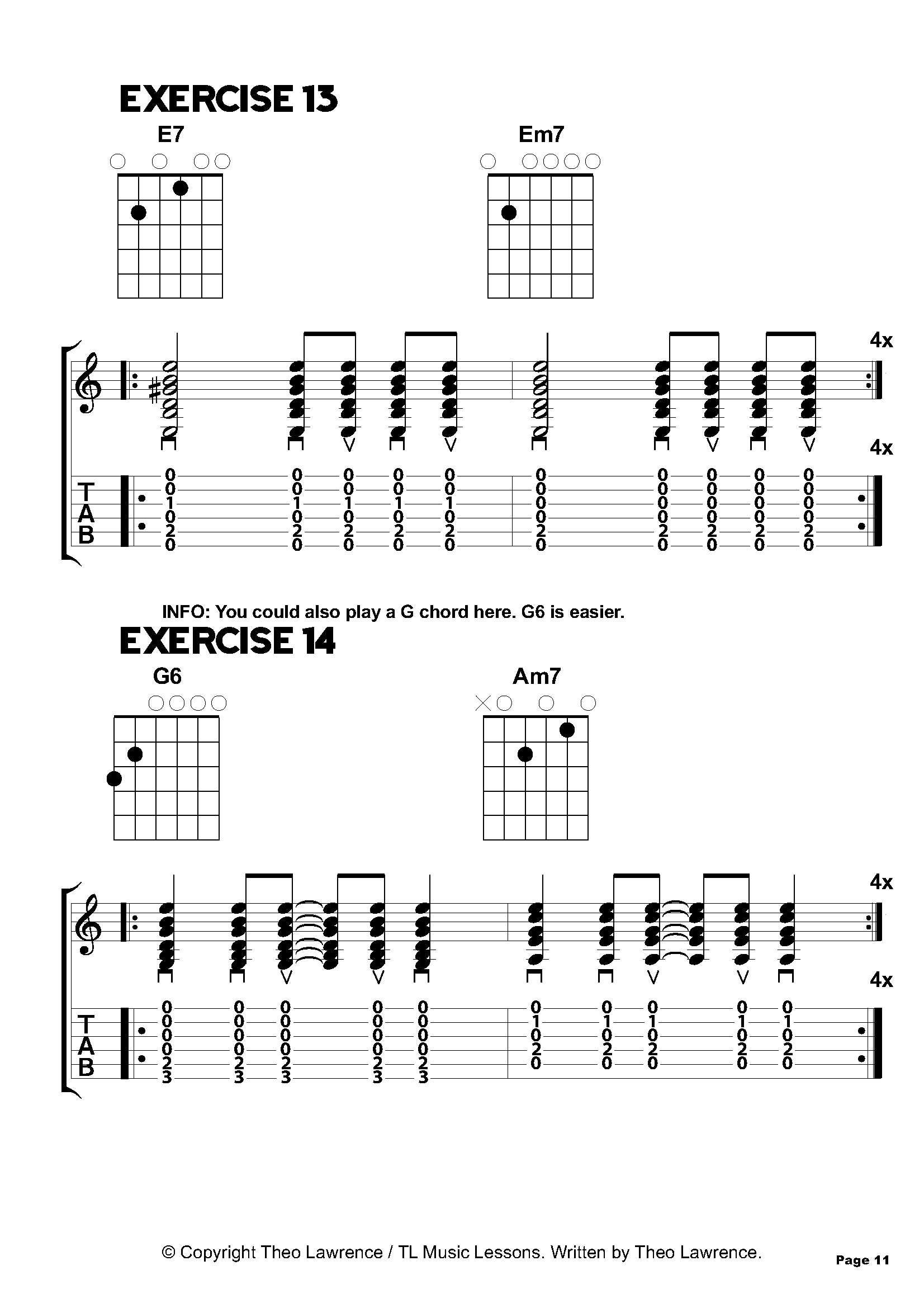
On this chords exercise sheet, we will be working with four chords: E7, Em7, G6 and Am7.

Exercise 13

E7 is used a lot in Blues music and Em7 can be used as a variation on the Em chord, but it’s not used as often.

The strumming is D 2 DUDU, D 2 DUDU.

The counting is 1 (2) 3 + 4 +, 1 (2) 3 + 4 +

Exercise 14

G6 and Am7 can be used as simplified chords of G and Am but are both individual chords in their own right.

The strumming is Down 2 3 Down, Down 2 3 Down.

The counting is 1 2 + (3) + 4, 1 2 + (3) + 4

Video Lesson


Watch on YouTube

← Exercises 11-12
Exercises 15-16 →
Buy The Book →

Exercises 11-12 – Inside The Book: 50 Chord Exercises for Beginners

These two guitar chords exercises are featured in the book 50 Acoustic Guitar Chord Exercises

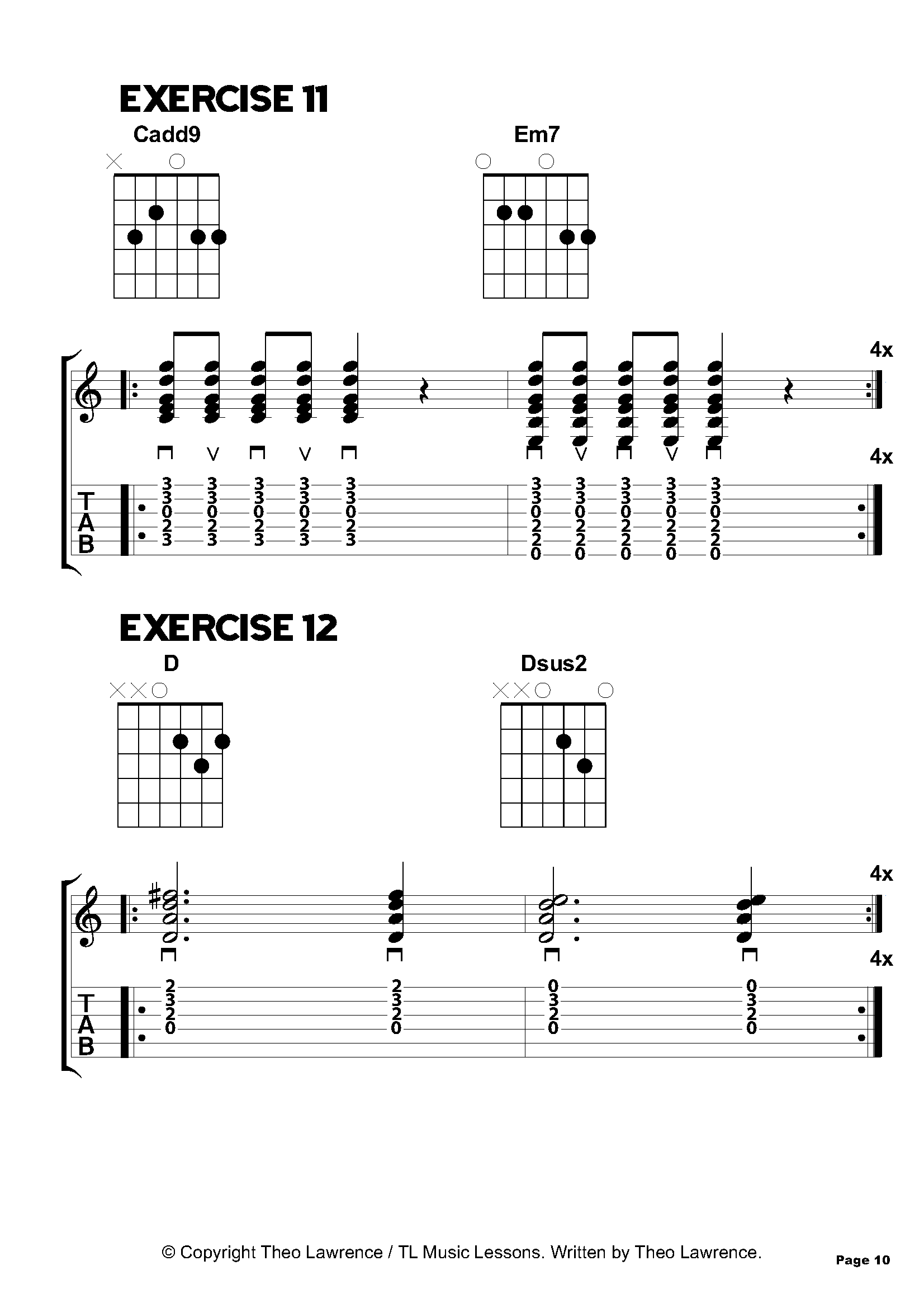
On this chords exercise sheet, we will be working with four chords: Cadd9, Em7, D and Dsus2.

Exercise 11

Cadd9 and Em7 are 2 very popular open chords, and are used in particular a lot on pop covers using a capo.

The strumming is DUDUD rest, DUDUD rest.

The counting is 1+2+3+(4), 1+2+3+(4).

Exercise 12

D and Dsus 2 are also used a lot on songs using a capo but they are also very common in rock songs.

The strumming is Down 2 3 Down, Down 2 3 Down.

The counting is 1 (2 3) 4, 1 (2 3) 4.

Video Lesson


Watch on YouTube

← Exercises 9-10
Exercises 12-13 →
Buy The Book →

6 Rock & Blues Play Along Backing Tracks [Premium]

Contents

6 Rock & Blues Play Along Backing Tracks (with full sheet music)

★ Over 30 PDF Files of Sheet Music ★ Over 60 MP3 Tracks ★ 6 Guitar Pro Files ★

Buy Now ⟶

Listen to the 6 tracks here:

  1. Blues in A (Sun Shines Through The Window) – Play Along Track 1

Grade 3 Lead Guitar & Barre Chords
Grade 1 Guitar
Grade 1-2 Ukulele
Grade 3 Bass Guitar
Grade 1-2 Drums
Lyrics for the Verses

  1. Blues in E with swing – Play Along Track 2

Grade 3 Lead Guitar & Barre Chords
Grade 1-2 Guitar
Grade 1-2 Ukulele
Grade 3 Bass Guitar
Grade 1-2 Drums

  1. Slow Rock in A Minor – Play Along Track 3

Grade 3-6 Lead Guitar
Grade 2 Guitar
Grade 3 Guitar (Barre Chords)
Grade 2 Ukulele
Grade 4 Bass Guitar
Grade 1-3 Drums

  1. Alternative Rock in E Minor – Play Along Track 4

Grade 6 Lead Guitar
Grade 2-3 Guitar
Grade 2-3 Ukulele
Grade 3 Bass Guitar
Grade 3-4 Drums

  1. Indie Rock in C – Play Along Track 5

Grade 3-5 Lead Guitar
Grade 2 Guitar 1
Grade 2 Guitar 2
Grade 2 Ukulele
Grade 3-5 Bass Guitar
Grade 3-4 Drums
Grade 2 Easy Drums

  1. Funk Rock in A Minor – Play Along Track 6

Grade 5 Lead Guitar
Grade 2 Guitar
Grade 3 Guitar
Grade 2 Ukulele
Grade 5 Bass Guitar
Grade 6 Drums
Grade 2-3 Easy Drums

Written and self published in 2020 by Theo Lawrence / TL Music Lessons.

Introduction

When the UK went into lockdown in March 2020 due to Covid-19, I quickly moved many of my lessons onto Skype/Zoom online lessons. I decided to make some of my own songs for my students to play so that they had backing tracks to play along with when they had learned and practiced the songs. I wanted to make sure they were possible for them to play, whilst also being a challenge to learn them. By the end of June, I had written these 6 songs and they felt like they worked together as a set of pieces to share with the world.

My students are all at different levels. Many of my beginners pupils of primary school age have been having lessons for at least a year or several years, so I wrote the lowest ability parts at Grade 1-2, and sometimes elements of Grade 3. I also have some grade 4-6 pupils on Guitar, Drums and Bass, so I wanted to make parts for them too. With all those parts together, there is something for almost everyone in here – just not for complete beginners because they need to work on the basics before learning these pieces.

People that might find this book useful

  • Guitar, Ukulele, Bass and Drum teachers can use these resources in their teaching or for their student’s performances.
  • Guitar, Ukulele, Bass and Drum students can teach themselves to play the music if they are able to read the sheet music. The backing tracks can then be used to practice with.
  • The Backing Tracks could potentially be used for school performances, such as for GCSE (check with the music teacher at school for song choice suitability.


About the PDF Sheet Music

These are the overall ranges of grades that the instruments cover in this selection of 6 songs. There are separate PDF files for each instrument part.

Grade 3-6 Lead Guitar
Grade 1-2 Guitar
Grade 3 Guitar Barre Chords
Grade 1-3 Ukulele
Grade 3-5 Bass Guitar
Grade 3-6 Drums
Grade 1-3 Easy Drums

About the MP3 Audio Files and the Guitar Pro Files

There are at least 3 different speeds of backing tracks available for each song. With performances in mind (such as for school GCSE submissions, school performances, or Eisteddfod entries), I have also included mp3s for each song without Lead Guitar, without Drums and without Bass Guitar. There are also one or two extras in there, such as ‘Just the Ukulele Part’ for some songs where I felt they would be especially helpful. If you need backing tracks that aren’t in the download pack, I strongly suggest investing in a copy of Guitar Pro, because you can do so much with these files. You can make the pieces be any speed you want, you can edit the parts, you can change the sounds of the instruments, and you can make your own mp3s and pdf files with it. You can also turn on the metronome and loop sections.

Summary

During the last few months, I have noticed that my students that carried on with online lessons have seemed to progress more than usual. I’m not sure if it’s the extra time at home with less going on, or if it’s these songs with backing tracks. I’d like to think it’s a mixture of all of those things, and probably more. I can say for sure that these pieces have gone down well with all of my students and that the range of techniques and rhythms included in the songs have been beneficial for them. It’s also been a nice outlet for me – it’s been like songwriting again (I’ve had a substantial break from it), and even though I was purposely trying not to write things that were out of reach for my students to learn, I was also enjoying the creative flow, and at times really went for it. I got really into the lead parts and was quite creatively free with those mostly, and on the drum parts I added my own style and flair into them, especially on the last piece with adding in fast double strokes on the hi hats and fills.

I hope you enjoy learning / teaching with these pieces.

6 Rock and Blues Play Along Backing Tracks

Buy Now ⟶


Theo Lawrence

www.tlmusiclessons.com

www.learndrumsforfree.com

www.payhip.com/tlmusiclessonsdrums

www.learnguitarforfree.com

www.payhip.com/tlmusiclessons

https://www.pinterest.com/tlmusiclessons

https://facebook.com/tlmusiclessons
Sheet 8 – Beginners Guitar Chords – Easy Reading Chord Exercise

Free PDF for this sheet.


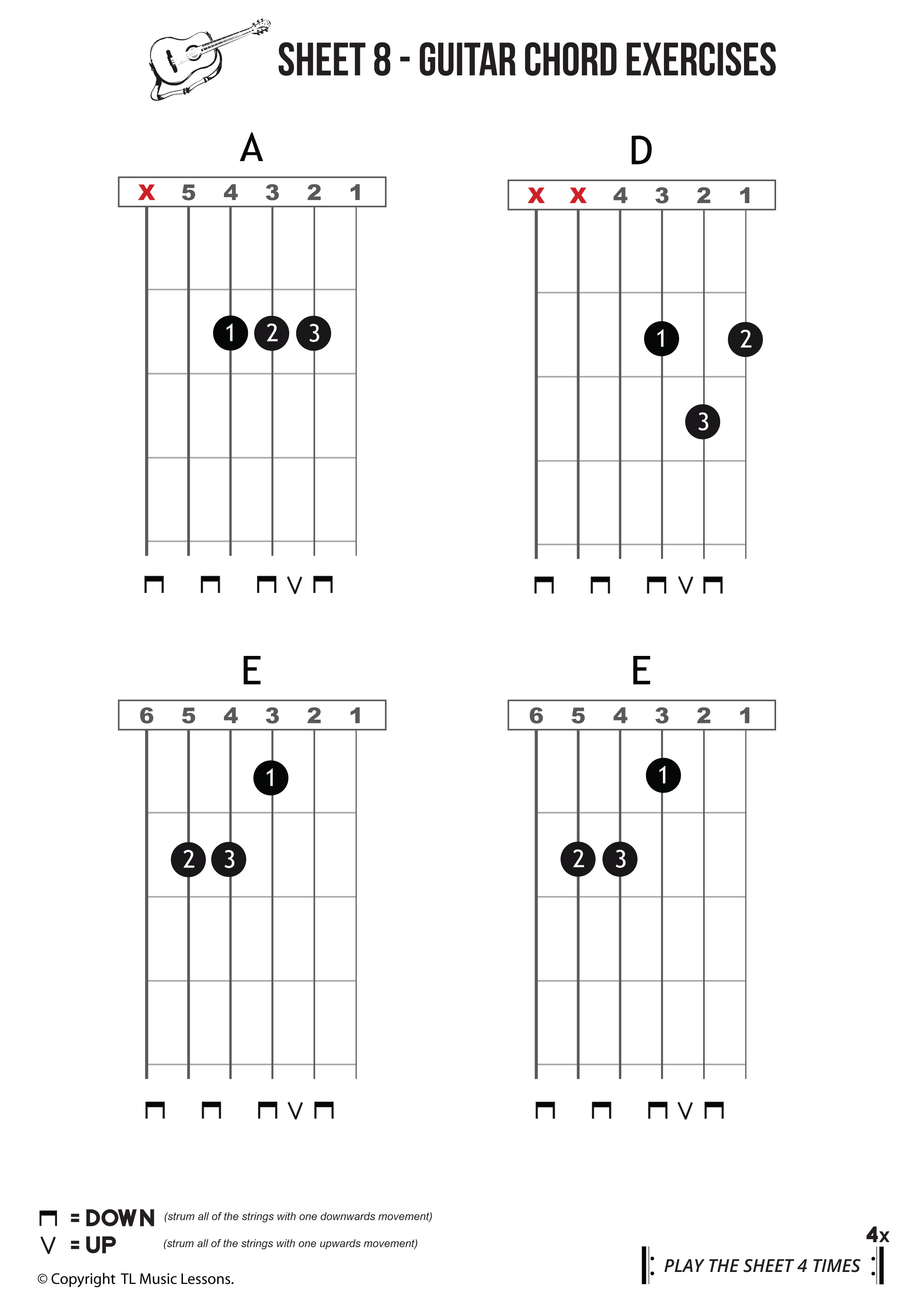
On this sheet we are going to use the beginners guitar chords A, D and E.

We are in the key of A and the chords are using the I IV and V (A = 1st, D = 4th, E = 5th) chord positions. The 1 4 5 pattern is very popular and playing them in order like that will sound very familiar.

In the chord exercise, you will need to look underneath the chord diagram to see the strumming pattern, and then play that for the chord. So, you will start with A, strumming 5 strings only (not the top string), and strum Down, Down, Down, Up Down, with the rhythm 1, 2, 3 + 4. Then moving onto the D chord with no gap if you can, or as quickly as you can make it, play the same rhythm for D. Then another quick change to E and this time it’s all 6 strings being played. As there are two E’s in a row, you will be able to easily go from one to the next without stopping because there is no chord change. The rhythm should be continuous, like this: 1, 2, 3 + 4, 1, 2, 3 + 4. Or like this: Down, Down, Down, Up Down, Down, Down, Down, Up Down.

When you have completed the two E chords, you then need to repeat the whole sheet a further 3 times to make 4 times around in total. Again, do a quick change from E back to A with as small of a gap as you can (but don’t go faster – there should still be 1 beat between the last E strum and the first A strum.


More sheets like this

This sheet is from an ebook called: Beginners Guitar Chords – Easy Reading PDF Ebook (Premium).

16 Beginners Guitar Chords

Get Free PDF Download →

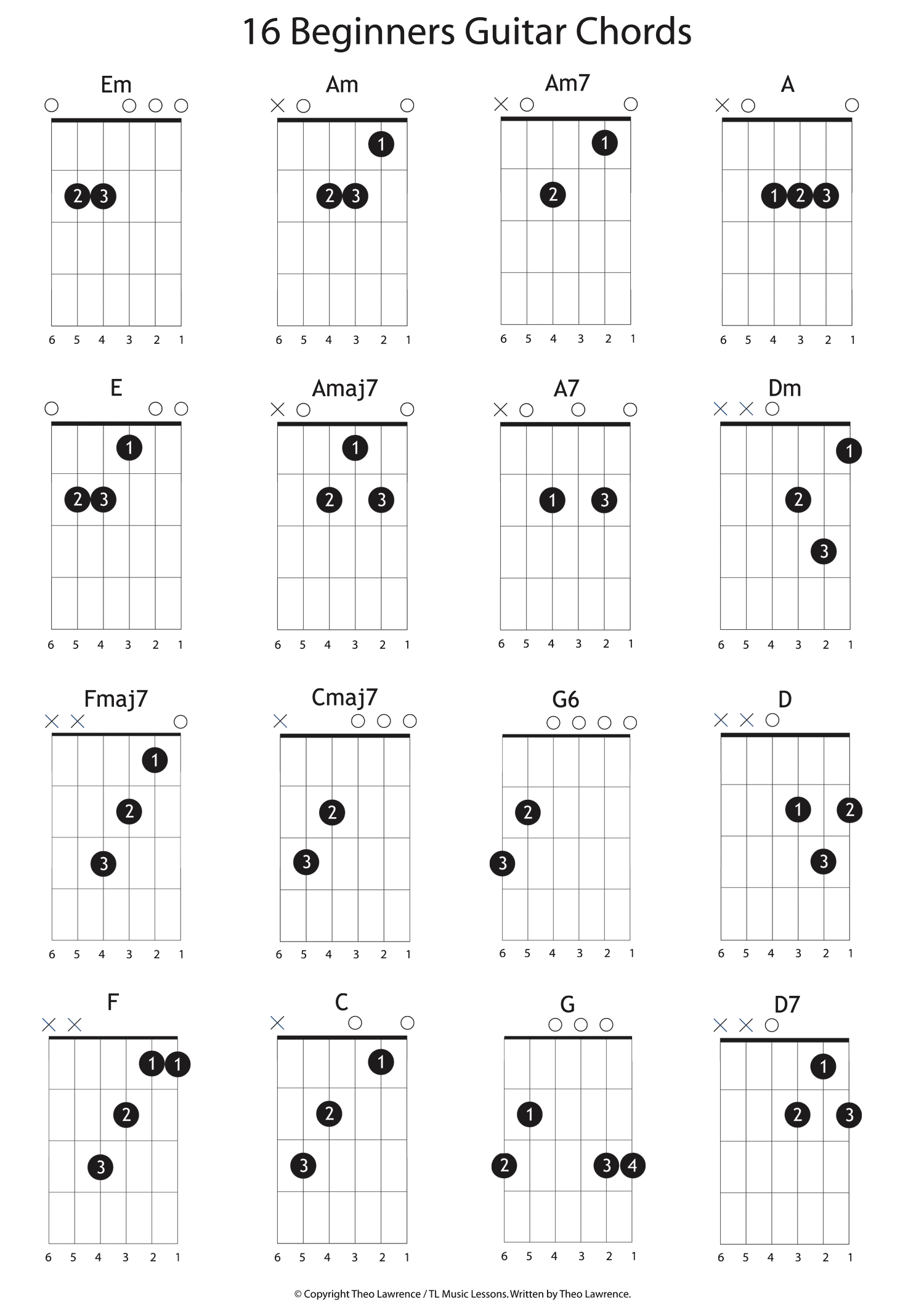
Here is a sheet of beginners open chords. It has been made using Adobe Illustrator.

Here’s a quick ‘how to’ for reading the sheet.

  • The vertical lines are the strings and they have string numbers underneath (there are 6 strings in total)
  • String 1 refers to the thinnest string and string 6 refers to the thickest. At first, it feels like it should be the other way around but make sure to learn and teach it this way because everywhere refers to them this way.
  • The horizontal lines are the frets. The ‘boxes’ or ‘rows’ that this creates are what we call frets. This can be confusing because those metal bars on the fretboards are the frets, but when we say ‘play fret 3, that means to put your finger in between the 2nd and 3rd raised metal fret.
  • The frets have been numbered 1 to 4 on the left hand side of each chord box. So, for the Em chord, you will be putting both fingers on Fret 2. One finger on string 4, fret 2, and another on string 5, fret 2.
  • The finger numbers are inside the blacked out circles and are for a guide. You may used different fingers as preferred.
  • The X above a string means to not strum that string.
  • The O above a string means that you will be playing this string too even though there are no fingers pressed down on it. It’s easier though just to look for the X’s and follow those, and just ignore the O’s.
  • The thick line at the top of the chord box is the ‘Nut’. This is usually a white plastic bit at the end of the neck where the guitar adjoins the head, which holds each string on their way through up to the tuning pegs.
  • Strum all required strings with one swift movement to perform a chord, making sure to play the correct amount of string (look out for the X’s). For example, Em is all 6 stings, and D is only the first 4 strings.
  • Each chord has a name, which is above the chord. anything with an ‘m’ after it is a minor chord, so Em is spoken as “E minor”. Chords with just a letter are major chords, so A is spoken as “A major”, or sometimes it is just spoken as “A”. Chords with a number after are just spoken as “A 7″ or G 6”.


Related:

100 beginners chord progressions for Guitar (Premium)

100 beginners chord progressions for Ukulele (Premium)

(Premium) – 50 Guitar Chord Exercises ebook – Beginners & Grade 1-2

Buy Now →


Playlist with video lessons for this Guitar book

Contents (29 pages)

  • Page 4 – Brief help with reading notation regarding the strumming hand
  • Page 5 – Exercises 1-20 – Chord Exercises in 4/4
  • Page 15 – Exercises 21-25 – 3/4 Time Signature
  • Page 17 – Exercises 26-31 – 6/8 Time Signature
  • Page 20 – Exercises 32-40 – Picking exercises in Various Time Signatures
  • Page 25 – Exercises 41-45 – Finger Picking Only Exercises (no guitar pick)
  • Page 27 – Exercises 46-50 – Finger Picking and Chords

Introduction

People that might find this book useful

  • Guitar teachers can print the book for their students.
  • Beginner guitar players can work through the book with the help of a teacher
  • Some guitar players may be able to work through the book on their own (reading knowledge needed)

About the book

This book was written following my first two books (released as a set) called 100 Beginners Chord Progressions For Guitar + Struming Rhythms. This guitar version was written after the ukulele version and transferred over very well and therefore they are both compatible and suitable for groups or ensembles of guitar and ukulele.

I started out writing this book in order to solve two problems I found in the first book of chord progressions – which were mainly problems for early beginners. The first problem was that by the time we got through all 4 chords, sometimes it had taken a while to change between chords and we lost the flow of the exercise. The second problem was that the new beginners were not familiar with the chords yet, so we had 2 books and a chord sheet to look at. The third problem was that for young beginners, some struggled to remember the rhythms and therefore got lost flicking between the books, rather than remembering the rhythm and then just looking at the chord progression book.

So, this book aims to solve all of the problems in the above paragraph for basic beginners level, by having the chord diagram and rhythm and tab all in one place and also only focuses on 2 chords at a time so the player can really master those chord changes. I tend to teach this book first and then move onto the 100 chord progressions books, which then get progressed through faster.

The book includes a lot of new content not seen in the first two books, like finger picking exercises and different time signatures. Therefore those who have started with the first books, could also go through this book afterwards and still feel like they are progressing.

Final Thoughts

In conclusion, I think this book is best to start with out of the 2 releases so far. The overall aim is to improve those chord changes and build up your rhythm and finger picking skills, preparing you to be able to play songs, to help you progress in general, and it to give you some new concepts for constructing your own music.

I hope you find the book useful.

Theo Lawrence
www.tlmusiclessons.com

Buy Now →

View Ukulele Version →

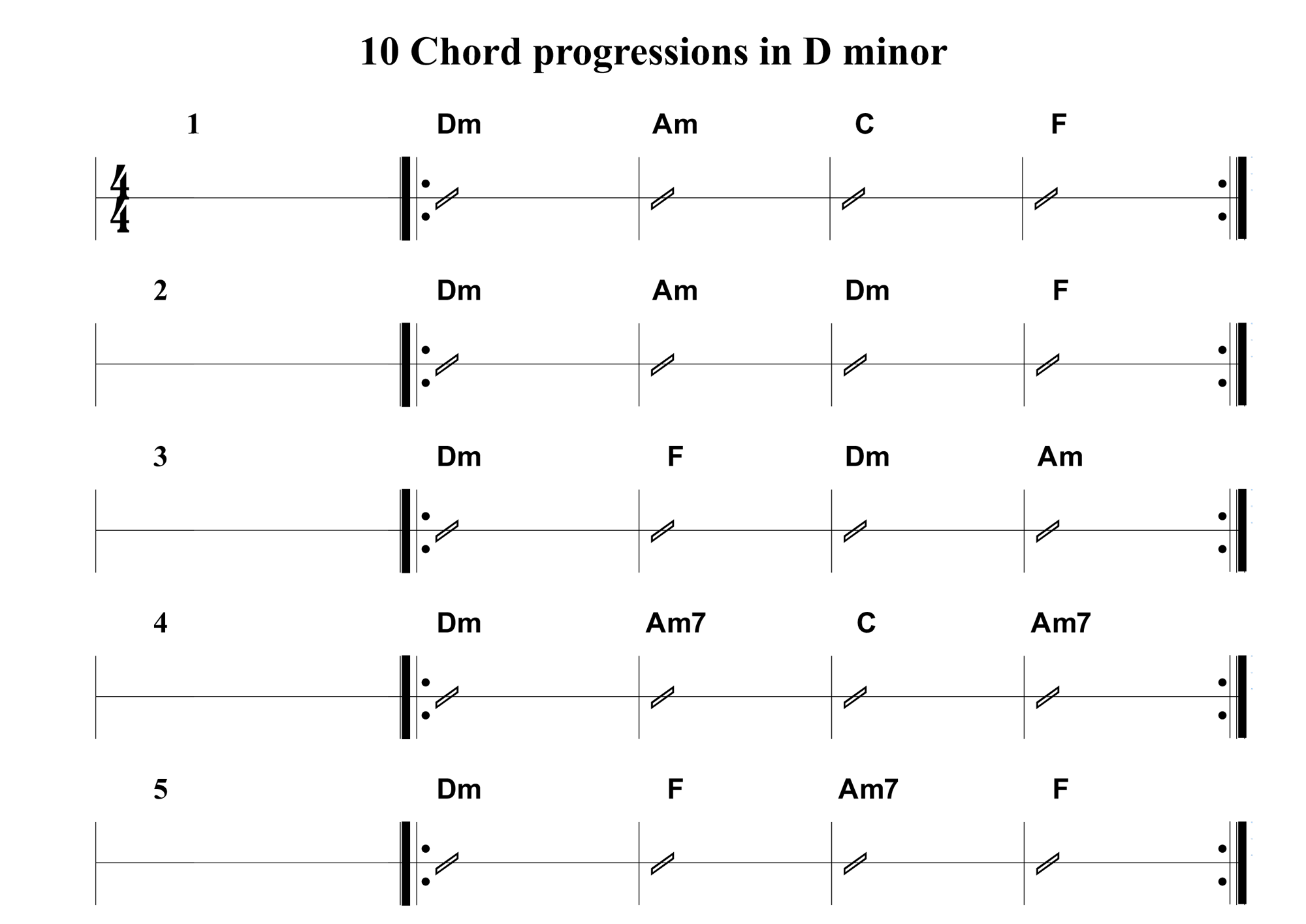
10 chord progressions in the key of D minor for guitar and ukulele

These 10 chord progressions in D minor are from my premium ebooks, 100 chord progressions for guitar and 100 chord progressions for ukulele ebooks.

The first sheet is for guitar, and the second for ukulele. They can be played together. Some of the chords are slightly different so that they are easier to play on each instrument – most of the chords are exactly the same on each sheet.


Guitar

The Sheet:

The Chords Reference Sheet:

Ukulele

The Sheet:

The Chords Reference Sheet:


Related (Premium): 100 chord progressions for guitar
Related (Premium): 100 chord progressions for ukulele

(Premium) – Guitar Ebooks: 100 Beginners Chord Progressions + 100 Strumming Rhythms

Buy Now →


These ebooks have been created after 6 years of teaching guitar. They follow on nicely from the ebook ’50 Acoustic Guitar Exercises’.

I have used my knowledge of how students learn chords, where they struggle the most, and what is needed to develop with rhythm playing and chord playing. The combination of these sort of chord progressions along with different strumming patterns is one that I have tried and tested, and have now compiled into a range of printable ebooks that can be used side by side to help many beginner guitarists improve their chord changing and rhythm playing.

There are 10 chord progressions on each sheet, covering 9 different key signatures in total.

People that might find these books useful

  • Guitar teachers can print the book for their students.
  • Beginner guitar players can work through the book with the help of a teacher
  • Some guitar players may be able to work through the book on their own
  • The 100 strumming rhythms will be useable for all grades of guitar. The strumming rhythms get quite hard towards the end and can be challenging up to grade 3 or 4 at higher speeds.

Contents for 100 Beginners Chord Progressions

Page 2 – Contents
Page 3-5 – Introduction
Page 6 – 10 Chord Progressions in A major
Page 7 – 10 Chord Progressions in A using A7, D7 and E7 chords
Page 8 – 10 Chord Progressions in A minor
Page 9 – 10 Chord Progressions in C major
Page 10 – 10 Chord Progressions in D major
Page 11 – 10 Chord Progressions in D minor – [View Sheet]
Page 12 – 10 Chord Progressions in E major
Page 13 – 10 Chord Progressions in E minor
Page 14 – 10 Chord Progressions in F major
Page 15 – 10 Chord Progressions in G major
Additional Sheet – Beginners Chord Chart


Also Available for Ukulele

View the Ukulele version →

Beginners guitar chord progression in Em with strumming rhythms

This chord progression exercise uses the beginners chords Em, G6, C, Am7.

The rhythms used are quarter notes and 8th notes, and has up and down strumming symbols on the guitar sheet music notation.

10 Beginners Chord Progressions for Guitar or Ukulele

These chord progressions will help you practice changing chords, and prepare for playing actual songs. They will also give you ideas for creating your own chord progressions – all you need to do is change the order of some of the chords to make your own.

If you need to know how to play the chords, check out the Chords page for diagrams.

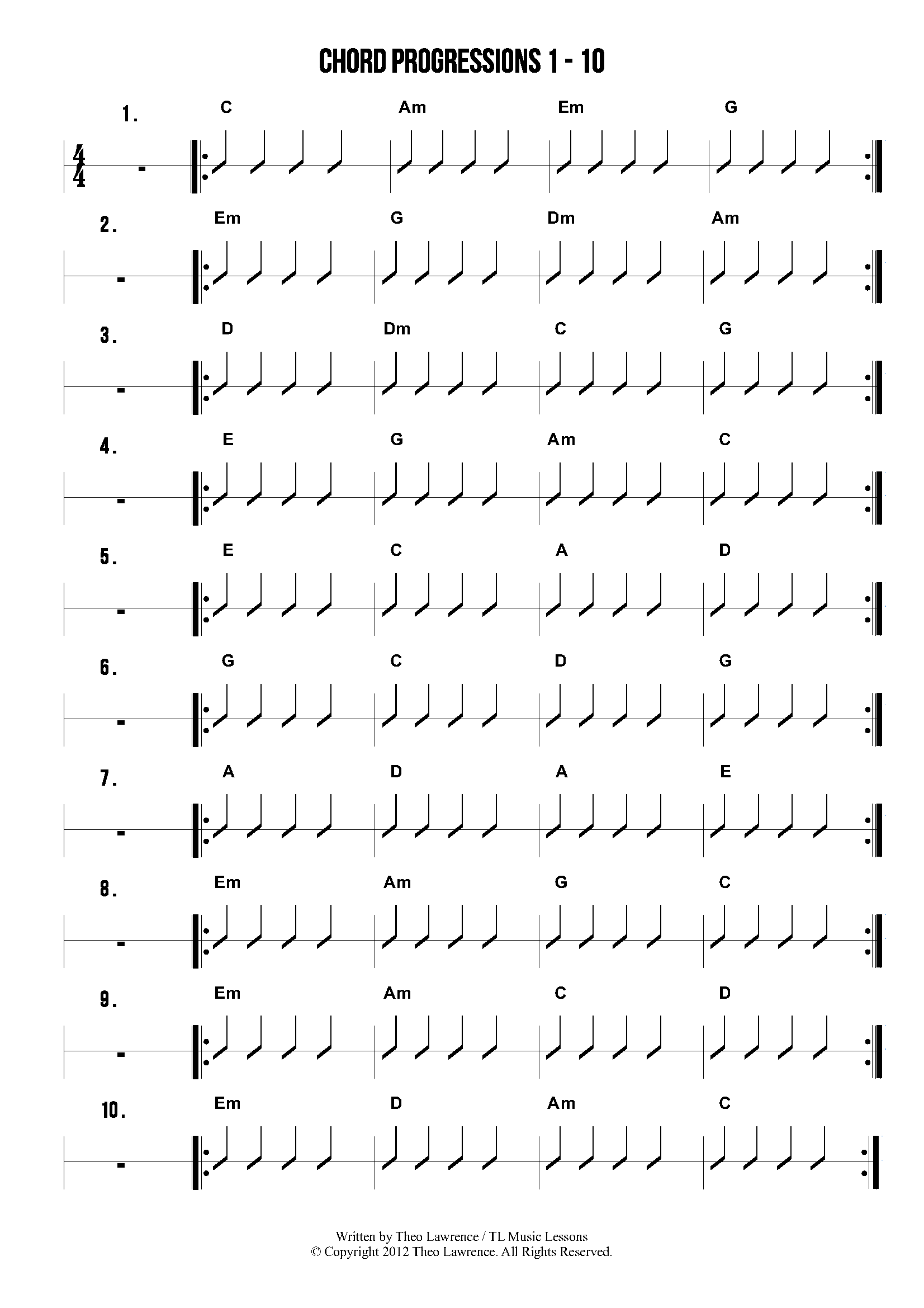
Here are the 10 chord progressions included on the sheet:

  1. C, Am, Em, G
  2. Em, G, Dm, Am
  3. D, Dm, C, G
  4. E, G, Am, C
  5. E, C, A, D
  6. G, C, D, G
  7. A, D, A, E
  8. Em, Am, G, C
  9. Em, Am, C, D
  10. Em, D, Am, C

On the notation, it appears that you should play each chord 4 times. These should all be down strums. However, when this has been mastered, it is a good idea to try out different strumming patterns for these chord progressions.

Grade 3 level guitarists could use these chord progressions to practice their barre chords.


Related: 100 beginners chord progressions & 100 strumming patterns for Guitar (Premium)

Related: 100 beginners chord progressions & 100 strumming patterns for Ukulele (Premium)

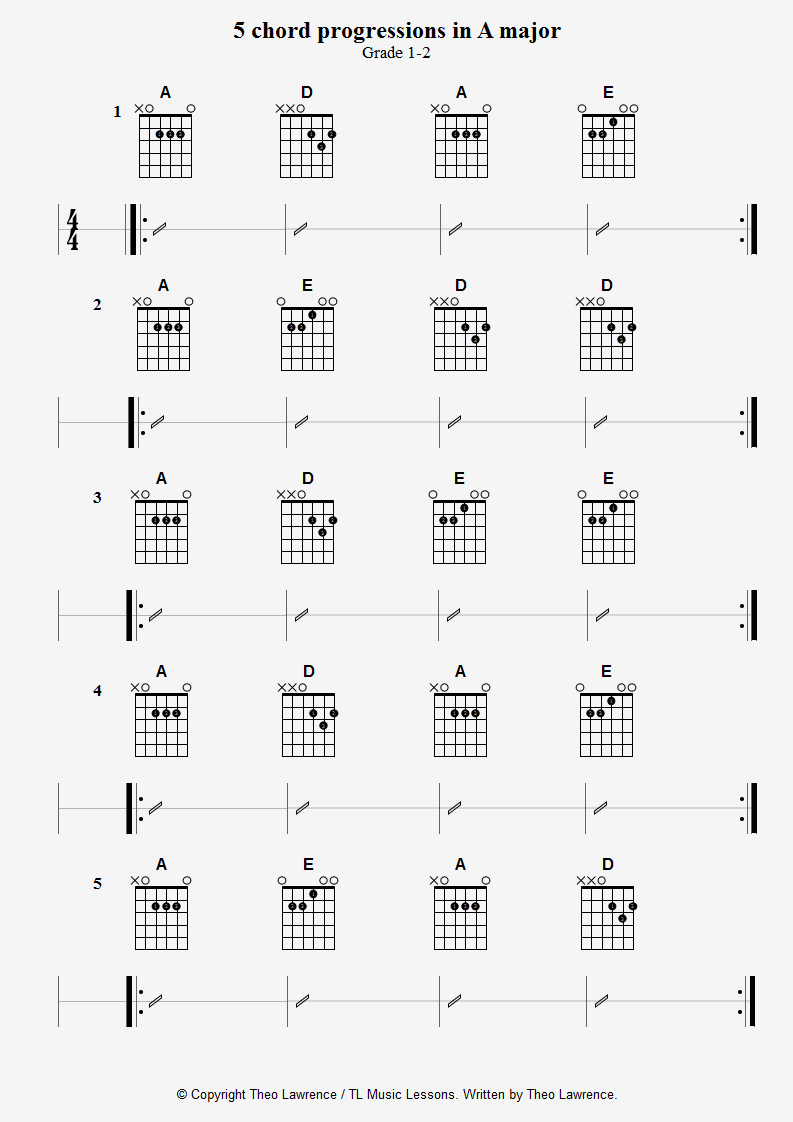
5 Ukulele and Guitar chord progressions in A major using A, D and E chords – Grade 1-2

Above, is the sheet for guitar.

Using 3 open major chords we have 5 chord progressions to practice. You could strum each one once, or maybe 4 times each, or make up your own rhythms.

You should look for any ‘cheats’ for changing the chords quickly. Rather than taking the fingers off completely for each chord change, look to see where the fingers need to navigate from and to for each chord. For example, from E to A on the guitar, the 1st finger needs to move up 1 string and 1 fret, so this is a simple diagonal movement.

If you found these free chord progressions useful for learning or teaching with, please check out my guitar ebooks with 100 chord progressions in each:

100 beginners chord progressions for Guitar


Ukulele

For the Ukulele, the hardest chord here is E. There are several workarounds for the “Horrific E major Ukulele chord”, but this is the one you should try and play first. It will take a while, and small fingers may not cope with this. I have included a sheet below for Ukulele beginners, which replaces the E chord with an E7 chord. E and E7 sound fine together, so you could play these chord progressions in a group with both ukulele and guitar players and they would still sound right.

If you found these free chord progressions useful for learning or teaching with, please check out my ukulele ebooks with 100 chord progressions in each:

100 beginners chord progressions for Ukulele

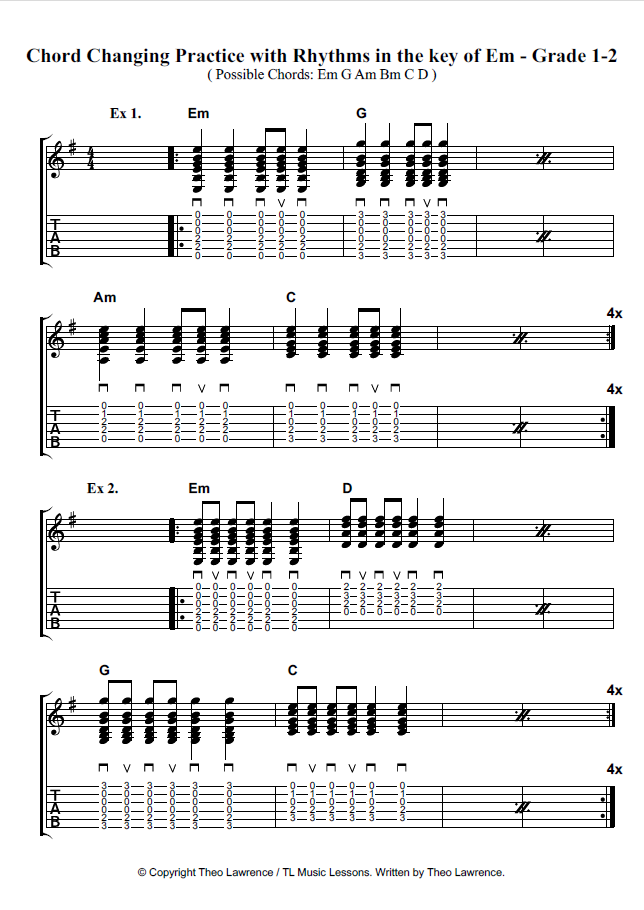
Chord Changing Practice With Rhythms In The Key Of Em – Grade 1-2

Exercise 1

This exercises adds quarter note and 8th note rhythms to an Em, G, Em, G, Am, C, Am, C chord progression, which is to be played 4 times around.

Look out for the down and up strokes in the notation to tell you which direction to strum. If you are unsure what this is or how to do it, go check out this useful article on How Strumming Is Notated In Music – By Bryan Mulford.

Also, look out for the bar that has the two bar repeat symbol. This means to repeat the previous 2 bars.


Exercise 2

Using a chord progression of Em, D, Em, D, G, C, G, C, we will apply a rhythm of 1 + 2 + 3 4. This sounds a bit like ‘quick quick quick quick slow slow’.

The strumming pattern is down, up, down, up, down, down.

Arpeggiated Chord Progressions using G6 Em7 A7sus2 Cmaj7 Dsus2

Here are some exercises to work on your picking technique, and for learning how to arpeggiate chords.

feel free to repeat the chord progressions for as long as you like, or just play through once.


The Chords

Before we get started, let’s just run through all the chords that will be used.


The Chord Progressions Audio Examples

Arpeggiated Chord Progression 1: G6, Cmaj7, Dsus2, Dsus2

Bar 1: Arpeggiated G6 Chord

Play 4 down strokes starting on the big E string, then 4 up strokes starting on the little E string.

Bar 2: Arpeggiated Cmaj7 Chord

Play 4 down strokes starting on the A string, then 4 up strokes starting on the little E string.

Bar 3: Arpeggiated Dsus2 Chord

Play 3 down strokes starting on the D string, then 3 up strokes starting on the little E string. The rhythm here is “1 + 2… 3 + 4….”, which is like “quick quick slow, quick quick slow”.

Bar 4: Arpeggiated Dsus2 Chord

The same as bar 3.

Arpeggiated Chord Progression 2: Em7, G6, Dsus2, A7sus2

For the following arpeggiated chord progressions, they are played in the same sort of way to the first one, so I won’t display the step by step info again for these.

Arpeggiated Chord Progression 3: A7sus2, Cmaj7, G6, Dsus2


Arpeggiated Chord Progression 4: Cmaj7, G6, Dsus2, Em7


Arpeggiated Chord Progression 5: Cmaj7, Cmaj7, G6, Dsus2


Moveable Barre Chord Shapes Grade 3 Level

Get Free PDF Download →

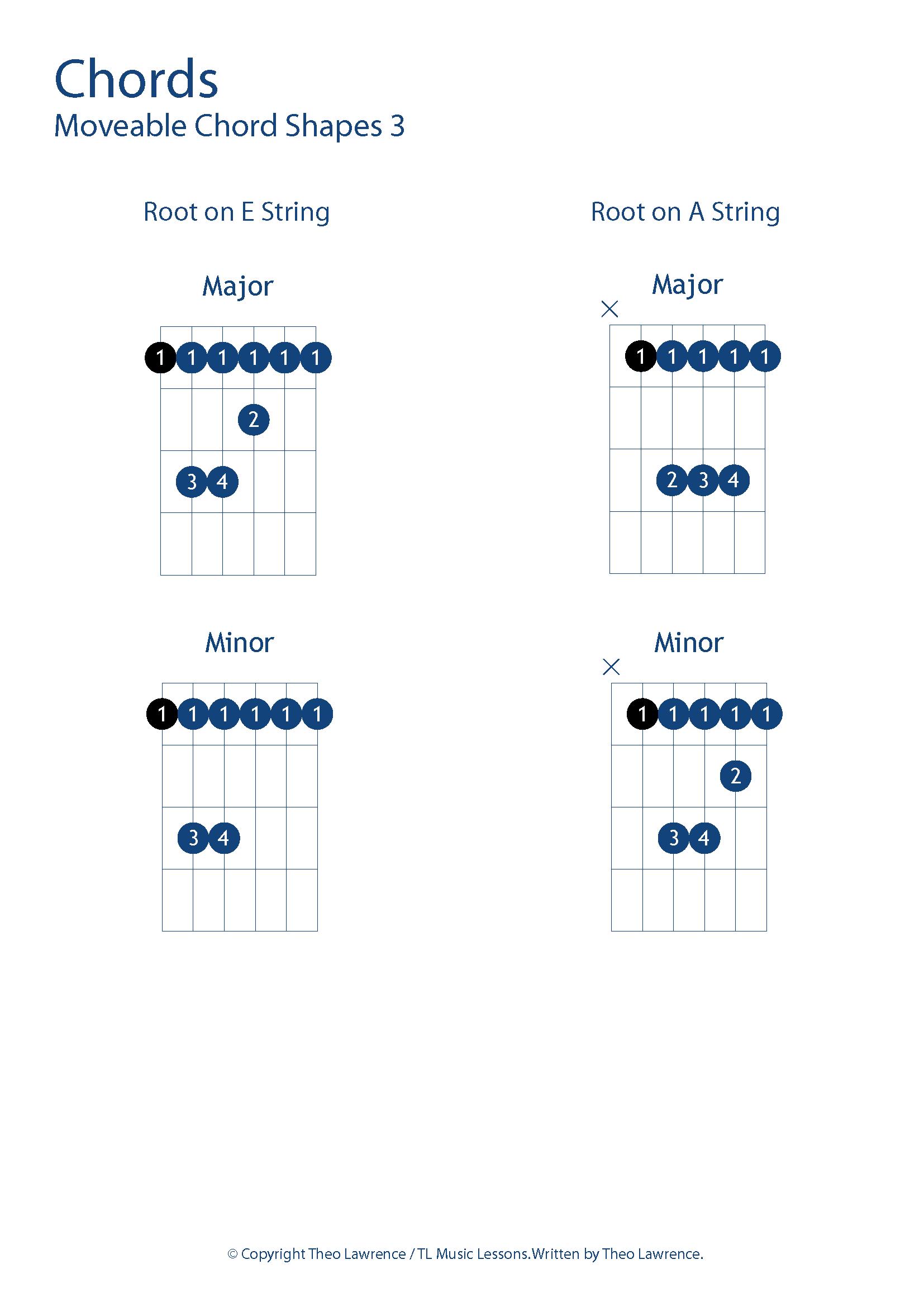
This printable PDF is a nice looking printout of the 4 main barre chord shapes you need to learn for Grade 3 guitar.

Each shape is moveable, so with these 4 shapes, you are able to play any major or minor barre chord on the guitar. For example, play the first major shape on fret 3 of the E string, and that will be G major, because the root note will be on G. The root note for each chord is shown on the sheet as black circles. So, if you want to play a C minor barre chord, use the bottom right chord on the sheet (the minor shape with the root on the A string) and match up the root note with fret 3.

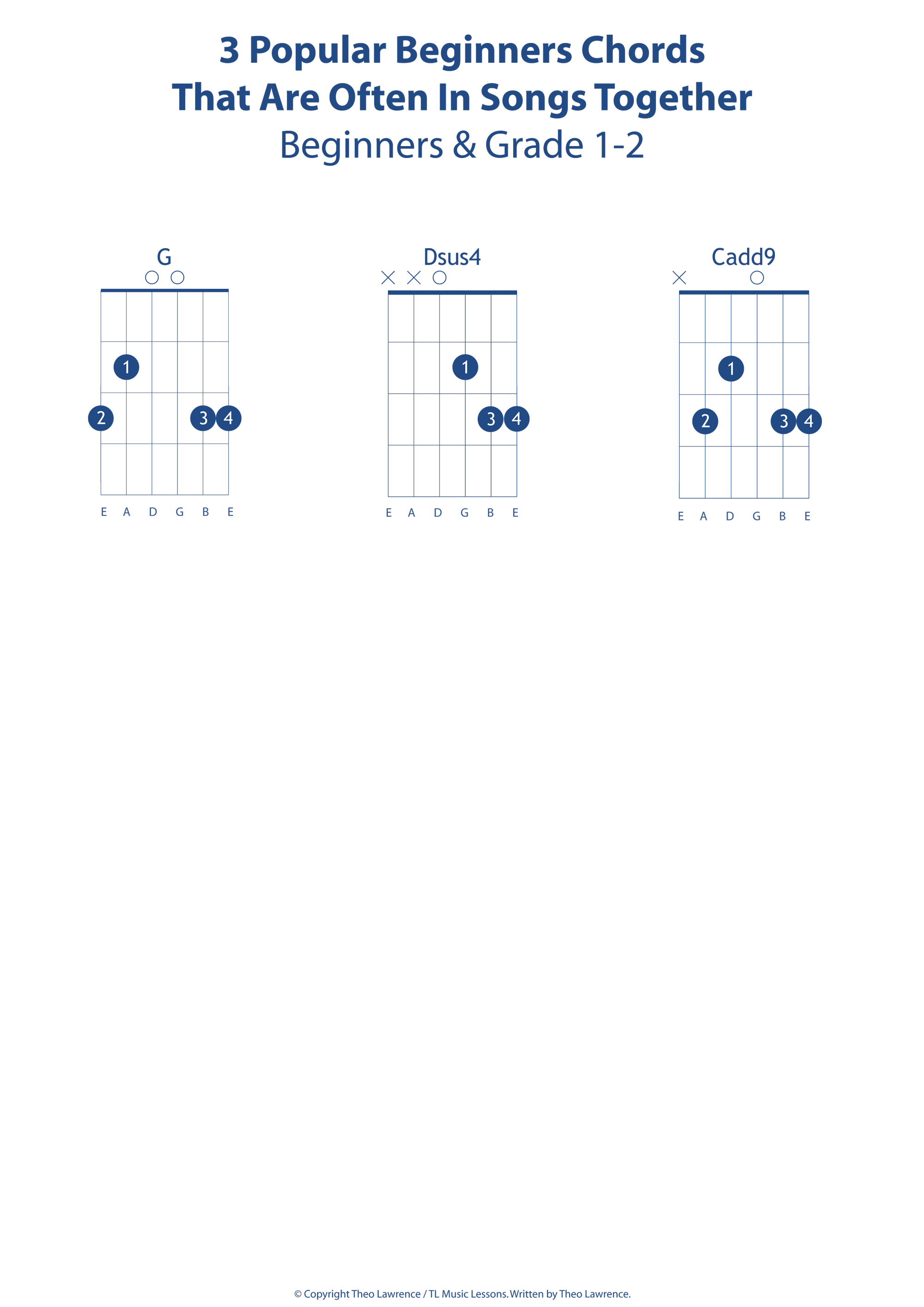
3 Popular Beginners Chords That Are Often In Songs Together – G, Dsus4, Cadd9

The chords Cadd9, Dsus4 and G, all fit together nicely in terms of changing chords easily, and have therefore become a popular choice for songwriters to use together in songs. This is obviously only a bonus though, as more importantly they also sound great together, in any order really.

Another more common chord that fits nicely with these chords is the Em Chord. In addition, the D Chord will also fit with these chords.

The G chord is still technically G, and referred to as G. When I wrote this sheet, I referred to it as ‘Custom G’ when teaching it to my students so they differenciate between this and the normal G Chord. However, since writing the sheet, I have decided to teach this chord to beginners as standard because most players find it less of a finger stretch.


Here are a few songs that use these chords:

  • We are Never Getting Back Together – Taylor Swift
  • 22 – Taylor Swift
  • Begin Again – Taylor Swift
  • Good Riddance (Time of Your Life) – Green Day
  • Sweet Home Alabama – Lynyrd Skynyrd

You will find more by googling “G Cadd9 Dsus4” (include the speech marks to target the search to include all the chords).

Check out this song, which uses the G chord with a capo:

  • A Team – Ed Sheeran

Video by JustinGuitar Songs