Computer Games Music – PDF Ebook – Ukulele, Guitar, Bass Sheet Music with TAB

GUITAR: Get The Free PDF ebook Download →
UKULELE: Get The Free PDF ebook Download →
BASS GUITAR: Get The Free PDF ebook Download →

Also available for Drums


Full Ukulele Tab sheet music for 11 computer music songs. ‘Computer Games Music’ uses the MIDI from songs written by TL Music Lessons for teaching purposes using ‘Guitar Pro’ software. The MIDI is run through various synths in Abelton Live and the songs have been made faster. Drums and Bass Guitar have also been added to the original 10 Acoustic Guitar & Ukulele Songs.

Audio

In addition to this free sheet music download, the 11 track album ‘Computer Games Music’ by TL Music Lessons is available on Spotify, Bandcamp and other stores.

About the Sheet Music

Most of the pieces have 3 difficulty levels, so therefore there are 60 pages in the guitar book and 49 pages in the ukulele book ebook to accommodate all of the versions. The fast pace of the songs pushes up the difficulty level quite high in places. A slower, acoustic version of the songs can be found here. The bass ebook has 15 pages and there is only 1 difficulty level.

These could potentially be used as performance pieces in schools, or maybe even exams as a free choice piece if you ask an exam board. Feel completely free to use the audio as a backing track by downloading it from itunes or bandcamp etc and using it to play along with.

About The Music

Last year I made an album of 10 songs to teach with, and created 6 ebooks for the instrument parts. This year, I made an album of 11 songs called ‘Computer Game Music’.

This year I exported the MIDI files from 8 of those songs, plus 3 new ones, and began adding synths to the MIDI in my music production software Abelton Live 9 to create music that I think would sound good in computer games. I found it quite easy, quick and enjoyable to do when I initially messed about with one of the songs for fun. I then decided to start the project, which only took about a month of spare time to create the new album of songs. I also added drums and bass guitar to the tracks to finish them off.

The drums were created by me in Abelton using the MIDI piano roll and a drum rack. I really enjoyed this! I then transcribed the drum loops into actual drum sheet music for people to learn to play along with the music if they wanted to.

The drum sheet music has a wide range of ability levels from complete beginner (Canon in C), right up to grade 8 with some complicated syncopation at high speeds. All of the drum loops were created specifically for these songs. I tried to make the majority of the beats playable by a real drummer. I was able to transcribe and transpose most of the beats without altering them, but there were some that would need extra hands, such as the hand claps and clave polyrhythms, so these have been left out or modified where I thought appropriate.

Music makers and music producers can feel free to use the drum loops audio and midi as they wish. You may freely use them in your own compositions. School pupils may also use the drum loops pack as they wish for school projects or coursework, if this is within the guidelines of the work.

I hope that the songs can be used by a range of abilities. I would say most or all ability levels would find challenges throughout the album, depending on which instrument you look at. They are all quite challenging in places.

I hope that the songs can be used by more advanced players. Initially the previous album of music was created for grades 1-3 (guitar and ukulele only), but now for this new one, I would say most or all ability levels would find challenges throughout the album, depending on which instrument you look at. They are all quite challenging in places.
I also hope that the songs can be used as backing tracks for performances, for example in schools, and possibly as part of marked school performances or maybe even as free choice pieces in grade exams.

I also hope that my students will enjoy listening to the album after getting to know the songs in their different style.

Whilst the songs have not been created for any particular computer game, I will try to get some of the music featured in actual games. I think they would work well with platform and retro type games.

(PREMIUM) – Guitar & Ukulele Basic Beginners Book 1

Since writing this ebook, I have developed some ‘Easy Reading’ guitar and ukulele scales and melodies ebooks, so although this page says ‘Book 1’, you might want to take a look at those easy reading books first, especially for younger players.


2 for 1: The premium download includes 1 book for guitar and 1 book for ukulele.

Buy Now →

People that might find these books useful

  • Guitar & Ukulele teachers can print the book or single sheets for their students
  • Students can teach themselves to learn the basics if they have some reading knowledge
  • Supplementary learning material for students that have guitar lessons
  • Beginner ukulele players and guitarists looking for some easy songs or exercises to get started with

Contents Highlights

17 topics of study for guitar and ukulele that is aimed at complete beginners. The book has a mixture of public domain songs, easy scales, easy melody exercises and easy chord exercises.

Teaching Notes

The books are designed so that even age 5 or 6 could play some of the pieces and exercises, so it starts off very easy with simple melodies such as Twinkle Twinkle Little Star, that almost everyone can play to some extent in their first lesson. There is however content for all ages in this book and the majority of content is designed to be played by all ages.

The book also takes a while to move onto chords. Like I said at the start of the post, I have developed some ‘Easy Reading’ books recently and at the time of updating this page for a new website launch (Jan 2019), I also have some ‘Easy Reading Chords’ ebooks in the pipeline, which have worked really well with my students. Check out the ebooks section and look for the Easy Reading Chords books – they’ll probably be available by the time you read this.

Example Page from the Guitar ebook:

Full Contents

3. Contents
4. Introduction
5. Twinkle Twinkle Little Star
6. Ice Cream
7. Canon in C – 2 sections
8. Silent Night in C – melody
9. 4 finger note / string / fret exercises
10. C major and A minor scales for beginners melodies
11. Canon in C – 3 sections
12. 2 melody exercises in C major
13. 2 melody exercises in A minor
14. Autumn Leaves
15. One Drop
16. Em and Am Chord Exercises 1-12
20. 5 Easy Chord Progressions with E, A, D, Em, Am, Dm (Free Preview)
21. Robin Reddocke – chords
22. C major scale practice with chords
23. Silent Night in C – chords + melody
24. Melody Exercises – A minor scale

About the book

The book is designed for use with teaching students with reading from as early as the first lesson if they are capable. All of the sheets are supposed to be achievable fairly quickly and easily by guitar and ukulele students of any age. Even students from the age of 5 or 6 could play some of these sheets. A teacher using this book would need to gauge the ability of the student. Often having something written down helps the student so even if they cannot read much of the music, they will be able to understand fret numbers and hopefully chord boxes too.

The best thing about these books is that the guitar and ukulele versions are compatible so if you happen to have beginner guitar and ukulele students in the same group, then you will be able to use these books to play along together. I don’t have many of these groups and they don’t always have a lesson together, but sometimes it works really well to have guitar and ukulele students playing together or learning in a group.

Final Thoughts

I hope that this book helps people get started quickly with learning guitar or ukulele and playing along to songs with others. The aim of this book is to progress quickly through it and to provide satisfaction through achieving. I hope to break down the barriers to getting started with learning guitar and ukulele with this book.

Buy Now →

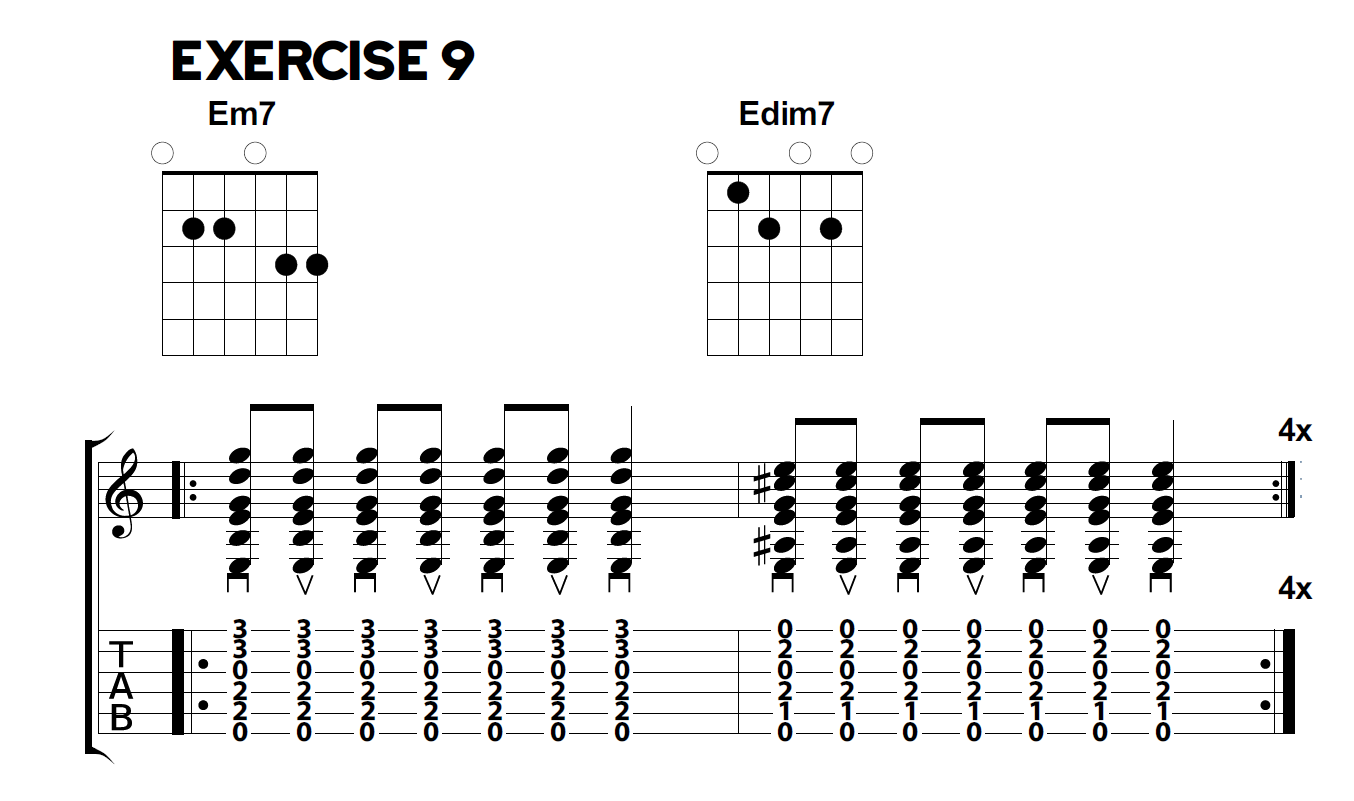
Exercises 9 and 10 from the 50 Guitar & Ukulele Chord Exercises ebooks

Two interesting exercises to try for free here for the guitar and ukulele. Both exercises are a lot harder on the guitar. In the ebook sometimes the ukulele chords are harder – it depends which chords are being used. The rhythms are exactly the same for both so guitar and ukulele players could work on these and play them together.

Exercise 9

This one has a bit of a spooky sound, changing from E minor 7 to E diminished. The ukulele chord shape can just be slid down one fret. For the guitar, a few of the fingers can slide across too – it’s not a huge chord change once you get used to it.

Exercise 10

On guitar, all you need to do is add on the little finger (pinky) for the chord changes. For ukulele, you just need to take one finger off to change to Fadd9. Just watch out for the rhythm on this one because the first note lasts for two beats. You need to count 1 2 3 4 and only strum on beats 1 3 and 4.

Guitar

Ukulele


For all 50 exercises, purchase the PDF ebooks here:

50 GUITAR Chord Exercises Ebook 
50 UKULELE Chord Exercises Ebook

Deck The Halls – Guitar, Ukulele and Bass Melody and Chords Sheet Music with TAB

Photo Credit: Brendan C

Here’s a quick and easy melody to play on Christmas day that everyone knows. In the sheet music you will find the notation and guitar tab for playing the melody on guitar, ukulele or bass guitar. There are also chords above the melody, which can be played as an accompaniment.

Guitar Melody

Ukulele Melody

Bass Melody

Christmas Is Here feat. Snejana

Back in October (2016) my guitar student Snejana asked ‘Can we write a Christmas Song?’.

We liked it so much that we ended up recording it, and here it is!

You can listen to the song here, and even download it if you like it here:

Stream / Download on Bandcamp

Stream on Spotify

Written and produced by Theo Lawrence & Snejana
Lyrics & vocals by Snejana
Cover Art edited by RogueSkins.

Merry Christmas!


Lyrics

VERSE

Cadd9 C/B Dsus4 x2
Cadd9 C/B G Dsus4 x2

Christmas is here where lots of good cheer will come around
The fire is burning the candles are lit our hearts are warm and full of joy.
The sky is dark the stars are shining brightly and Jack Frost’s outside making everything sparkle nicely

PRE CHORUS

Cadd9 G Dsus4 x6

Woah oh oh oh
Woah oh oh

Christmas is here it’s official
Don’t be alone this Christmas
Invite a couple friends over and have some fun
And that’s why it’s Christmas

CHORUS

G Cadd9 Em7 Dsus4 x8

Christmas trees fairy lights baubles everywhere
Can’t you see Christmas cheer and carols all around
Don’t you worry you’ll get a carol at your doorstep

Christmas is here don’t fear Santa’s on his way
There’s some snow on a slope and people sledding down it
Baubles are shining in some people’s faces
And that is why it’s gonna be Christmas time

BRIDGE

G Dsus4 Em7 Cadd9 x4

woah oh oh oh oh…..
Christmas time
Christmas time
It’s just Christmas time

CHORUS

G Cadd9 Em7 Dsus4 x9 (Then end on G)

Christmas trees fairy lights baubles everywhere
Can’t you see Christmas cheer and carols all around
Don’t you worry you’ll get a carol at your doorstep

Christmas is here don’t fear Santa’s on his way
There’s some snow on a slope and people sledding down it
Baubles are shining in some people’s faces
And That is why it’s Christmas time

Wouldn’t be any other time, cus it’s Christmas time


Credits

Written and produced by Theo Lawrence & Snejana
Lyrics & vocals by Snejana
Backing vocals by The Guilsfield Cupcakes
Sleigh Bells performed by students of TL Music Lessons
Cover Art edited by RogueSkins.

Silent Night in C – Melody and Chords – Guitar, Ukulele, Piano, Violin, Flute

Photo Credit: Alice Popkorn

This song is also featured in the Christmas Songs Ebook for Guitar, Ukulele and Lyrics.

Silent night is one of the best Christmas songs for beginner guitarists to play chords with, for both guitarists and ukulele players.

Silent night is a public domain Christmas song.

The sheet music contains the guitar chords and ukulele chords for the song, along with sheets for the melodies too. There are also versions for piano, flute and violin.

There are only 3 chords needed: C, F and G.


Guitar Melody

Ukulele Melody

Flute / Violin Melody

Piano Melody & Chords (Left and Right Hand)

Guitar Chords

Ukulele Chords

PDF – Easy – Silent Night Ukulele in C
PDF – Medium – Ukulele Chords with Strumming – Silent Night in C

We Wish You A Merry Christmas – Guitar & Ukulele Chords

Photo Credit: Kevin Dooley

You can download the pdfs of this song and more in this Christmas Ebook.

This song is really great for working on chord changes. You don’t always find songs easily with the basic chords in (and no barre chords), but this song has a good selection of them. No capo needed either.

The chords featured in the song are as follows: A, B7, C, D, Em, G.

The chords are basic on both guitar and ukulele and can be learned by beginners. More intermediate or advanced players can develop the rhythm rather than doing single strums.

Guitar Melody

Guitar Chords

Ukulele Melody

Ukulele Chords

We Three Kings – Guitar and Ukulele Sheet Music with Tab

This is quite a majestic Christmas song – one of my favourites in the public domain. It is great for building up chord changing skills and for learning how to play simple melodies on the guitar and ukulele.

There are only 2 sections to the song. You can keep playing Verse, Chorus, Verse, Chorus for as long as you like.

Guitar

Ukulele

Autumn Leaves – A Ukulele and Guitar song for kids

Photo Credit: Travis Simon

Autumn Leaves is a Ukulele and Guitar song for kids about the colours of Autumn Leaves and falling from the tree.

The chords are easy for beginners and the words are easy to sing along. There is a basic notated melody, but you can make up your own to suit the singers.

The song is ideal for primary schools, from about year 1-5. You can listen to the audio example of a group of year 5 girls playing the song on guitar here:

GUITAR (EASY CHORDS)

UKULELE

GUITAR

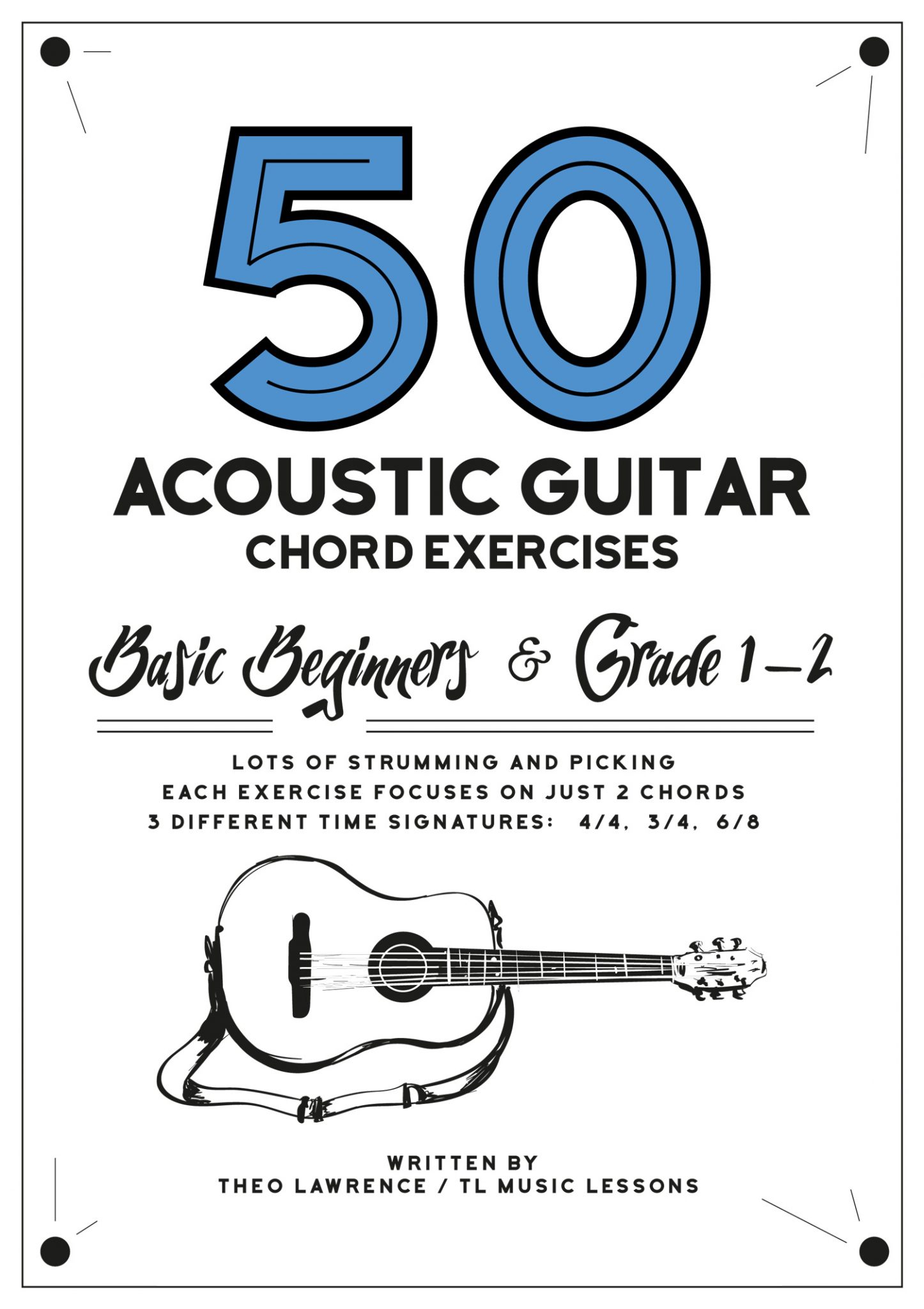
(Premium) – 50 Guitar Chord Exercises ebook – Beginners & Grade 1-2

Buy Now →


Playlist with video lessons for this Guitar book

Contents (29 pages)

  • Page 4 – Brief help with reading notation regarding the strumming hand
  • Page 5 – Exercises 1-20 – Chord Exercises in 4/4
  • Page 15 – Exercises 21-25 – 3/4 Time Signature
  • Page 17 – Exercises 26-31 – 6/8 Time Signature
  • Page 20 – Exercises 32-40 – Picking exercises in Various Time Signatures
  • Page 25 – Exercises 41-45 – Finger Picking Only Exercises (no guitar pick)
  • Page 27 – Exercises 46-50 – Finger Picking and Chords

Introduction

People that might find this book useful

  • Guitar teachers can print the book for their students.
  • Beginner guitar players can work through the book with the help of a teacher
  • Some guitar players may be able to work through the book on their own (reading knowledge needed)

About the book

This book was written following my first two books (released as a set) called 100 Beginners Chord Progressions For Guitar + Struming Rhythms. This guitar version was written after the ukulele version and transferred over very well and therefore they are both compatible and suitable for groups or ensembles of guitar and ukulele.

I started out writing this book in order to solve two problems I found in the first book of chord progressions – which were mainly problems for early beginners. The first problem was that by the time we got through all 4 chords, sometimes it had taken a while to change between chords and we lost the flow of the exercise. The second problem was that the new beginners were not familiar with the chords yet, so we had 2 books and a chord sheet to look at. The third problem was that for young beginners, some struggled to remember the rhythms and therefore got lost flicking between the books, rather than remembering the rhythm and then just looking at the chord progression book.

So, this book aims to solve all of the problems in the above paragraph for basic beginners level, by having the chord diagram and rhythm and tab all in one place and also only focuses on 2 chords at a time so the player can really master those chord changes. I tend to teach this book first and then move onto the 100 chord progressions books, which then get progressed through faster.

The book includes a lot of new content not seen in the first two books, like finger picking exercises and different time signatures. Therefore those who have started with the first books, could also go through this book afterwards and still feel like they are progressing.

Final Thoughts

In conclusion, I think this book is best to start with out of the 2 releases so far. The overall aim is to improve those chord changes and build up your rhythm and finger picking skills, preparing you to be able to play songs, to help you progress in general, and it to give you some new concepts for constructing your own music.

I hope you find the book useful.

Theo Lawrence
www.tlmusiclessons.com

Buy Now →

View Ukulele Version →

(Premium) – 10 Acoustic Guitar & Ukulele Songs – Beginners to Intermediate – Audio & PDF Sheet Music Ebooks

***These are 10 original songs written by TL Music Lessons for teaching purposes, to get students using chords and melodies in real song scenarios, which have been written specifically for beginners from grade 1 to 3.***

Buy Now / Free Preview →


What’s in the download?

  • 10 audio tracks
  • 10 more audio tracks with count in (for playing along)
  • 3 x PDF sheet music ebooks for GUITAR (Level 1-3)
  • 3 x PDF sheet music ebooks for UKULELE (Level 1-3)
  • 10 ‘Guitar Pro’ master files containing all the music notation

About the 6 Individual Sheet Music ebooks

  • Guitar 1: Beginners Guitar focusing more on chords
  • Guitar 2: Advanced Beginners focusing more on melody
  • Guitar 3: Beginners to Intermediate focusing more on lead
  • Ukulele 1: Beginners Guitar focusing more on chords
  • Ukulele 2: Advanced Beginners focusing more on melody
  • Ukulele 3: Beginners to Intermediate focusing more on lead

Who is it for?

  • Grade 1-3 levels of guitar and ukulele
  • Guitar Teachers, Ukulele Teachers can print these for their students
  • Leaders of Guitar and/or Ukulele ensembles
  • Students looking to learn on their own

Audio (included in the premium download)


Useful Copyright Info: You are free to print copies of the sheet music for educational or performance purposes and you are also free to perform the songs in public.

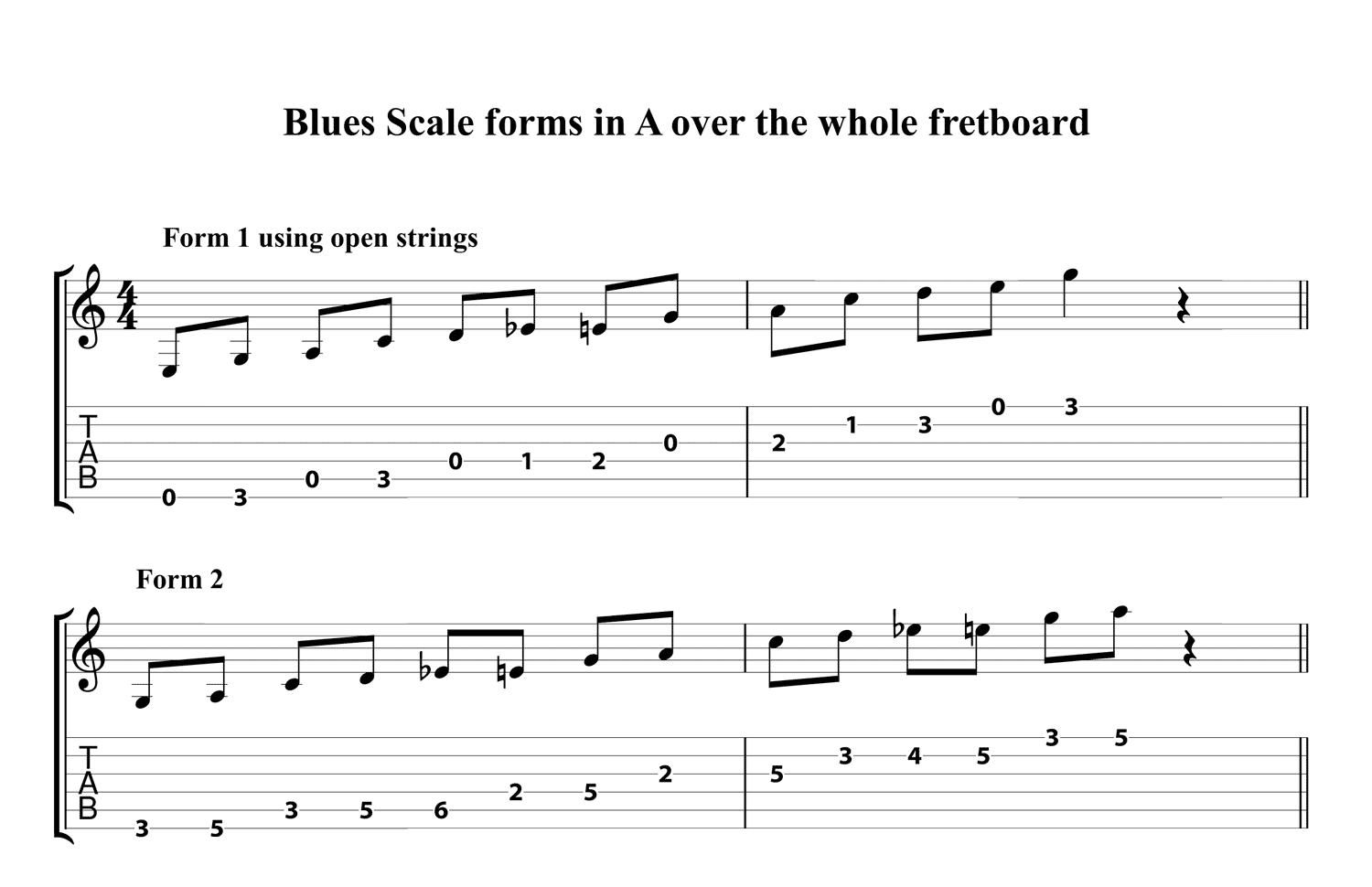
5 Blues Scale forms in A over the whole fretboard – Guitar TAB and Scale Boxes

Here is a selection of content for learning the blues scales all over the fretboard. There are tabs to follow and also scales boxes, which can help visualise and remember the shapes of the scales.

The Sheets

1. Guitar Tab for all blues scales on the fretboard.

2. Page 2 of Guitar Tab for all blues scales on the fretboard.

3. This sheet shows you the scale box shapes. It’s essentially the same information as the first 2 sheets, presented in a different way:

4. This sheet shows you recommended finger numbers:


Related: If you liked this page, you might also be interested in purchasing this: Learning Minor Pentatonic Scales Ebook.

Spanish Guitar Chord Progression Loop – Flamenco style Chord Progression – Guitar & Ukulele

Photo Credit: Sean Molin. License Link: CC BY-NC-ND 4.0


The Am, G, F, E chord progression is used in Spanish improvisation, and is the fundamental part of some flamenco songs.

In the images below, I have modified the final chord to be E7 on ukulele, and I have also shown a simple rhythm to get started with.

For the guitar chords, you may play the F as a barre chord, and you may also use F7.

It is also common to spend two bars on each chord instead of 1.

Guitar

Ukulele

10 chord progressions in G major – Grade 4

Here are 10 chord progressions in the Key of G for grade 4 guitar.

All guitar chords should be played as barre chords when using these as practice exercises for the RGT guitar grades, and rhythms/strumming patterns are to be improvised.

At grade 4 level, we need to be able to play barre chords including major and minor, and all the main 7 chords: minor 7, major 7 and dominant 7.

You should use strumming rhythms with these chord progressions when you have mastered the chord shapes. This is also a requirement of Grade 4 RGT, due to it being in the ‘Rhythm Playing’ section of the book.

All Through The Night (Ar Hyd y Nos) – Welsh Traditional Song – Guitar & Ukulele TAB – Public Domain

Photo by Felix Mittermeier from Pexels


The arrangements should be playable by grade 1-2 level students.

As I teach in Wales during my working week, some of my primary school students have been learning this tune on guitar or ukulele to play at school events to mark St. David’s day.

By some, the song is considered a traditional Welsh Christmas song. I’m not too sure on this, but it says on wikipedia here: https://en.wikipedia.org/wiki/Ar_Hyd_y_Nos

2017 update: Now includes a lyrics file.


Guitar:


Ukulele:


Lyrics:

11 tips and advice for running your own guitar or ukulele teaching business

Photo by rawpixel.com from Pexels


Whether you are thinking of starting your own music leaching business, or looking for ways to improve the management of your self employed music lessons business, these 10 tips have been written with you in mind. All of these bits of advice are related to my own business and are things that I do or have learned throughout the 6 years of teaching music in schools and doing private lessons, while being self employed and organising everything else involved outside of the actual teaching.

1. Plan your week with a digital calendar

Easily manage your schedule online and sync it to your mobile devices. Reschedule lessons on the move and set reminders to pop up at certain times if needed. The main advantage of a digital calendar is that you can schedule recurring lessons to be the same every week, and then modify each one individually if you need reschedule for one week – saving you lots of time writing in the same things into your calendar each week. I use google calendar and sync it with my phone’s calendar.

2. Get a digital to do list

A todo list that syncs to your phone, like Remember The Milk, is very useful and can help build up your reputation of someone that is reliable, because you will actually follow through with the things you say you will do. There is always something that crops up in the day that needs to be addressed at a later time. A busy music teacher can have hundreds of little tasks in a week that crop up, and adding them to a todo list will make sure they get done. Tip: On super busy times, sometimes I do ignore my to do list so I email myself absolute must do things so I can’t ignore them.

3. Organise your lesson plans and content

Structure your teaching into ability levels and topics. Make sure you are covering everything that you should be teaching to the best of your knowledge. Create lesson plans or exercise sheets, or compile ones from books or online lessons. Keep digital files and print as needed. I keep my files in google drive so I can use them on the move. Don’t hand write everything in your own time unless you are only doing it once and photocopying it for future lessons. You should end up with more content than you can carry with you at once. Therefore you might want to structure lesson material into different topics throughout the year, or use or create a series of books that the students can progress through.

4. Use books and booklets rather than individual lesson handout sheets most of the time

If creating your own lesson plans, try to compile them into a book or booklet that can be printed out and stapled or binded together, or used as an ebook. This will mean you won’t need to worry about printing off new lesson handouts every week or so. Even better, the student will be able to visualise their progress as they make their way through the book. Furthermore, you could think about selling your books online. It can be a nice way of passively bringing in an extra income while you are doing other things. I use a company called Payhip to sell my ebooks and premium downloads.

5. Offer to teach grades

Working through a grade book is a good way of learning and teaching. Make sure you only teach grades that you could do yourself. You should always be at a higher grade than what you are teaching, and ideally be several higher.

Grade 6-8 award ucas points, which are a good incentive to start learning early and have dedication to progress up through the grades before university age, where extra ucas points might prove useful.

6. Dress smart and be professional

If you take your job seriously and want your students and parents of students to take you seriously then I believe you need to make the effort to look smart whilst working. You might also be a musician and have a strong image as well, but it is best to save certain things for the stage. Being your own boss is great so you don’t have to, but people feel more comfortable if you make the effort with your appearance, especially if you work in schools as a peripatetic music teacher.

7. Make sure you work enough hours per week

Music teachers can charge much more than minimum wage, which is great unless they don’t do enough billable hours. To make this job pay a decent wage you need to make sure you are putting full time hours during term time at least. It is easy to fall for the illusion of charging a high hourly rate, and working part time hours, only to end up with a low income at the end of the year.

8. Have music related goals and activities outside of your teaching

Keep your dreams, goals, ambitions and love of music alive. You might downsize them as the years pass by, but always remember why you play your instruments and do all you can to be a musician as well as a music teacher.

9. Practice and improve

There is always something new to learn in music. Never stop learning and improving! Make sure you practice – practice what you preach to your students. I also see recording music to a click as practice, and you are also getting a physical end result from it.

10. Keep a contact list of all pupils or parents of pupils

I use mailchimp as my registration form (this was implimented to be GDPR compliant in 2018), and I transfer these to google contacts so I can stay in contact about lesson times and news etc. I group them by instrument, and also by which school they have lessons in, or if they have non-school lessons. Emails are the best method of contact I think because you can send to many all at once easily, most people use email now, it is free, and you can attach things. In fact, parents started to request invoices to be emailed, so I switched to that too. Phone calls are inconvenient to many now, texts are not as easy to send to everyone quickly, and facebook and twitter messages/updates are easily missed. However, texts are great (preferred) for late cancellations and last minute rearranging of individual lessons.

11. Invoicing Software

Jan 2019 Update: I have started using Quickbooks for my invoicing, because some off my emails sent from Gmail were going straight to spam folders, probably due to sending a pdf file to multiple BCC contacts. It’s also been quicker for me to create, send and chase up invoices. This is especially useful for teaching instrumental music lessons in schools where you invoice the parents directly, because you don’t usually see them in person.


I hope you have found some or all of these points useful and relevant to you. There are many other things I could write about in this list, and I hope to write another one in the future. Meanwhile, have a look around the internet for similar things as there are many helpful bits of advise. One website that I constantly find tips from for running a business, which I would recommend to you, is: www.entrepreneur.com

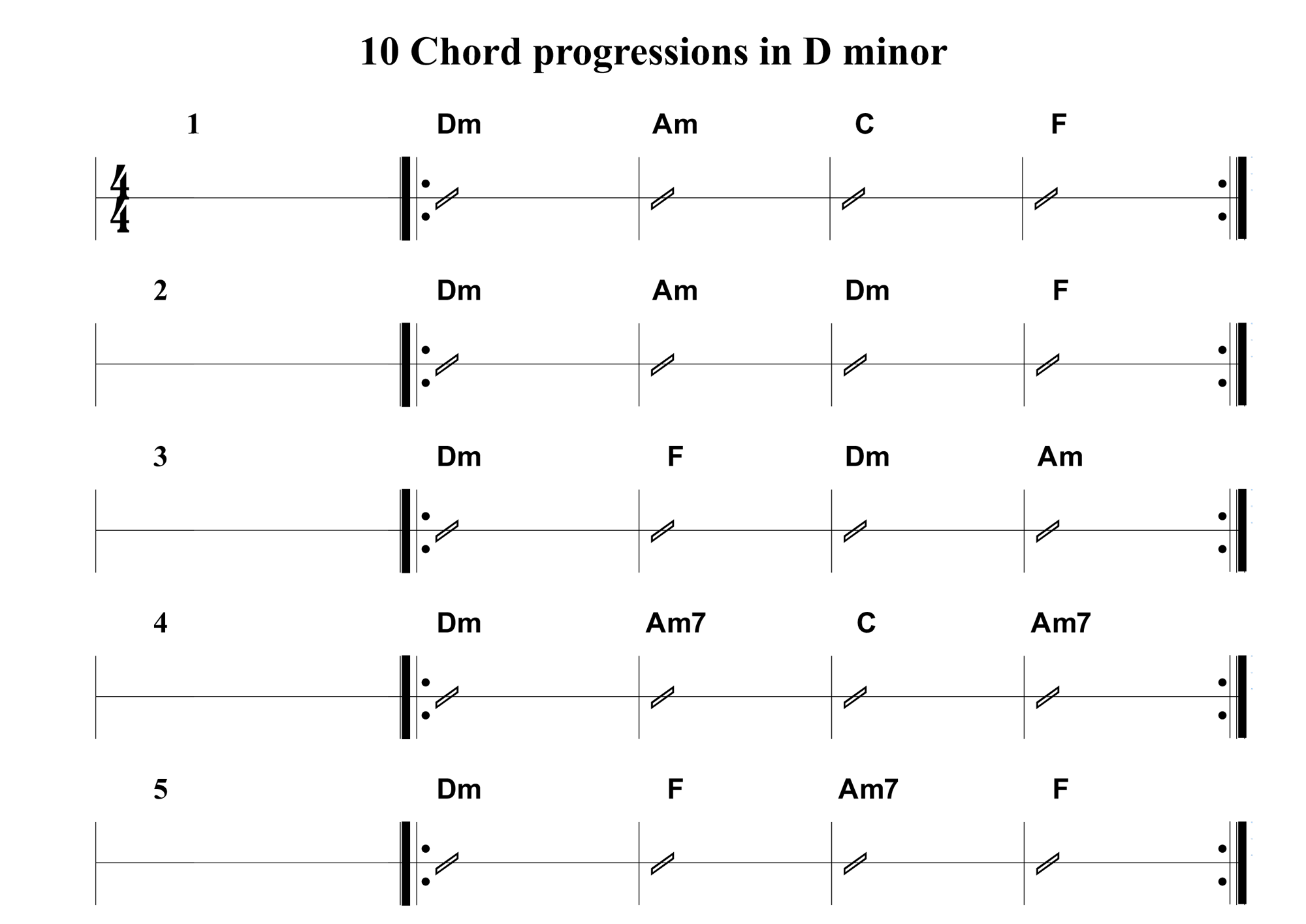
10 chord progressions in the key of D minor for guitar and ukulele

These 10 chord progressions in D minor are from my premium ebooks, 100 chord progressions for guitar and 100 chord progressions for ukulele ebooks.

The first sheet is for guitar, and the second for ukulele. They can be played together. Some of the chords are slightly different so that they are easier to play on each instrument – most of the chords are exactly the same on each sheet.


Guitar

The Sheet:

The Chords Reference Sheet:

Ukulele

The Sheet:

The Chords Reference Sheet:


Related (Premium): 100 chord progressions for guitar
Related (Premium): 100 chord progressions for ukulele

(Premium) – Guitar Ebooks: 100 Beginners Chord Progressions + 100 Strumming Rhythms

Buy Now →


These ebooks have been created after 6 years of teaching guitar. They follow on nicely from the ebook ’50 Acoustic Guitar Exercises’.

I have used my knowledge of how students learn chords, where they struggle the most, and what is needed to develop with rhythm playing and chord playing. The combination of these sort of chord progressions along with different strumming patterns is one that I have tried and tested, and have now compiled into a range of printable ebooks that can be used side by side to help many beginner guitarists improve their chord changing and rhythm playing.

There are 10 chord progressions on each sheet, covering 9 different key signatures in total.

People that might find these books useful

  • Guitar teachers can print the book for their students.
  • Beginner guitar players can work through the book with the help of a teacher
  • Some guitar players may be able to work through the book on their own
  • The 100 strumming rhythms will be useable for all grades of guitar. The strumming rhythms get quite hard towards the end and can be challenging up to grade 3 or 4 at higher speeds.

Contents for 100 Beginners Chord Progressions

Page 2 – Contents
Page 3-5 – Introduction
Page 6 – 10 Chord Progressions in A major
Page 7 – 10 Chord Progressions in A using A7, D7 and E7 chords
Page 8 – 10 Chord Progressions in A minor
Page 9 – 10 Chord Progressions in C major
Page 10 – 10 Chord Progressions in D major
Page 11 – 10 Chord Progressions in D minor – [View Sheet]
Page 12 – 10 Chord Progressions in E major
Page 13 – 10 Chord Progressions in E minor
Page 14 – 10 Chord Progressions in F major
Page 15 – 10 Chord Progressions in G major
Additional Sheet – Beginners Chord Chart


Also Available for Ukulele

View the Ukulele version →

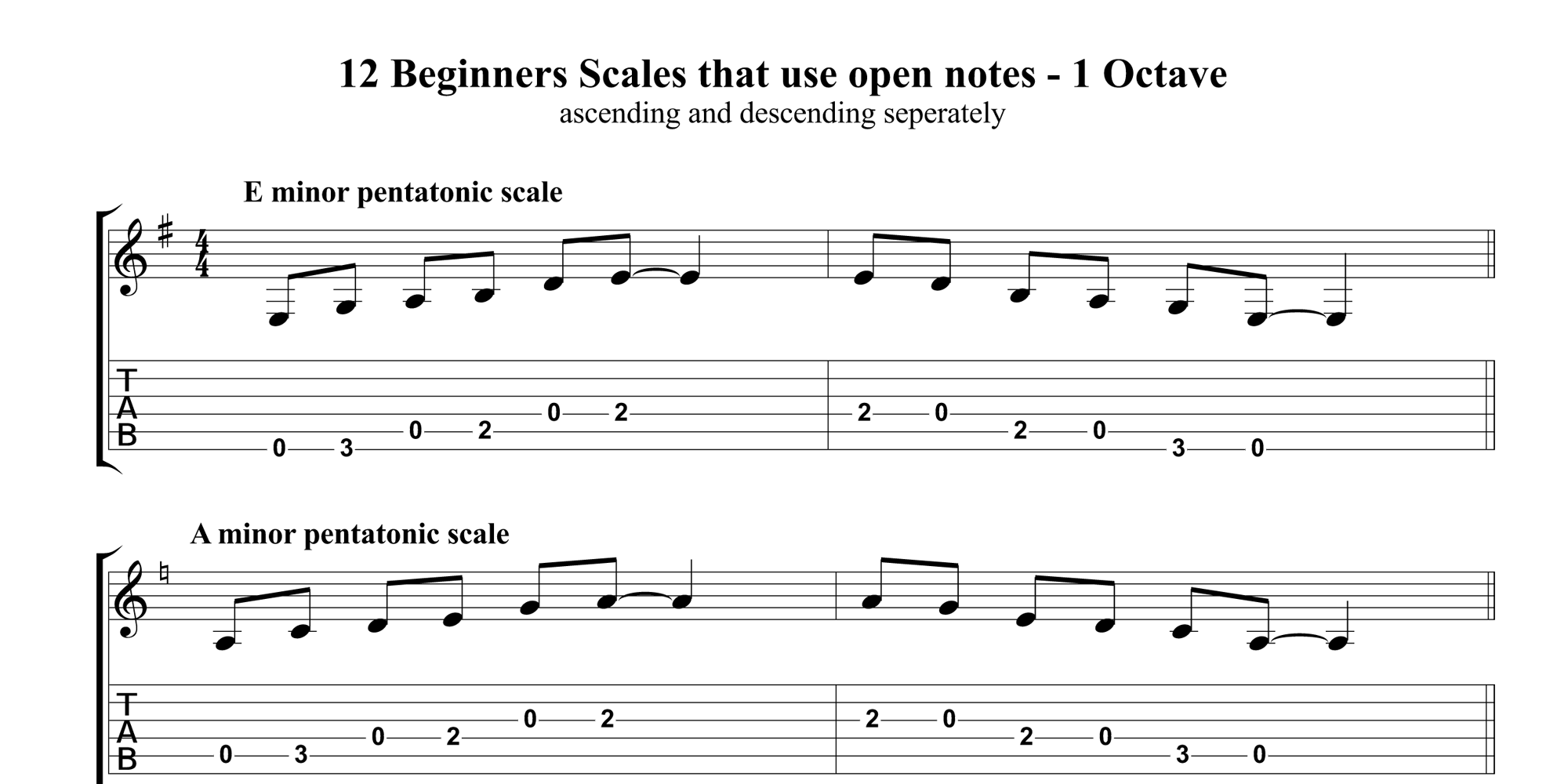
12 Beginners 1 Octave Open Scales – ascending and descending exercises

The following 1 octave open scales are to be played in ascending and descending pattern with a pause in between (the root note is held for a short time).

Here is a list of all the 1 octave open scales included in the 2 sheets:

  1. E minor pentatonic sclae
  2. A minor pentatonic scale
  3. E natural minor scale
  4. A natural minor scale
  5. E blues scale
  6. A blues scale
  7. G major pentatonic scale
  8. C major scale
  9. F major scale
  10. Bb major scale
  11. E major scale
  12. A major scale