This lesson plan is great for beginner guitarists and ukulele players. The D = Down and U = Up markings are used widely online, and are easy to follow for beginners and all. This sheet is best used by a teacher because they will instantly know how to demonstrate the rhythms. For those self taught players, if there are spaces in between like this “D D D D” then they are one beat each, but if they are joined like DUDU then they are quavers (8th notes), which are half a beat, so they are faster.
For complete beginners, try starting with chords like Em and Am on guitar, and C, Am and F on ukulele, as they can be played fairly easily and learned without reading.
Strumming Lesson With Basic Chords
D = DOWN
U = UP
Practice these chords with each rhythm: G, Em, F, E7, C, D, Dm, A, Am, G7.
Two interesting exercises to try for free here for the guitar and ukulele. Both exercises are a lot harder on the guitar. In the ebook sometimes the ukulele chords are harder – it depends which chords are being used. The rhythms are exactly the same for both so guitar and ukulele players could work on these and play them together.
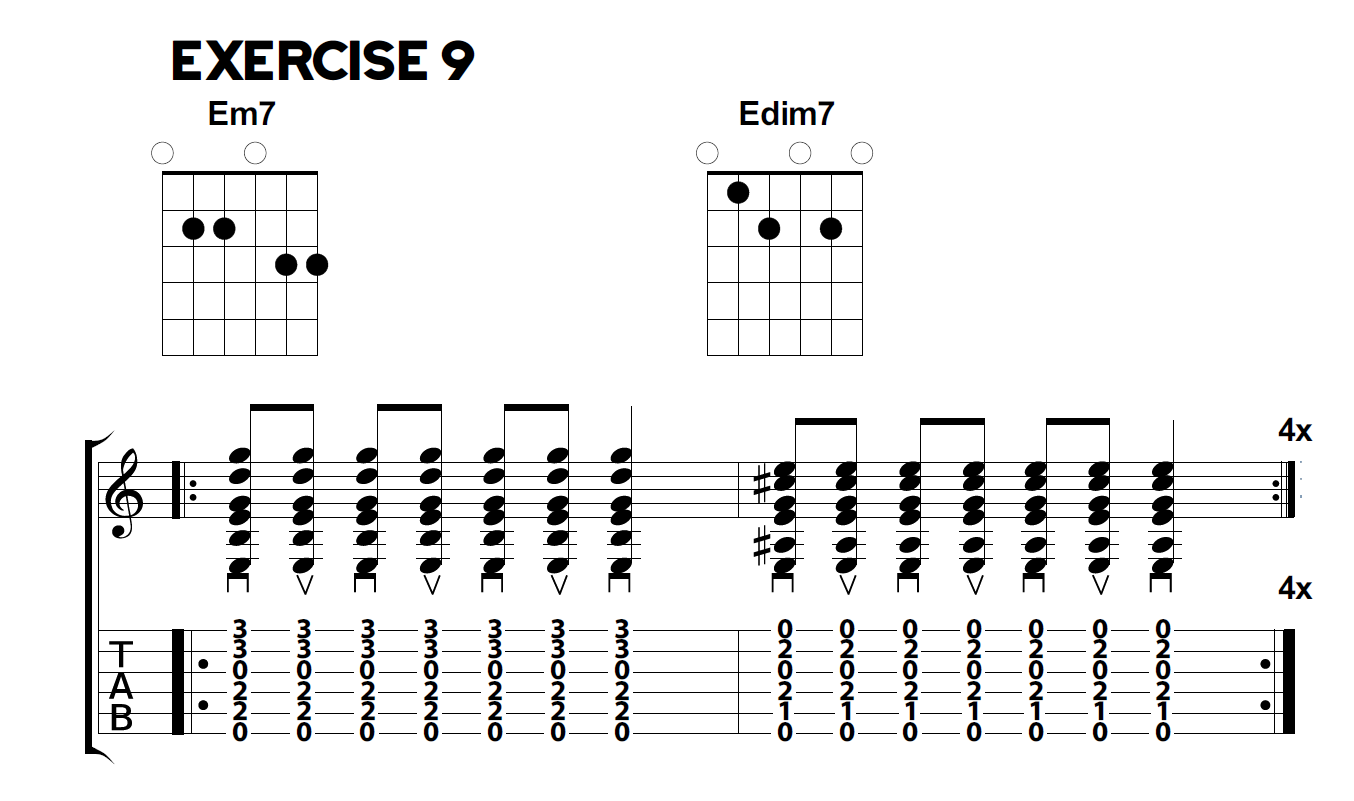
Exercise 9
This one has a bit of a spooky sound, changing from E minor 7 to E diminished. The ukulele chord shape can just be slid down one fret. For the guitar, a few of the fingers can slide across too – it’s not a huge chord change once you get used to it.
Exercise 10
On guitar, all you need to do is add on the little finger (pinky) for the chord changes. For ukulele, you just need to take one finger off to change to Fadd9. Just watch out for the rhythm on this one because the first note lasts for two beats. You need to count 1 2 3 4 and only strum on beats 1 3 and 4.
Guitar
Ukulele
For all 50 exercises, purchase the PDF ebooks here:
Either book could be started first, but I tend to start with this one, and then burn through the 100 chord progressions a lot quicker following this book.
I started out writing this book in order to solve two problems I found in the first book of chord progressions – which were mainly problems for early beginners. The first problem was that by the time we got through all 4 chords, sometimes it had taken a while to change between chords and we lost the flow of the exercise. The second problem was that the new beginners were not familiar with the chords yet, so we had 2 books and a chord sheet to look at. The third problem was that for young beginners, some struggled to remember the rhythms and therefore got lost flicking between the books, rather than remembering the rhythm and then just looking at the chord progression book.
So, this book aims to solve all of the problems in the above paragraph for basic beginners level, by having the chord diagram and rhythm and tab all in one place and also only focuses on 2 chords at a time so the player can really master those chord changes.
The book includes a lot of new content not seen in the first two books, like finger picking exercises and different time signatures. Therefore those who have started with the first books, could also go through this book afterwards and still feel like they are progressing.
Final Thoughts
In conclusion, I think this book is best to start with out of the 2 releases so far. The overall aim is to improve those chord changes and build up your rhythm and finger picking skills, preparing you to be able to play songs, to help you progress in general, and it to give you some new concepts for constructing your own music.
These ebooks have been created after 6 years of teaching guitar and 1 year of ukulele. They follow on nicely from the premium ebook ’50 Ukulele Exercises’.
I have used my knowledge of how students learn chords, where they struggle the most, and what is needed to develop with rhythm playing and chord playing. The combination of these sort of chord progressions along with different strumming patterns is one that I have tried and tested, and have now compiled into a range of printable ebooks that can be used side by side to help many beginner guitarists and ukulele players improve their chord changing and rhythm playing.
People that might find these books useful
Ukulele teachers can print the book for their students.
Beginner ukulele players can work through the book with the help of a teacher
Some ukulele players may be able to work through the book on their own
Page 2 – Contents
Page 35 – Introduction
Page 6 – 10 Chord Progressions in A major
Page 7 – 10 Chord Progressions in A using A7, D7 and E7 chords
Page 8 – 10 Chord Progressions in A minor
Page 9 – 10 Chord Progressions in C major
Page 10- 10 Chord Progressions in D major Page 11 – 10 Chord Progressions in D minor – [View Sheet]
Page 12 – 10 Chord Progressions in E major
Page 13 – 10 Chord Progressions in E minor
Page 14 – 10 Chord Progressions in F major
Page 15 – 10 Chord Progressions in G major
Additional Sheet Beginners
Ukulele Chord Chart (21 chords)
Contains information related to marketing campaigns of the user. These are shared with Google AdWords / Google Ads when the Google Ads and Google Analytics accounts are linked together.
90 days
__utma
ID used to identify users and sessions
2 years after last activity
__utmt
Used to monitor number of Google Analytics server requests
10 minutes
__utmb
Used to distinguish new sessions and visits. This cookie is set when the GA.js javascript library is loaded and there is no existing __utmb cookie. The cookie is updated every time data is sent to the Google Analytics server.
30 minutes after last activity
__utmc
Used only with old Urchin versions of Google Analytics and not with GA.js. Was used to distinguish between new sessions and visits at the end of a session.
End of session (browser)
__utmz
Contains information about the traffic source or campaign that directed user to the website. The cookie is set when the GA.js javascript is loaded and updated when data is sent to the Google Anaytics server
6 months after last activity
__utmv
Contains custom information set by the web developer via the _setCustomVar method in Google Analytics. This cookie is updated every time new data is sent to the Google Analytics server.
2 years after last activity
__utmx
Used to determine whether a user is included in an A / B or Multivariate test.
18 months
_ga
ID used to identify users
2 years
_gali
Used by Google Analytics to determine which links on a page are being clicked
30 seconds
_ga_
ID used to identify users
2 years
_gid
ID used to identify users for 24 hours after last activity
24 hours
_gat
Used to monitor number of Google Analytics server requests when using Google Tag Manager
1 minute
Marketing cookies are used to follow visitors to websites. The intention is to show ads that are relevant and engaging to the individual user.
A video-sharing platform for users to upload, view, and share videos across various genres and topics.
Registers a unique ID on mobile devices to enable tracking based on geographical GPS location.
1 day
VISITOR_INFO1_LIVE
Tries to estimate the users' bandwidth on pages with integrated YouTube videos. Also used for marketing
179 days
PREF
This cookie stores your preferences and other information, in particular preferred language, how many search results you wish to be shown on your page, and whether or not you wish to have Google’s SafeSearch filter turned on.
10 years from set/ update
YSC
Registers a unique ID to keep statistics of what videos from YouTube the user has seen.
Session
DEVICE_INFO
Used to detect if the visitor has accepted the marketing category in the cookie banner. This cookie is necessary for GDPR-compliance of the website.
179 days
LOGIN_INFO
This cookie is used to play YouTube videos embedded on the website.