Originally posted as 10 seperate blog posts, they are now all contained here on this page. go ahead and download the free ebook, listen to the audio examples below (or from the download) and read the description of each exercise below as you go through it.
Get Free Downloads (PDF, MP3, Guitar Pro) →
The 7 chords in this ebook are heavily used in pop and alternative music and are a fundamental set of chords to learn and be comfortable playing together in various sequences and with different strumming rhythms. They are also often used in different Capo positions on the Guitar. Some of the chords are more used than others out of the 7, but I think they are all very useful to learn.
This course of 10 exercise sheets will take you from grade 1 to grade 3 quite quickly and is primarily aimed at those around the grade 2 or 3 level, especially those on the brink of being able to play along with some popular songs.
Listen to exercises 1-10
About the exercise sheets
Sheet 1


Welcome to the first in the series of Chord Changing Rhythms with G, Cadd9, Dsus4, G/F#, and Em7 chords for Guitar and Ukulele.
These 5 chords are heavily used in pop and alternative music and are a fundamental set of chords to learn and be comfortable playing together in various sequences and with different strumming rhythms. They are also often used in different Capo positions on the Guitar.
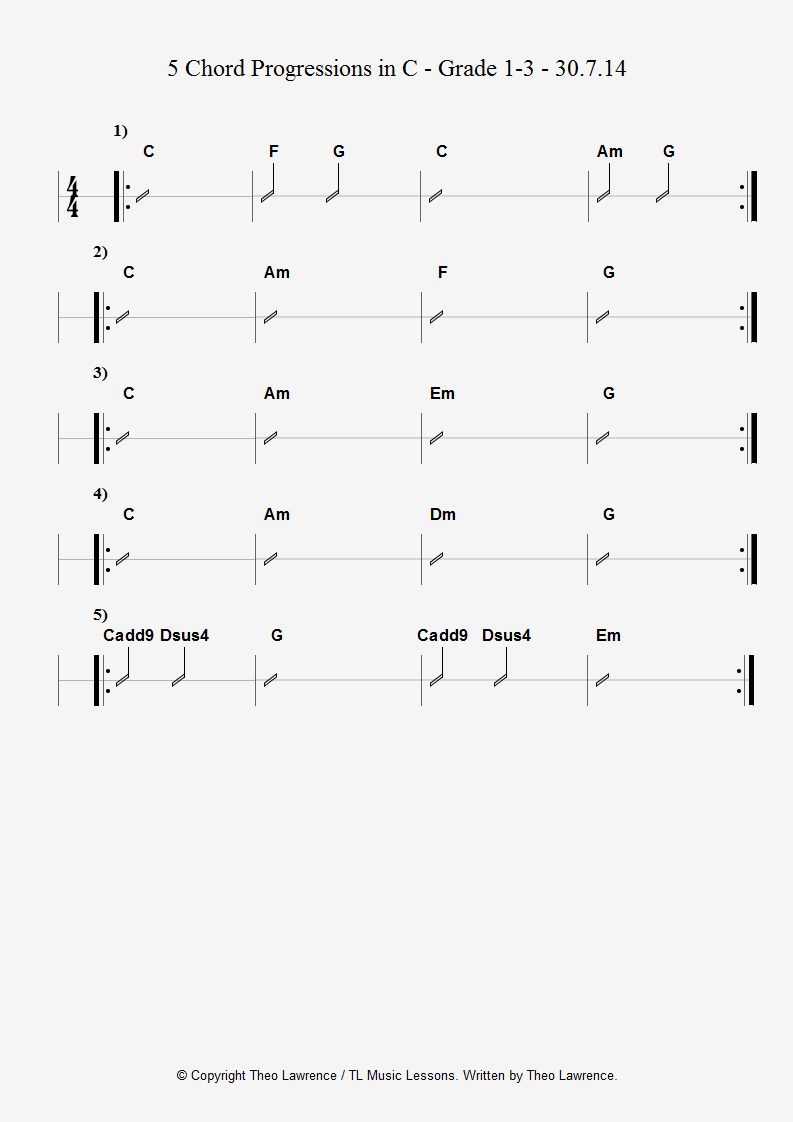
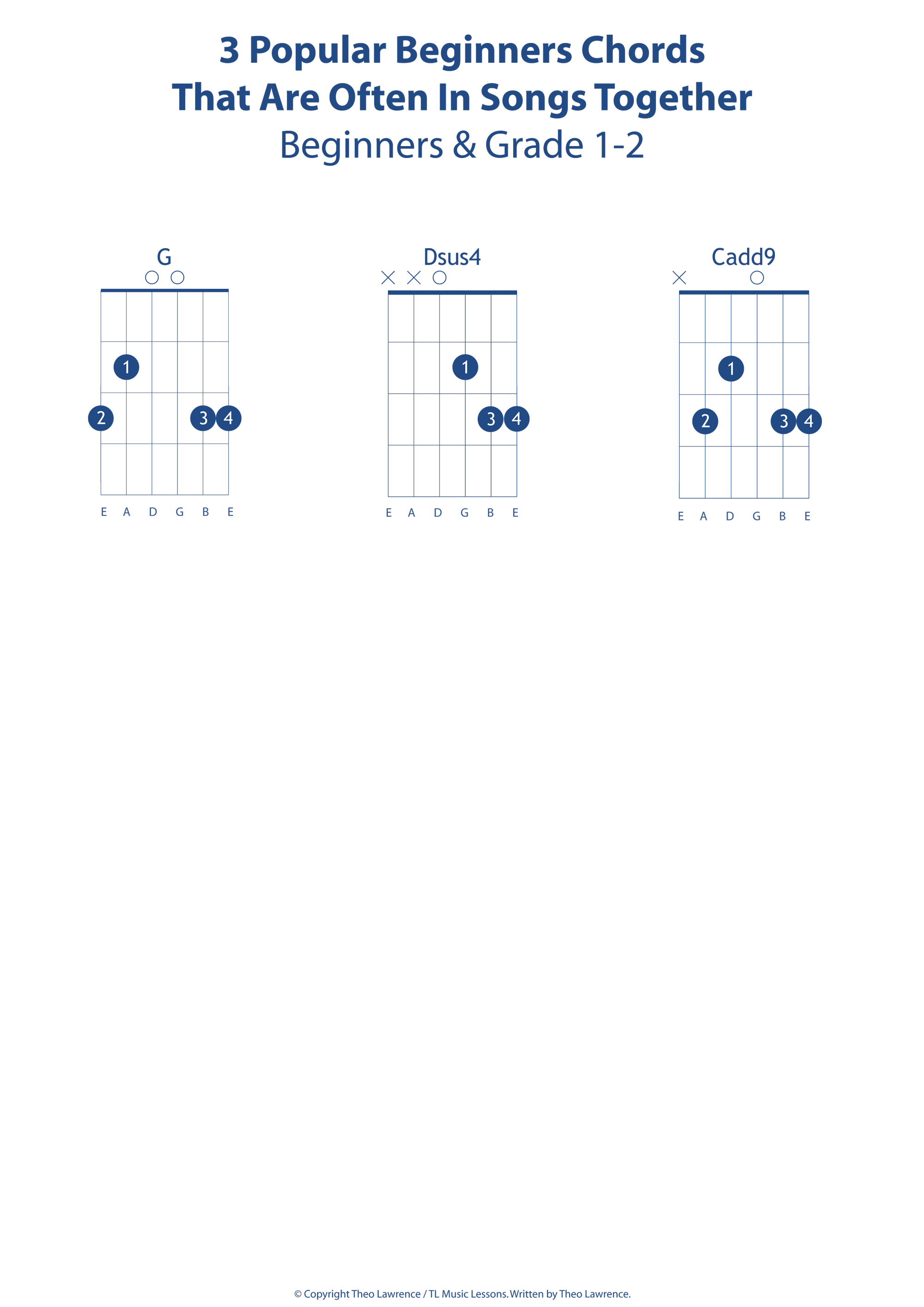
In Exercise Sheet 1, we stick to the first 3 chords, G, Cadd9, and Dsus4. Let’s master these first.
In the next exercise sheet we introduce the Em7 chord and work on some new strumming rhythms.
Sheet 2


Welcome to the second in the series of Chord Changing Rhythms with G, Cadd9, Dsus4, G/F#, and Em7 chords for Guitar and Ukulele.
These 5 chords are heavily used in pop and alternative music and are a fundamental set of chords to learn and be comfortable playing together in various sequences and with different strumming rhythms. They are also often used in different Capo positions on the Guitar.
In Exercise Sheet 2, we introduce a 4th chord, Em7 to add to the G, Cadd9, and Dsus4 chords we started with in Exercise Sheet 1.
As with the other three guitar chords, you still don’t need to move your 3rd and 4th fingers. Whilst keeping your 3rd and 4th fingers on fret 3 of the the first two strings, all you need to do with Em7 is move the 1st and 2nd fingers into an Em position and you will now have Em7.
On the Ukulele, the Em7 is the same as the G6 chord. Both chords share the same notes. You can get away with this more on the ukulele as all the strings are quite high sounding so the root notes are not as prominent as the guitar.
By the way, if you are wondering what the symbols in bar 3 and 4 and again in 5 and 6 are, they mean to ‘repeat the previous two bars’. So, basically play the first line 3 times, then the 4th line, and then repeat it all again before playing the final bar.
Sheet 3


Welcome to the third in the series of Chord Changing Rhythms with G, Cadd9, Dsus4, G/F#, and Em7 chords for Guitar and Ukulele.
These 5 chords are heavily used in pop and alternative music and are a fundamental set of chords to learn and be comfortable playing together in various sequences and with different strumming rhythms. They are also often used in different Capo positions on the Guitar.
In Exercise Sheet 3, we re use the 4 chords from the previous exercise, Em7, G, Cadd9, and Dsus4, and develop different rhythmic skills in a new time signature of 6/8.
The rhythm is the same in every bar. It is not an easy rhythm, but once mastered will be enjoyable to play.
Sheet 4


Welcome to the fourth in the series of Chord Changing Rhythms with G, Cadd9, Dsus4, G/F#, and Em7 chords for Guitar and Ukulele.
These 5 chords are heavily used in pop and alternative music and are a fundamental set of chords to learn and be comfortable playing together in various sequences and with different strumming rhythms. They are also often used in different Capo positions on the Guitar.
In Exercise Sheet 4, we re use the 4 chords from the previous exercise, Em7, G, Cadd9, and Dsus4, and introduce a new chord, G/F#.
To play this new G/F# chord on guitar, you need to remove the top two fingers, and simply put the first finger on fret 2 of the 6th string. This finger should be held lazily so that it touches the 5th string. This will make the 5th string into a dead note, which means you play the string but no note comes out – it’s more of a hitting sound because the string is muted.
To play this new G/F# chord on ukulele, it’s more of a makeshift chord to fit the guitar rather than a true G/F# chord, because the F# isn’t actually the lowest note in the chord. It is actually technically a Gmaj7 chord, which has the same notes as G/F#.
The rhythm is the same in every bar. I have gone for a hard rhythm here, but it is a popular and familiar one so you should pick it up. Beginners might want to listen to the audio to pick up the rhythm rather than trying to read this one.
The rhythm changes at the end of every 4 bars – only one thing changes. Instead of doing the tied note (the fake down strum that doesn’t connect), we will strum this down. Listen to the drums, you will hear an extra bass drum on this 4th bar, which you can try and lock in time with.
The repeats are nested, which is a bit un common. This is so it fits onto the page and avoids the need to use D.C. markings, which some may not understand. Basically, play the first 4 bars twice, then the final 4 bars, and then play through everything again including the repeat of the first 4 bars.
G/F# slash chord explanation
This is a slash chord. The deepest note in the G chord is a G. The G chord is made up of 3 notes, G, B and D.
For G/F# we are replacing that lowest G note with an even lower note of F#, which is only 1 fret lower and therefore easy to play. Therefore, adding an F# is adding a new note to the chord. The note added is the 7th note in the G major scale, which fits because we are playing in the key of G. You can’t do this with every chord.
Usually the 7th note of G major would be played as a F diminished chord, using diatonic chord theory (you usually learn about this at grade 5 level). So, just adding the F# note onto a G chord is a good way of using that 7th major note, without the need for wrecking a chord progression by throwing in a diminished chord.
You can read more about slash chords here.
Sheet 5
If you got this far, it’s probably worth going to download the pdf ebook to view the rest, so I’ll leave off the images from this post for sheets 5-10.
Get Free Downloads (PDF, MP3, Guitar Pro) →
Welcome to the fifth in the series of Chord Changing Rhythms with G, Cadd9, Dsus4, G/F#, and Em7 chords for Guitar and Ukulele.
These 5 chords are heavily used in pop and alternative music and are a fundamental set of chords to learn and be comfortable playing together in various sequences and with different strumming rhythms. They are also often used in different Capo positions on the Guitar.
In Exercise Sheet 5, we re use only 3 chords from the previous exercises,G, Cadd9, and Dsus4. The exercises are getting harder though! There is a very quick rest after beat 3 on each bar, for only a quarter of a beat (16th note), and followed by 3 quick up picks with a 16th note speed, which then leads into a quick chord change to go into the next bar. The chord choices and style of playing was inspired by the song “We are never getting back together” by Taylor Swift. That song would be great to learn on the side of this series of chord changing with rhythm. The only other chord that it uses is Em. The picking is more complex than this, and the rhythm is different, but the chords are similar (in a different order).
The rhythm is the same in every bar. Beginners might want to listen to the audio to pick up the rhythm rather than trying to read this one.
Sheet 6
Welcome to the 6th in the series of Chord Changing Rhythms with G, Cadd9, Dsus4, G/F#, A7sus4, G/B, and Em7 chords for Guitar and Ukulele.
This selection of chords are heavily used in pop and alternative music and are a fundamental set of chords to learn and be comfortable playing together in various sequences and with different strumming rhythms. They are also often used in different Capo positions on the Guitar.
In exercise sheet 6 we have introduced 2 new chords. A7sus4 is the same shape as Em7 on guitar, but we just move our first 2 fingers down 1 string to make the shape. The G/B chord moves off Cadd9 in the same way that you would change from G to G/F# in previous exercise sheets.
This chord progression is in a 6/8 time signature. In each bar apart from the penultimate, the rhythm follows the 1, 2, 3, 4 rhythm with down strokes and then doubles up with “down, up” strokes on the 5 and 6. The second to last bar rhythm doubles up on the 2, 3 and 5, 6.
Sheet 7
Welcome to the 7th in the series of Chord Changing Rhythms with G, Cadd9, Dsus4, G/F#, A7sus4, G/B, and Em7 chords for Guitar and Ukulele.
In this session we take a break from the guitar pick and strumming rhythms, and focus on using a finger picking style with some of these chords. This can be very hard for beginners. I’ve slowed the tempo down a little to 70bpm. If you download the Guitar Pro 6 file (you need to have Guitar Pro installed), you can slow it down further.
We only use some of the chords in this exercise – G, Cadd9, Em7, Dsus4. We also use some notes like F# and B in the first section but we don’t play full chords with them. On the guitar they are used as bass notes.
For the second section you can see the p i m a markings above the music, which show you which fingers to use, and then continue for the following bars. Go here if you need to learn more about p i m a.
Sheet 8
Welcome to the 8th in the series of Chord Changing Rhythms with G, Cadd9, Dsus4, G/F#, A7sus4, G/B, and Em7 chords for Guitar and Ukulele.
In this session we start with some simple rhythms. The exercises are at a slower speed than in the previous session 8. After the repeats we have a complicated rhythm, so you’ll be glad of the slower tempo.
The tempo is very fast so you should start off slower before building up to this. If you download the Guitar Pro 6 file (you need to have Guitar Pro installed), you can slow it down further.
Sheet 9
Welcome to the 9th in the series of Chord Changing Rhythms with G, Cadd9, Dsus4, G/F#, A7sus4, G/B, and Em7 chords for Guitar and Ukulele.
In this session we take down the tempo and play a bit slower. The intro should be pretty easy but just make sure you are getting the timing right of the minims (half notes, worth 2 beats). The second section has a difficult rhythm so you’ll probably be glad of the slow tempo here.
If you would like to slow down or speed up the tempo, you can do this with the Guitar Pro 6 file (you need to have Guitar Pro installed).
Sheet 10
While the rhythms on this sheet probably go into Grade 4 territory, I recommend listening to the audio to get a grip on the rhythm and use the sheet for a guide for which up and down strokes to use.