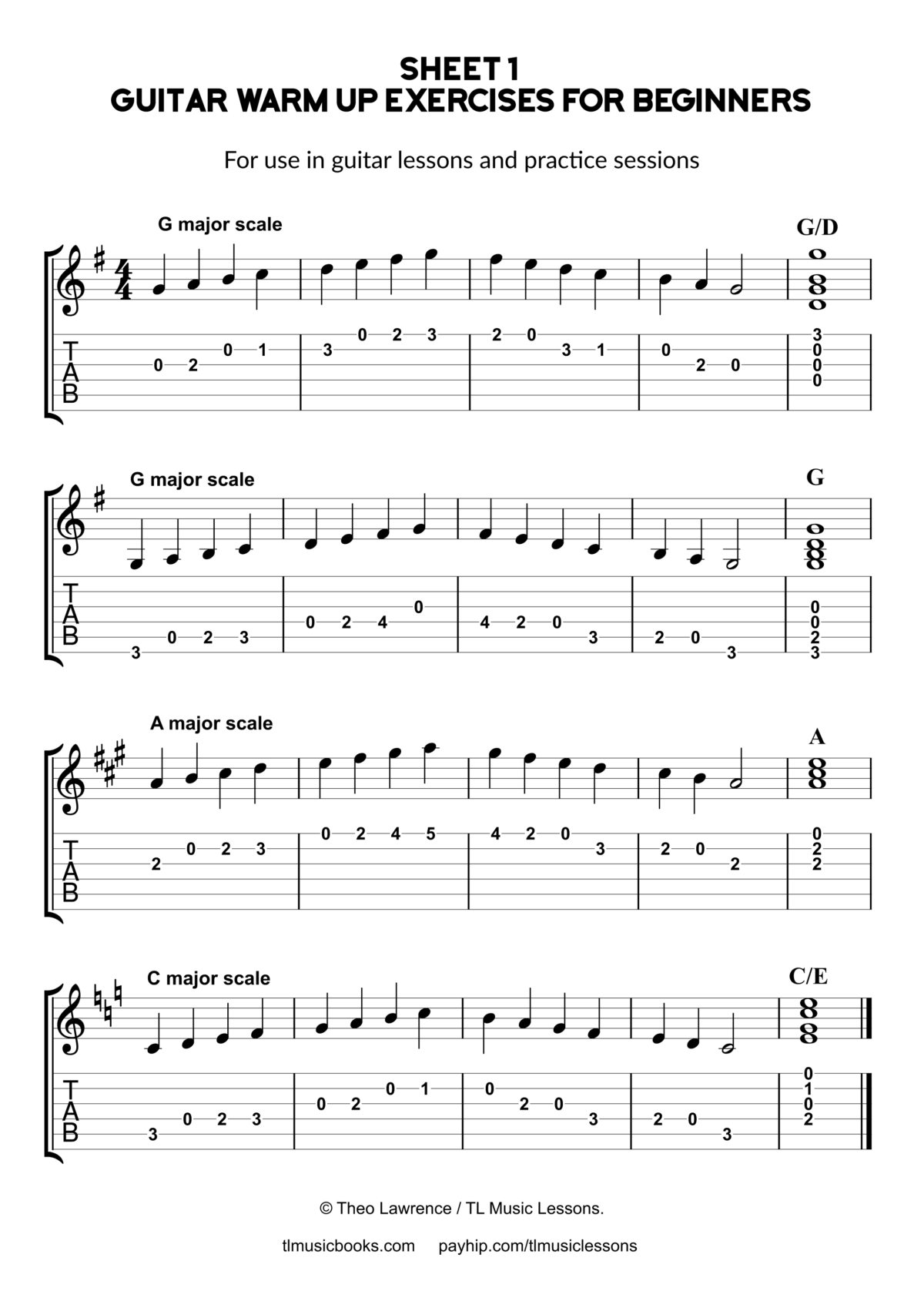
This beginners guitar scales warm up sheet with chords contains 4 one octave scales with the corresponding chords at the end of each one. The scales included are two G major scales in different octaves and with different chord variations at the end and also A major and C major scales.
The C/E chord is an easy variation of a C chord, and the G/D chord is an easy variation of a G chord. If you are able to do the full chords you can play them instead, or have a go at these easy chords instead, which by the way are useful moveable shapes if you move them up the fretboard and convert them into barre chord shapes by holding down the 1st finger across the first 4 strings and playing the rest of the chord in relation to this.
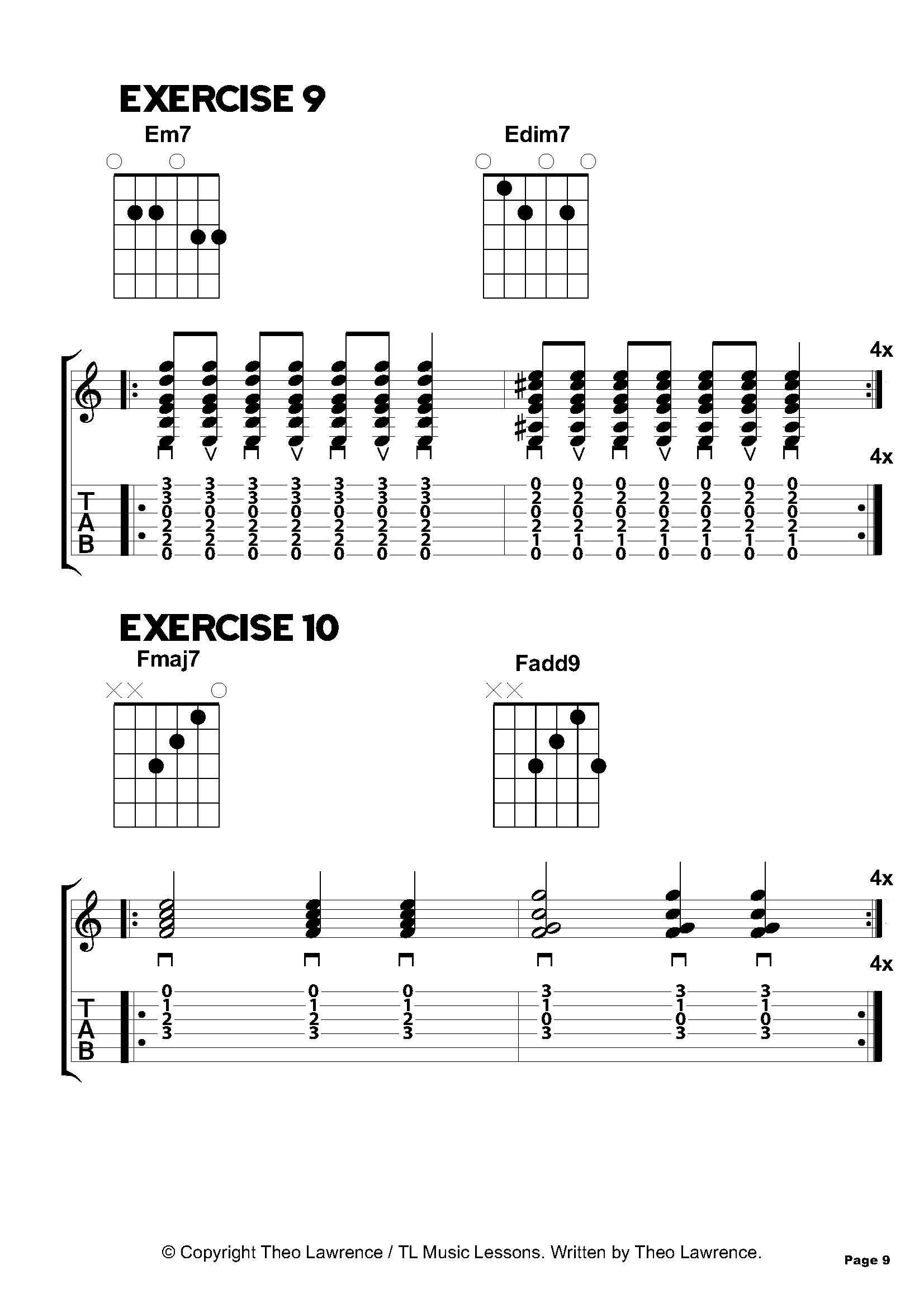
On this chords exercise sheet, we will be working with four chords: Em, Edim7, Fmaj7 and Fadd9.
Exercise 9
Whilst we don’t usually play diminished chords at beginners level, this one is not very difficult because it is an open chord, similar to an A7 chord shape with an added finger.
Counting: 1+2+3+4
Exercise 10
Fadd9 is a moveable chord. We sometimes forget about these simple moveable shapes and get stuck playing only barre chords and power chords. Move it up 2 frets and you have Gadd9. Two more frets up and you have Aadd9. Incase you were wondering what an add9 chord is, it’s a full major chord with an added major 2nd or major 9th note added (major 9th and major 2nd are the same notes, but major 9th is an octave higher.
On this chords exercise sheet, we will be working with three chords: A, A7 and Dsus2.
Exercise 7
The first strum is worth 2 beats. You can see that the note is not coloured in and it has a stem, so that makes it a minim, worth 2 beats (also known as a half note because it lasts for half of the bar). This is followed by two cotchets, which are 1 beat each. Here is the counting that you should use for this exercise (strumming on the parts in bold font).
1 2 3 4
Exercise 8
The rhythm for this exercise is almost the same as exercise 7. All we do is add an up strum after beat 3. Here is the counting that you can use to help:
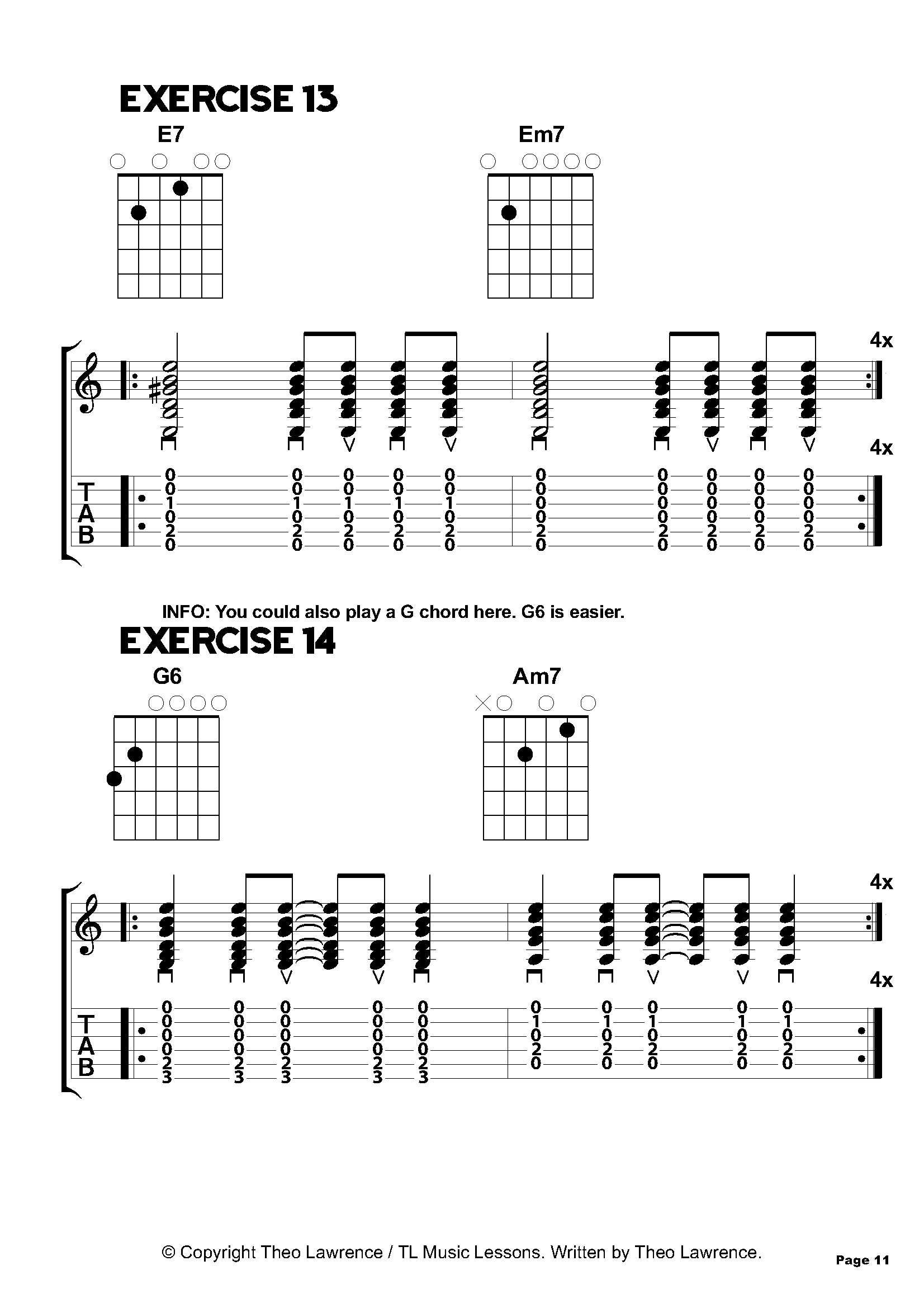
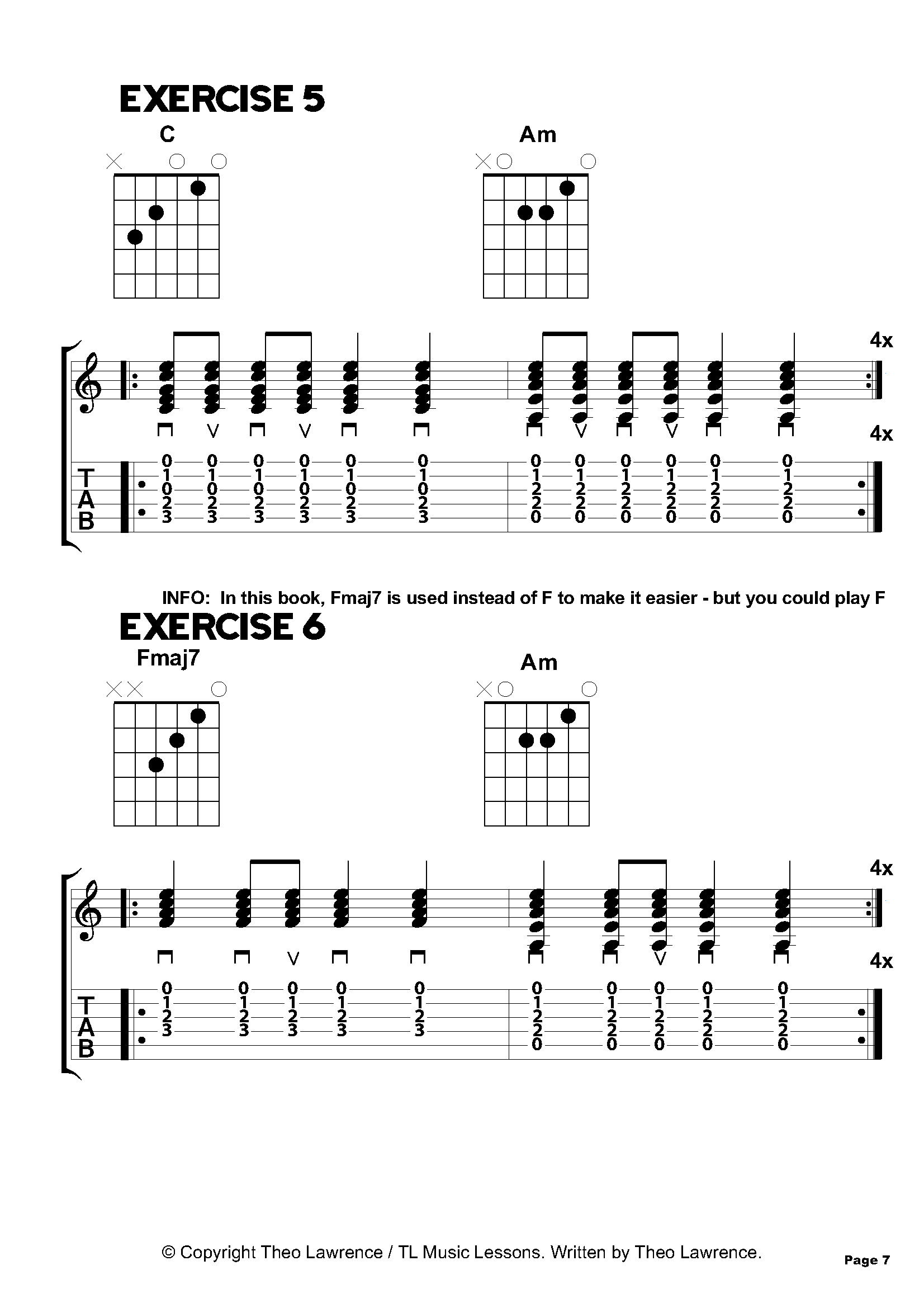
On this sheet, we start to work on strumming rhythms. Exercise 5 uses C and Am chords and the rhythm is down up down up down down. Exercise 6 uses F and Am chords and the rhythm is down down up down down. On the video I show you how to practice these using a metronome. You could use this sheet and follow this video for a quick 5 minute lesson on practicing the C, Am and F chords, which are fundamental to learn and practice on the guitar.
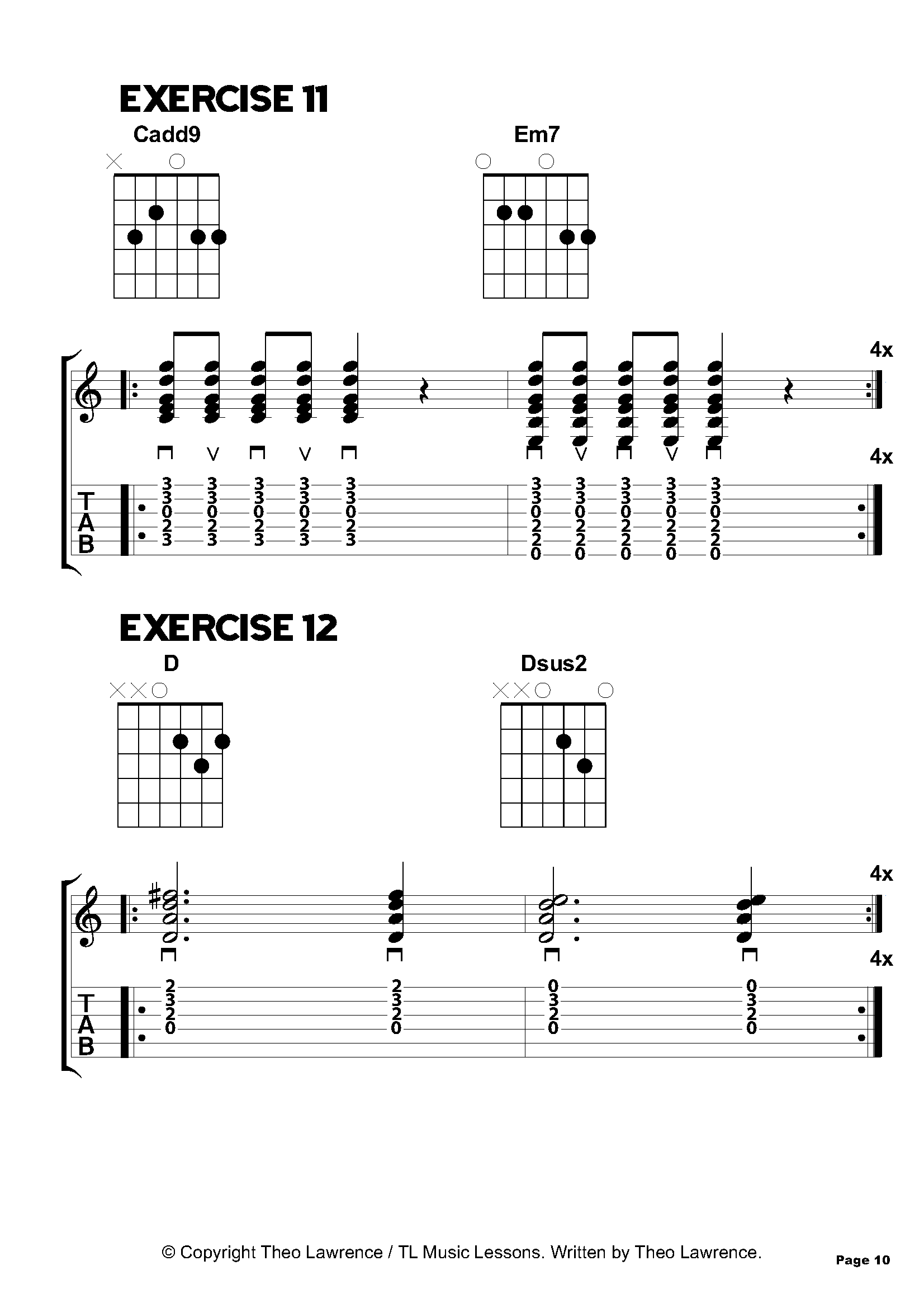
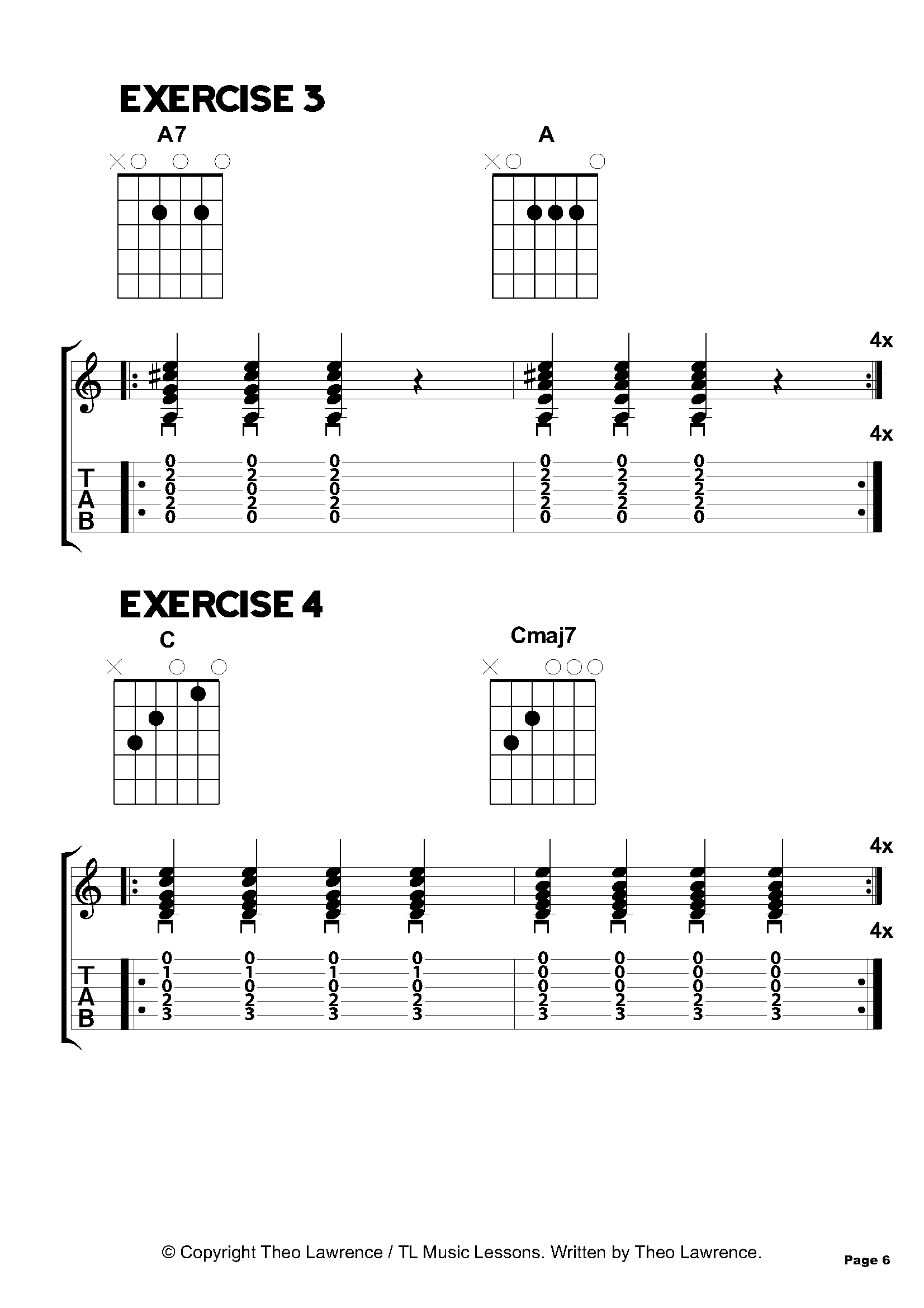
Here are 2 beginners guitar chord exercises using A7, A, C and Cmaj7. There are very simple rhythms in each exercise. Use the video below to help you with knowing how to count them.
Here we have 2 guitar chords exercises for beginners. The chords are Cmaj7, Am7 and Am. The first exercise has single strums, lasting for 4 beats, and the second exercise has 2 strums per chord, each lasting for 2 beats.
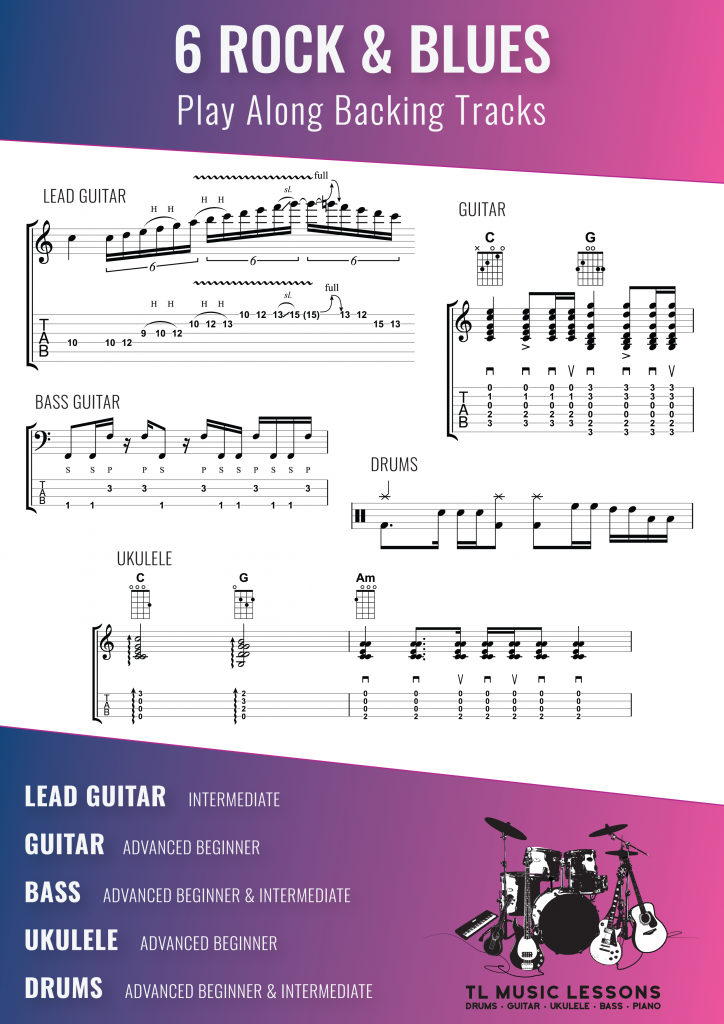
This song has been written as an educational piece for Drums, Guitar, Bass and Ukulele. I made it for my students to learn and I am sharing it online for everyone else too. I created the piece in Guitar Pro 7, which is a great way to learn and practice this because you can mute insruments and change the speed and even change parts if you like.
This blues song is played straight, without swing. There are drum beats and fills in the piece in keeping with the blue style. You could solo the drums and bass on it’s own to practice locking in with the bass – making sure the bass drum syncs up with the bass guitar when ever they are played together.
12 Bar Blues
The pattern of the 12 bar blues usually follows a pattern of chord changes. The pattern of bars where the main chord changes are is this: 4,2,2,1,1,1,1.
The pattern below is clearer. It uses roman numerals to show which chord in the diatonic chord sequence that is being used.:
I / / /
IV / I /
V IV I V
Lyrics
I wrote this song originally for just the instruments, but I thought it would be good to write some lyrics in case there are any singers out there that would like to sing along too. I have a rough idea of how it would go in my head, but I’m no singer, so you’re on your own!
VERSE 1
The sun shines through the window
And I’m stuck inside the house
It’s half past 1 in the afternoon,
And the day is going fast
I’m tryin to make things work
I’m tryin to make things rhyme,
But there’s harder times ahead,
And I’m running out of time.
I can’t see when this will end
All my plans are on their head
But the sun keeps shining through
Takin’ away those blues
VERSE 2
The sun shines through the window
And I’m stuck inside the house
It’s half past 2 in the afternoon,
And the day is going fast
I’m tryin to make things work
I’m tryin to make things rhyme,
But there’s harder times ahead,
And I’m running out of time.
I can’t see when this will end
All my plans are on their head
But the sun keeps shining through
Takin’ away those blues
VERSE 3
The sun shines through the window
And I’m stuck inside the house
It’s half past 3 in the afternoon,
And the day is going fast
I’m going to make things work
I’m going to make things rhyme,
But there’s harder times ahead,
And I’m running out of time.
I can’t see when this will end
All my plans are on their head
But the sun keeps shining through
Takin’ away those blues
About the lyrics
This song and it’s lyrics were written during the Covid-19 corona virus and it’s about having your job taken away and having to rebuild and adapt before you get into financial trouble. Many people will be in this situation with governments being very slow to offer financial support. I hope learning and playing this song can give some enjoyment to people in this strange time of crisis.
Send in videos of you playing this song
I will add your videos to this page if you record yourself playing it. Please get in contact.
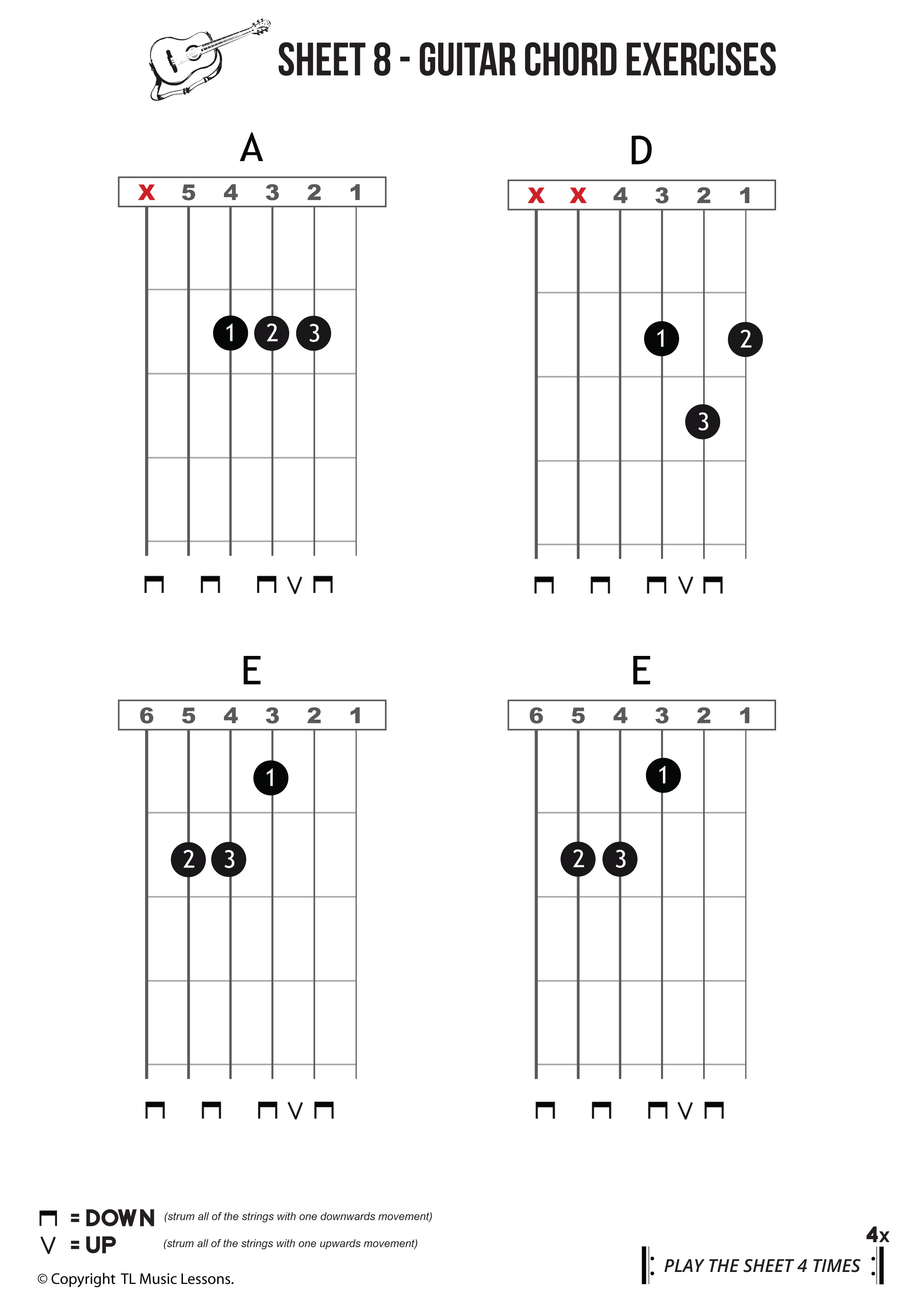
On this sheet we are going to use the beginners guitar chords A, D and E.
We are in the key of A and the chords are using the I IV and V (A = 1st, D = 4th, E = 5th) chord positions. The 1 4 5 pattern is very popular and playing them in order like that will sound very familiar.
In the chord exercise, you will need to look underneath the chord diagram to see the strumming pattern, and then play that for the chord. So, you will start with A, strumming 5 strings only (not the top string), and strum Down, Down, Down, Up Down, with the rhythm 1, 2, 3 + 4. Then moving onto the D chord with no gap if you can, or as quickly as you can make it, play the same rhythm for D. Then another quick change to E and this time it’s all 6 strings being played. As there are two E’s in a row, you will be able to easily go from one to the next without stopping because there is no chord change. The rhythm should be continuous, like this: 1, 2, 3 + 4, 1, 2, 3 + 4. Or like this: Down, Down, Down, Up Down, Down, Down, Down, Up Down.
When you have completed the two E chords, you then need to repeat the whole sheet a further 3 times to make 4 times around in total. Again, do a quick change from E back to A with as small of a gap as you can (but don’t go faster – there should still be 1 beat between the last E strum and the first A strum.
All of these chords are featured at least once: A, Am, A7, Asus2, B7, C, Cmaj7, Cadd9, D, Dm, E, Em, Em7, F#m, F, G, G6, Gmaj7, G7.
Introduction
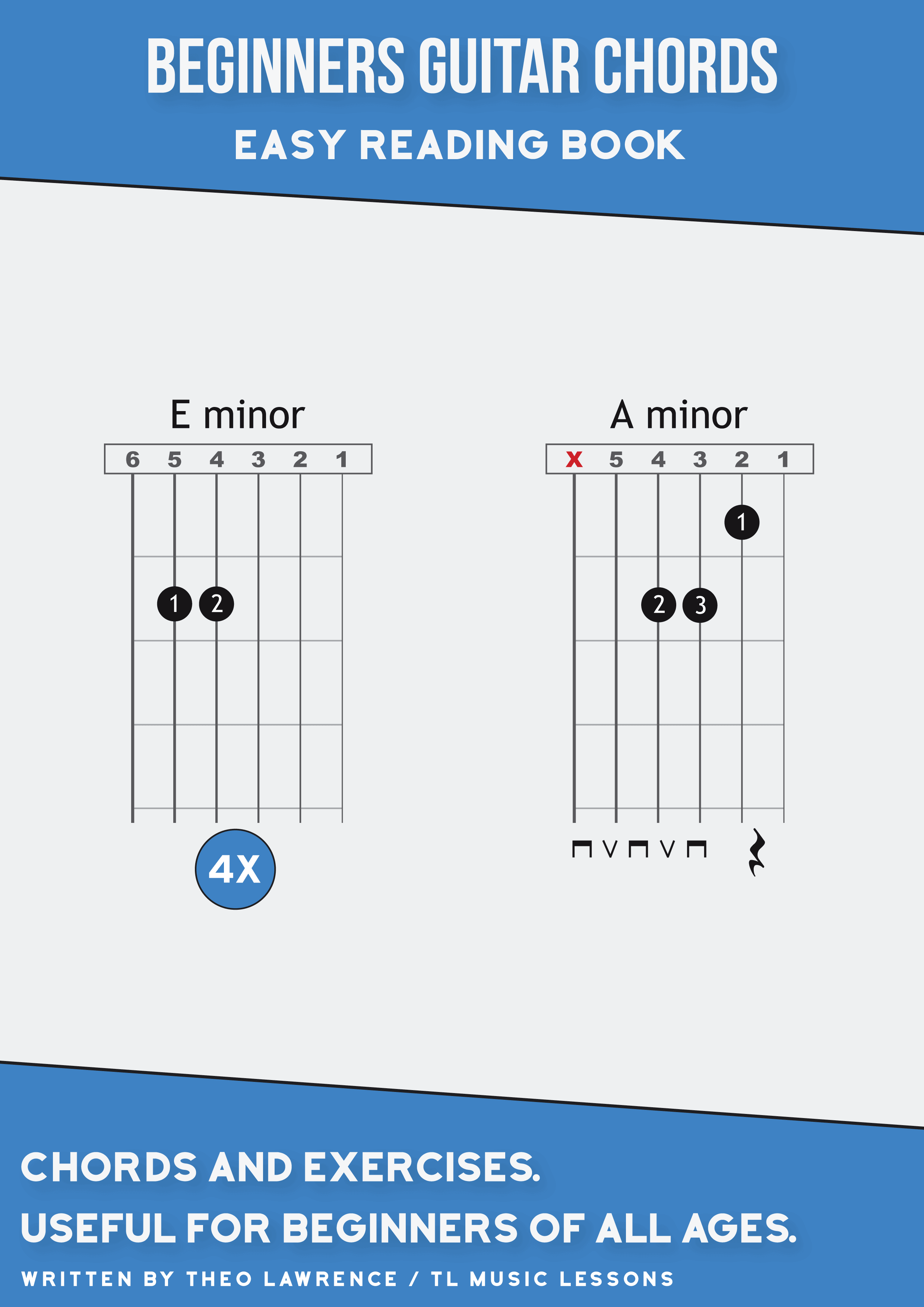
This ‘Beginners Guitar Chords’ easy reading book has been written following a year of testing and planning and with the knowledge and experience of over 10 years of guitar teaching.
The book is designed in a large ‘easy reading’ format, to be accessible for primary school age, whilst also being suitable for older children and adults.
The book contains 15 exercise sheets. On each sheet, you read the chords in the same order you would read a book; top left to top right, then bottom left to bottom right. The goal for each sheet is not to leave a gap in between chords, and to play each sheet continuously 4 times in a row. The numbers in the black circles are the finger numbers. These are suggestions as a guide, so other fingers can be used if preferred or more comfortable.
By the end of the book, the beginner guitar player should be ready to start playing songs that have beginners chords in. The student will have build up a good basic understanding of strumming, counting and chord changes.
The book covers most of the beginners chords you need for starting to play songs. It also covers techniques and fundamentals such as strumming, strumming rhythms, rests, repeats, and counting.
Make sure to spend plenty of time on each sheet and try not to work on too many sheets at once if you are new to guitar chords. Get comfortable and confident on each one before moving on and try to limit yourself to no more than 3 sheets per session or lesson. You could tick each sheet as you go along and make notes on the sides where needed. Once you have done more work and practice on the book, you might be able to do more sheets in one lesson or practice session.
The usual info
When you purchase this book online, you get a pdf file to keep forever.
Please do not redistribute the file or printed book publically or for profit.
Teachers can send the PDF file to individual students to practice with.
Teachers can print the book or single sheets as required for their students as many times as they like.
Feel free to make copies of the PDF file or printed copies, but only for personal or educational use or for keeping backups.
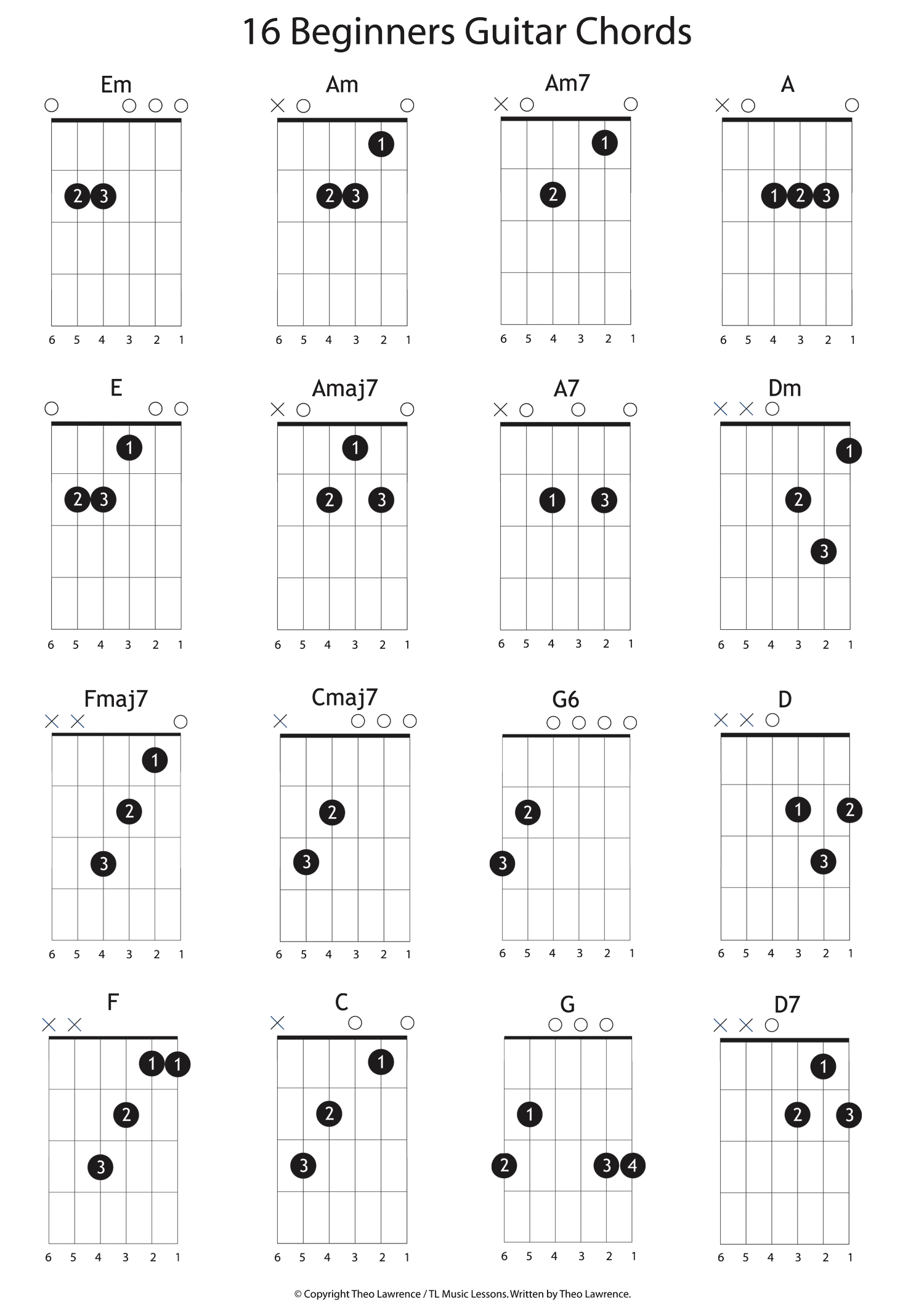
Here is a sheet of beginners open chords. It has been made using Adobe Illustrator.
Here’s a quick ‘how to’ for reading the sheet.
The vertical lines are the strings and they have string numbers underneath (there are 6 strings in total)
String 1 refers to the thinnest string and string 6 refers to the thickest. At first, it feels like it should be the other way around but make sure to learn and teach it this way because everywhere refers to them this way.
The horizontal lines are the frets. The ‘boxes’ or ‘rows’ that this creates are what we call frets. This can be confusing because those metal bars on the fretboards are the frets, but when we say ‘play fret 3, that means to put your finger in between the 2nd and 3rd raised metal fret.
The frets have been numbered 1 to 4 on the left hand side of each chord box. So, for the Em chord, you will be putting both fingers on Fret 2. One finger on string 4, fret 2, and another on string 5, fret 2.
The finger numbers are inside the blacked out circles and are for a guide. You may used different fingers as preferred.
The X above a string means to not strum that string.
The O above a string means that you will be playing this string too even though there are no fingers pressed down on it. It’s easier though just to look for the X’s and follow those, and just ignore the O’s.
The thick line at the top of the chord box is the ‘Nut’. This is usually a white plastic bit at the end of the neck where the guitar adjoins the head, which holds each string on their way through up to the tuning pegs.
Strum all required strings with one swift movement to perform a chord, making sure to play the correct amount of string (look out for the X’s). For example, Em is all 6 stings, and D is only the first 4 strings.
Each chord has a name, which is above the chord. anything with an ‘m’ after it is a minor chord, so Em is spoken as “E minor”. Chords with just a letter are major chords, so A is spoken as “A major”, or sometimes it is just spoken as “A”. Chords with a number after are just spoken as “A 7″ or G 6”.
The chords used in these 5 chord progressions are Em, G, Am, Bm, C, D. You could play them as is, by strumming each chord once, or you can improvise strumming patterns to fit with the timing of the music, to work on your rhythm playing.
Cookie Consent
We use cookies to improve your experience on our site. By using our site, you consent to cookies.
Cookie Preferences
Manage your cookie preferences below:
Essential cookies enable basic functions and are necessary for the proper function of the website.
Name
Description
Duration
Cookie Preferences
This cookie is used to store the user's cookie consent preferences.
30 days
Statistics cookies collect information anonymously. This information helps us understand how visitors use our website.
Google Analytics is a powerful tool that tracks and analyzes website traffic for informed marketing decisions.
Contains information related to marketing campaigns of the user. These are shared with Google AdWords / Google Ads when the Google Ads and Google Analytics accounts are linked together.
90 days
__utma
ID used to identify users and sessions
2 years after last activity
__utmt
Used to monitor number of Google Analytics server requests
10 minutes
__utmb
Used to distinguish new sessions and visits. This cookie is set when the GA.js javascript library is loaded and there is no existing __utmb cookie. The cookie is updated every time data is sent to the Google Analytics server.
30 minutes after last activity
__utmc
Used only with old Urchin versions of Google Analytics and not with GA.js. Was used to distinguish between new sessions and visits at the end of a session.
End of session (browser)
__utmz
Contains information about the traffic source or campaign that directed user to the website. The cookie is set when the GA.js javascript is loaded and updated when data is sent to the Google Anaytics server
6 months after last activity
__utmv
Contains custom information set by the web developer via the _setCustomVar method in Google Analytics. This cookie is updated every time new data is sent to the Google Analytics server.
2 years after last activity
__utmx
Used to determine whether a user is included in an A / B or Multivariate test.
18 months
_ga
ID used to identify users
2 years
_gali
Used by Google Analytics to determine which links on a page are being clicked
30 seconds
_ga_
ID used to identify users
2 years
_gid
ID used to identify users for 24 hours after last activity
24 hours
_gat
Used to monitor number of Google Analytics server requests when using Google Tag Manager
1 minute
Marketing cookies are used to follow visitors to websites. The intention is to show ads that are relevant and engaging to the individual user.
A video-sharing platform for users to upload, view, and share videos across various genres and topics.
Registers a unique ID on mobile devices to enable tracking based on geographical GPS location.
1 day
VISITOR_INFO1_LIVE
Tries to estimate the users' bandwidth on pages with integrated YouTube videos. Also used for marketing
179 days
PREF
This cookie stores your preferences and other information, in particular preferred language, how many search results you wish to be shown on your page, and whether or not you wish to have Google’s SafeSearch filter turned on.
10 years from set/ update
YSC
Registers a unique ID to keep statistics of what videos from YouTube the user has seen.
Session
DEVICE_INFO
Used to detect if the visitor has accepted the marketing category in the cookie banner. This cookie is necessary for GDPR-compliance of the website.
179 days
LOGIN_INFO
This cookie is used to play YouTube videos embedded on the website.