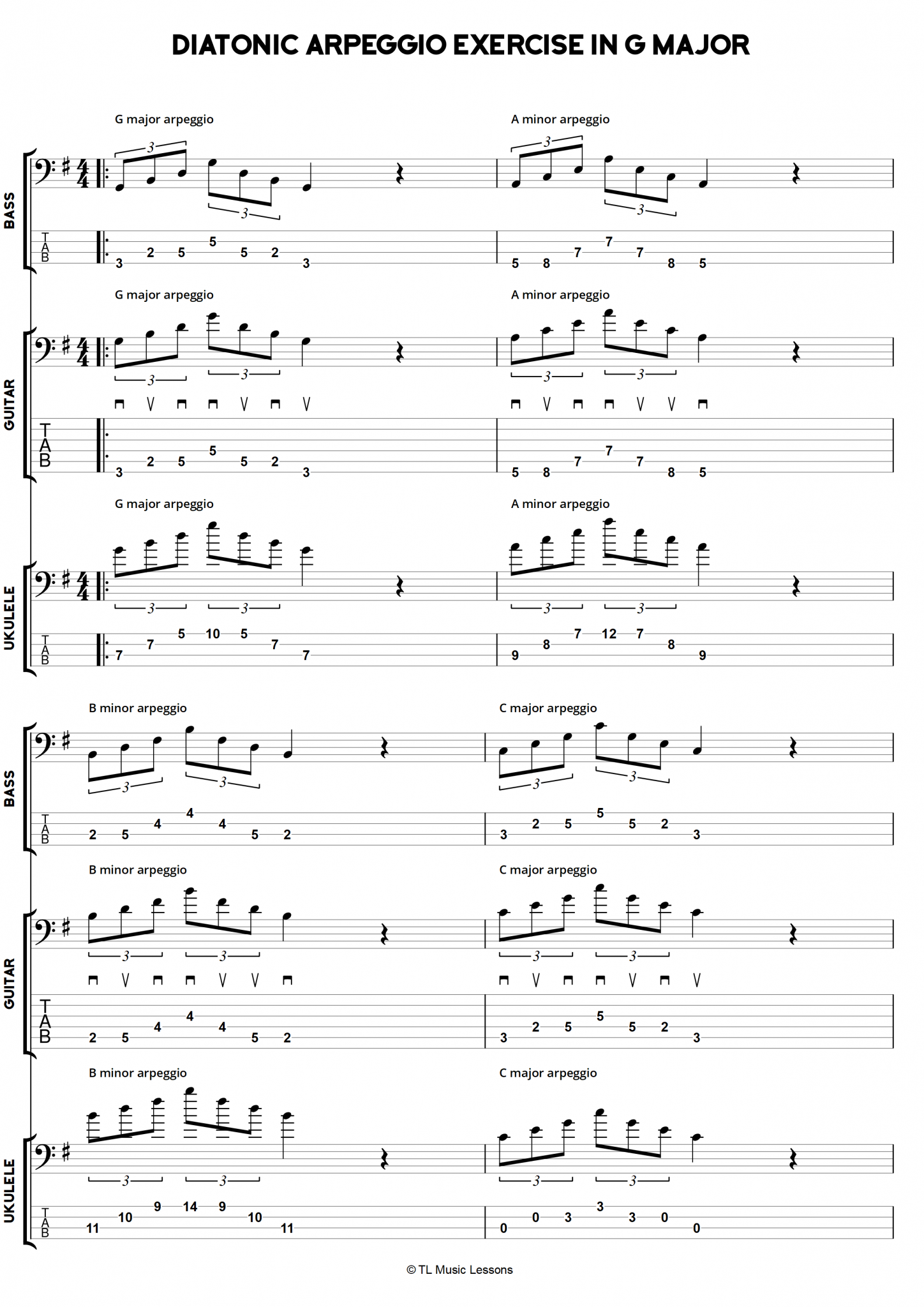
Diatonic Arpeggio Exercise in G Major

This arpeggios exercise has a sequence of 8 arpeggios and has sheets for Guitar, Bass and Ukulele.

The guitar and bass sheets are essentially the same, although the guitar part has picking instructions for downs and ups. For bass, you could probably use the guitar downs and ups. I use my fingers on the bass and I would play these with a walking right left right left of the first two fingers. I think most people start with their left finger (index finger) but I’ve always led with might right finger (middle finger), because following a RLRL pattern is more familiar as I play drums too.

The diatonic sequence is going up the G major scale and making each note into a chord that theoretically fits, and in this case turning them into an arpeggio.

With the repeat at the end, I have suggested to play through the sheet 2 times as a whole exercise. You may like to practice each arpeggio individually at first or if you are making mistakes.
Free File Downloads

Guitar PDF
Bass PDF
Ukulele PDF
Guitar Pro 7 File

6 major and minor arpeggio practice exercises with Chord Progressions – Grade 3-4

These exercises are from this Premium PDF Ebook →

Either follow the steps below, or purchase the PDF ebook linked above to access the arpeggio exercises on pages 12-13.

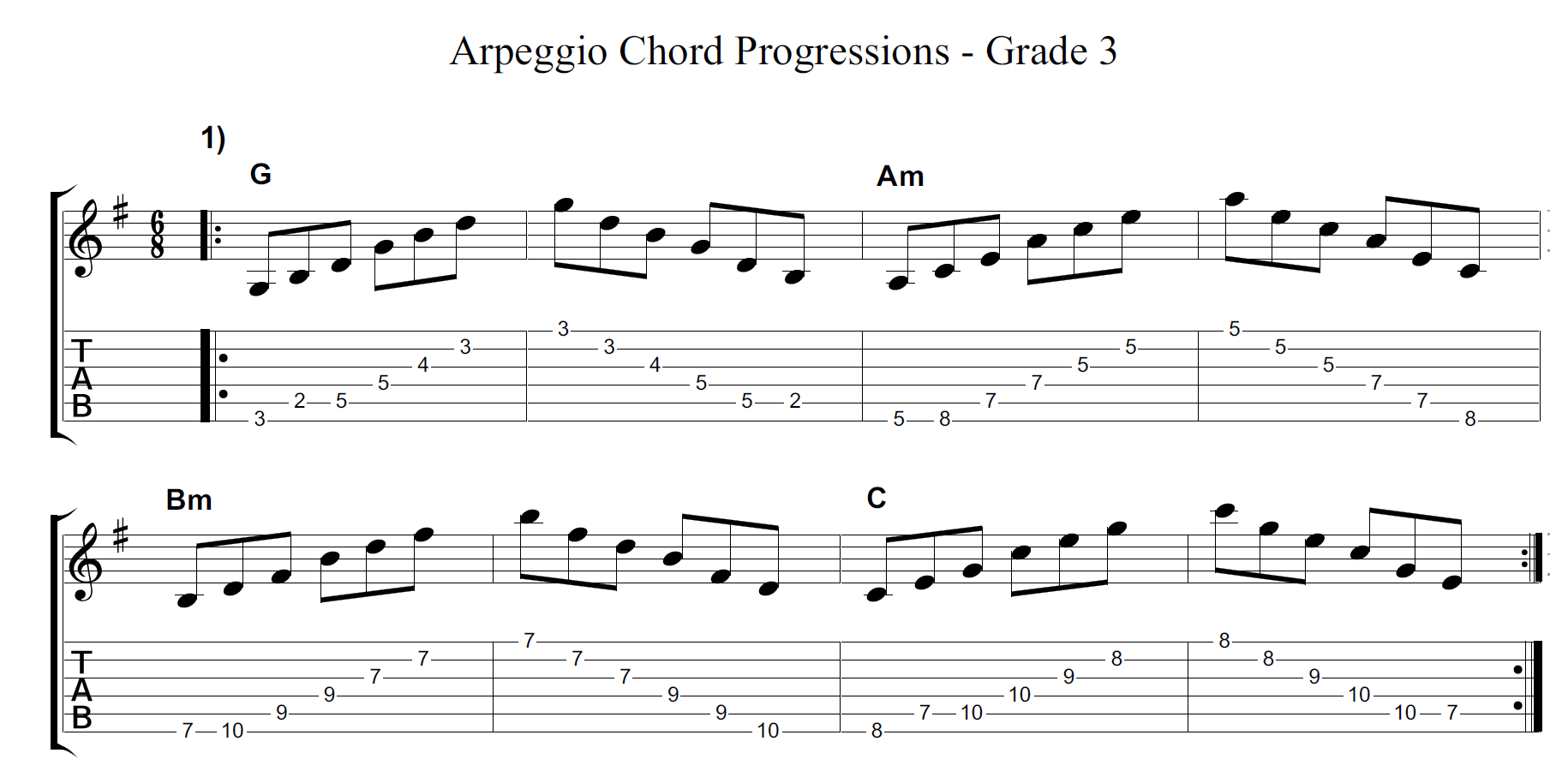
For these 6 arpeggio chord progression exercises, we will be working on the two grade 3 arpeggio shapes: 2 octave major arpeggio, and the 2 octave minor arpeggio.

Please ignore the repeat markings on the notation when you play along with the backing tracks.

The backing tracks above may be helpful for practicing along with. They are only 1 speed, so if you wanted to, you could record yourself playing the chord progression and then practice playing along. If using these exercises in a music lesson, a guitar teacher could play the chords whilst the student plays the arpeggios. Or, you could play them along with a metronome at various speeds – nothing wrong with that!

Exercise 1

This exercise uses the chord progression: G, Am, B, C. The arpeggios are based on these chords.

Exercise 2

This exercise uses the chord progression: Am, C, Em, F. The arpeggios are based on these chords.

Exercise 3

This exercise uses the chord progression: Bm, A, F#m, G. The arpeggios are based on these chords.

Exercise 4

This exercise uses the chord progression: C, Am, G, Dm. The arpeggios are based on these chords.

Exercise 5

This exercise uses the chord progression: Fm, Ab, Bbm, Db. The arpeggios are based on these chords.

Exercise 6

This exercise uses the chord progression: Bb, Cm, Gm, F. The arpeggios are based on these chords.