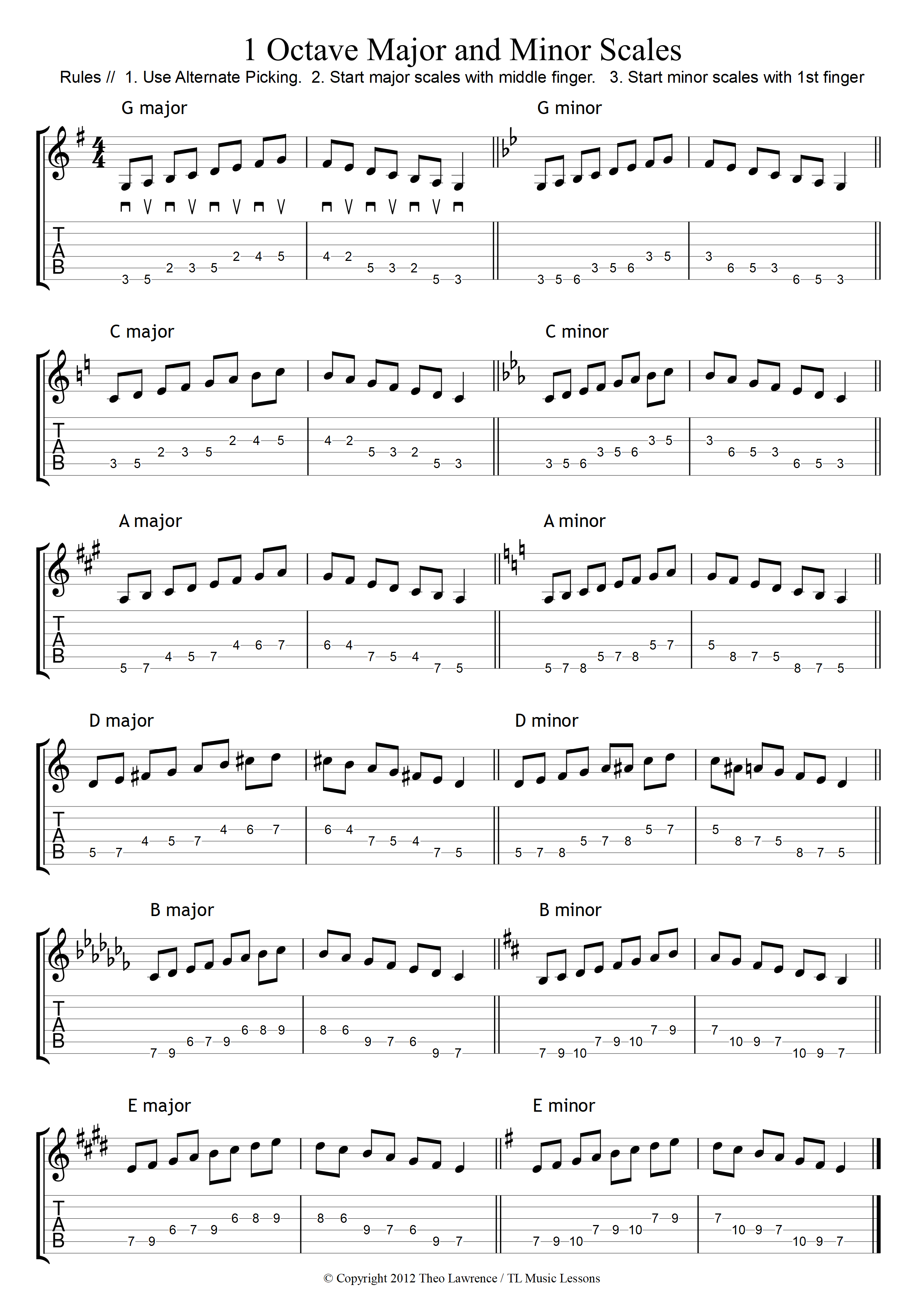
12 Beginners Major and Minor Guitar Scales (1 Octave)

Beginners should practice these scales regularly. Make sure to repeat each scale (at least 2x) when you get faster.

The symbols on the first bar are down, up, down, up etc (this continuous pattern is called Alternate Picking), to be played with a guitar pick if you are using one. See below key for which one is which. Make sure to do this for every scale. At first though, you can just do all down picks to make it easier if you prefer.


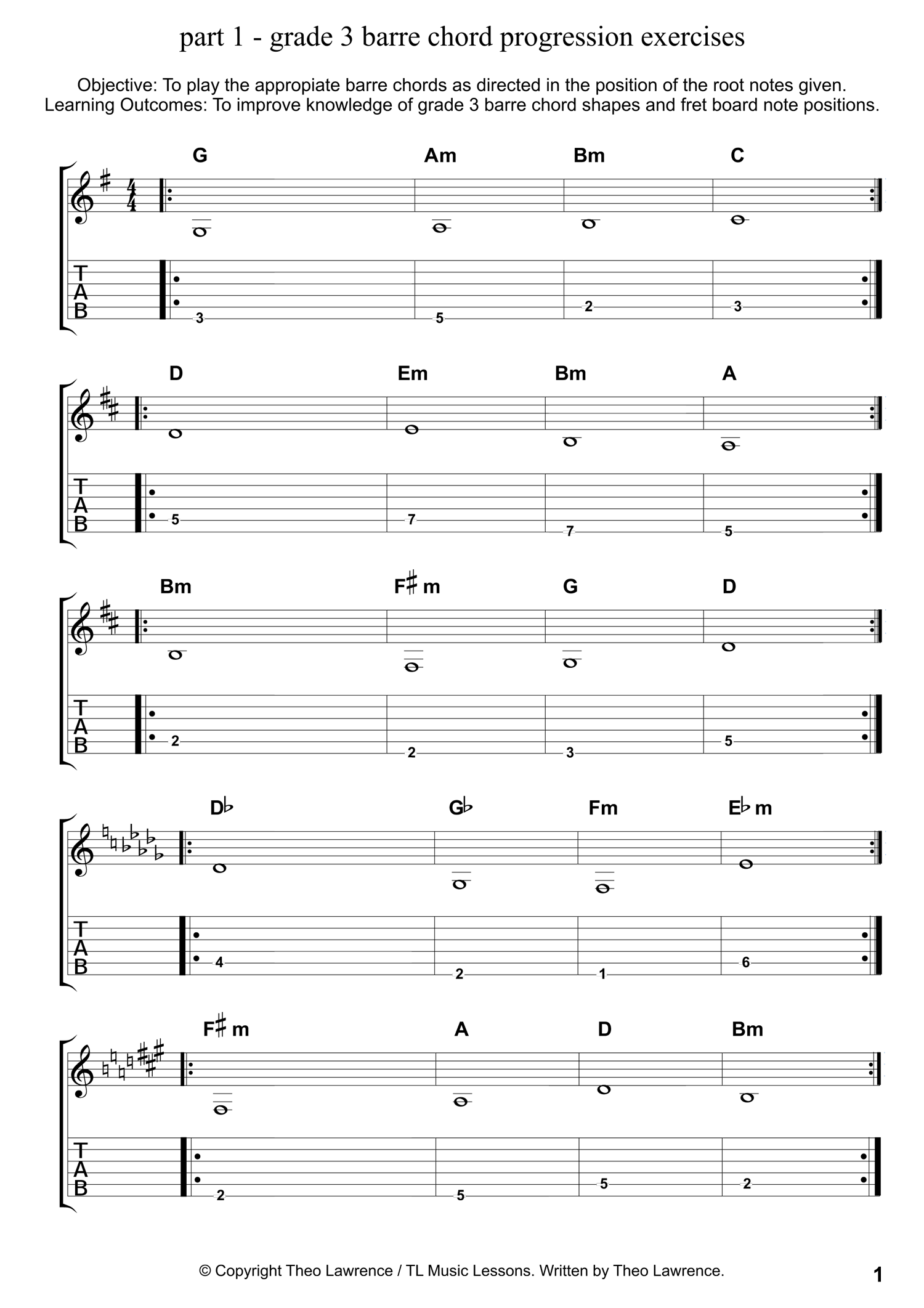
Part 1 – Grade 3 Barre Chord Progression Exercises

Each one of the barre chord exercises involve playing all 4 of the main grade 3 moveable barre chord shapes, found in both Rockschool and RGT grade 3.

Use these 4 major and minor barre chord shapes, and apply them to the positions of the root notes on this sheet.

Objectives: To practice all 4 main major and minor barre chord shapes in each exercise. To use the sheet as an opportunity to improvise various strumming rhythms during the exercises.

Here are the chord progressions included in the download:

  1. G Am Bm C
  2. D Em Bm A
  3. Bm F#m G D
  4. Db Gb Fm Ebm
  5. F#m A D Bm

Related: Both Part 1 and Part 2 of this exercise are featured in the Premium ebook Grade 3-4 Ebook – Scales, Arpeggios, Barre Chords and Guitar Solo Exercises

12 Minor Pentatonic Scale Exercises – Featured on the Guitar Pro Blog

This lesson has been published on the Guitar Pro Blog, so for the full article, click here.

The scale exercises are written for anyone that has learned (or is learning) the 2 octave minor pentatonic scale shape, and are ideal for anyone studying for grade 3 or grade 4 guitar. Those 12 concrete examples are aimed to widen your soloing chops and skills.

To read more and download the guitar pro file, use the following link:

http://blog.guitar-pro.com/2015/04/12-minor-pentatonic-scale-exercises/

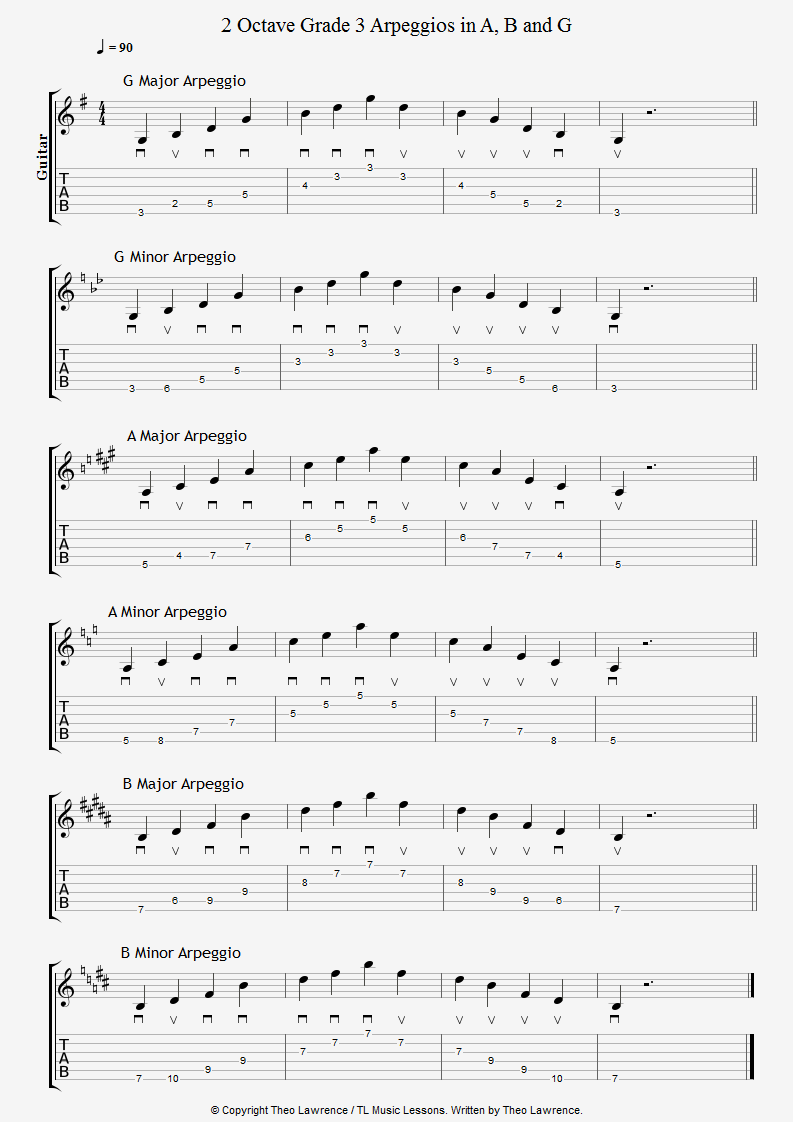
Grade 3 Arpeggios in A, B and G (Major + Minor Shapes) – 2 octaves – starting on the E string

This sheet includes:

  • G major Arpeggio – 2 Octaves
  • G minor Arpeggio – 2 Octaves
  • A major Arpeggio – 2 Octaves
  • A minor Arpeggio – 2 Octaves
  • B major Arpeggio – 2 Octaves
  • B minor Arpeggio – 2 Octaves

This sheet has been created for guitarists studying Rockschool Grade 3 guitar (base on the 2012-18 syllabus). It is recommended that you follow the picking as notated. All three keys need to be prepared for, so all three are included in the download. The root notes are located on fret 3, 5 and 7 of the E string.

These arpeggios are also in the Grade 3 RGT syllabus, but you’ll need to be able to play them in any position on the E string. Once you play through all of these though, you’ll soon get used to the 2 shapes.

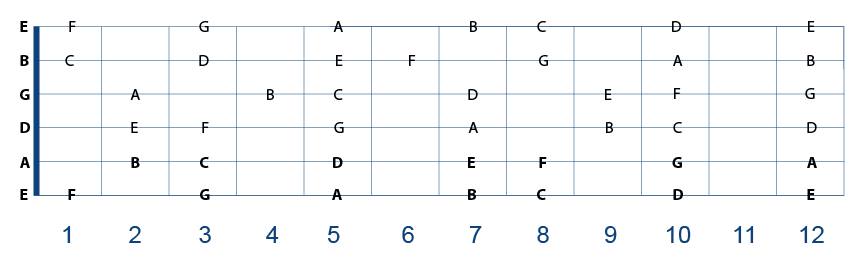
Notes on the Guitar Fretboard on all of the strings – Quick Reference Sheet for Grade 3+

Rockschool Syllabus:

You will need to learn the main notes on the E and A strings to get by in Rockschool, in particular from Grade 3 onwards because they will be needed to play barre chords and scales in the correct places. It is beneficial to understand how sharps and flats (# and b) work from Grade 3, and by Grade 5 you might struggle without this knowledge.

RGT Syllabus:

You will need to learn the notes on the E and A strings including all the sharps and flats in RGT Grade 3 because they will be needed to play barre chords and scales in the correct places. By Grade 5 you will need to have some understanding of all the fretboard notes including sharps and flats, and at least the ability to quickly work out any note on the fretboard in your head if you don’t remember it.

Sharps (#) and Flats (b)

1 fret higher is a sharp, or 1 fret lower is a flat. So fret 2 of the E string could be either F sharp of G flat (F# or Gb). They are both the same note. Try not to get confused with this at first, because you don’t need to understand why until Grade 5.

Remember This:

“SHARPEN UP” +1 FRET
“FLATTEN DOWN” -1 FRET

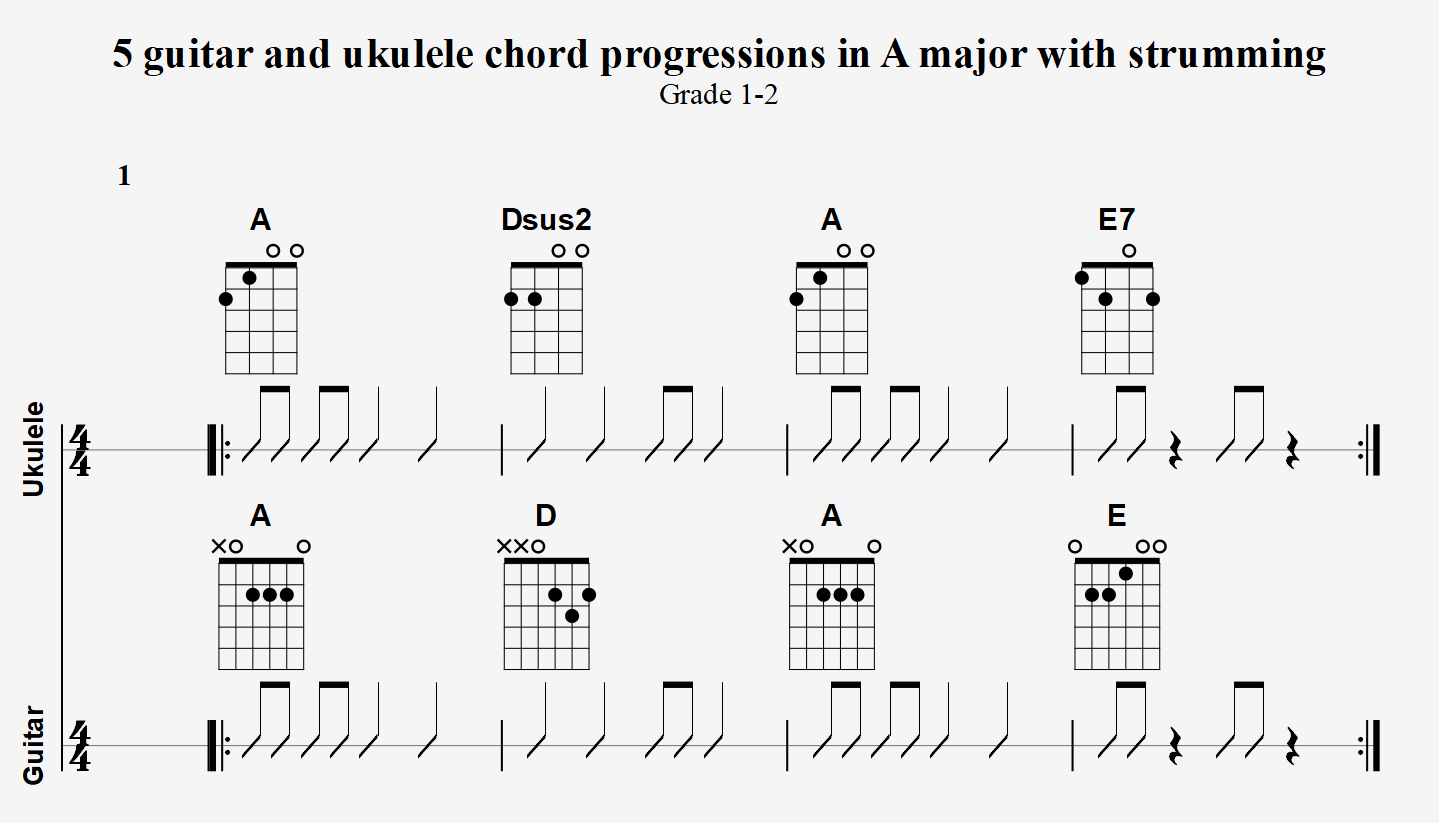
5 guitar and ukulele chord progressions in A major with strumming – Essential Beginners and Grade 1 – 2

About the sheets

The rhythms mainly work with 8th notes and quarter notes, so playing the 8ths with a down, up strumming pattern, and the quarter notes with down strums would be a good way to strum these exercises.

Some of the notes and rests may be less familiar to beginners, so you might need to brush up on your note values with this reference sheet: Understanding Notes and Rests in Music Notation – Reference Sheet

Guitar

The A, D and E chords are used a lot in songs, so this sheet is a good way to practice changing between the chords, as well as working on rhythms.

Ukulele

The ukulele chords can be played by beginners, and more advanced players could substitute the Dsus2 and E7 chords for the full D and E chords if they wish.


If you found these free chord progressions useful for learning or teaching with, please check out my guitar and ukulele ebooks with 100 chord progressions in each:

(Premium) 100 beginners chord progressions for Guitar – ebook

(Premium) 100 beginners chord progressions for Ukulele – ebook

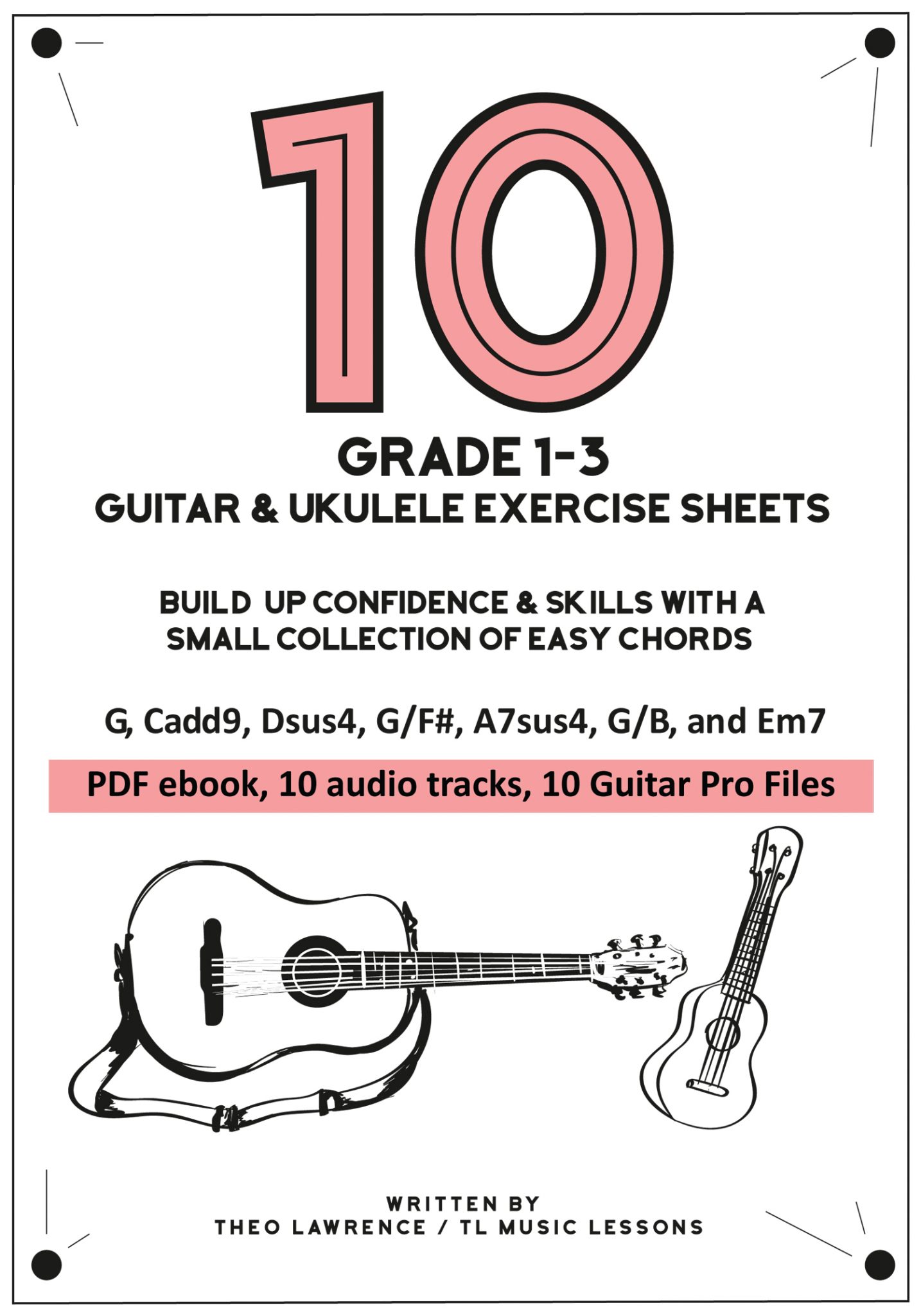
(Free ebook) – 10 Grade 1-3 Guitar & Ukulele Chord Exercise Sheets – Build up Confidence & Skills with a Small Collection of Easy Chords

Originally posted as 10 seperate blog posts, they are now all contained here on this page. go ahead and download the free ebook, listen to the audio examples below (or from the download) and read the description of each exercise below as you go through it.

Get Free Downloads (PDF, MP3, Guitar Pro) →

The 7 chords in this ebook are heavily used in pop and alternative music and are a fundamental set of chords to learn and be comfortable playing together in various sequences and with different strumming rhythms. They are also often used in different Capo positions on the Guitar. Some of the chords are more used than others out of the 7, but I think they are all very useful to learn.

This course of 10 exercise sheets will take you from grade 1 to grade 3 quite quickly and is primarily aimed at those around the grade 2 or 3 level, especially those on the brink of being able to play along with some popular songs.

Listen to exercises 1-10


About the exercise sheets

Sheet 1

Welcome to the first in the series of Chord Changing Rhythms with G, Cadd9, Dsus4, G/F#, and Em7 chords for Guitar and Ukulele.

These 5 chords are heavily used in pop and alternative music and are a fundamental set of chords to learn and be comfortable playing together in various sequences and with different strumming rhythms. They are also often used in different Capo positions on the Guitar.

In Exercise Sheet 1, we stick to the first 3 chords, G, Cadd9, and Dsus4. Let’s master these first.

In the next exercise sheet we introduce the Em7 chord and work on some new strumming rhythms.

Sheet 2

Welcome to the second in the series of Chord Changing Rhythms with G, Cadd9, Dsus4, G/F#, and Em7 chords for Guitar and Ukulele.

These 5 chords are heavily used in pop and alternative music and are a fundamental set of chords to learn and be comfortable playing together in various sequences and with different strumming rhythms. They are also often used in different Capo positions on the Guitar.

In Exercise Sheet 2, we introduce a 4th chord, Em7 to add to the G, Cadd9, and Dsus4 chords we started with in Exercise Sheet 1.

As with the other three guitar chords, you still don’t need to move your 3rd and 4th fingers. Whilst keeping your 3rd and 4th fingers on fret 3 of the the first two strings, all you need to do with Em7 is move the 1st and 2nd fingers into an Em position and you will now have Em7.

On the Ukulele, the Em7 is the same as the G6 chord. Both chords share the same notes. You can get away with this more on the ukulele as all the strings are quite high sounding so the root notes are not as prominent as the guitar.

By the way, if you are wondering what the symbols in bar 3 and 4 and again in 5 and 6 are, they mean to ‘repeat the previous two bars’. So, basically play the first line 3 times, then the 4th line, and then repeat it all again before playing the final bar.

Sheet 3

Welcome to the third in the series of Chord Changing Rhythms with G, Cadd9, Dsus4, G/F#, and Em7 chords for Guitar and Ukulele.

These 5 chords are heavily used in pop and alternative music and are a fundamental set of chords to learn and be comfortable playing together in various sequences and with different strumming rhythms. They are also often used in different Capo positions on the Guitar.

In Exercise Sheet 3, we re use the 4 chords from the previous exercise, Em7, G, Cadd9, and Dsus4, and develop different rhythmic skills in a new time signature of 6/8.

The rhythm is the same in every bar. It is not an easy rhythm, but once mastered will be enjoyable to play.

Sheet 4

Welcome to the fourth in the series of Chord Changing Rhythms with G, Cadd9, Dsus4, G/F#, and Em7 chords for Guitar and Ukulele.

These 5 chords are heavily used in pop and alternative music and are a fundamental set of chords to learn and be comfortable playing together in various sequences and with different strumming rhythms. They are also often used in different Capo positions on the Guitar.

In Exercise Sheet 4, we re use the 4 chords from the previous exercise, Em7, G, Cadd9, and Dsus4, and introduce a new chord, G/F#.

To play this new G/F# chord on guitar, you need to remove the top two fingers, and simply put the first finger on fret 2 of the 6th string. This finger should be held lazily so that it touches the 5th string. This will make the 5th string into a dead note, which means you play the string but no note comes out – it’s more of a hitting sound because the string is muted.

To play this new G/F# chord on ukulele, it’s more of a makeshift chord to fit the guitar rather than a true G/F# chord, because the F# isn’t actually the lowest note in the chord. It is actually technically a Gmaj7 chord, which has the same notes as G/F#.

The rhythm is the same in every bar. I have gone for a hard rhythm here, but it is a popular and familiar one so you should pick it up. Beginners might want to listen to the audio to pick up the rhythm rather than trying to read this one.

The rhythm changes at the end of every 4 bars – only one thing changes. Instead of doing the tied note (the fake down strum that doesn’t connect), we will strum this down. Listen to the drums, you will hear an extra bass drum on this 4th bar, which you can try and lock in time with.

The repeats are nested, which is a bit un common. This is so it fits onto the page and avoids the need to use D.C. markings, which some may not understand. Basically, play the first 4 bars twice, then the final 4 bars, and then play through everything again including the repeat of the first 4 bars.

G/F# slash chord explanation

This is a slash chord. The deepest note in the G chord is a G. The G chord is made up of 3 notes, G, B and D.

For G/F# we are replacing that lowest G note with an even lower note of F#, which is only 1 fret lower and therefore easy to play. Therefore, adding an F# is adding a new note to the chord. The note added is the 7th note in the G major scale, which fits because we are playing in the key of G. You can’t do this with every chord.

Usually the 7th note of G major would be played as a F diminished chord, using diatonic chord theory (you usually learn about this at grade 5 level). So, just adding the F# note onto a G chord is a good way of using that 7th major note, without the need for wrecking a chord progression by throwing in a diminished chord.

You can read more about slash chords here.

Sheet 5

If you got this far, it’s probably worth going to download the pdf ebook to view the rest, so I’ll leave off the images from this post for sheets 5-10.

Get Free Downloads (PDF, MP3, Guitar Pro) →

Welcome to the fifth in the series of Chord Changing Rhythms with G, Cadd9, Dsus4, G/F#, and Em7 chords for Guitar and Ukulele.

These 5 chords are heavily used in pop and alternative music and are a fundamental set of chords to learn and be comfortable playing together in various sequences and with different strumming rhythms. They are also often used in different Capo positions on the Guitar.

In Exercise Sheet 5, we re use only 3 chords from the previous exercises,G, Cadd9, and Dsus4. The exercises are getting harder though! There is a very quick rest after beat 3 on each bar, for only a quarter of a beat (16th note), and followed by 3 quick up picks with a 16th note speed, which then leads into a quick chord change to go into the next bar. The chord choices and style of playing was inspired by the song “We are never getting back together” by Taylor Swift. That song would be great to learn on the side of this series of chord changing with rhythm. The only other chord that it uses is Em. The picking is more complex than this, and the rhythm is different, but the chords are similar (in a different order).

The rhythm is the same in every bar. Beginners might want to listen to the audio to pick up the rhythm rather than trying to read this one.

Sheet 6

Welcome to the 6th in the series of Chord Changing Rhythms with G, Cadd9, Dsus4, G/F#, A7sus4, G/B, and Em7 chords for Guitar and Ukulele.

This selection of chords are heavily used in pop and alternative music and are a fundamental set of chords to learn and be comfortable playing together in various sequences and with different strumming rhythms. They are also often used in different Capo positions on the Guitar.

In exercise sheet 6 we have introduced 2 new chords. A7sus4 is the same shape as Em7 on guitar, but we just move our first 2 fingers down 1 string to make the shape. The G/B chord moves off Cadd9 in the same way that you would change from G to G/F# in previous exercise sheets.

This chord progression is in a 6/8 time signature. In each bar apart from the penultimate, the rhythm follows the 1, 2, 3, 4 rhythm with down strokes and then doubles up with “down, up” strokes on the 5 and 6. The second to last bar rhythm doubles up on the 2, 3 and 5, 6.

Sheet 7

Welcome to the 7th in the series of Chord Changing Rhythms with G, Cadd9, Dsus4, G/F#, A7sus4, G/B, and Em7 chords for Guitar and Ukulele.

In this session we take a break from the guitar pick and strumming rhythms, and focus on using a finger picking style with some of these chords. This can be very hard for beginners. I’ve slowed the tempo down a little to 70bpm. If you download the Guitar Pro 6 file (you need to have Guitar Pro installed), you can slow it down further.

We only use some of the chords in this exercise – G, Cadd9, Em7, Dsus4. We also use some notes like F# and B in the first section but we don’t play full chords with them. On the guitar they are used as bass notes.

For the second section you can see the p i m a markings above the music, which show you which fingers to use, and then continue for the following bars. Go here if you need to learn more about p i m a.

Sheet 8

Welcome to the 8th in the series of Chord Changing Rhythms with G, Cadd9, Dsus4, G/F#, A7sus4, G/B, and Em7 chords for Guitar and Ukulele.

In this session we start with some simple rhythms. The exercises are at a slower speed than in the previous session 8. After the repeats we have a complicated rhythm, so you’ll be glad of the slower tempo.

The tempo is very fast so you should start off slower before building up to this. If you download the Guitar Pro 6 file (you need to have Guitar Pro installed), you can slow it down further.

Sheet 9

Welcome to the 9th in the series of Chord Changing Rhythms with G, Cadd9, Dsus4, G/F#, A7sus4, G/B, and Em7 chords for Guitar and Ukulele.

In this session we take down the tempo and play a bit slower. The intro should be pretty easy but just make sure you are getting the timing right of the minims (half notes, worth 2 beats). The second section has a difficult rhythm so you’ll probably be glad of the slow tempo here.

If you would like to slow down or speed up the tempo, you can do this with the Guitar Pro 6 file (you need to have Guitar Pro installed).

Sheet 10

While the rhythms on this sheet probably go into Grade 4 territory, I recommend listening to the audio to get a grip on the rhythm and use the sheet for a guide for which up and down strokes to use.
4 Chord Progressions with Rhythm – Em – Essential Beginners – Ukulele & Guitar

These 4 chord progressions are all in the key of E minor.

The two bar repeating exercises only have 2 easy chords, and the rhythm is the same for each bar, so although we are working on rhythm and changing chords at the same time, these exercises are very accessible to beginner guitarists.

The chords have been simplified as much as possible, so instead of the standard G, C and D chords, they have been replaced with G6, Cmaj7, and Dsus2. These are all easier on ukulele and guitar, apart from the C chord on the ukulele, which is exactly the same amount of easy! Furthermore, these simplified chords still sound great, and do sound ok when played with the standard chords, so these could be used for other exercises or in songs, when struggling to play G or C for example.

GUITAR

UKULELE

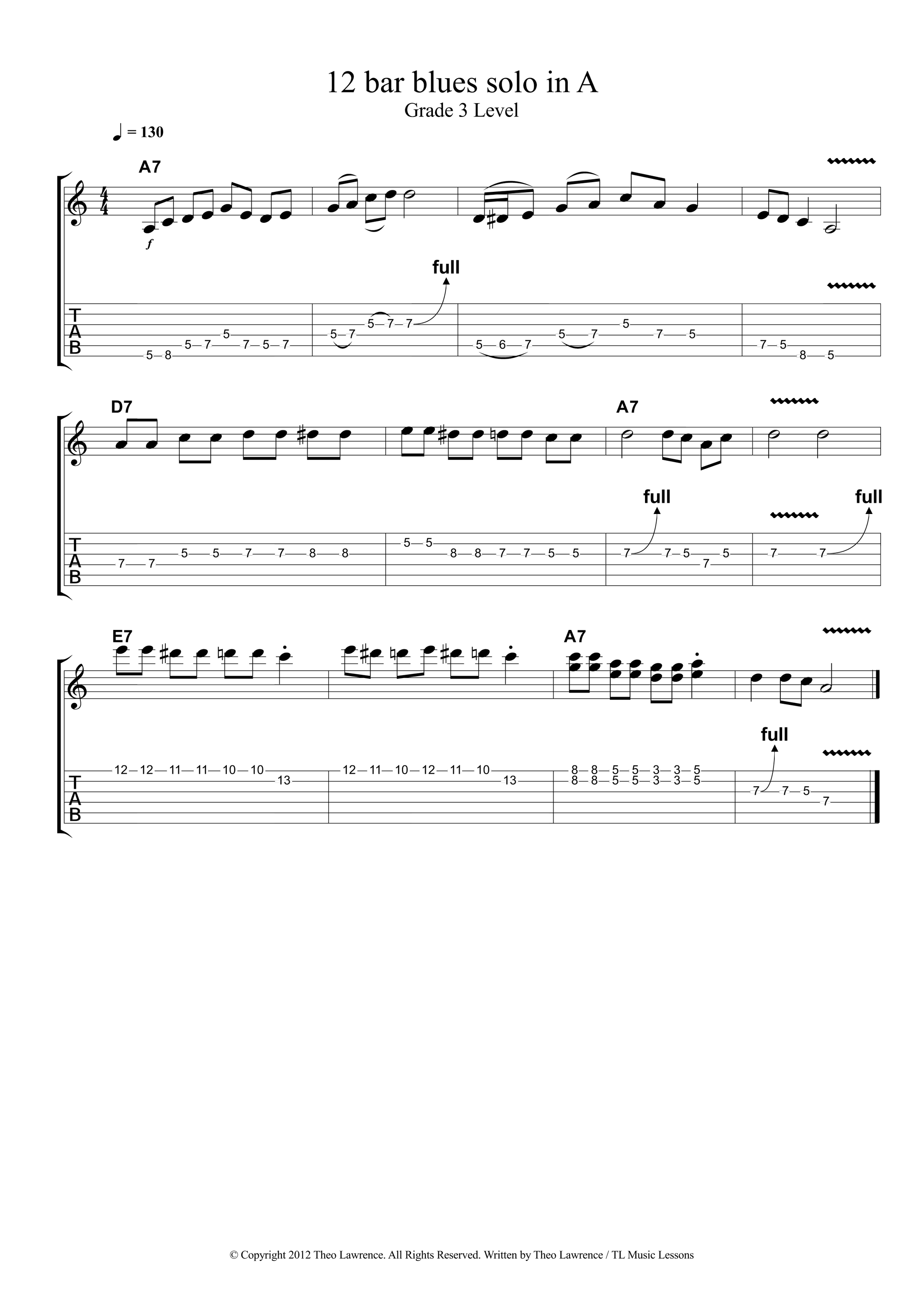
12 bar blues solo in A – grade 3

This is a nice challenging guitar solo practice exercise for grade 3 level, which could be used in a guitar lesson, or for anyone learning on their own.

There are plenty of techniques, such as bends, legato (hammer ons and pull offs), vibrato, and other things to watch out for like staccato markings. The scale used is A blues.

This guitar solo was prepared as a practice exercise for learning to blues solo in the key of A. After a few exercises like this, students can then start to reuse the creative concepts and make their own improvisations and guitar solos.

As many blues songs are in the key of A, this could also help people more in general, or also provide a good practice exercise to anyone learning the blues. This guitar solo could be played with or without shuffle, and there are also suggested chords in the sheet music for an accompaniment.

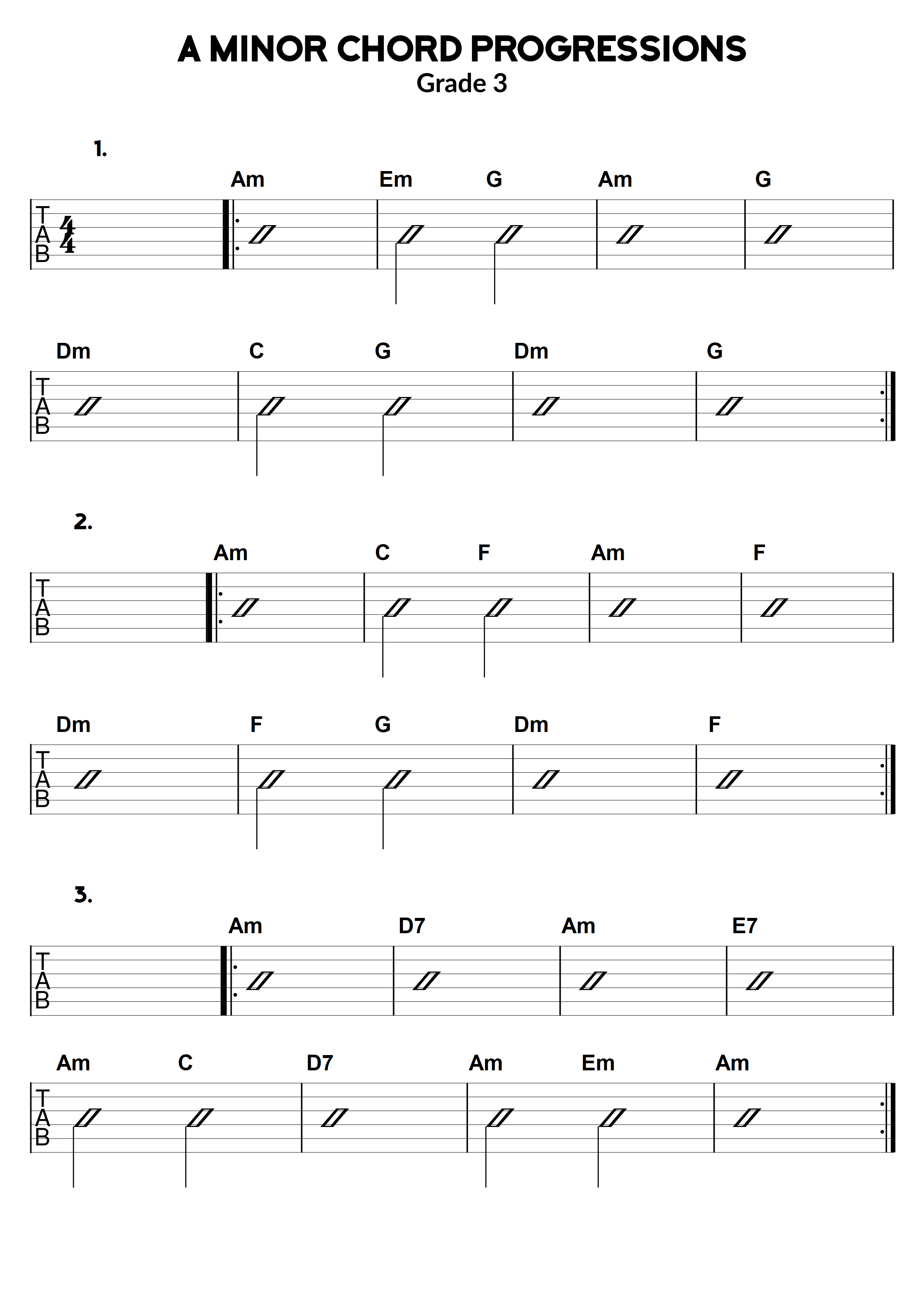
A minor Chord Progressions Exercises – Grade 3

I wrote these chord progressions to help students with their Rockschool Improvisation (based on the 2012-2018 syllabus) practicing. I would also highly recommend getting their companion guides, which have official practice exercsies. My exercises are just as an add on to these practice examples, so you can get plenty of practice in (they are not endorsed by rockschool in any way).

You are free to play the chords as open chords or as barre chords – whatever you want. Barre chords would be grade 3-4 level, and open chords would be grade 1-2 level. For anyone not doing an exam, what you do need to do is improvise your own rhythms to make things interesting and to get the most out of the sheet. If there is 1 chord per bar, it will need to last for 4 beats, and if there are 2 chords per bar, you need to play those for 2 beats each.

For the actual rockschool exam though, you only need to follow the same rhythm for each Improvisation & Interpretation exercise, which can be found in the example in the grade book. In RGT, you would be required to develop your own rhythms.

You could extend these exercises into playing them in different styles, tempos, and time signatures (although all the Rockschool ones are in 4/4).

Whilst these chord progressions exercises were written for guitar, you could definitely use these for ukulele chord practice.


Related Post: G major Chord Progressions Exercises – Grade 3 →

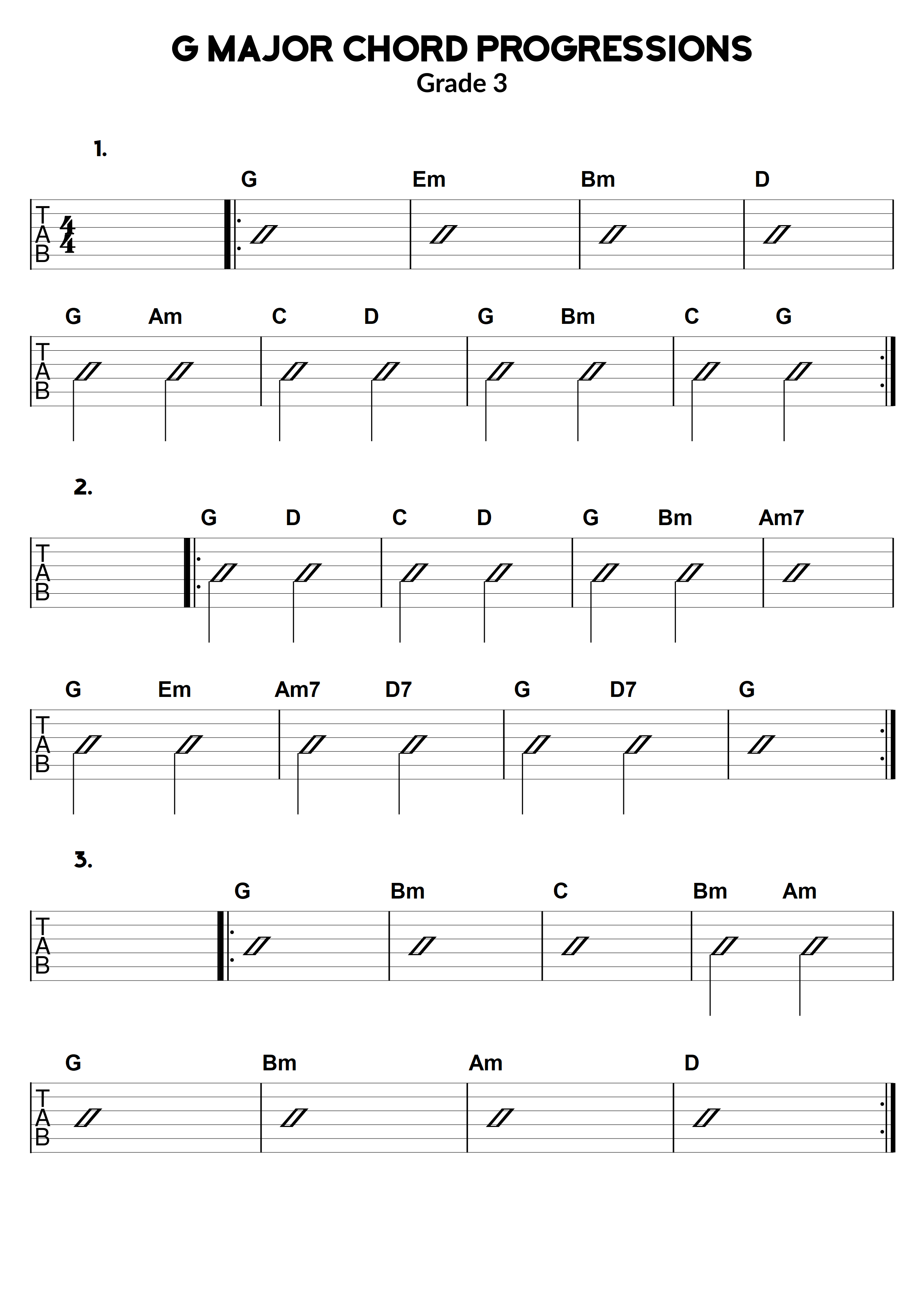
G major Chord Progressions Exercises – Grade 3

I wrote these chord progressions to help students with their Rockschool Improvisation (based on the 2012-2018 syllabus) practicing. I would also highly recommend getting their companion guides, which have official practice exercsies. My exercises are just as an add on to these practice examples, so you can get plenty of practice in (they are not endorsed by rockschool in any way).

You are free to play the chords as open chords or as barre chords – whatever you want. Barre chords would be grade 3-4 level, and open chords would be grade 1-2 level. For anyone not doing an exam, what you do need to do is improvise your own rhythms to make things interesting and to get the most out of the sheet. If there is 1 chord per bar, it will need to last for 4 beats, and if there are 2 chords per bar, you need to play those for 2 beats each.

For the actual rockschool exam though, you only need to follow the same rhythm for each Improvisation & Interpretation exercise, which can be found in the example in the grade book. In RGT, you would be required to develop your own rhythms.

You could extend these exercises into playing them in different styles, tempos, and time signatures (although all the Rockschool ones are in 4/4).

Whilst these chord progressions exercises were written for guitar, you could definitely use these for ukulele chord practice.


Related Post: A minor Chord Progressions Exercises – Grade 3 →

1 Octave major scale exercises for Grade 5-6 in 5 positions with legato and vibrato techniques

These 5 major 1 octave scale exercises are in the key of A major.

The 1 octave scales in 5 positions can get a bit laborious when you have to practice them, so why not add a bit of flair and work out your techniques at the same time? These are a requirement for RGT grade 5 and above, but anyone would benefit from learning them. When you know the scales, it means you can transfer melodies to different places on the neck to achieve different tones, and it also opens up different possibilities in terms of which techniques can be used (e.g. hammer-ons between certain notes cannot be achieved in all 5 positions).

Try playing these with and without a click at various tempos.

Also try linking two, three or even all 5 exercises together.

Exercises 2-5

Choosing the right size acoustic guitar or ukulele

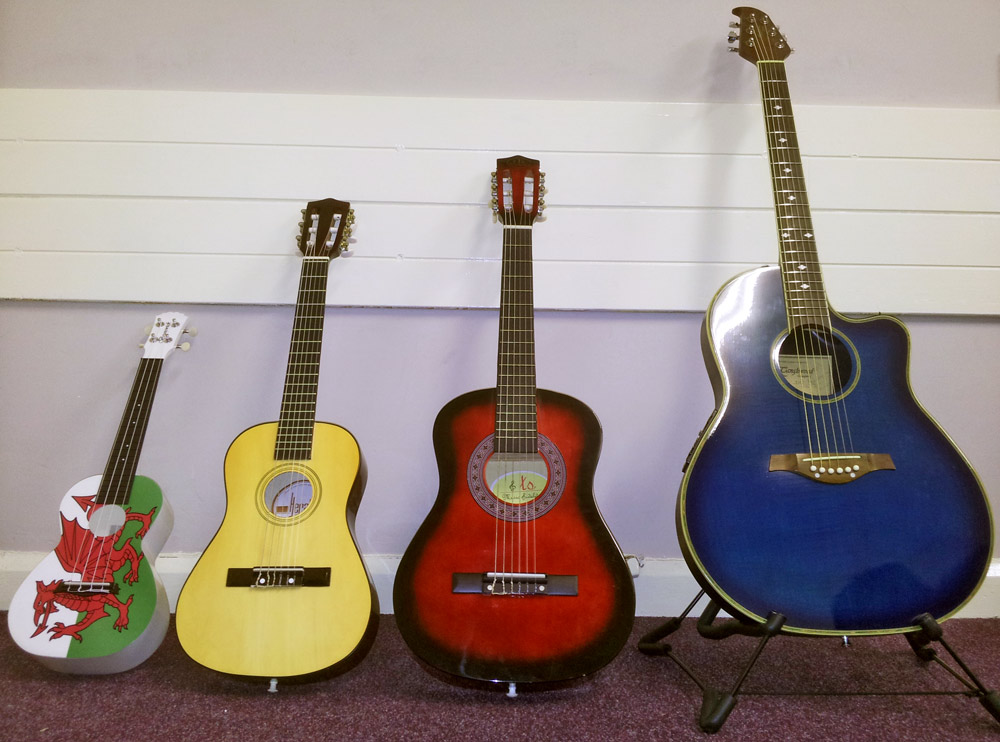
Take a look at this picture and you will see the size difference for each guitar. From Left to right, the guitars are Concert Ukulele, 1/2 size guitar, 3/4 size guitar, full size guitar. Apologies that the full size acoustic is on a stand, but it has a curved back so it doesn’t stand up on it’s own. I hope you will find this useful. The ukulele is a concert size – you can also get a smaller ‘soprano’ size, but they aren’t much different. Anyone could play either size really. If buying for someone very young, then a soprano would be the better choice. If buying for an adult, a soprano would be fine too really – they are both playable. The main playing difference here is the size of the frets, and the length of the fretboard. There is also a little difference in the sound due to the size difference.

I believe that if in doubt, buy a 3/4 size guitar – but read on for more info.

Most adults play a full size guitar, but just look at the type of guitar size that Ed Sheeran uses – his is only a 3/4 sized guitar, and he does pretty well playing it!

Generally, I would say that year 1-2, or possibly year 3, would be best to have a 1/2 size, and anyone from year 3 or 4+ would be fine with a 3/4 size. Anyone in high school would be fine with a 3/4 or a full size – but if they are quite small, 3/4 might be a better choice. Having said this, I have taught quite a few girls and boys in year 5 and 6 who have a full sized guitar and manage just fine. There are no rules really – you should head down to your local music shop and try out some different sizes, and if you are buying for someone else, ideally take them with you and get them to try out different sizes. If you are buying a guitar as a gift then hopefully my advise has been helpful to you. Remember; if in doubt, go smaller.

The main differences between a 1/2 size and a 3/4 size is that the body is smaller, the neck is a bit smaller, and the strings are a bit closer together – this makes the 1/2 size perfect for kids with small hands and small fingers, because they will find it easier to play. They will however grow out of this size, and find it difficult to play when their fingers get bigger or longer.

The main difference between the 3/4 and the full size is the width of the body, and also the depth, meaning that they can be tough to hold comfortably for smaller people. There are different types of full size acoustics too – I quite like the rounded back on mine, because some of the bigger guitars are quite chunky and uncomfortable – particularly if you are using it all day to teach with like me. There can be a trade off with sound though – usually the bigger the guitar, the richer and more rounded the tone is.

Ukulele

The ukulele on the left is a concert size, and the ones on the right are both Soprano.

Chord inversions, Slash Chords, Alternative Bass Notes – A quick explanation

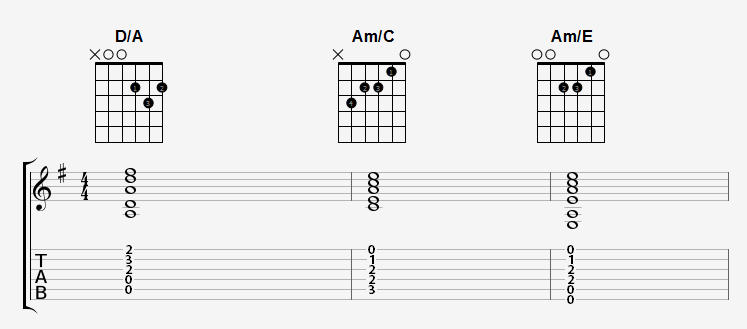
You may have seen chords like Am/C or G/F#. You may have just learned the chord without understanding it. You may have panicked and not played it.
Here is a quick explanation of how it works

The first part of the slash chord is the main chord being played. Some of the slash chords add a lower note, and some take away the lowest notes and replace them with the second part of the slash.

For example, on Am/C, it’s mainly the Am that’s being played, but with an added C note. In this case, the ‘A’ root note is not played, because you will play the C instead.

In another example, for D/A, you are mainly playing a D chord, but you also play the A string as the root note, so in this case no notes have been removed.
Is it an inversion?

An inversion is when you use one of the notes that make up a chord (eg. C E G = the C chord), and place one of those notes as the lowest note (e.g. play the low E string and you get C/E).
When is it not an inversion?

When you add a note that’s in the same key, but wasn’t in the chord initially. For example, G/F# is not an inversion; it’s just called a slash chord with an alternative bass note, because the regular G chord is only usually made up of the notes G, B and D. An inversion of G would be G/B or G/D.
Further Reading

There is some quite good info here that shows you various chords: http://www.scenicnewengland.net/guitar/chords/slash.htm


5 Ukulele and Guitar chord progressions in A major using A, D and E chords – Grade 1-2

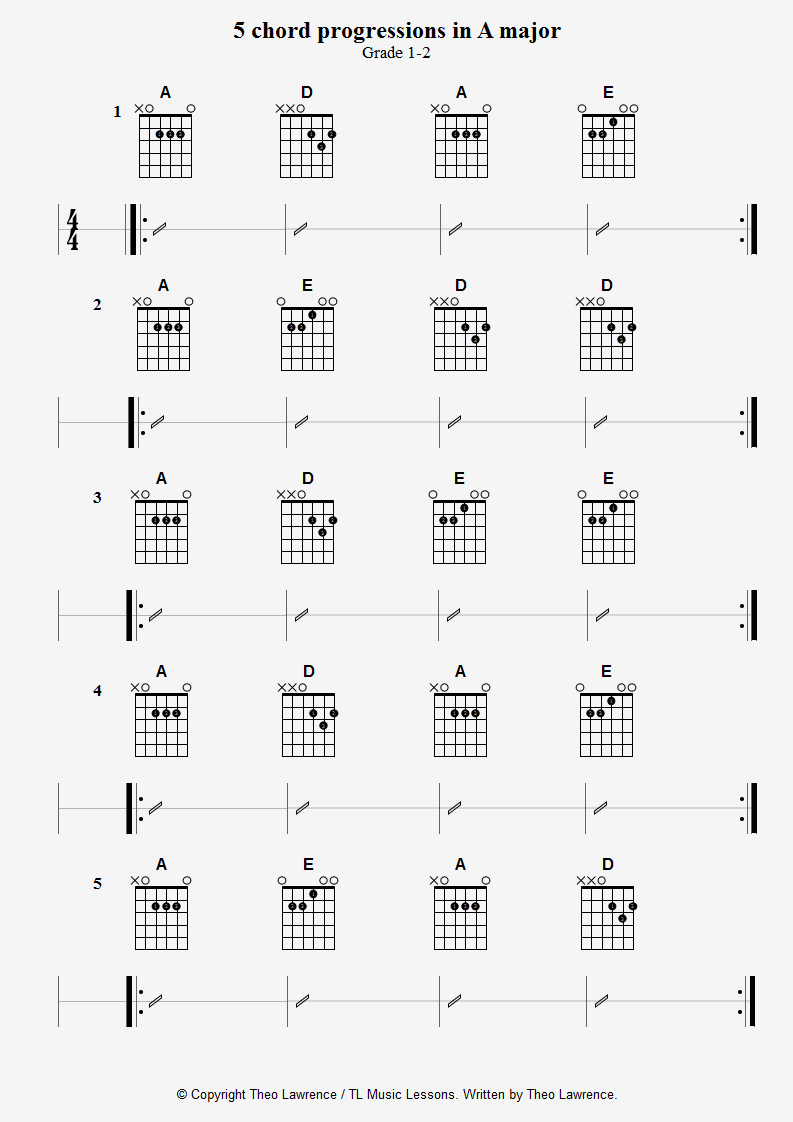
Above, is the sheet for guitar.

Using 3 open major chords we have 5 chord progressions to practice. You could strum each one once, or maybe 4 times each, or make up your own rhythms.

You should look for any ‘cheats’ for changing the chords quickly. Rather than taking the fingers off completely for each chord change, look to see where the fingers need to navigate from and to for each chord. For example, from E to A on the guitar, the 1st finger needs to move up 1 string and 1 fret, so this is a simple diagonal movement.

If you found these free chord progressions useful for learning or teaching with, please check out my guitar ebooks with 100 chord progressions in each:

100 beginners chord progressions for Guitar


Ukulele

For the Ukulele, the hardest chord here is E. There are several workarounds for the “Horrific E major Ukulele chord”, but this is the one you should try and play first. It will take a while, and small fingers may not cope with this. I have included a sheet below for Ukulele beginners, which replaces the E chord with an E7 chord. E and E7 sound fine together, so you could play these chord progressions in a group with both ukulele and guitar players and they would still sound right.

If you found these free chord progressions useful for learning or teaching with, please check out my ukulele ebooks with 100 chord progressions in each:

100 beginners chord progressions for Ukulele

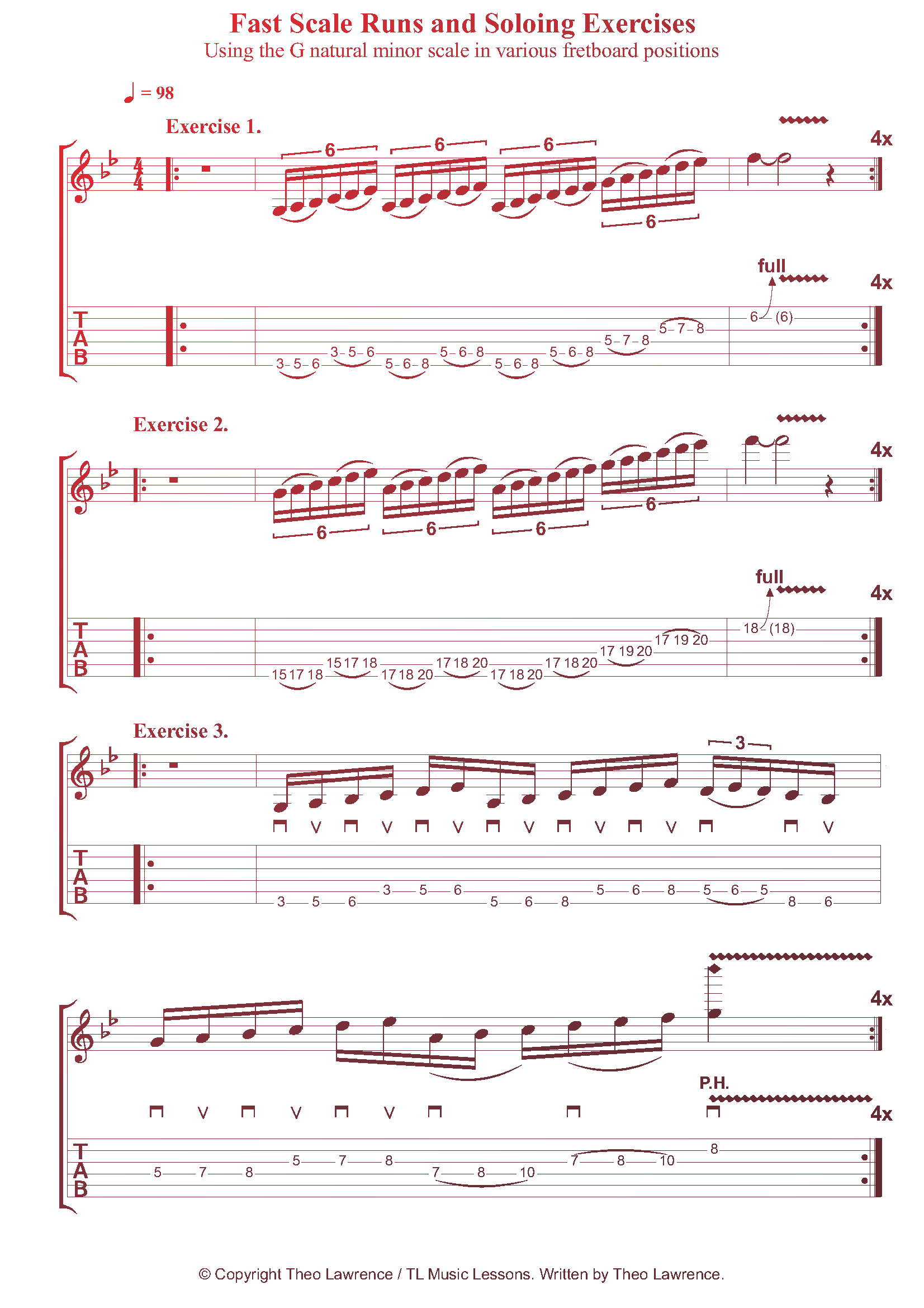
6 Guitar Shredding Exercises – Fast Scale Runs and Soloing Exercises in G minor and F# minor – Lead Sheet – Rockschool

Get Free PDF Downloads →

About the Difficulty Levels

These are written for grade 8 level, but it wouldn’t hurt a grade 5-7 player to try them at the slower speeds. The PDF file in the key of F# minor is the one that fits with the song ‘Lead Sheet’ from the Grade 8 guitar 2012-18 Rockschool syllabus.

Guitar Tab and creative concepts for preparing the faster parts of the guitar solo for the 2012-18 Rockschool Grade 8 piece “Lead Sheet”

These exercises came about from preparing for the guitar solo in the 2012-2018 Rockschool Grade 8 piece “Lead Sheet”. They are not endorsed by Rockschool in any way, but they are designed to help players with ideas of the types of things they could do for this solo – which is entirely from my perspective, as a guitar teacher with 5 years teaching experience.

These 5 exercises are meant to build up your speed for shred style rock solos, which would also work with metal, as the Lead Sheet song is based on a lot of ‘Nu-Metal’ artists, as cited in the book.

You will need to remember that this is a series of 2 bar exercises, and for the “Lead Sheet” song, you will need to prepare an 8 bar solo. Please do not copy these exercises verbatim and stick them together for the exam, but you could draw inspiration from the ideas and make them your own. Remember to build an interesting guitar solo (one that will score the most marks), it needs to ‘tell a story’ rather than ‘filling the air with a thousand notes’, but it does need to show off a competant level of speed and techniques at this level. You need to be musical, and like the example on Track 5 of the CD, the guitarist makes it musical. It has plenty of the fast sextuplet shredding style, but it also has some slower 16th note groovy soloing, which sounds a little funky too. As a whole, the solo seems to be modeled on Tom Morello’s style (Rage Against The Machine), so for more ideas along those lines, go check their music out – they have plenty of guitar solos in their back catalogue.

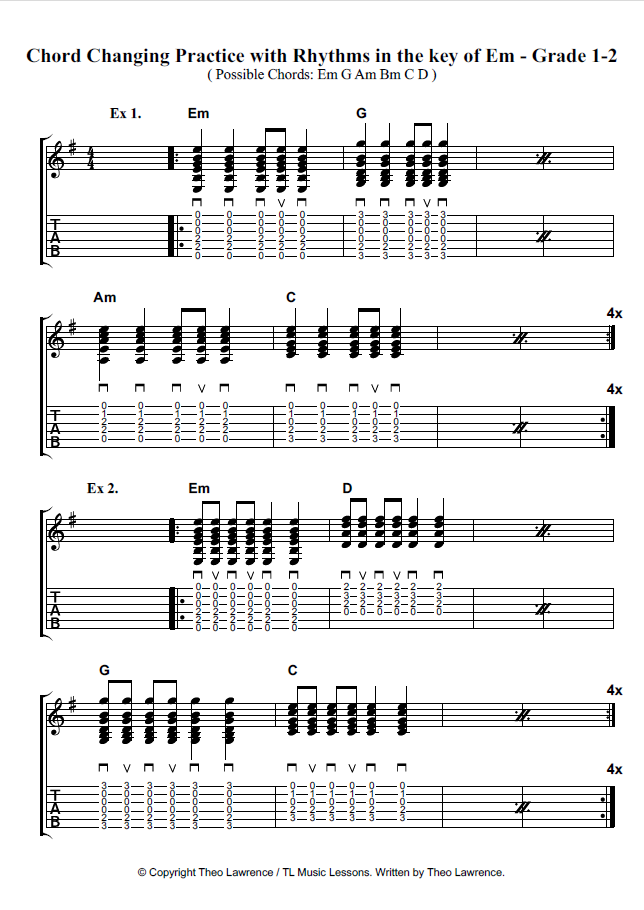
Chord Changing Practice With Rhythms In The Key Of Em – Grade 1-2

Exercise 1

This exercises adds quarter note and 8th note rhythms to an Em, G, Em, G, Am, C, Am, C chord progression, which is to be played 4 times around.

Look out for the down and up strokes in the notation to tell you which direction to strum. If you are unsure what this is or how to do it, go check out this useful article on How Strumming Is Notated In Music – By Bryan Mulford.

Also, look out for the bar that has the two bar repeat symbol. This means to repeat the previous 2 bars.


Exercise 2

Using a chord progression of Em, D, Em, D, G, C, G, C, we will apply a rhythm of 1 + 2 + 3 4. This sounds a bit like ‘quick quick quick quick slow slow’.

The strumming pattern is down, up, down, up, down, down.

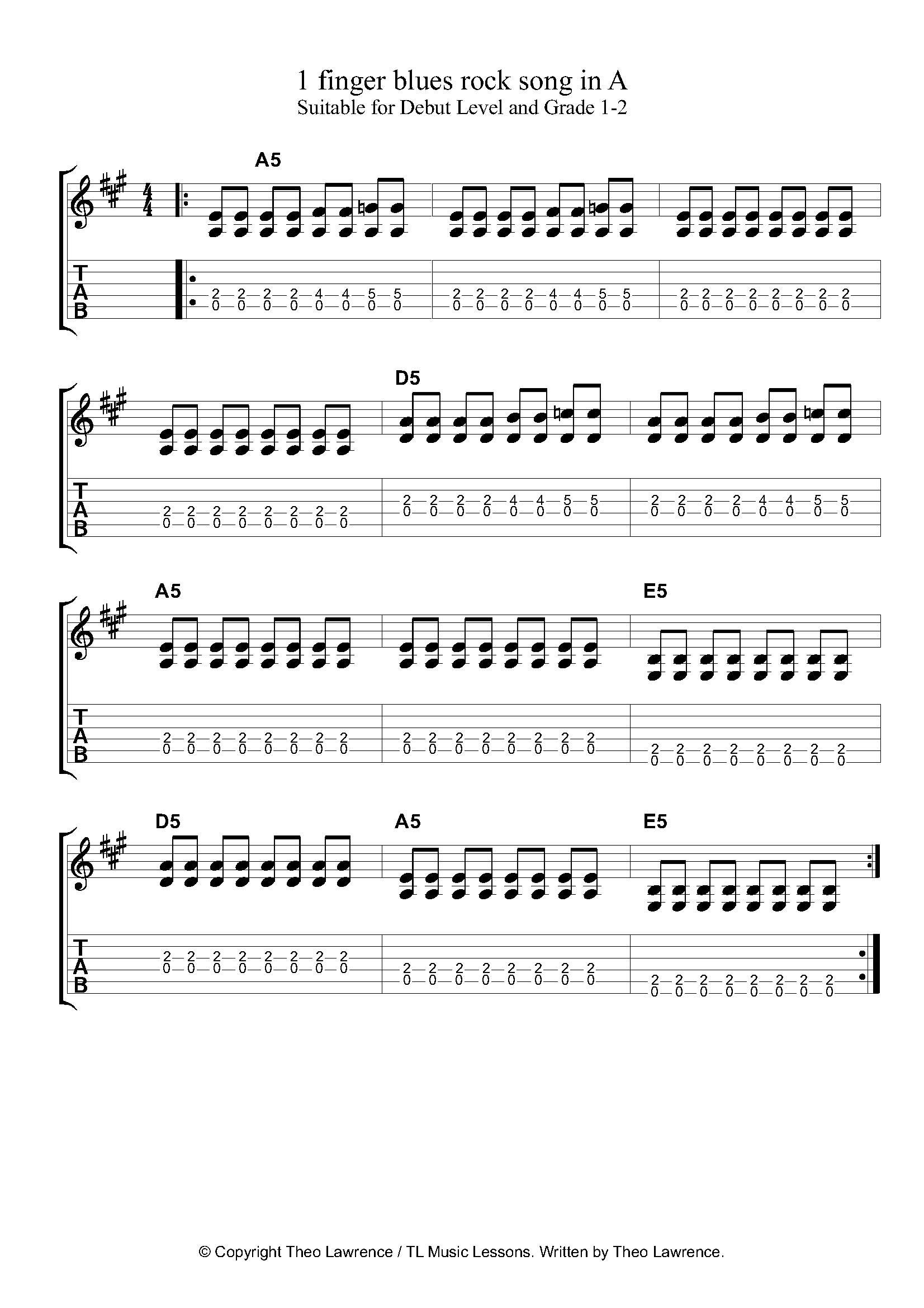
1 finger blues rock exercise in A with fret variations around the power chord shapes – for beginners

For this blues rock exercise you only actually need 1 finger!

You will be playing 12 bar blues in no time! You could however use your third finger for fret 4 and little finger for fret 5 if you want to develop those fingers and play at an even faster tempo.

The blues rock exercise is based around a 12 bar blues pattern in E blues, and the chords have been replaced by power chords. This is fairly common practice for some blues riffs, especially as it deviates from the basic power chord by moving up to fret 4 and 5 – you really get the blues feel by doing this. The great thing about this, is that the same fret pattern of 2 4 5 fits for each of the E5, A5 and D5 chords, so it’s quite an easy pattern to get to grips with, while at the same time you are really getting somewhere on the guitar and making something that sounds musical. There is a lot of scope for variations with these fret patterns – this is just one example.

Work hard on repeating and practicing this blues exercise so that you can play it fairly fast eventually.

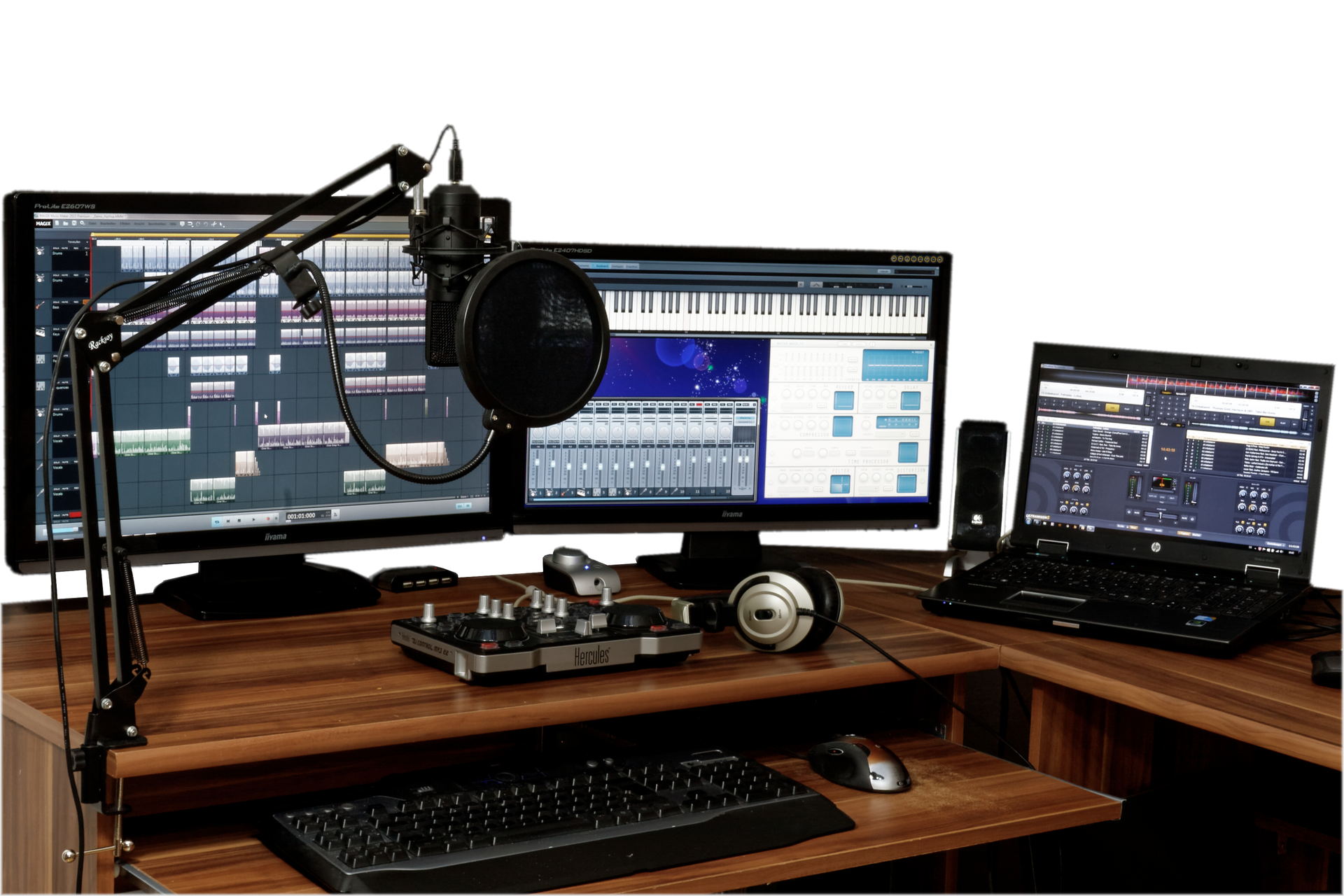
5 Beginners Guitar Home Recording Tips

Here are some tips that I wrote when I started out home recording. They will take you through some of the basics and logistic thoughts that you are likely to come across yourself.


  1. Neighbours – When I first started recording music I worried about upsetting the neighbours. Since starting recording however, I have come to realise that my neighbours are just as nosiy as me if not noisier. I have to contend with grass cutting, dogs barking, cars coming and going and passing by, shouting, wind chimes, kids playing and kicking footballs, hammering and general DIY out side, oh and a steam train that blows it’s whistle when it comes past our little country village. So when you sit down to record and start worrying about upsetting the neighbours with your recording levels, just remember these things, but try to be respectful of times of day you are recording and keep noise levels to a similar level to all the background noise you have to endure. It’s actually usually fine to record a guitar amp at a fairly quiet volume, so I’m not sure if anyone hears it anyway when I record. It’s more about recording the right sounds from the amp, and sometimes a lower volume will be better. Note that the closer the mic is to the amp, the bassier the sound, so you don’t want to fall into that trap of moving the mic closer to make up for low amp volume.
  2. Where to sit – If you are on your own, you need to be at the computer so you can stop and start quickly if you are recording on your own, so sit at your desk, or in front of your laptop wherever that is. This is not ideal because many movements, computer noise, and all mouse clicks will be heard if you are using a microphone in the same room. Make sure to leave time at the end of each recording before clicking that mouse! If you are recording an acoustic guitar, the mic can be placed a few feet away from the guitar with good results, so swivel your chair to the left or right from the computer, and set up your acoustic and mic there to the side.
  3. Amp / Mic Placement – As you are going to be sitting in front of your computer, you will need to put your amp in another room if you are using a microphone to pick up the sound, or at least as far away as possible in the same room as your computer. This goes for anything you are recording with a mic – get it away from the computer if you can. Ideally put the guitar amp in a room with the least ambient noise and run the cables under the door. For me it’s in a slightly noisier room than the one I sit in to record into the computer, but that’s just where my work station is for now. Ideally i’d love to go into a recording studio and have a dead room, but we can’t always have everything. If you are just demoing stuff there are no problems anyway, but if you are going to release anything you will want to carefully listen to the recording for any background noise and record it again if need be. It’s not the end of the world if you need to re-record especially if you consider you are not paying any studio fees; it’s only your time you are spending, and if you make sure to enjoy what you are doing and don’t pressure yourself, then it’s not time wasted and it’s all experience and learning.
  4. Time Constraints – If you are new to home recording, understand that it will take time to go through the process of writing songs, recording them, and then releasing and promoting them. If it is your first time, don’t set yourself a deadline to get it done, because you will probably get anxious and stressed and take longer than if you had no deadline. Don’t let the drive of wanting to make the music get in the way of enjoying creating the music and enjoying the process of recording it. It SHOULD be fun recording and writing music! I see recording music as a way of practicing and improving on my instrument, which has an amazing by-product of having something to show for it at the end. It’s much more rewarding than practicing scales to a click (keep doing that though)! The more you go through the writing and recording process, the more experienced and quicker you will be, so in the future maybe you can give your self a block of time to record a set of songs based on your past experience of how long things take, but I would still not recommend setting a deadline on your first few rounds of recording. Allow your self time to be creative and don’t get stressed doing something that should be fun. Sometimes you do need to grind out the mix to finish something off, perhaps you know you won’t have time to finish it for a long period of time. That’s up to you. There’s many ways of looking at it. I think though that if that’s your default method of working, or if you push yourself hard too often, there will come a time when you burn out and need to take an even longer break.
  5. Record a rough draft first – When you think you have come up with a song, record it roughly first using a DAW, with single guitar tracks. Record it with a click so you can copy and paste sections easily if the structure needs to change. When you are happy with the structure, you can then start doing things like getting the perfect guitar sound, double tracking guitars, making sure mics and amps are positioned properly and that the guitar is fine tuned. Often you will discard sections after rough drafts, so being able to chop them up and listen back to it on the computer is really useful. In the long run this is almost always the fastest way of recording a song, even though it seems like you are adding in an unneccesary step. Otherwise, you tend to record many more of the ‘perfect sounding’ takes to get the song finished.