All That Jazz: How to Get Started Playing Jazz Guitar

Photo credits: Marius Masalar and Katie Montgomery.

Guest post by Know Your Instrument.


Eager to begin your jazz guitar journey but don’t know where to start? You’ve come to the right place to get the top tips for jazz guitar beginners. Here we’ll discuss the things you need to do first when you set out to become a jazz player.

Ready? Here we go!

Get the basics down

We’re talking about guitar basics. If you’re going to be playing jazz, it’s a must for you to already be able to play the guitar, and play it well. If you are confident in your playing skills, have a good mastery of chords and scales and have a repertoire that includes a few jazz standards (‘The Girl From Ipanema,’ ‘My Funny Valentine,’ and ‘Fly Me to the Moon’ are a few examples), then you’re ready to focus on jazz music.

If you’re not quite there yet, then we suggest getting more practice time in. Supplement your learning with more songs from various artists so you can further develop your ear – and your playing style – for jazz music.

Get a good guitar

While you can definitely get a good jazz sound from a standard solid-body electric guitar, if you really want a really nice jazzy tone then you’ll have to get a guitar that’s designed for playing jazz music. Solid-body electrics are built more for rock, but there are those like the Fender Jazzmaster that’s really built for jazz.

Of course, nothing beats semi-hollowbody and hollowbody guitars when it comes to making jazz music. Some of the best guitars for jazz are of these body types. Check out the Gibson ES-335, Epiphone Sheraton II-PRO and the Ibanez Artcore AS73, which are all semi-hollow, and the Epiphone Emperor Swingster, which is a hollowbody guitar. For budget-conscious beginners, the Epiphone and Ibanez models come highly recommended.

Learn to read music


Legendary jazz guitarist Wes Montgomery couldn’t read notes but he didn’t really have to, being the fretboard genius that he was. Unfortunately, many of us don’t have the same natural, innate ability to create melodic lines and navigate our way across the fretboard without the aid of music sheets.

So, unless you have Montgomery’s talent, reading music is a skill you must learn to become a good jazz guitar player. This skill is a plus too if you’re looking to teach guitar or compose your own music in the future.

Expand your repertoire

Once you’ve started to listen to more jazz tunes and read music, you can now increase your repertoire and really learn to play jazz. Start with songs you like – learn to play the melody first and then the chords. Break down each section and get it right before moving on to the next.

The more you listen and play, the more you will be able to internalize the rhythms, melodies, harmonies and the various song forms in jazz music. You won’t simply be imitating or memorizing jazz standards, you will actually be expressing jazz. This will not only help you in doing improvisations but also in becoming a better jazz guitarist overall.

Final Word

The most important thing you need to do when you start learning jazz guitar is to develop a thirst for knowledge. Keep on learning and honing your playing skills and technique. Be conscious of what you still need to know and improve on to become a better player and work on it. Practice regularly and soon you’ll be able to improvise with ease, play sophisticated solos and express your own musical voice. Good luck!

Connection Between Guitar Fretboard And Piano Keyboard

  • How are guitar fretboard and piano keyboard related?
  • Will it be easier for guitarist learn piano notes or pianist learn guitar notes?

Today, our guest Neil from Sublimelody.com brings us a visual guide to answer two questions above.

Let’s get started.

1. Music Notes And Fret-Strings On The Guitar Fretboard

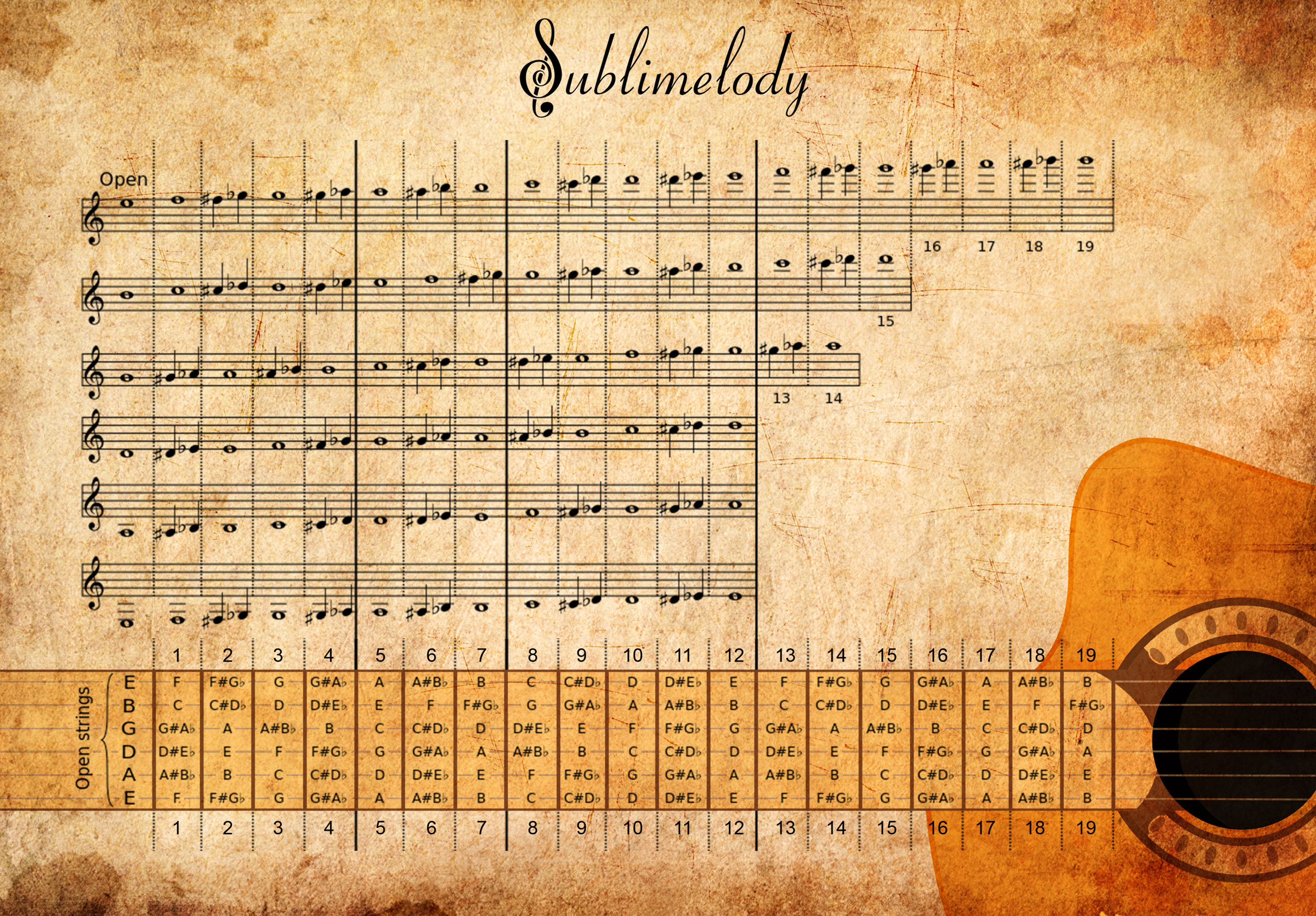
The diagram below shows you the connections between music notes and their corresponding string-frets on a standard classical guitar fretboard.

As you already know, we use the treble clef in guitar sheet music.

Each music note on the sheet music often has two or more corresponding string-frets on the guitar fretboard.


We call the string numbers by standard order. From the bottom to the top of the diagram above:

  • E (on the bottom) is the 6th string
  • A is the 5th string
  • D is the 4th string
  • G is the 3rd string
  • B is the 2nd string
  • E (on the top) is the 1st string


Let’s see how we can use the chart above to read music note and its corresponding string-frets:

Where is this note on the fretboard (G4)?

Look at the diagram above, we can see its positions on the fretboard are:

  • 5th string and 10th fret
  • 4th string and 5th fret
  • Open 3rd string


It’s not so hard, isn’t it?

Well, from a pianist point of view, it’s a bit complicated to learn guitar notes. Since to play the G4 note, we have 3 positions to choose from.

And each string is like a mini-piano-keyboard. Therefore, we have 6 keyboards!

Now, let’s move to the next section to see how music notes and piano keys are connected.

2. Music Notes And Keys On The Piano Keyboard

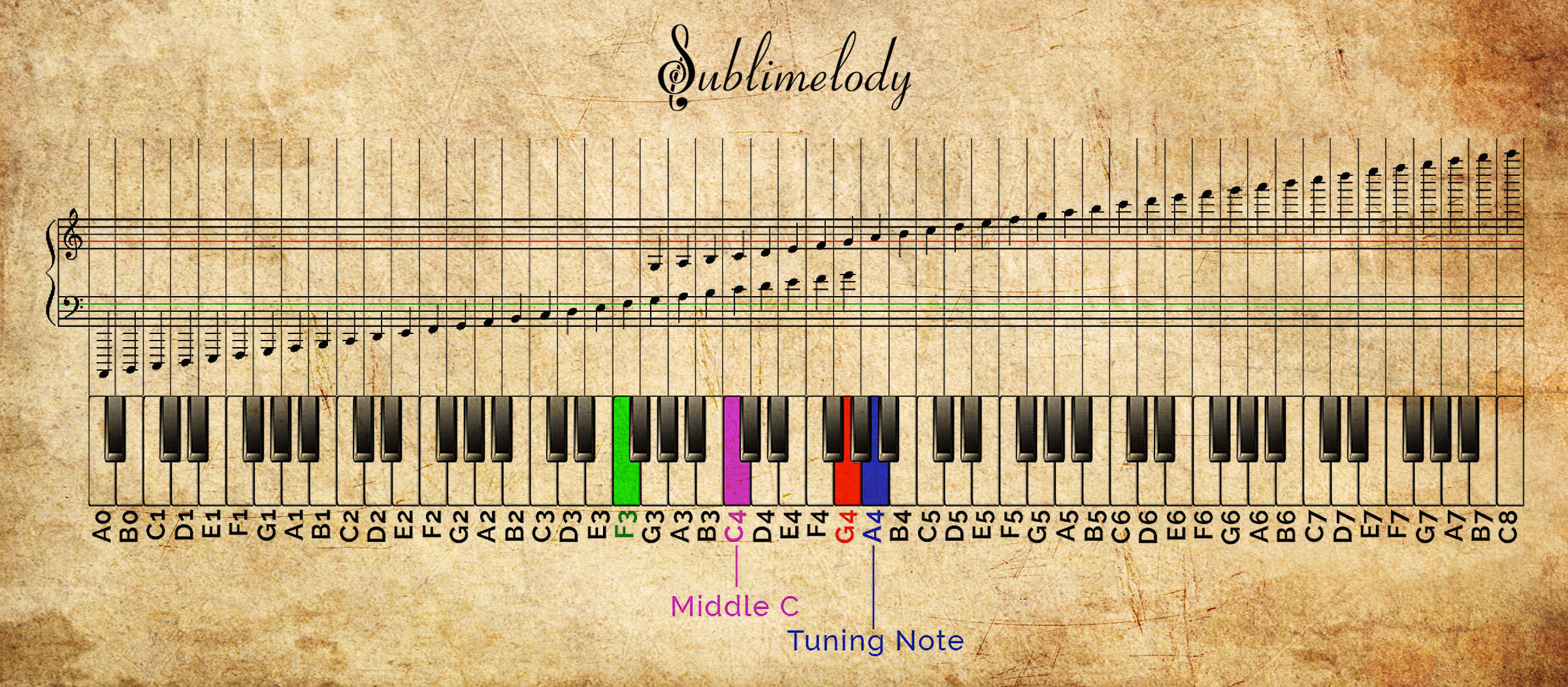
The diagram below shows you the connection between music notes and piano keys.

It may seem complicated at first, but if look closely, you will see that’s pretty simple.


From a guitarist point of view, a piano keyboard is just a string of a guitar. Each piano key is similar to a guitar fret.

The difference is the this “piano string” is much longer and presents wider pitch range than a guitar.


So, learning piano notes seems pretty easy for a guitarist.


Also, you may wonder what is the name of the clef below the treble clef. It’s the bass clef.

In piano, the left-hand plays notes on the bass clef and the right-hand plays notes on the treble clef.


If you want to learn more about reading piano notes and piano keys, and how to do sight-reading fast without memorizing a bunch of facts, click here to visit the visual guide from Sublimelody.


3. The Connection Between The Guitar Fretboard And The Piano Keyboard

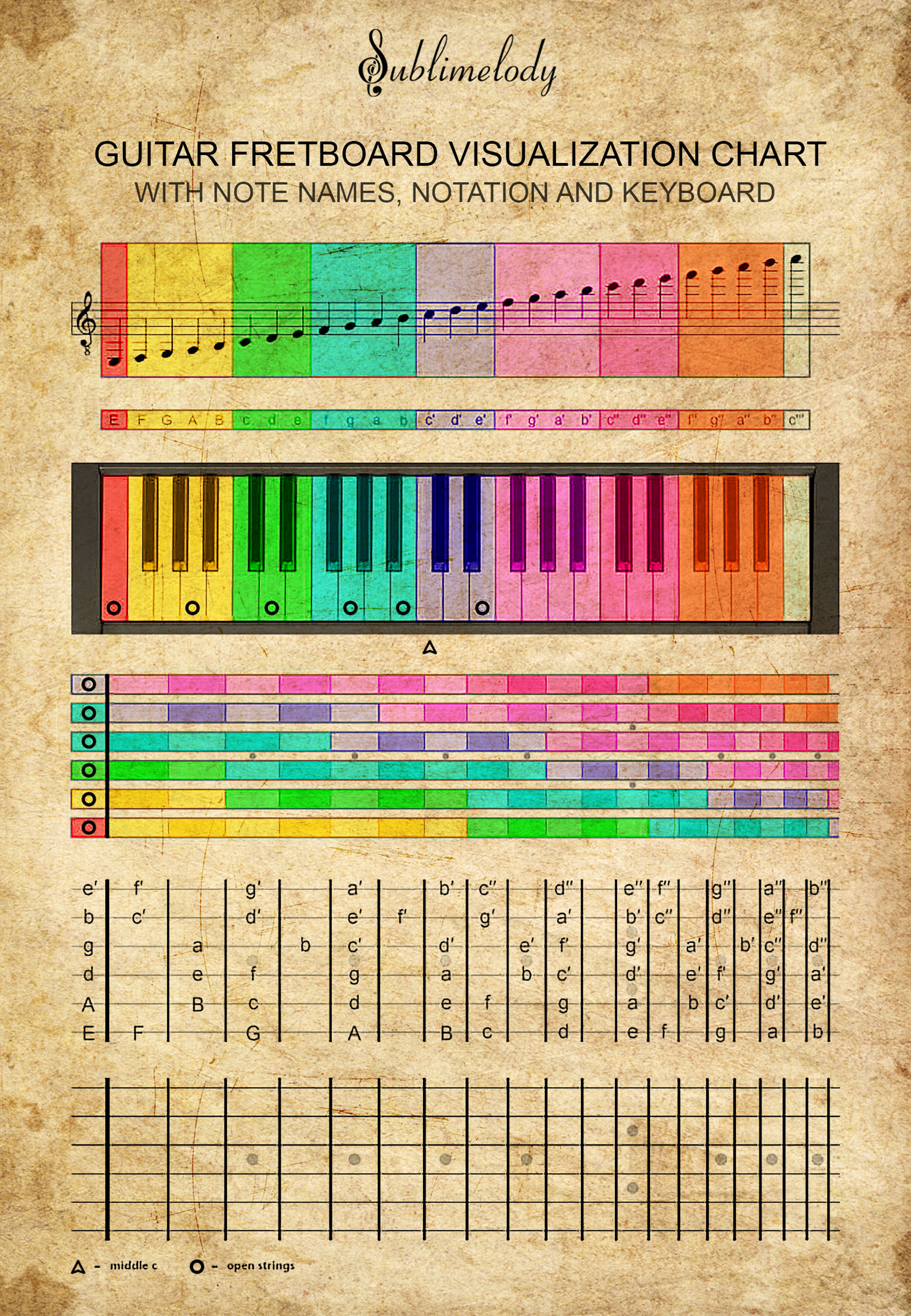
Combine 2 diagrams above, and we have the following illustration:

Now, I guess you’ve got the point how music notes, piano keys, and guitar string-frets are connected.


And that’s it for my guide.


If you have any question about this guide, please visit sublimelody.com to get in contact.

8 Great Albums and EPs Recently Released by Female Musicians

Featured Image is Crimson Apple – New Album expected in 2019.

This small list is a showcase of some of the albums and EP’s that I’ve been listening to with female musicians in. I’ve grown up around female musicians my whole life, so it’s strange for me to mainly see men playing instruments at the majority of concerts I’ve seen. If you don’t count singers, there are so many more male musicians represented in music and at music festivals, but it’s certainly changing.

Turn Out The Lights – Julian Baker

Boygenius EP – Boygenius

Dissolve – Tusks

The Sun Will Come Up, The Seasons Will Change – Nina Nesbitt

Flow State – Tash Sultana

Something To Tell You – HAIM

Hunter – Anna Calvi

Under Northern Skies – The Glass Child

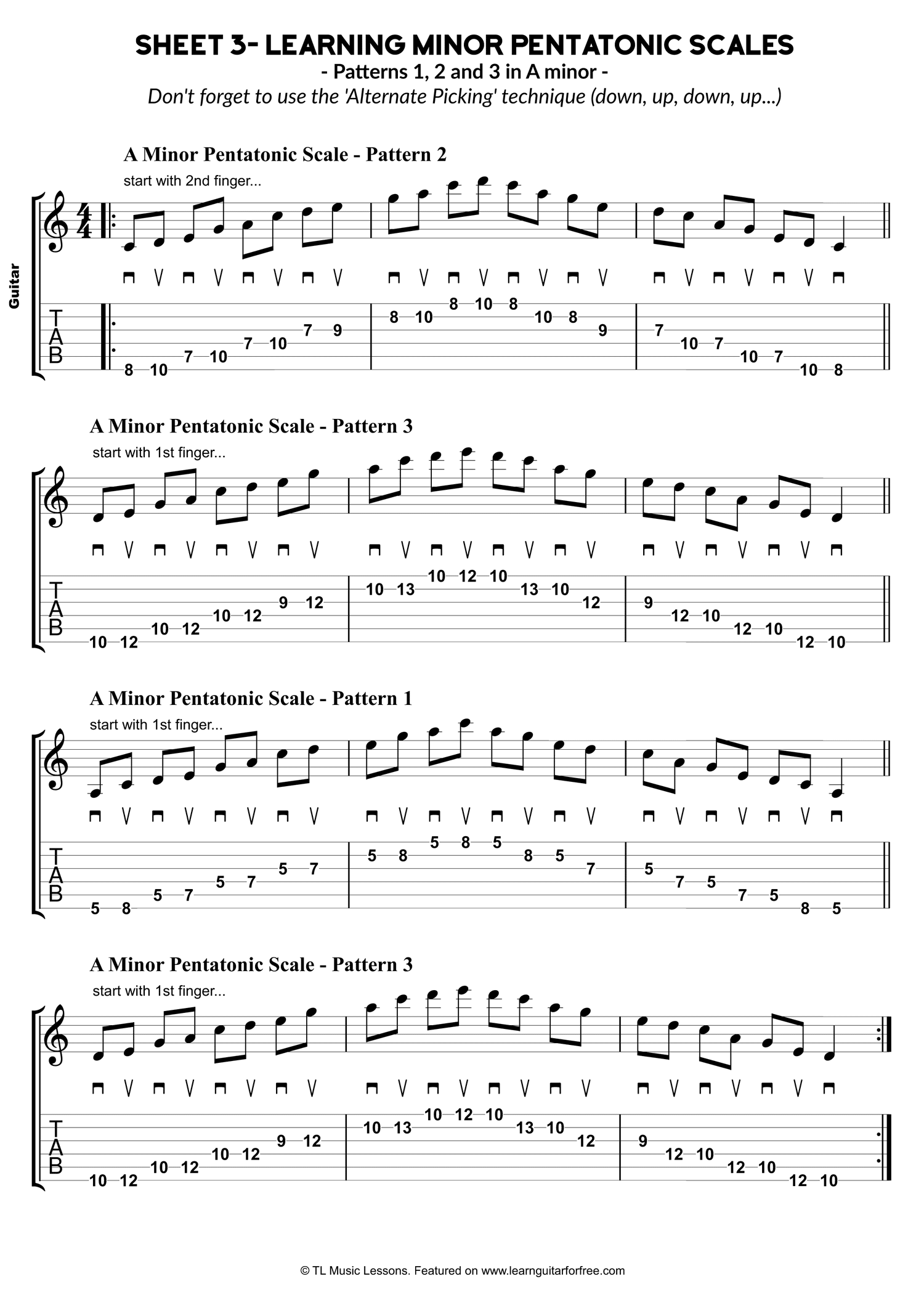
Sheet 3 – Learning Minor Pentatonic Scales – A minor – Patterns 1, 2 and 3

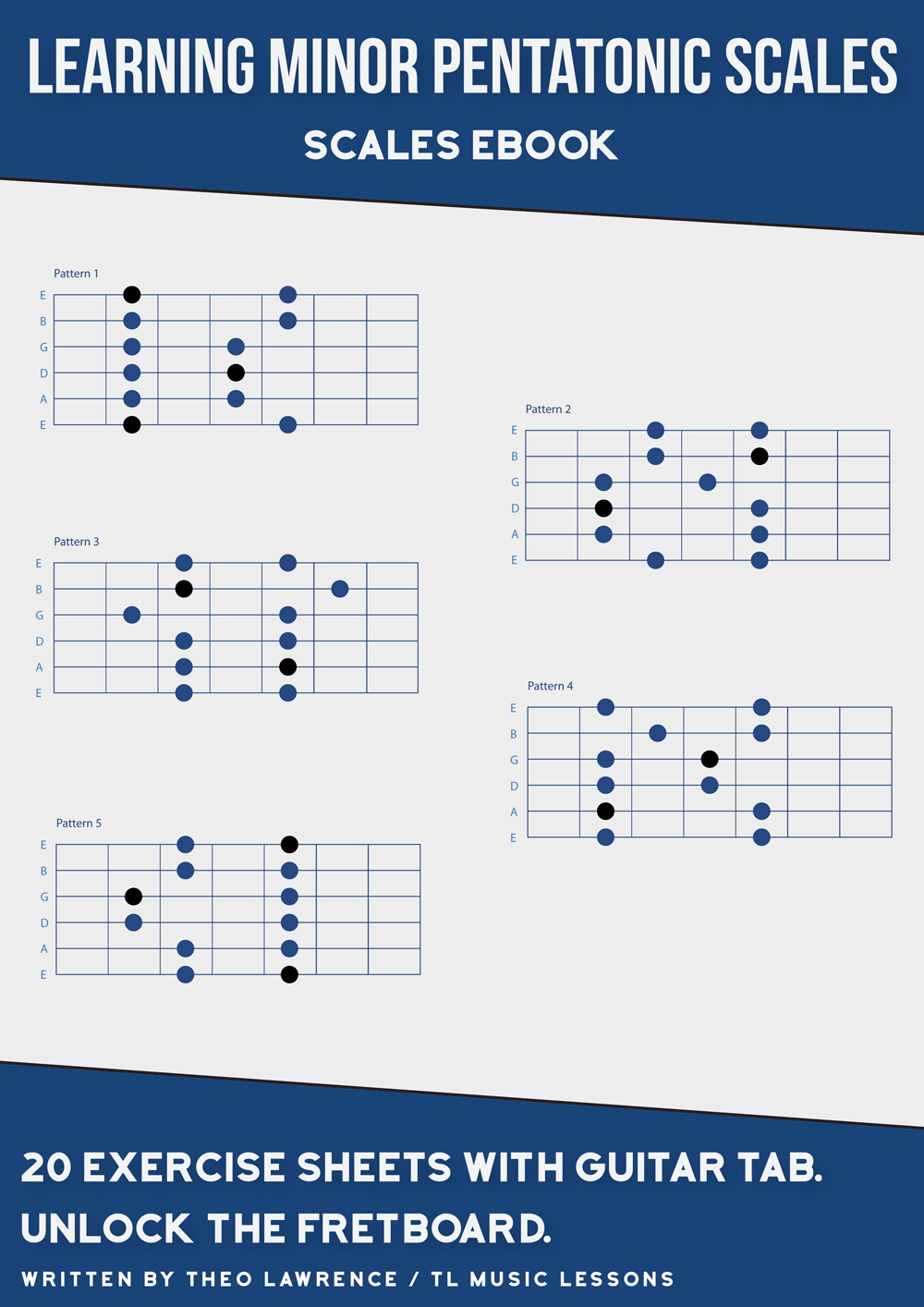
This sheet progresses on from Sheet 2 and is part of an ebook called Learning Minor Pentatonic Scales.

Just like we did in the last sheet, you will be working on patterns 1, 2 and 3 but this time, 2 frets higher in the key of A minor.

More Sheets in the series…

← Sheet 2


Related (Premium): The sheets in this series are from a 25 page PDF ebook: Learning Minor Pentatonic Scales

(PREMIUM) – First Guitar Book – Easy Reading Scales, Riffs & Melodies

Buy Now →

A Ukulele Version is also available.

  • PDF ebook
  • 20 pages
  • Easy to read design
  • Song melodies
  • Scales
  • Riffs
  • Useful for beginners of all ages.
  • Includes 3 blank template PDF files for writing your own scales and exercises

Contents

  1. Front Cover
  2. Contents
  3. Introduction
  4. How To Read The Music – Part 1
  5. How To Read The Music – Part 2
  6. Twinkle Twinkle Little Star (FREE)
  7. Happy Birthday
  8. Sheet 1 – Guitar Scale Exercises (FREE)
  9. Sheet 1 – Rock Riffs
  10. Camptown Races
  11. Sheet 2 – Rock Riffs
  12. Amazing Grace
  13. Sheet 2 – Guitar Scale Exercises
  14. Morning Has Broken
  15. Sheet 3 – Rock Riffs
  16. Sheet 3 – Guitar Scale Exercises
  17. Can Can
  18. Sheet 4 – Guitar Scale Exercises
  19. Sheet 4 – Rock Riffs
  20. Mexican Hat Dance

People that might find this book useful

  • Beginner Guitar students of any age group.
  • Guitar teachers can print the book or single sheets for their students and teach it to them.
  • Get used to the basics with this easy to read book before moving onto standard tab and notation.
  • Parents may be able to teach their children with this book.
  • Some may be able to teach themselves the basics with this book.

About The Book

This easy reading ebook is a compilation of 9 years teaching guitar and preparing lesson sheets for my students. I developed the easy reading design for complete beginners. It is based on normal guitar tab, but simplifies it so that there are no distractions, and it’s huge and easy to look at rather than the numbers being small.

I tested some of these sheets over the last 6 months until I was ready to create the rest of the book. I have found that the format that I have created takes away any unnecessary distractions in order to teach the basics without distractions and confusion. I believe it solves problems with reading the music for beginners of any age, but particularly for young beginners.

I decided to create this range of sheets like this one to make both my life easier and to help my students get to grips with reading tab quicker for playing scales, melodies, public domain songs, traditional songs and riffs. I have created the sheets using Adobe Illustrator.

There are different ways of playing the scales so it’s ok to do what works for you but don’t just use 1 finger for all of it! Younger players think it’s faster at first, but it’s really not in the long run. If you have frets 1 2 3 and 4 to play in an exercise, you could use all 4 fingers to play it (1st, 2nd, 3rd and 4th finger). Use this technique of ‘one finger per fret’ where it seems comfortable to do so. If a scale only has 0, 2 and 3 in it, then you could use just your strongest 2 fingers to play it (1st finger for the fret 2’s and 2nd finger for the fret 3’s).

Guitar teachers can use this ebook in their own teaching and they are welcome to print physical copies for their students.

Buy Now →

(PREMIUM) – Learning Minor Pentatonic Scales – PDF Ebook

Buy Now →

Contents

2 – Contents
3 – Introduction
4 – The 5 Moveable Scale Shapes
5 – Exercise Sheets 1 – 13
18 – Full run through of all 5 scale shapes in various keys
24 – All possible A minor pentatonic scale positions covering the whole neck

Self published in 2018 by TL Music Lessons.

Introduction

People that might find this book useful

  • Guitarists wanting to learn how to play guitar solos and improvise along with songs.
  • Guitar teachers can print the book or single sheets for their students.
  • Guitarists can teach themselves how to play the 5 minor pentatonic scales by following the book. The aim is to be able to do this from memory by the end of the book in various keys.
  • Guitarists on Grade 3 and above will find the scales useful for soloing. The 5 scale shapes are required for Grade 5, and for some syllabuses they are required for Grade 4.

About the book

This minor pentatonic scales ebook is a compilation of 9 years of preparation work teaching guitar to a wide range of abilities. After trying many ways of teaching scales to students and moving them on to improvising and soloing, I have developed this exercise ebook to really get to grips with these 5 scale shapes. If you follow the whole ebook and spend time on each sheet there is a strong chance of being able to use these scale shapes from memory for improvising and soloing.

I recommend spending about a week’s worth of practice on each sheet in the book. Really focus on that sheet for 3 or 4 practice sessions. It’s going to take you 20 weeks to do that, so you might want to move through it quicker, but I recommend doing that as you progress further through the book. Start out slow and then once it starts to click and you get used to the shapes then you can spend less time on each sheet. Make sure to follow the repeats on each sheet, which usually say to repeat the sheet twice. You are welcome to play more than twice though, or don’t do the repeat if you only have a short time to practice.

The finger suggestions are a guide to what I recommend to my students. There are different ways of playing the scales so it’s ok to do what works for you. Just don’t use 1 finger for all of it! Younger players think it’s faster at first, but it’s really not in the long run. I remember one student that I had to battle with for ages to agree to use more than 1 finger on her scales and then after a few weeks of practicing with all the fingers, she found it funny because it was much quicker and easier than using just one finger.

The guitar tab sheets have been created using Guitar Pro 7 and the scale shapes and cover were created using Adobe Illustrator.

Guitar teachers can use this ebook in their own teaching and they are welcome to print physical copies for their students.

Free Previews

  • Click the Buy Now button below and then click ‘Preview’ at the top right of the product image
  • There is also a series of free posts featuring some of the minor pentatonic scale exercise sheets.

Buy Now →

Sheet 2 – Learning Minor Pentatonic Scales – G minor – Patterns 1, 2 and 3

This sheet progresses on from Sheet 1.

In this sheet we introduce the 3rd minor pentatonic pattern. This pattern appears twice in the exercise. We are trying to learn it but at the same time we will try and build relationships between the 3rd shape and the 1st and 2nd shapes. Make sure to go around the sheet twice to complete the exercise. This can be revisited many more times. I would spend at least one week’s worth of practice time focusing on one sheet at a time in this series, rather than rinsing all the sheets in one go.

When learning the minor pentatonic scales (and most other scales too), it is important not to view them as boxes that you get stuck in when playing guitar solos. There are 5 shapes and the sooner you get used to linking them up and not lingering on one shape, the better. The scale shapes are a tool for navigating guitar neck and it’s useful to start linking up the shapes so that you can move from one shape to another seamlessly.

The ultimate aim is to be able and to be comfortable moving between shapes, regardless of how many notes you have played in the scale. The aim is not to play up and down each scale and seamlessly to the next, it’s to be so comfortable with moving between shapes that when you start playing guitar solos, you can move between the shapes without needing to follow the full scale. So, for example play a few notes of Shape 1, and slide up to shape 2 and play a couple more, and maybe quickly switch up to a combination of notes on shapes 4 and 5.

When you are comfortable, stick on a song in the given key and try playing the scales along. Then try improvising some melodies, or maybe some guitar solos if you are ready, using a combination of the 2 scale shapes. Try doing these along with some music. Use songs in the key of G minor to play along with.

More Sheets in the series…

← Sheet 1
Sheet 3 →


Related (Premium): The sheets in this series are from a 25 page PDF ebook: Learning Minor Pentatonic Scales

Sheet 1 – Learning Minor Pentatonic Scales – G minor and A minor – Patterns 1 and 2

When learning the minor pentatonic scales (and most other scales too), it is important not to view them as boxes that you get stuck in when playing guitar solos. There are 5 shapes and the sooner you get used to linking them up and not lingering on one shape, the better. The scale shapes are a tool for navigating the guitar neck and it’s useful to start linking up the shapes so that you can move from one shape to another seamlessly.

The ultimate aim is to be able and to be comfortable moving between shapes, regardless of how many notes you have played in the scale. The aim is not to play up and down each scale and seamlessly to the next, it’s to be so comfortable with moving between shapes that when you start playing guitar solos, you can move between the shapes without needing to follow the full scale. So, for example play a few notes of Shape 1, and slide up to shape 2 and play a couple more, and maybe quickly switch up to a combination of notes on shapes 4 and 5.

So, with this sheet, we are starting with Shape 1 and 2 in G minor and we hope to achieve the first goal of getting used to 2 scale shapes back to back and hopefully starting to remember the shapes as we move them both up 2 frets into the key of A minor. Repeat each exercise 2-4 times regularly until you are comfortable and fluent. You can revisit these exercises at any time – they will always be useful.

Make sure to use 1 finger per fret, because each scale shape only spans 4 frets. That way you will play them quicker in the long run. Don’t waste time thinking you will be faster with 1 finger only because you will soon be faster using all 4 fingers after a bit of practice. Also, use the ‘alternate picking’ technique (down, up, down, up) as written.

When you are comfortable, stick on a song in the given key and try playing the scales along. Then try improvising some melodies, or maybe some guitar solos if you are ready, using a combination of the 2 scale shapes. Try doing these along with some music. Use songs in the key of G minor for the first exercise (first 2 lines), and songs in the key of A minor for the second exercise (lines 3 and 4).

More Sheets in the series…

When you have spent at least few practices on this sheet and start to recognise the shapes a little bit, try moving onto Sheet 2:

Sheet 2 →


Related (Premium): The sheets in this series are from a 25 page PDF ebook: Learning Minor Pentatonic Scales

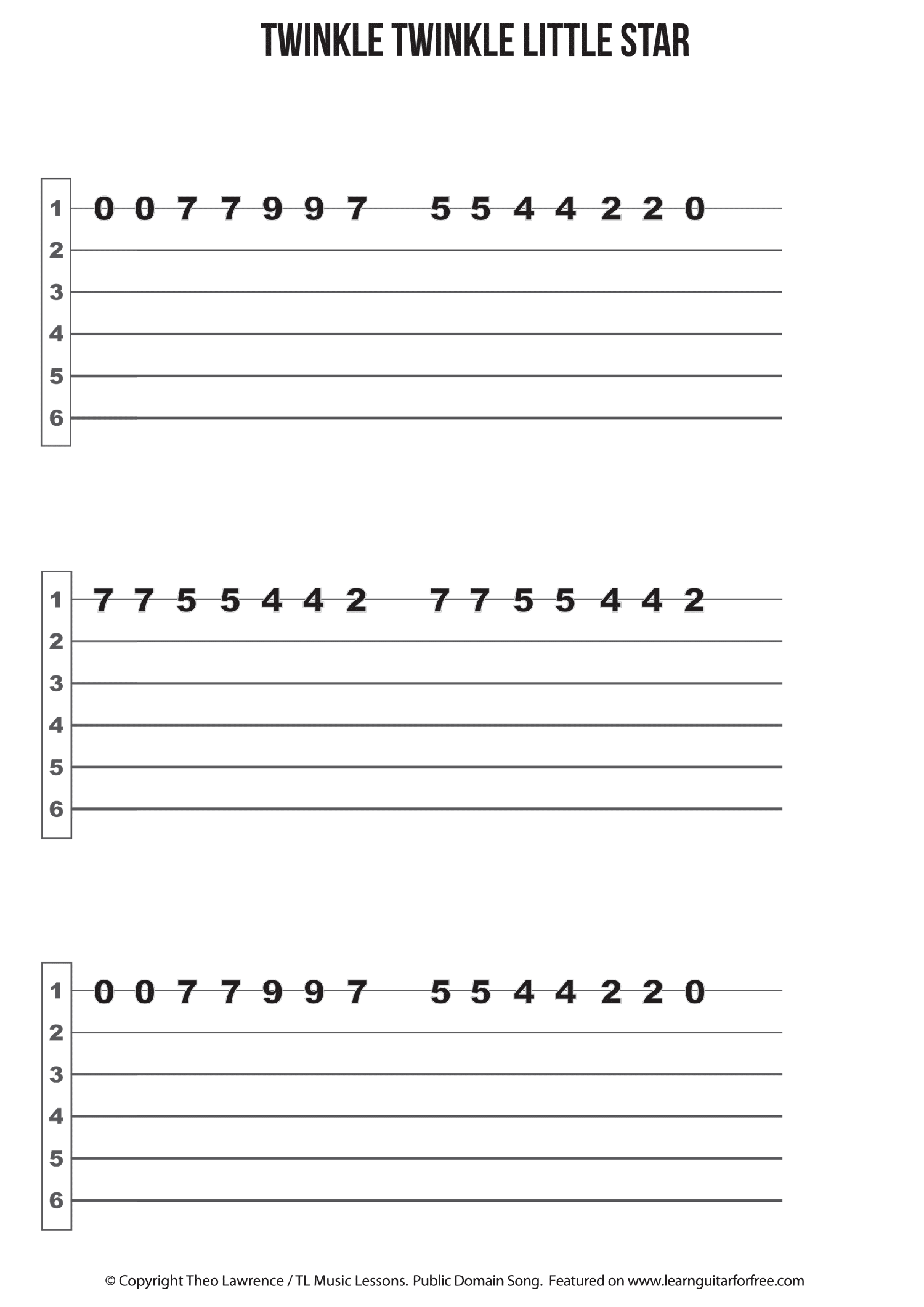
Twinkle Twinkle Little Star – Easy Reading Guitar Tab

Here is an easy to read and easy to play guitar sheet of Twinkle Twinkle Little Star in guitar tab. It’s been designed in Adobe Illustrator for a custom look and easy to read for young beginners. Ideal to use as teaching material.


Related: This sheet is included in this premium PDF ebook: First Guitar Book – Easy Reading (Scales and Melodies) →
Related: Twinkle Twinkle Little Star – Ukulele Easy Reading Tab

Sheet 1 – Easy Reading Guitar Scale Exercises

Over the last 9 years of teaching guitar I have noticed young beginners in particular struggle to get to grips with reading guitar tab, but it’s sometimes any age. They get confused over which string the top line of the tab is. Usually they think it’s the 6th string at the top because it’s at the top of their guitar when they look at it, and they find it hard to get over this being the other way around at first!

Also, students often get distracted by other things on the sheet music and often ask questions like; “what does TAB mean”, “do we play 4/4 at the start?”, “what do these notes mean? (pointing to the notes above the tab), or say things like “the numbers are too small”, “I keep getting lost” (again with regards to the numbers being small and getting lost because they have taken a while looking down at their instrument trying to find fret 3 on the 4th string, for example).

So as a teacher I decided to create a range of sheets like this one to make both my life easier and to help my students get to grips with reading tab quicker for playing scales, melodies and exercises. I have created the sheet using Adobe Illustrator. I intend to post more of these sheets and similar ones for playing chord progressions, and I will release one or two ebooks based on these. There will also be ukulele ones.

How to read the sheet

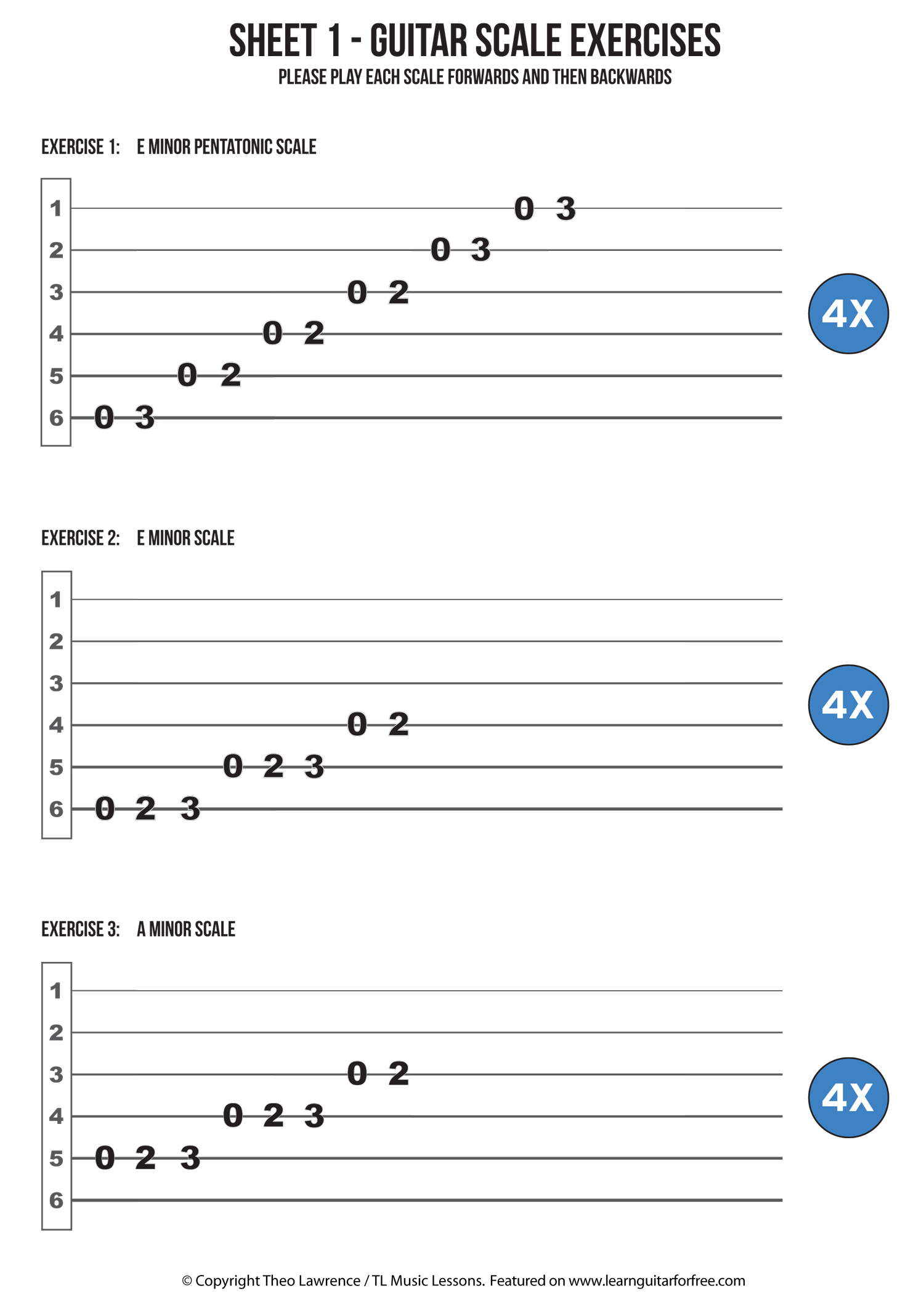
  • On exercise 1, read all 6 strings at once from left to right.
  • You will play in this order: Play the open string (that is the 0) on string 6 and then press down on fret 3 of the 6th string and then play that string to make the note.
  • Then in a similar way play 0 2 on string 5, then 0 2 string 4, 0 2 string 3, then 0 3 on string 2, then 0 3 on string 1.
  • Next, do all of this in reverse.
  • Finally, repeat all of this a further 3 times so that you will have been around 4 times in total.
  • Play exercise 2 and 3 in the same way.

Related: This sheet is featured in the premium ebook First Guitar Book – Easy Reading.
Related: Sheet 1 – Easy Reading Ukulele Scale Exercises.

16 Beginners Guitar Chords

Get Free PDF Download →

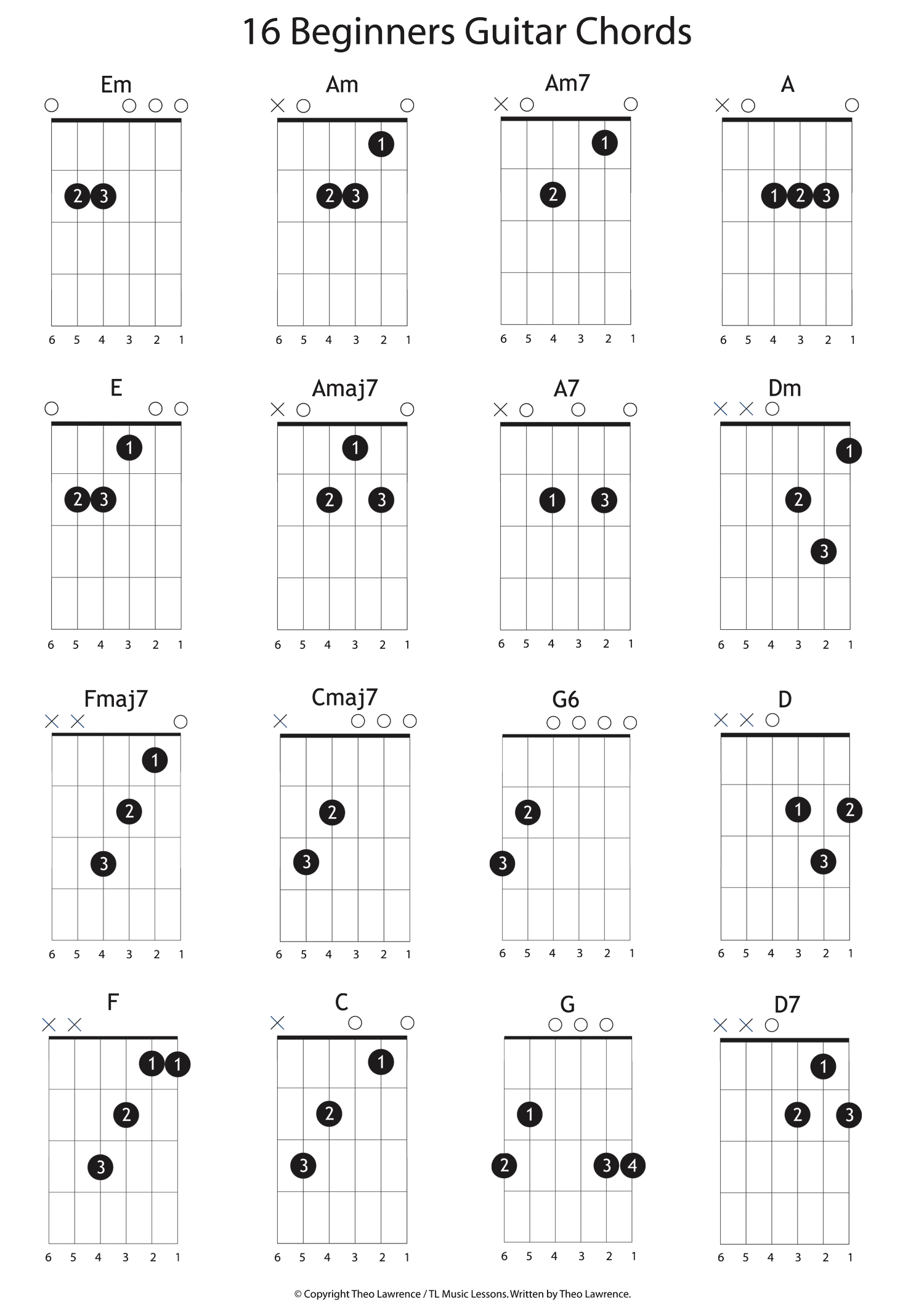
Here is a sheet of beginners open chords. It has been made using Adobe Illustrator.

Here’s a quick ‘how to’ for reading the sheet.

  • The vertical lines are the strings and they have string numbers underneath (there are 6 strings in total)
  • String 1 refers to the thinnest string and string 6 refers to the thickest. At first, it feels like it should be the other way around but make sure to learn and teach it this way because everywhere refers to them this way.
  • The horizontal lines are the frets. The ‘boxes’ or ‘rows’ that this creates are what we call frets. This can be confusing because those metal bars on the fretboards are the frets, but when we say ‘play fret 3, that means to put your finger in between the 2nd and 3rd raised metal fret.
  • The frets have been numbered 1 to 4 on the left hand side of each chord box. So, for the Em chord, you will be putting both fingers on Fret 2. One finger on string 4, fret 2, and another on string 5, fret 2.
  • The finger numbers are inside the blacked out circles and are for a guide. You may used different fingers as preferred.
  • The X above a string means to not strum that string.
  • The O above a string means that you will be playing this string too even though there are no fingers pressed down on it. It’s easier though just to look for the X’s and follow those, and just ignore the O’s.
  • The thick line at the top of the chord box is the ‘Nut’. This is usually a white plastic bit at the end of the neck where the guitar adjoins the head, which holds each string on their way through up to the tuning pegs.
  • Strum all required strings with one swift movement to perform a chord, making sure to play the correct amount of string (look out for the X’s). For example, Em is all 6 stings, and D is only the first 4 strings.
  • Each chord has a name, which is above the chord. anything with an ‘m’ after it is a minor chord, so Em is spoken as “E minor”. Chords with just a letter are major chords, so A is spoken as “A major”, or sometimes it is just spoken as “A”. Chords with a number after are just spoken as “A 7″ or G 6”.


Related:

100 beginners chord progressions for Guitar (Premium)

100 beginners chord progressions for Ukulele (Premium)

(PREMIUM) – Christmas Songs Ebook – Guitar, Ukulele and Lyrics

Buy Now →

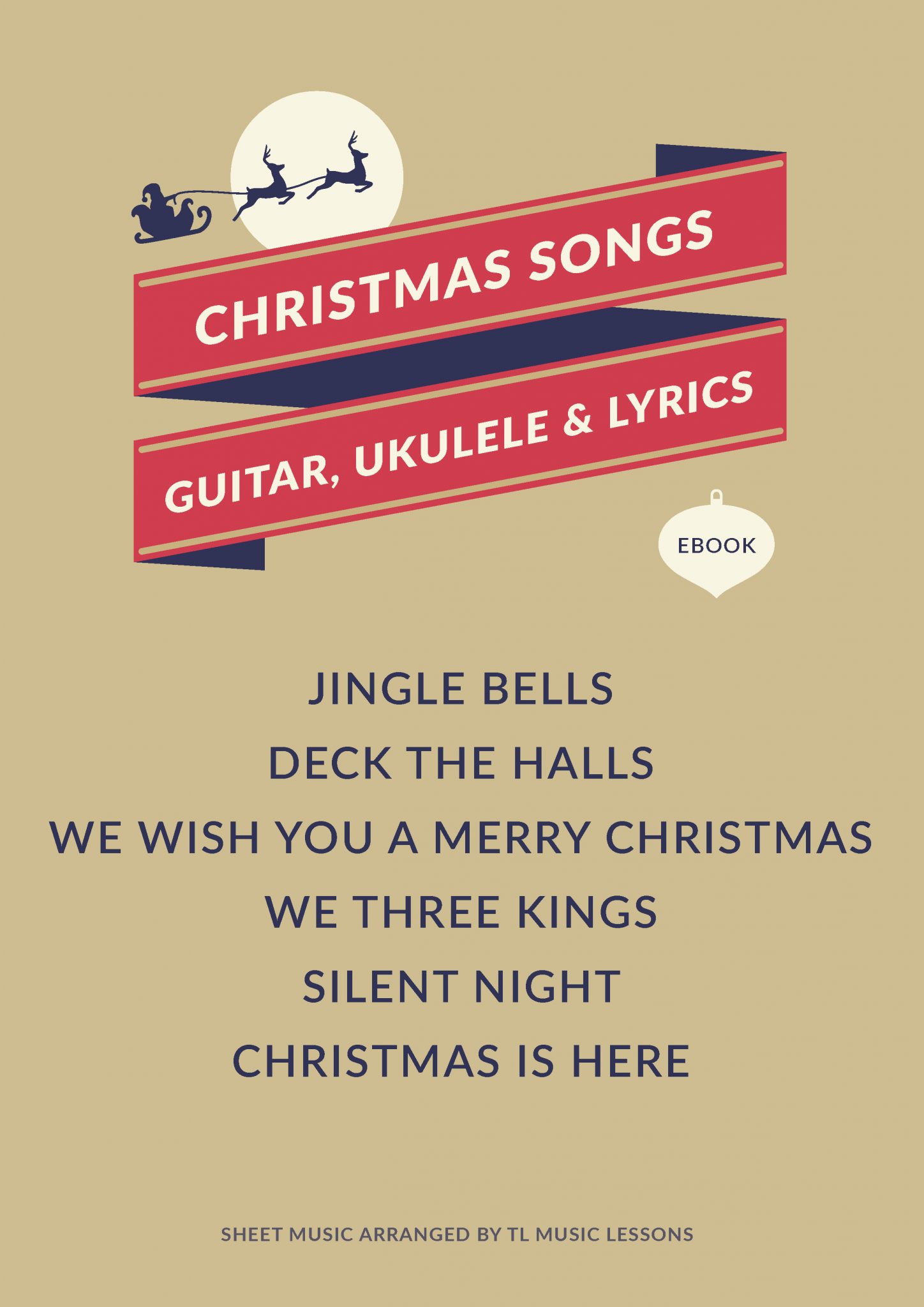
9 years of preparing songs for teaching at Christmas later, and I have created this refined ebook for guitar and ukulele. It includes sheet music with TAB for both melody and chords parts. I have arranged the sheet music myself, so I could aim the ebook at beginners, but I have not changed melodies or structures. I have presented the sheet music in the most simplistic way whilst also aiming to provide a challenge to players that have been learning for a while.

Contains Sheet Music for both guitar and ukulele, and Lyrics Sheets, which can all be printed an unlimited amount of times by the purchaser. Ideal for guitar teachers and ukulele teachers.

The download contains 4 seperate ebooks. One with them all in, and then 3 seperate ebooks for easy printing of guitar, ukulele and lyrics.

  • Jingle Bells
  • Deck The Halls
  • We Wish You A Merry Christmas
  • We Three Kings
  • Silent Night
  • Christmas Is Here

There are both chords and melodies (including ukulele and guitar TAB) for the 5 public domain Christmas songs. There are also guitar and ukulele chords for the original Christmas song called ‘Christmas Is Here’.

Buy the ebook →

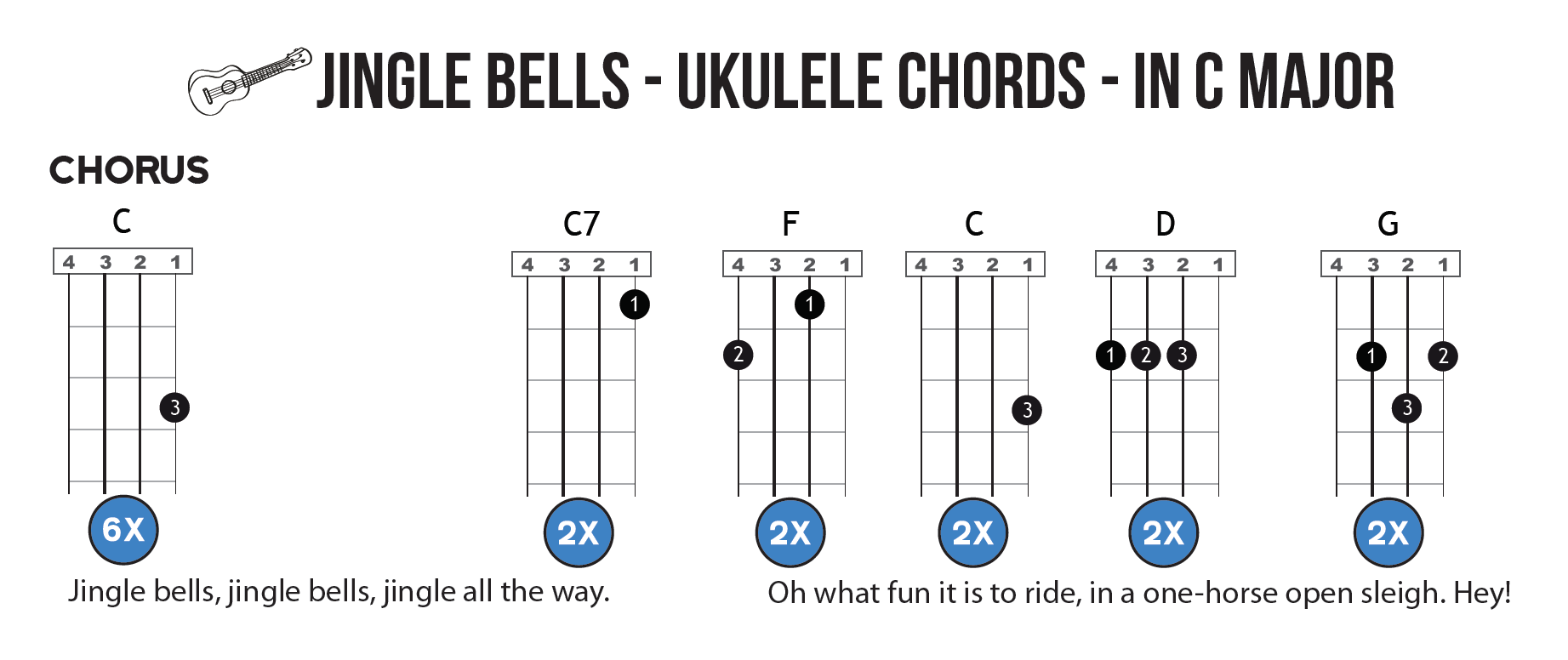
Jingle Bells in C – Chords & Melody – Guitar & Ukulele

The sheet music below includes guitar chords, guitar melody, ukulele chords, ukulele melody and lyrics for the popular traditional Christmas song, Jingle Bells.

Jingle Bells is in the public domain so there are no copyright issues for printing and performing this song.

The chords have been written out to be played with rhythm. This rhythm is aimed to be accessible for beginner guitar players and ukulele beginners.

Guitar Chords & Melody

Ukulele Chords

Ukulele Melody

(PREMIUM) – Grade 3-4 Ebook – Scales, Arpeggios, Barre Chords and Guitar Solo Exercises

Buy Now →

The Buy Now button will take you to the product page. There you can download a free 9 page preview by clicking the ‘Preview’ link at the top right of the cover image.


3. Contents
4. Introduction
5. Scales & Arpeggios: Grade 3 – Fretboard Shapes
6. Grade 3 Scales in G
7. Grade 3 Scales in A
8. Grade 3 Scales in B
9-10. B minor pentatonic scale exercises (8th notes)
11 . Grade 3 Arpeggios in A, B and G (major & minor)
12-13. Arpeggio Chord Progressions
14. Notes on the Fretboard for Grade 3+
15. Grade 3 barre chord shapes
16. Part 1 – grade 3 barre chord progression exercises
17. Part 2 – grade 3 barre chord progression exercises
18. 12 bar blues solo in G
19. Guitar Solo in Gm
20. 12 bar blues solo in A
21. Fallout Guitar Solo in Em
22-23. Grade 3 Chords, Scales and Arpeggios Exercises
24. Grade 4 barre chord shapes
25. Part 1 – grade 4 barre chord progression exercises
26. Part 2 – grade 4 barre chord progression exercises
27-29. B minor pentatonic scale exercises (8ths, triplets and 16th notes)
30-32. Grade 4 Chords, Scales and Arpeggios Exercises
33. Songwriting Cheat Sheet

Introduction

  • Guitar teachers can print the book or single sheets for their students.
  • Guitarists can teach themselves following on from a strong basic foundation in reading and playing
  • Guitarists that want to build up a foundation in the core aspects of Grade 3-4.

About the book

This Grade 3-4 ebook is a compilation of almost 9 years of preparation work teaching guitar. I have included guitar lesson sheets that I have prepared and revised many times over the 9 years to be the best they can be for use with my lessons.

To create the book I selected only the best sheets from my selection of many more that I created for teaching with. I printed them all out and arranged them into a coherent order. Finally, I created and modified a few more just to make the book run smoothly.

I have included only the sheets, rather than add lots of teaching text you might normally find in tuition books. This is partly to limit the amount of pages for those printing, and also to give teachers using the books freedom to put their own take on the lesson sheets. Personally when I get a tuition book for myself, I tend to go straight to the exercises. This will probably make it harder for self taught players, so to anyone getting stuck reading the book I would recommend giving it a go and if you get stuck, research how to read the parts you struggle with. There are plenty of youtube videos out there and help articles that you will find to help. Sometimes youtube videos lack sheet music and written parts, so you should be able to use this book alongside these popular methods of learning, if you are not learning with a teacher.

Guitar teachers can use this ebook as a guide for their own teaching. These are the core parts of grade 3-4 but it does not nearly cover every aspect of these levels, so you can dip in and out of this book with your teaching. Let the book provide a fundamental knowledge to the student and loosely give structure and a guide to your teaching and allow yourself to go off on tangents as you and the students move through the book. The key thing here is to tailor your teaching to the students, because they’re all different and will require different paths to explore their own style and learning experience.

Each topic in the book is briefly covered. There is much more depth you could go into, and this is encouraged. So far, I have already released another ebook that works more on rhythms with barre chords in chord progressions at grade 3-4 level called 10 Group Chord Exercise Sheets – Grades 1-4.

Free Preview / Buy Now →

10 easy strumming rhythms for beginners

This lesson plan is great for beginner guitarists and ukulele players. The D = Down and U = Up markings are used widely online, and are easy to follow for beginners and all. This sheet is best used by a teacher because they will instantly know how to demonstrate the rhythms. For those self taught players, if there are spaces in between like this “D D D D” then they are one beat each, but if they are joined like DUDU then they are quavers (8th notes), which are half a beat, so they are faster.

For complete beginners, try starting with chords like Em and Am on guitar, and C, Am and F on ukulele, as they can be played fairly easily and learned without reading.

Strumming Lesson With Basic Chords

D = DOWN
U = UP

Practice these chords with each rhythm: G, Em, F, E7, C, D, Dm, A, Am, G7.

Repeat 4x each:

  1. D D DU D
  2. DUDUD D
  3. D DUDUD
  4. D D D DU
  5. DUD D D
  6. D DUD DU
  7. DU UD D
  8. D DU UD
  9. DUDU UD
  10. DU UDU U

(PREMIUM) – 10 Group Chord Exercise Sheets – 3 Ebooks – Guitar & Ukulele

Buy Now →

People that might find this book useful

● Guitar and Ukulele groups can use these as warm ups or practice exercises
● Guitar & Ukulele teachers can print the book or single sheets for their students (unlimited printing)
● Students can teach themselves if they have some reading knowledge
● Supplementary learning material for students that have guitar lessons

Contents Highlights

10 exercise sheets, containing a total of 27 individual exercises. There are 3 books; Guitar Chords (Grade
1-2), Guitar Barre Chords (Grade 3-4), Ukulele (Grade 1-2).

About the book

As my students progress up to grade 3 and 4 level they move on to barre chords, so this book has been
made for those players, to play along with the other ability levels in the youth music group. Perhaps there
will be other groups in the world that will find this useful in a similar type of group scenario. For many others,
the books can also be used as exercise books for the individual instrument level, and therefore there are 3
seperate ebooks included in the online download.

Free Previews

Page 3: Guitar Grade 1-2 ebook

Page 3: Ukulele Grade 1-2 ebook

Page 3: Guitar Grade 3-4 Barre Chords ebook

Final Thoughts

I hope that this book provides a useful set of lesson material for guitar teachers and ukulele for grade 1-4
levels. I also hope that it is used by self taught players, or by players that are having lessons and are
looking for extra things to work on.

– Theo Lawrence / TL Music Lessons

Buy Now →

Dynamics

Here is a list of dynamic markings you might encounter in drum sheet music. This list will be updated as more dynamic markings are thought of, and will start out as a basic list of fundamental dynamics notation.

  • pp (pianissimo = very soft/quiet)
  • p (piano = soft/quiet)
  • mp (mezzo piano = medium quiet / medium soft)
  • mf (mezzo forte = medium loud)
  • f (forte = loud)
  • ff (fortissimo = very loud)
  • a wide version of this shape: < (crescendo = gradually getting louder)
  • a wide version of this shape: > (diminuendo = gradually getting quieter)
  • > these arrows above the notes are accents, which indicate that you play loud on this note only.

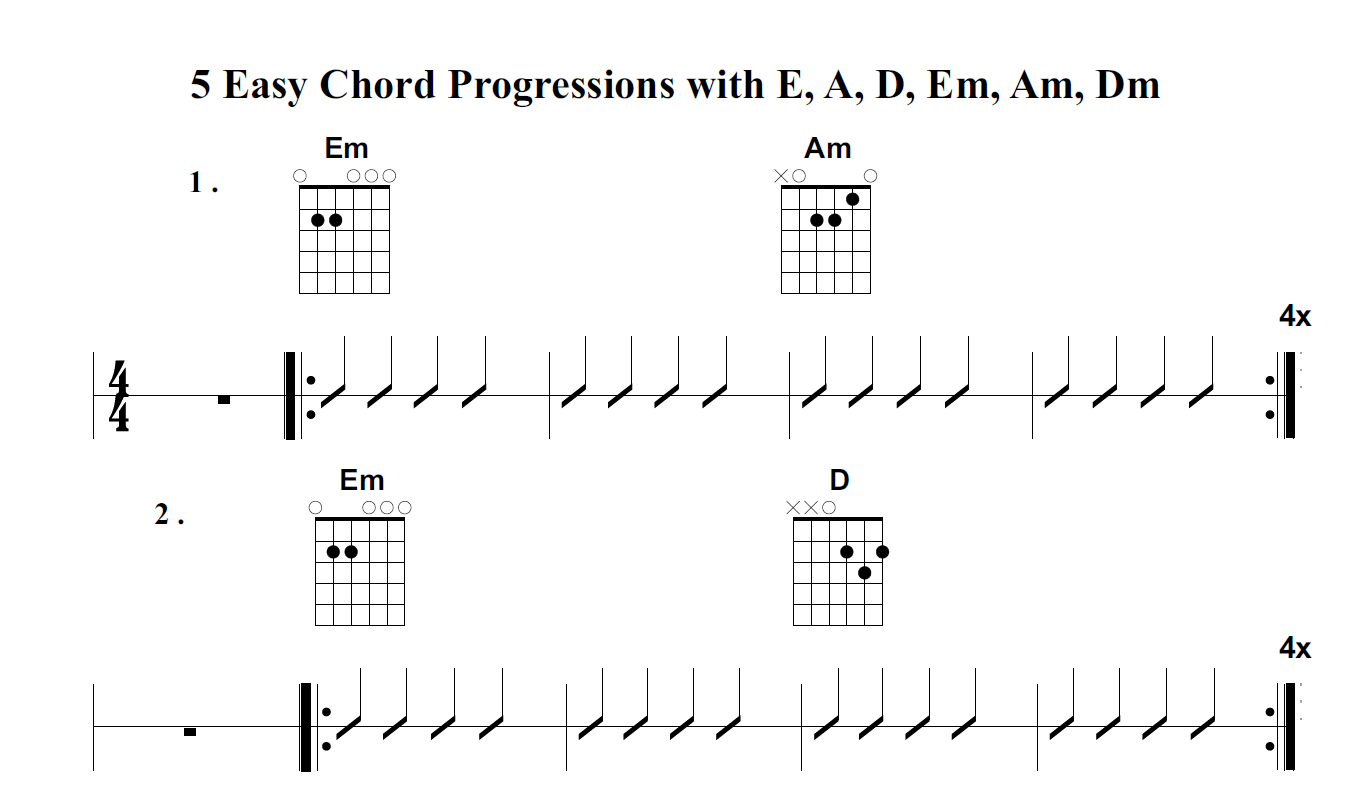
5 beginners Guitar & Ukulele Chord Exercises with E7, D, Em, Am

These exercises are for practicing chord changes using a selection of basic chords. Each quarter note (crotchet) is 1 down strum, so on the first exercise, Em has 8 down strums, then Am has 8 down strums and then you repeat the exercise until you have been aroud 4 times. Take the speed slow to allow time for changing chords. Aim for a steady and slow constant speed before increasing the tempo afterwards. Keep going around the repeats for a while on each exercise.

The guitar and ukulele exercises 2-5 are compatible with each other so you can even play these exercises in groups with guitars and ukuleles together.

These exercises are featured in the Basic beginners book 1 for Guitar & Ukulele.


Related (Premium): Basic beginners book 1 for Guitar & Ukulele.

Exercises 13 and 14 from the 50 Guitar & Ukulele Chord Exercises ebooks

Using the easy open chords, follow the rhythms and down/up markings shown on the sheet.

Exercise 13

Exercise 13 – strum down for 2 beats, then down up down up. The counting would be “1 (2) 3 + 4 +”.

Exercise 14

Exercise 14 – strum down for 1 beat, down up (small space) up down. The counting would be “1 2 + (3) + 4”.

The counting in brackets are where you count but don’t strum anything.

Guitar

Ukulele


For all 50 exercises, purchase the PDF ebooks here:

50 GUITAR Chord Exercises Ebook →
50 UKULELE Chord Exercises Ebook →

30 essential productivity apps, business management tools and other apps or websites that help to run an online business and a local music teaching business
Here is a list of 30 essential productivity apps, business management tools and other apps or websites that help to run an online business and a local music teaching business.

The list here is what suits me and keeps me going as an individual business. There are other things I use but these are the main ones. These may not be suitable for everyone but they are all things that I happily recommend to others. Some are obvious, like the google products, but you might find a few that you haven’t heard of in the list.

Below the list is more information about how I use the things in the list to operate my businesses.

1. Google Calendar & synced to phone calendar (scheduling and also useful for setting reminders at specific times)
2. Google Docs / Spreadsheets (for creating invoices, records of who has paid, income spreadsheets). For offline and advanced database use, Libre Office Sheets and Calc are free and are just as good as Word and Excel imo.
3. Google Drive (access everything on the move; lesson plans, ebooks, records of who has paid invoices)
4. Google Keep (for saving photos or notes on the move)
5. Gmail (email)
6. Google Maps & Belkin Phone Holder (replaced sat nav)
7. Google Contacts (can group contacts into categories such as school names)
8. Remember The Milk (to do list, web and mobile app)
9. Mailchimp (mailing lists)
10. Payhip (for selling ebooks)
11. Paypal (payment processing)
12. Bandcamp (for audio downloads)
13. Ditto Music (digital distribution for music)
14. Sentric Music / Hit Licence (pitching music to tv / film etc)
15. BBC Weather Web / App (Try to dress for the weather)
16. WhatsApp (Reluctantly stay in close contact for certain projects)
17. Adsense (advertisement revenue)
18. Phone’s native clock, countdown timer and calculator
19. Heart Internet Web Hosting and Domains (to power the websites)
20. Drupal & WordPress (CMS for websites)
21. Spotify (always have access to songs that I need to teach)
22. DaTuna app (tune guitars using phone – android)
23. Justin Guitar metronome app
24. Abelton Live 9 (Suite) – Education Price (DAW for making music)
25. Dropbox or Wetransfer.com (sending / sharing large files)
26. Landr (Cheap and Easy Mastering Service)
27. Adobe Photoshop & Adobe Illustrator (for all artwork needs such as posters, music artwork, ebook covers, web banners etc.)
28. Adobe Acrobat Pro (for creating ebooks from single pdf files)
29. Guitar Pro (for creating lesson plans and sheet music for ebooks)
30. Quickbooks Self Employed (Used for Invoicing students’ parents every half term and for forwarding email receipts to record them in Quickbooks. It is basic, but it suits my needs.)


I do most of my work from a desktop computer. It’s pretty old school I know but actually I like sitting down at the desk and getting immersed and then being able to walk away and leave it, rather than have the temptation of trying to work on the sofa (I know some people that prefer the sofa though!). I keep my mobile contract slim and use a cheap to mid range phone, which is a smart phone, but it doesn’t cost loads.

My bookkeeping, teaching schedules, invoices, paid lists, have all been done using my own system of documents and spreadsheets that are quite refined and easy to use for my business now. I have recently moved onto Quickbooks Self Employed for invoices, which has made writing and sending them easier. My process to record payments for school lessons used to be to input it into a spreadsheet, then copy and paste into a ‘paid’ documents file for each given half term and school, and delete the pupil’s name that has been paid for. I would then check who still needs to pay. My invoices use a template I made and I had a copy of that in the same folder as the paid file for each half term and school name. The invoices always include payment info and at the top of that list is bank transfer details because that form of payment has the least admin for me. I then export that as a pdf file and email the parents at the start of a half term. Mostly I have to make different ones for each half term and ammend for different pupils if they have missed lessons or have not paid for a half term.

I also have a spreadsheet of all of my pupils in each school and their instrument and time details, and rows of checkboxes so I can print them off and use them as a rota for the half term. In high schools the rotas need to have time slots added to the rota. For primary schools, they are too hectic and unpredictable to make rigid timetables for, so I don’t bother. At the start of a new half term, I will copy over all the files from the previous half term and begin editing them for the next one. Usually the amount of weeks per half term changes so there is always something to change. I leave an extra list of pupils per school in the paid files so that I can copy them into a fresh ‘unpaid’ area below, and then I can delete them off as they pay.

I keep an up to date copy of parents’ email addresses in Google contacts and group them into different schools and also give them instrument tags incase I need to email all of the guitarists for something at once. I always try to email the parents using the bcc send field, and this is easy on a computer with a mouse because you can select all the contacts from google contacts, and click to send email, then drag all the addresses into the bcc field. I also have a mailchimp list but it’s not easy to keep that updated as well so I tend not to use it. I do for my website subscribers though.

For my websites www.learndrumsforfree.com and www.learnguitarforfree.com most of the files are hosted on the websites. I learned how to make websites before starting to teach, which has really given me the tools to build an online business too. I learned html and css using an O’Reilly book and the rest followed from there. Actually it all started from the coding features on myspace when bands could change the styles on their pages and adding in banners etc. My sister does web design and artwork in the music industry and she said that probably started her off too, or gave her the coding bug. I use dreamweaver to edit code because the colours are useful, but other free ones are available, and filezilla for ftp file transferring.

I use payhip for all of my pdf ebooks, which is the best I have found. It links to paypal for payments and it has just added a feature to automatically add customers to mailchimp lists. People that download free ebooks are added to my regular subscriber list for upadtes of free blog posts, and paying customers are added to a special list, which I send info of new ebook products to when they are released. Bandcamp is used in a similar way for audio and music, although their mailing list integration is not as good so I can’t really use that effectively at the moment unless I set up more accounts and then export email addresses to the appropriate subscriber lists.

I have found that social media is pretty much a waste of time for my online business at the moment but the mailing list is great, and actually pinterest generates the most hits, so I do chose to get rid of all but the pinterest. It’s all about finding what works for your business and choosing the right platforms to get the most out of your time and effort.

I get many hits per day on both sites quite often and almost all the traffic is organic from search engines. It’s taken years to build up so it really is a lot of hard work but adding to it “little and often” really helps build up a huge site over time. Most of my ebook sales follow searching for free stuff from organic google searches and then discovering the ebooks. I believe this is called a “fremium” business model. When I launch a new ebook and send it to my paying customers mailing list, I usually get quite a few sales from them, so that is really useful for me and them.
Hopefully this gives gives you ideas for your own online business. I tried in the past setting up my own ubercart shopping cart and hosting everything myself, but I had to switch to payhip due to new EU tax rules on digital products. It was too hard to manage myself but payhip and bandcamp both sort sll this out for you. For every ebook sale, payhip takes off the tax, which is different depending on each country, from the money I receive, so they literally take care of everything without me needing to register to pay tax in every country. It completely took the hassle away from thiose new laws.

I also make music and play in a band so I have an unlimited ditto music subscription to release to spotify and itunes etc. whilst bandcamp is the best, not all customers are used to that so you kind of have to make things available where the customers are.

Guitar Pro is the best in my opinion! I’ve tried Sibelius but that’s probably only better for orchestral stuff. Guitar Pro is amazing for most instrumentsl sheet music writing, including guitar, drums, ukulele, bass and even instruments such as flute and piano. I always use it for all of my sheet music. I even use it to export midi to Abelton sometimes, rather than using the piano roll to input midi.

Abelton has been great for making music from midi, recording my own music, making backing tracks, and for teaching other music production. The education price helped me to buy it. Landr is a quick, easy and cheap way to finish off tracks so they are ready to release. The mastering is pretty good. I subscribe for a month and then cancel it when I am done.

All of the chaos that is my schedule is fairly organised with Remember The Milk and Google Calendar. Both can set tasks and appointments to repeat weekly or as often as needed, which is really useful. I use both services on the desktop and synced to my phone. My email is also really important for my business. I sometimes send emails to myself with important TO DO list items for that day, so I can’t possibly miss them.


Related: (www.learndrumsforfree.com) 10 tips and advice for running your own drum teaching business