Guitar Warm Up Exercises for Beginners

Free PDF Download

Download the PDF for ‘Sheet 1 – Guitar Warm Up Exercises for Beginners’

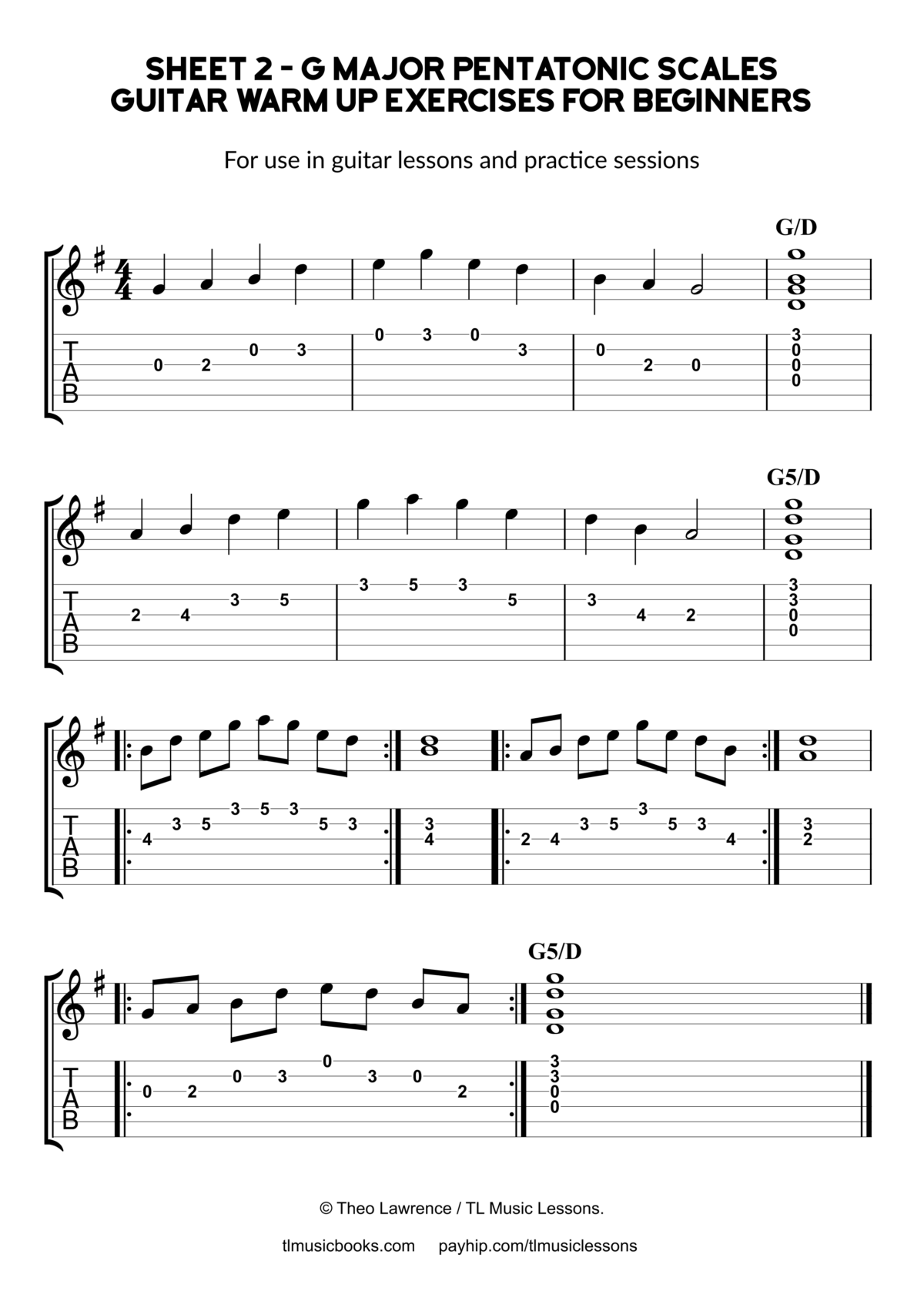
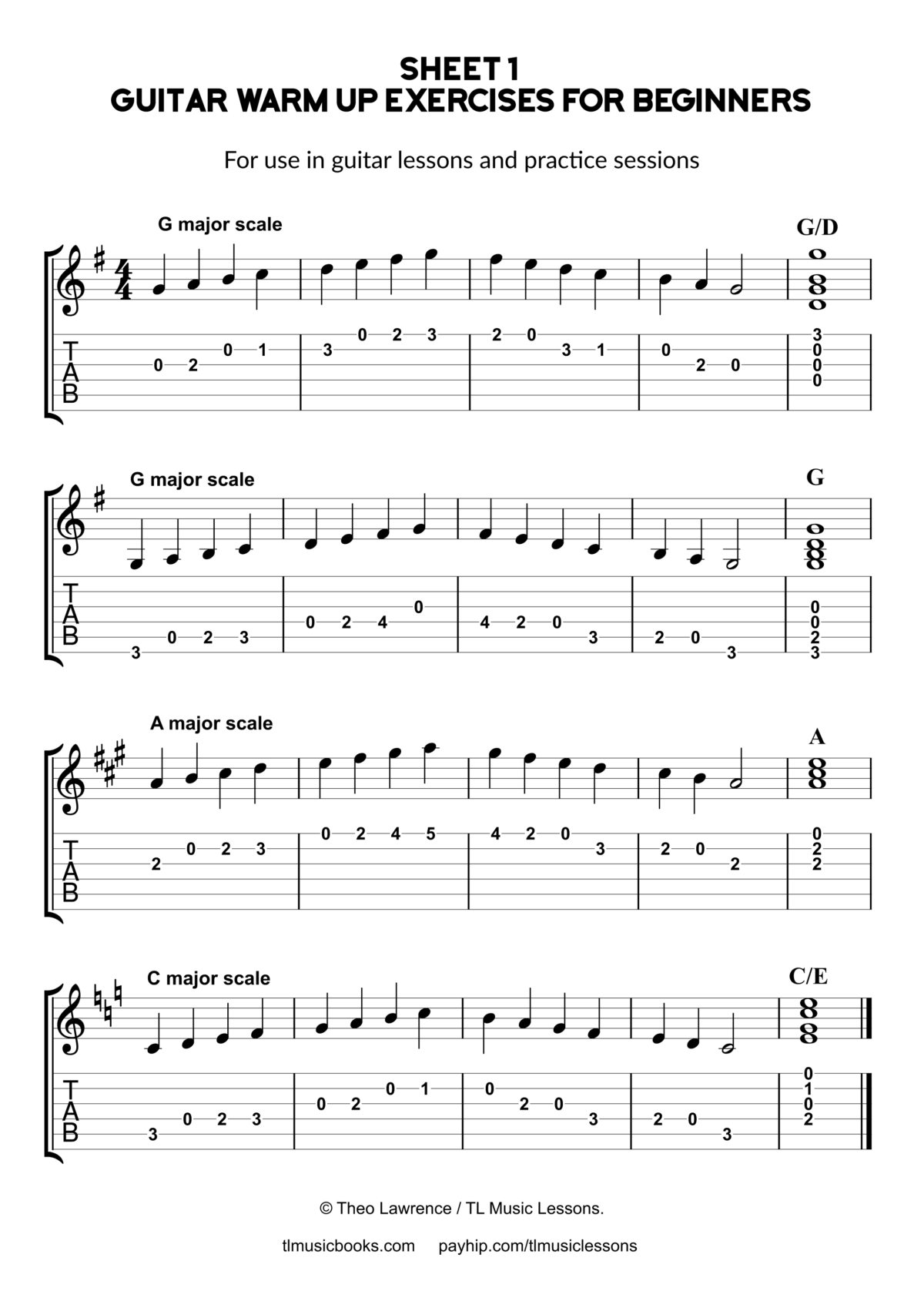
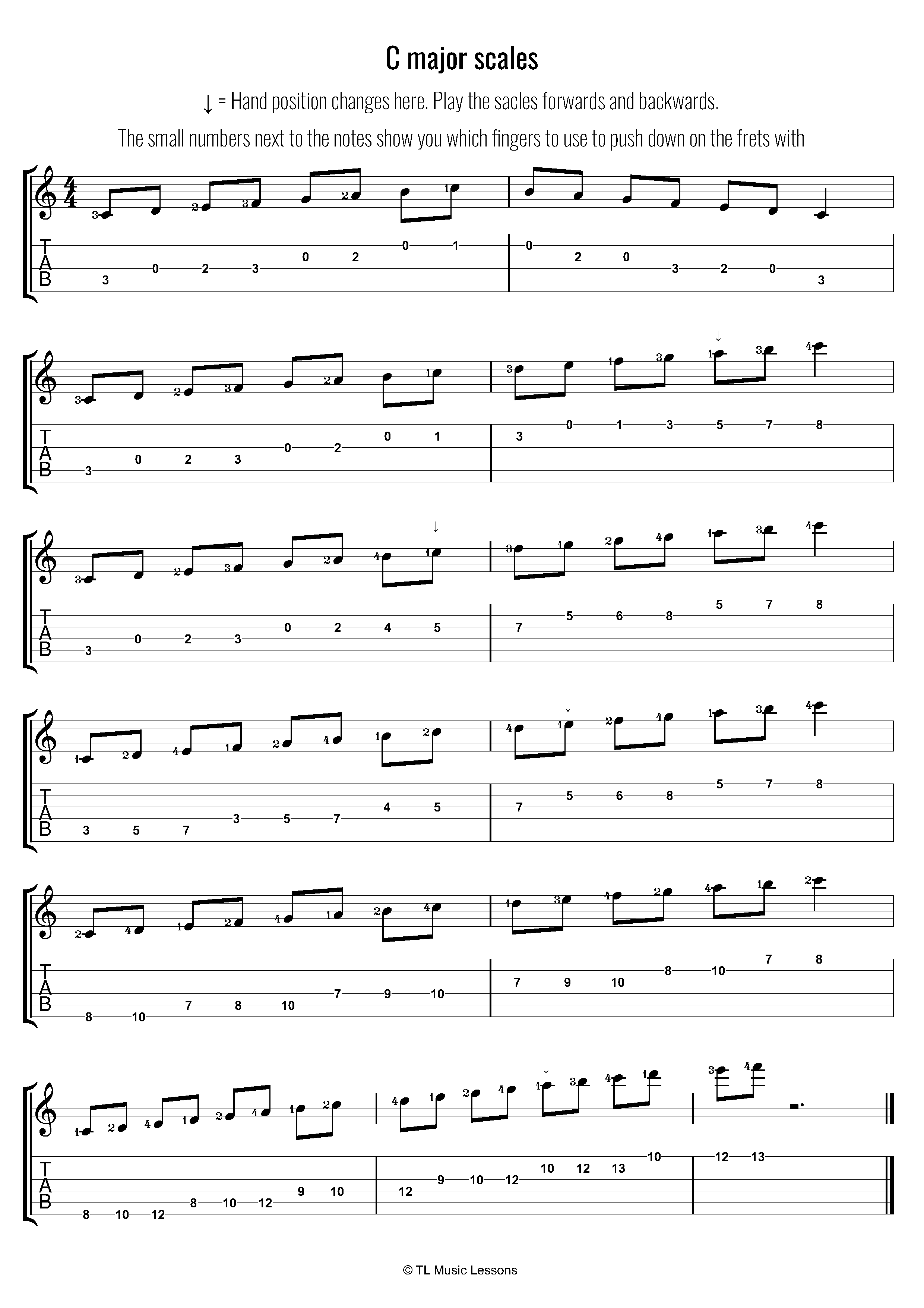
This beginners guitar scales warm up sheet with chords contains 4 one octave scales with the corresponding chords at the end of each one. The scales included are two G major scales in different octaves and with different chord variations at the end and also A major and C major scales.

The C/E chord is an easy variation of a C chord, and the G/D chord is an easy variation of a G chord. If you are able to do the full chords you can play them instead, or have a go at these easy chords instead, which by the way are useful moveable shapes if you move them up the fretboard and convert them into barre chord shapes by holding down the 1st finger across the first 4 strings and playing the rest of the chord in relation to this.

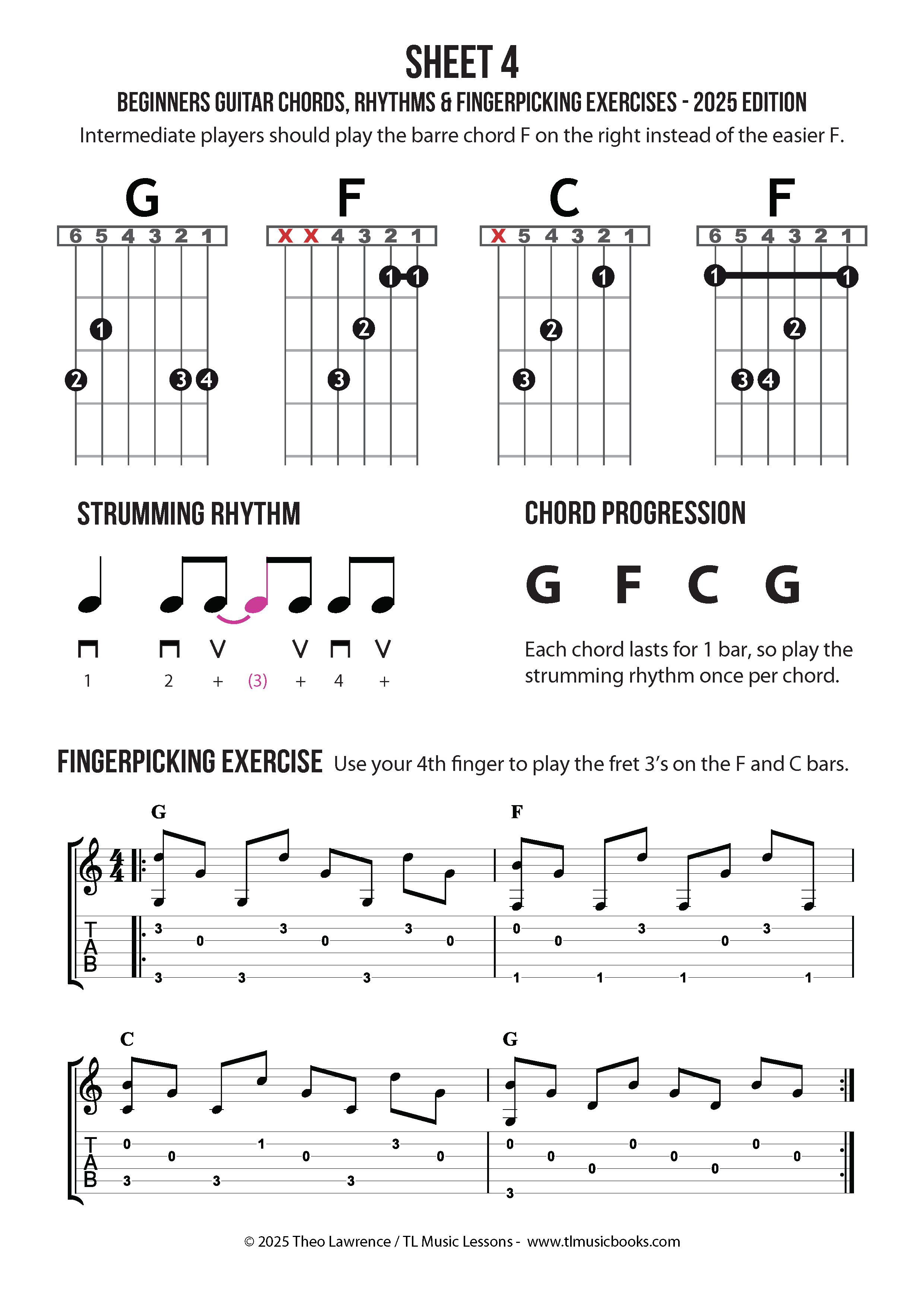
Beginners Chords Exercise using C, G and F, with a strumming rhythm and fingerpicking tab

Use the strumming rhythm with the chord progression and chord diagrams to play the strumming exercise. Then for the fingerpicking exercise you will need to follow the tab and play the exercise using all 4 fingers. Holding the suggested chords down won’t help much with this exercise but the chords above the tab will fit if someone else plays those along with the fingerpicking pattern.

The strumming pattern for each chord is Down, Down Up, Up Down Up. D DU UDU.

Intermediate players could play the barre chord F on the right instead of the easier F.

This chord progression of G F C G is could be in the key of C, where I IV and V are C F and G (V IV I V), or it could be in the key of G where the 7th diatonic chord is flattened to a major chord, and the chord progression would be I bVII IV I.

This exercise sheet is from a 21 page pdf ebook called Beginners Guitar Chords, Rhythms & Fingerpicking Exercises – 2025 Edition.

Where to follow my more recent content outside of the website

Hi, I’ve kept this website going for a long time now, must be about 15 years. It still generates quite a bit of traffic from old posts but when I first made the website I had loads of free time. After building up a full time self employed business and starting a family, there isn’t much time left after that! So nowadays I do create content but it’s mostly ebooks that I make, which I charge for. I’m keeping the website going for the traffic that it creates but if it looks a bit dated or lacks recent content, that’s why.

If I have any new content, I will be more likely to add it to my pinterest or youtube or payhip accounts going forward, so please do follow me there if you are interested. If you are interested in drums too, then you might also be interested in my payhip for drums account too.

Thanks for reading,

Theo

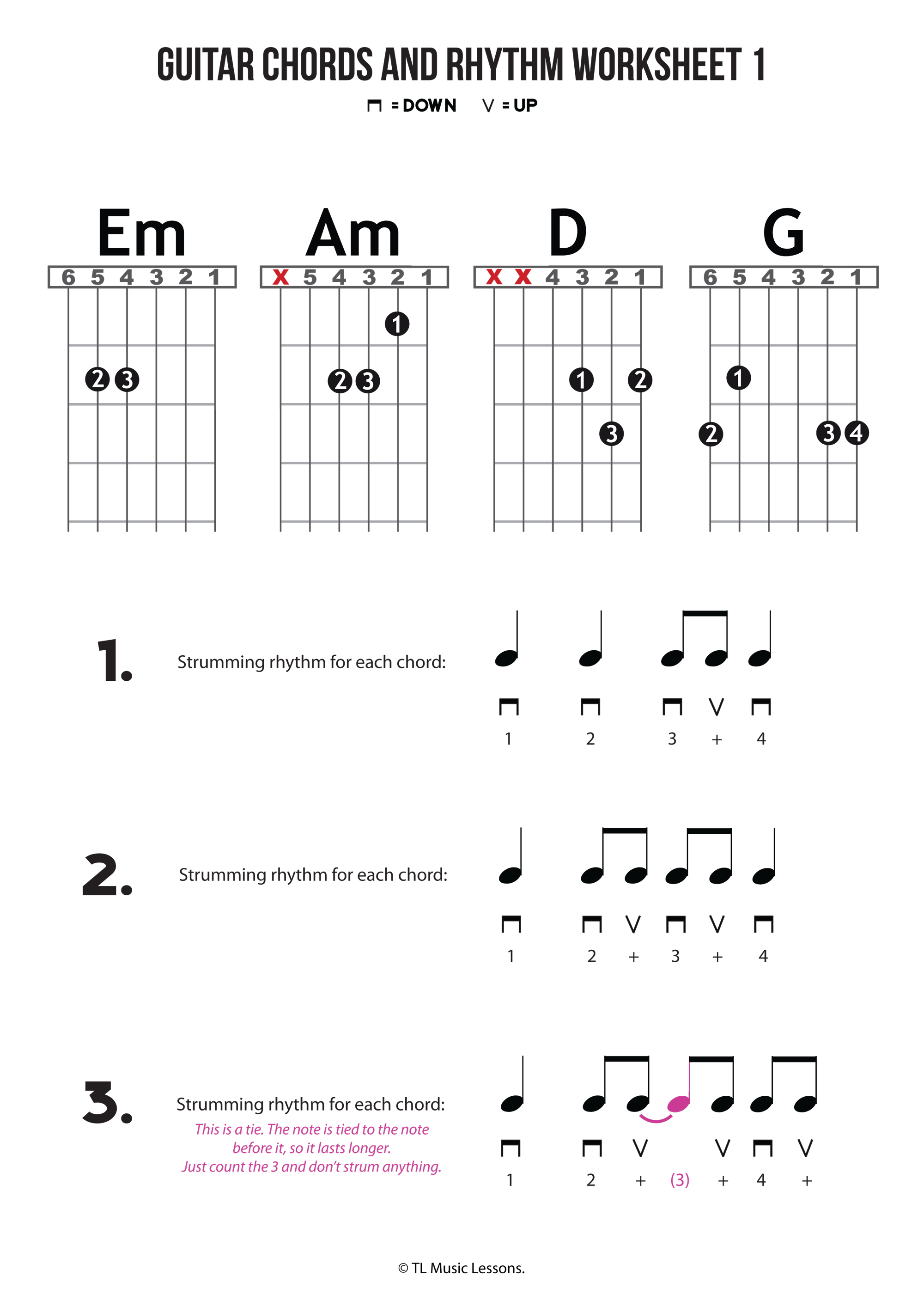
Guitar Chords and Rhythm Worksheet 2

PDF – Guitar Chords and Rhythm Worksheet 2

← Go back to worksheet 1

This exercise sheet is for beginner guitarists and advanced beginners.

Method: Using rhythm 1, play this rhythm for all 4 chords on the sheet in sequence (e.g. Em – down down down up down up, C – down down down up down up etc.). Then repeat it all again. Repeat as much as you want in order to practice.. Then do all this again for rhythms 2 and 3 as seperate exercises.

Extend: You could try rearranging the chords and practice with the same rhythms. You could do different rhythms for each chord, using the example rhythms. You could try different chords with these rhythms. You could play 2 rhythms per chord, either the same one twice or different rhythms back to back.


If you have found this exercise sheet useful, you might like the following books:

Beginners Guitar Chords Book (Easy Reading)

Beginners Guitar ebook (Easy Reading)

Guitar Chords and Rhythm Worksheet 1

PDF – Guitar Chords and Rhythm Worksheet 1

Go to worksheet 2 →

This exercise sheet is for beginner guitarists and advanced beginners.

Method: Using rhythm 1, play this rhythm for all 4 chords on the sheet in sequence (e.g. Em – down down down up down, Am – down down down up down etc.). Then repeat it all again. Repeat as much as you want in order to practice.. Then do all this again for rhythms 2 and 3 as seperate exercises.

Extend: You could try rearranging the chords and practice with the same rhythms. You could do different rhythms for each chord. You could try different chords with these rhythms. You could make the chord progression longer (e.g. Em, Am, D, G, Am, G, Am, D).

If you have found this exercise sheet useful, you might like the following books:

Beginners Guitar Chords Book (Easy Reading)

Beginners Guitar ebook (Easy Reading)

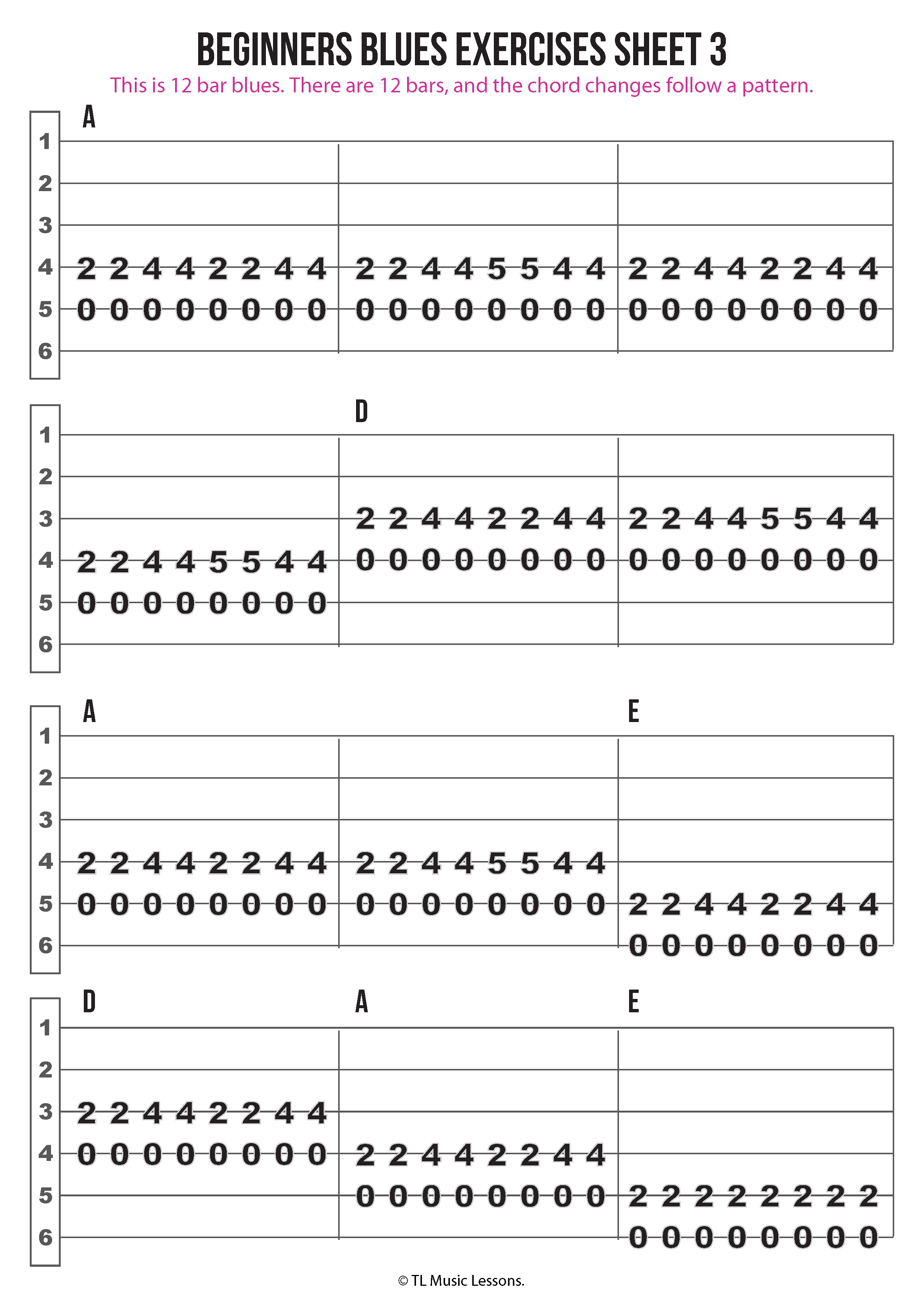
12 Bar Blues in A – Easy Reading Tab

This sheet is for beginners and Grade 1 level guitarists. The blues pattern follows the basic 12 bar blues. The riffs used here are popular for the blues style and can also be found in rock and roll.

You could play this exercise with either straigh 8th notes or swung 8th notes.

Free PDF: Beginners Blues Exercises Sheet 3 copy

This sheet is from my Beginners Guitar ebook, in the Blues Riffs chapter.

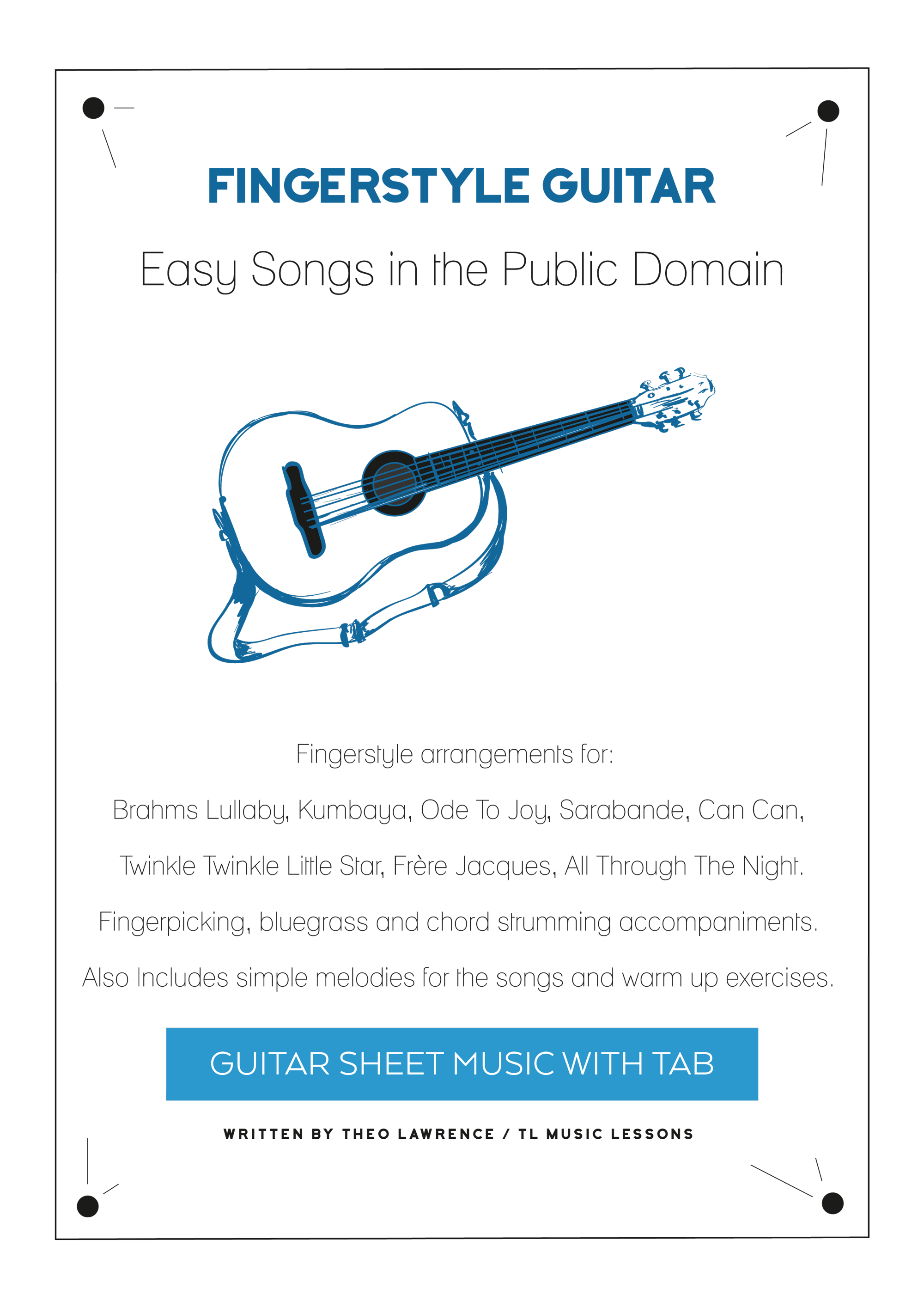
Fingerstyle Guitar – Easy Songs in the Public Domain

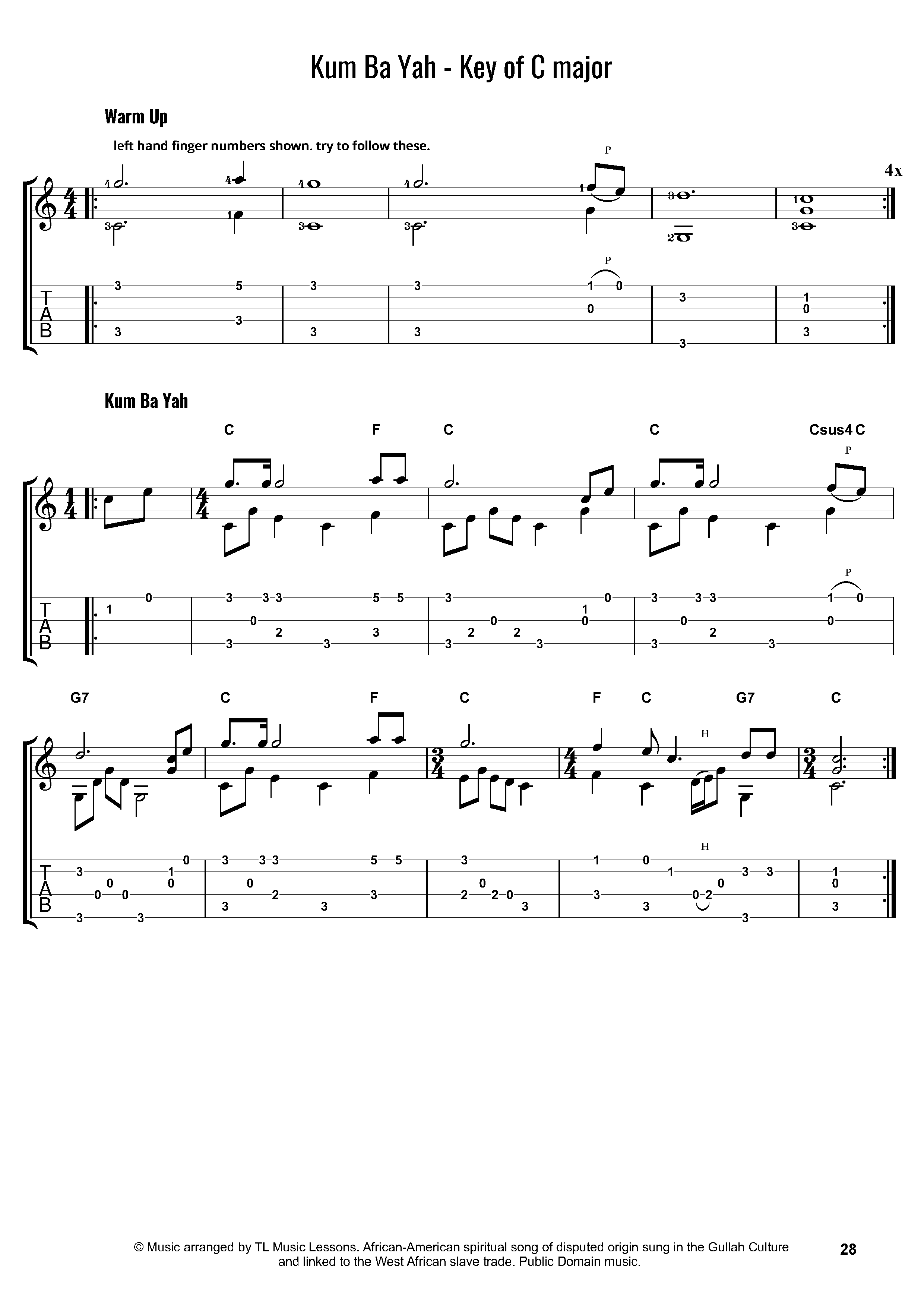
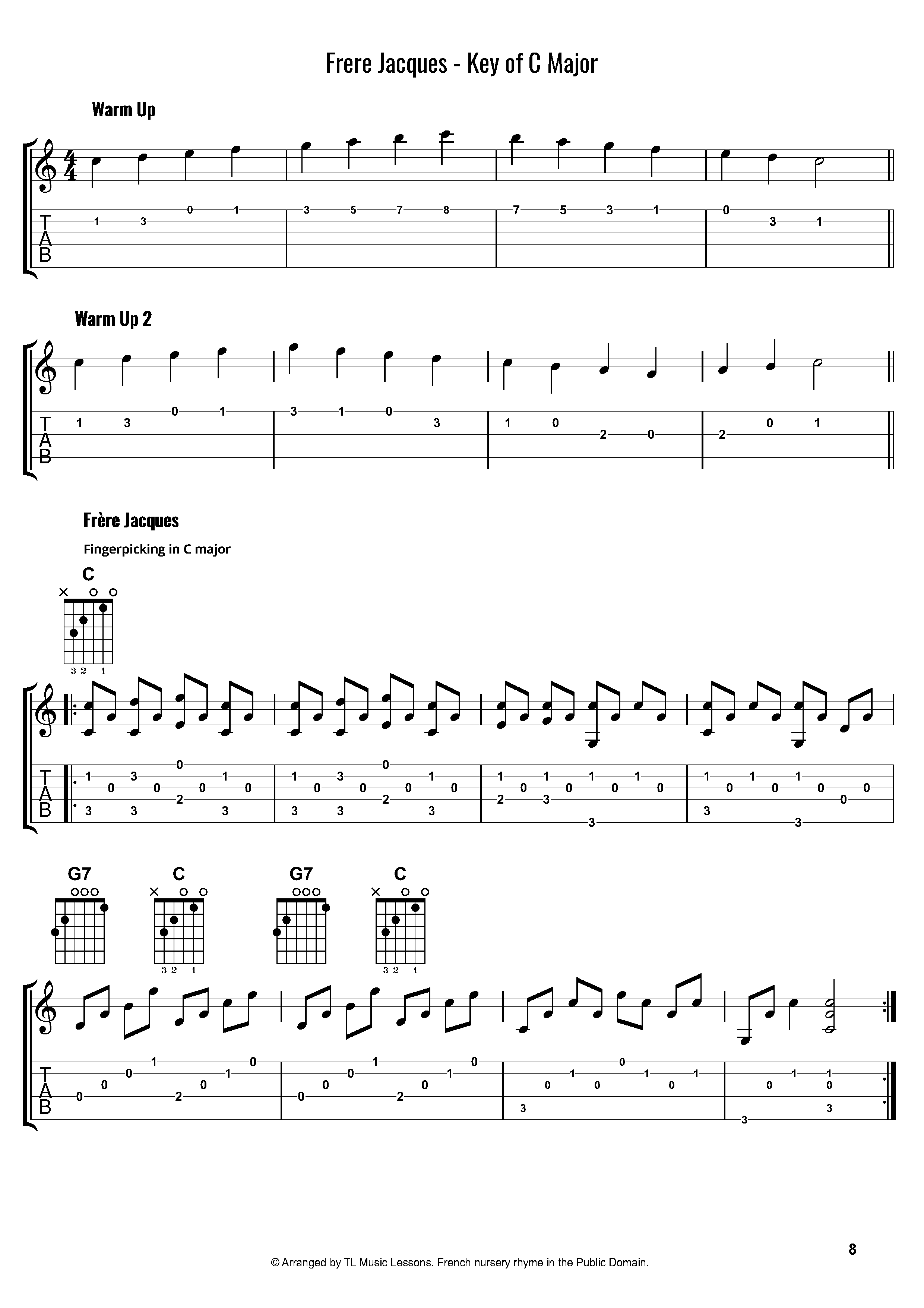
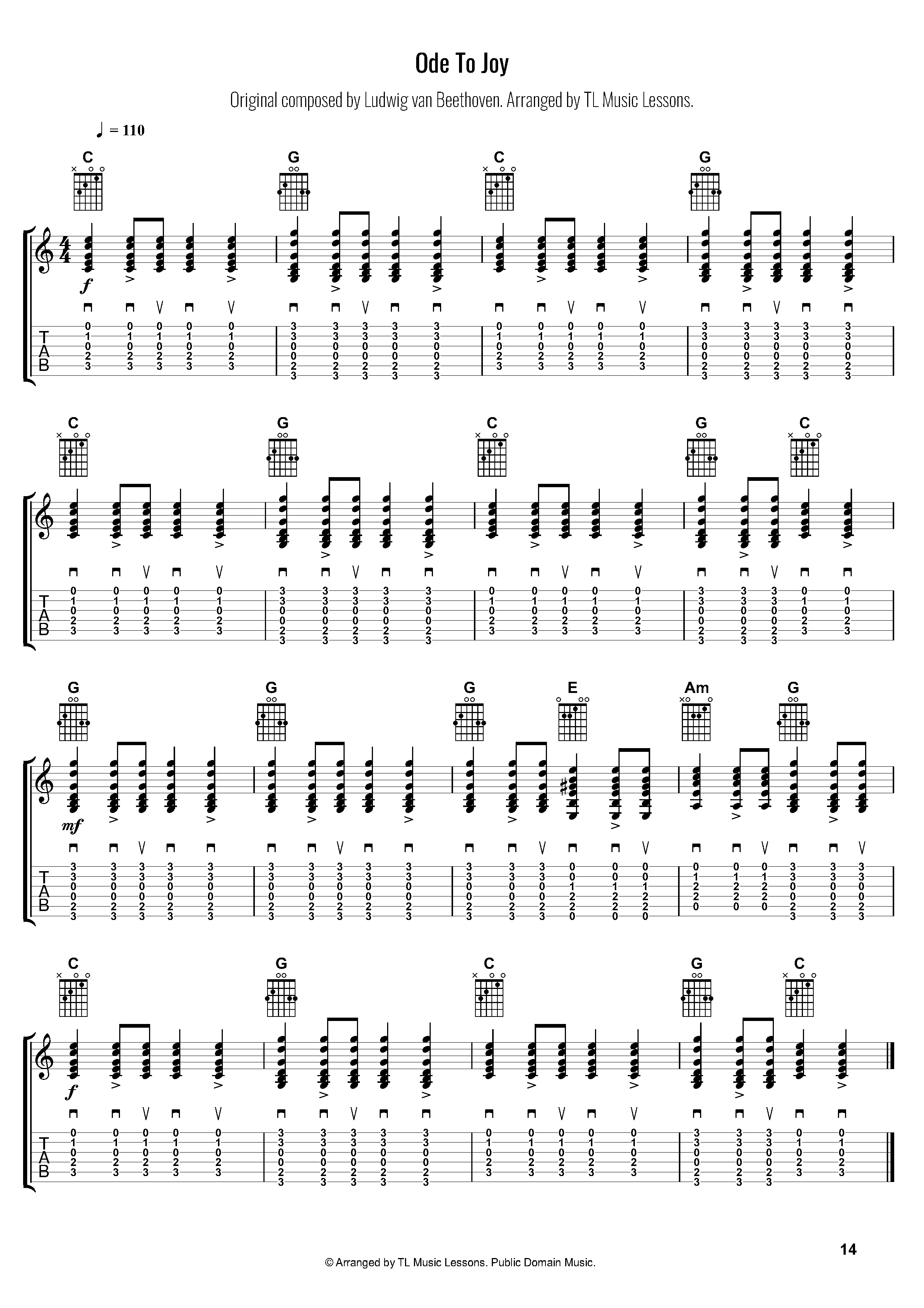
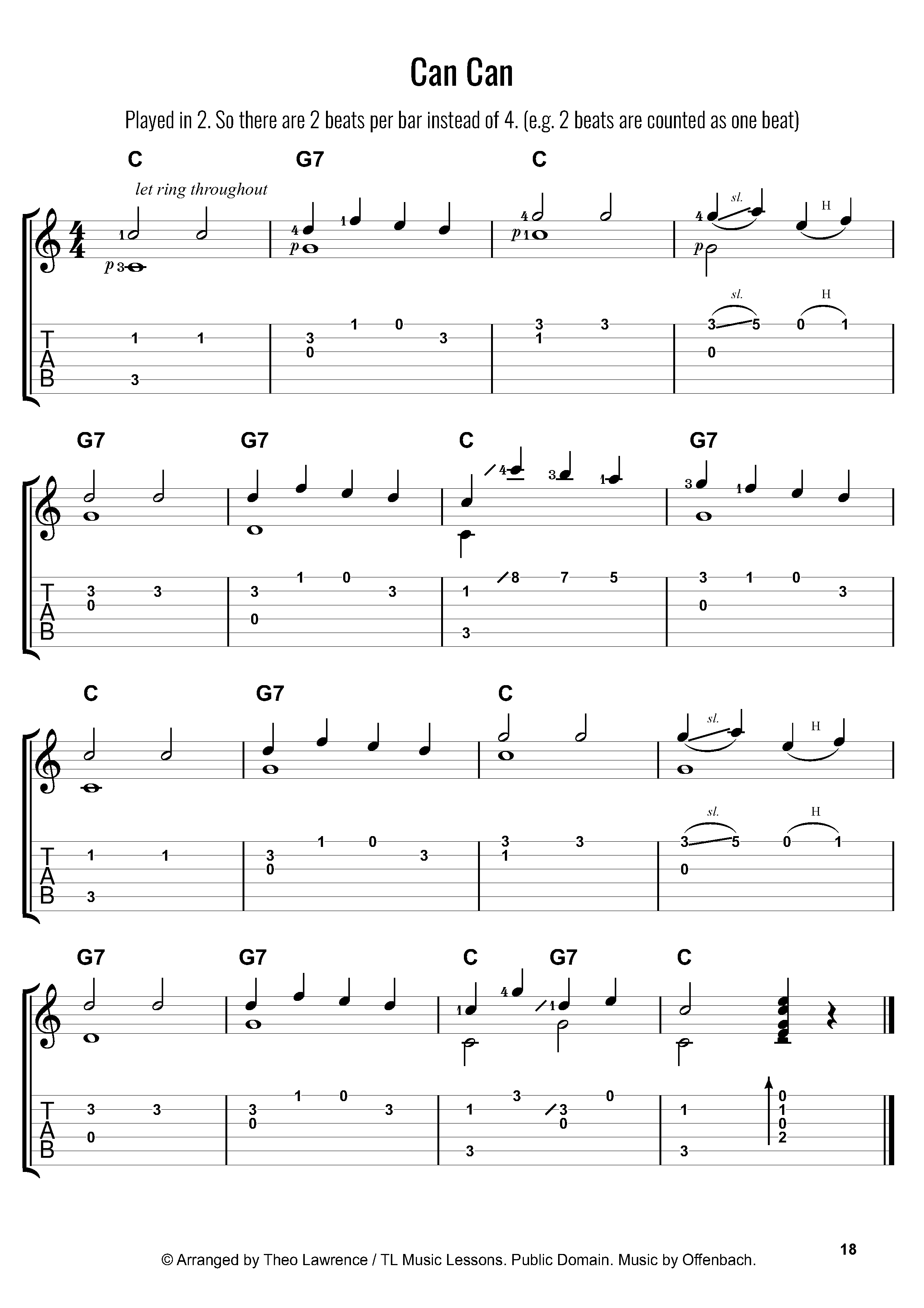
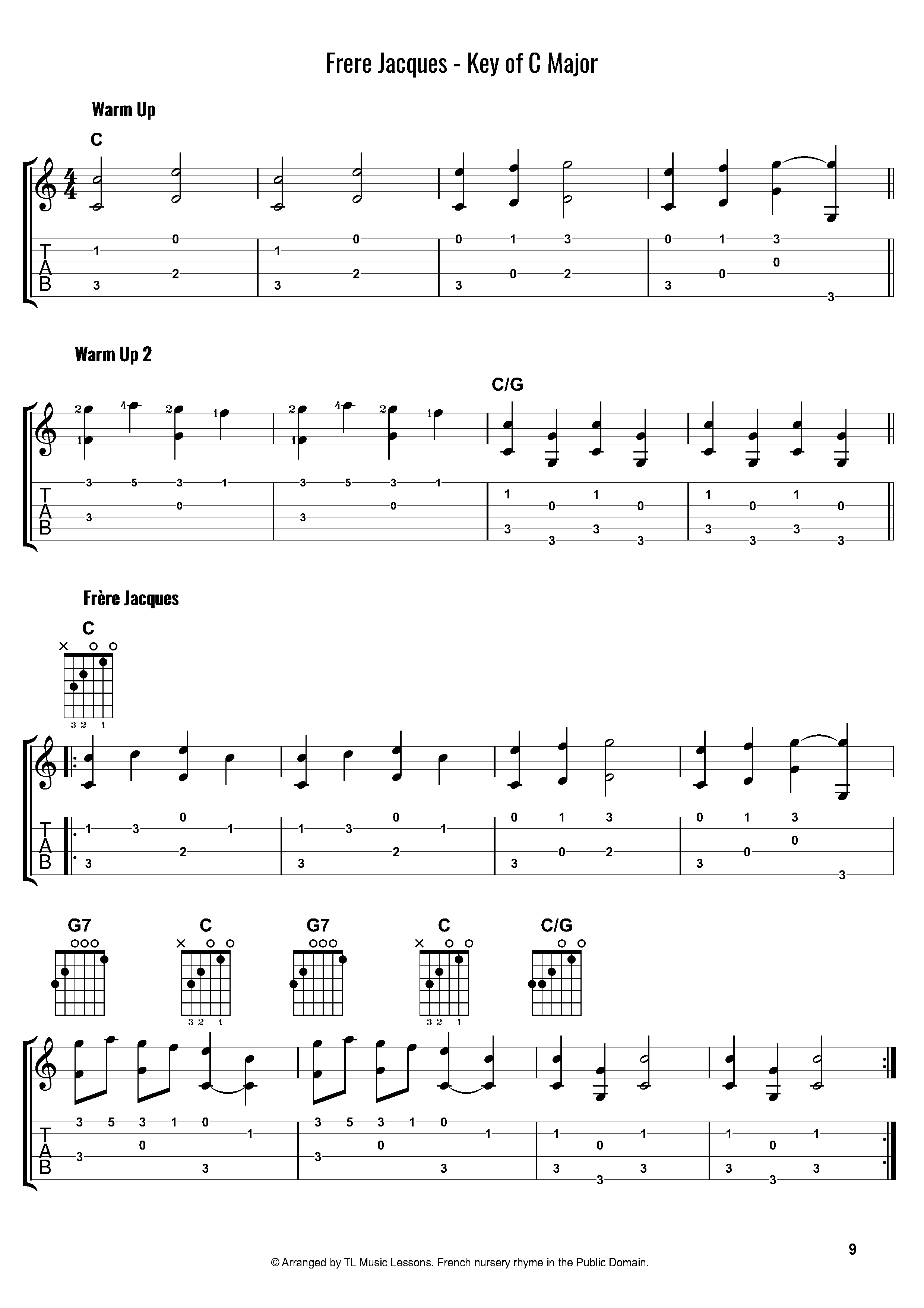
This guitar ebook includes fingerstyle arrangements for Brahms Lullaby, Kumbaya, Ode To Joy, Sarabande, Can Can, Twinkle Twinkle Little Star, Frère Jacques and All Through The Night. There is also a selection of fingerpicking, bluegrass and chord strumming accompaniments for these pieces. Also includes simple melodies for the songs and warm up exercises.
Buy the ebook →

I have been playing guitar for a while now, but I didn’t start playing classical or fingerstyle until sometime after beginning with rock, pop, funk, reggae and metal styles. I have since started to fall for this style of guitar playing. It’s so relaxing and it’s a challenge and really interesting to explore what can be done. I am nowhere near being a good fingerstyle player, but I’ve been teaching beginners for 12 years and this experience makes it possible to put together an interesting selection of pieces for this book that is for beginner guitar and advanced beginners. The book can be used by teachers in their lessons. Self taught players can learn too, but they would need some prior knowledge of reading music and some basic beginners ability to play a few simple chords together, such as C, F, Am, E, G, G7, D and Dm..

In this book you will find a collection of public domain songs with unique fingerstyle arrangements. There is also a selection of fingerpicking, bluegrass and chord strumming accompaniments for the pieces. The patterns in these accompaniments are fairly basic ideas that can be used for many other songs. It is worth studying these and learning the fingerpicking patterns, how the bluegrass bass notes work and linking that with the off beat chord strums and also getting a grasp of the simple strumming rhythm with accents on beats 2 and 4 for Ode to Joy.

My aim for this book is to make it easy for people to find an collection of simple fingerstyle songs that doesn’t get too hard too quickly, and opens the door for learning harder or longer songs after confidence has been built up by playing songs that have been arranged to be fairly easy and inviting to play for the beginner or advanced beginner. Some of the fingerstyle arrangements would take some rehearsing for even more advanced players actually, to play them well, so it’s not just a book for beginner guitarists. Perhaps the player may be great at other things but not familiar with fingerstyle, so this might be a good entry.

This book of easy songs has been created by making new arrangements from public domain songs. Public domain songs are great for learning because the tunes are familiar and there are no copyright restrictions for performing or for creating arrangements of them. This book can be used by teachers and students, or by anyone learning on their own.

The fingerstyle arrangements are unique to this book and have been made by playing around with various combinations of melody, bass and notes from the chords until a good balance was reached between being fairly easy to play but also challenging and enjoyable/relaxing.

Whilst you may find other fingerstyle versions of these songs elsewhere, they won’t be the same as these. I have made them up and not followed anyone else’s so it would be almost impossible for them to be the same, because there are lots of combinations of bass notes (root notes, 3rds, 5ths) to go along with the melody, perhaps different bass line rhythms, and there are also some hammer ons, pull offs and slides in places. You can find many different melody transcriptions with the same melody presented in slightly different ways, but the beauty of fingerstyle playing is that you can be quite creative with the arrangements to make something fairly different and unique, even though these public domain songs have been played countless times before.

The style of the book should come across as a coherent body of work as it’s been arranged by one person. However, it’s good to explore other books written by other people too if you are interested in learning more fingerstyle playing, because other arrangers will add their own style to pieces too and you will learn different things from them. I hope this book will help you start or continue your journey into learning fingerstyle, or perhaps with finger picking or bluegrass guitar playing.

Buy the ebook →
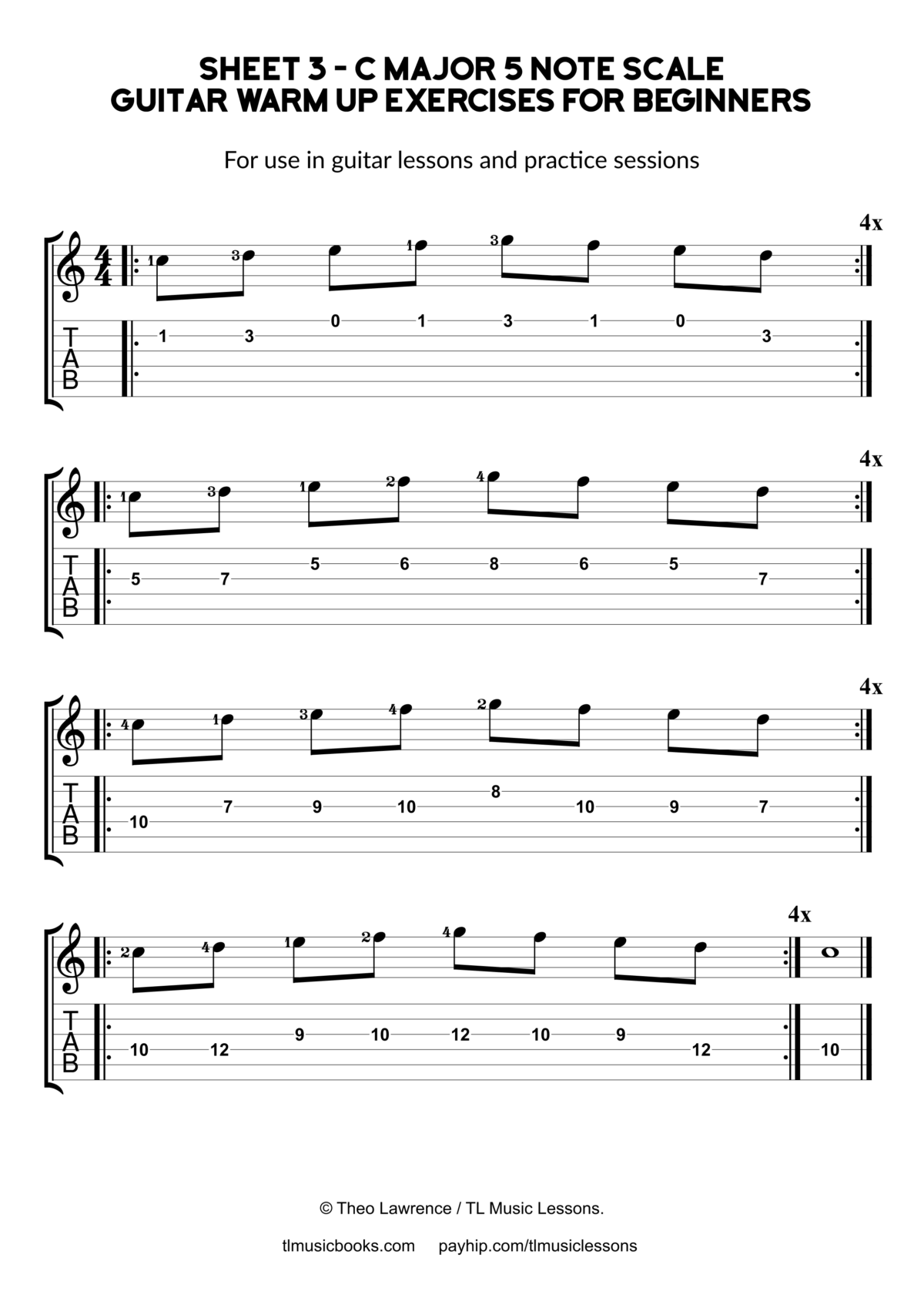
5 Movable 1 Octave Scale shapes in 5 keys – 25 Scales – PDF

Free PDF:
5 Moveable 1 Octave Guitar Scales in 5 different keys

Free Guitar Pro 7 File:
5 Moveable 1 Octave Guitar Scales in 5 different keys

All scales in 5 keys: G, A, B, C, D

5 Major scales
5 Major Pentatonic scales
5 Minor Pentatonic scales
5 Blues scales
5 Natural minor scales

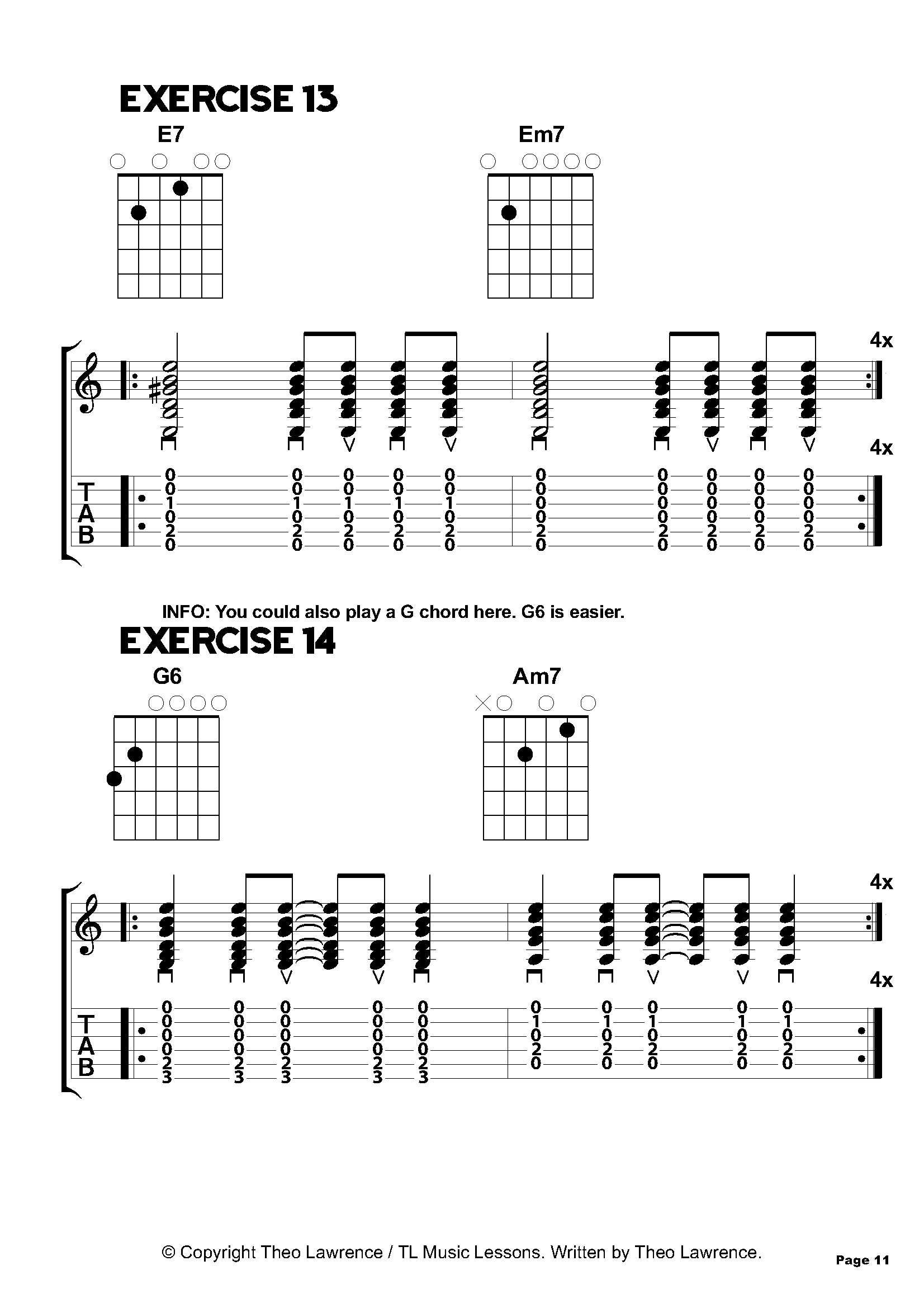
Exercises 13-14 – Inside The Book: 50 Chord Exercises for Beginners

These two guitar chords exercises are featured in the book 50 Acoustic Guitar Chord Exercises

On this chords exercise sheet, we will be working with four chords: E7, Em7, G6 and Am7.

Exercise 13

E7 is used a lot in Blues music and Em7 can be used as a variation on the Em chord, but it’s not used as often.

The strumming is D 2 DUDU, D 2 DUDU.

The counting is 1 (2) 3 + 4 +, 1 (2) 3 + 4 +

Exercise 14

G6 and Am7 can be used as simplified chords of G and Am but are both individual chords in their own right.

The strumming is Down 2 3 Down, Down 2 3 Down.

The counting is 1 2 + (3) + 4, 1 2 + (3) + 4

Video Lesson


Watch on YouTube

← Exercises 11-12
Exercises 15-16 →
Buy The Book →

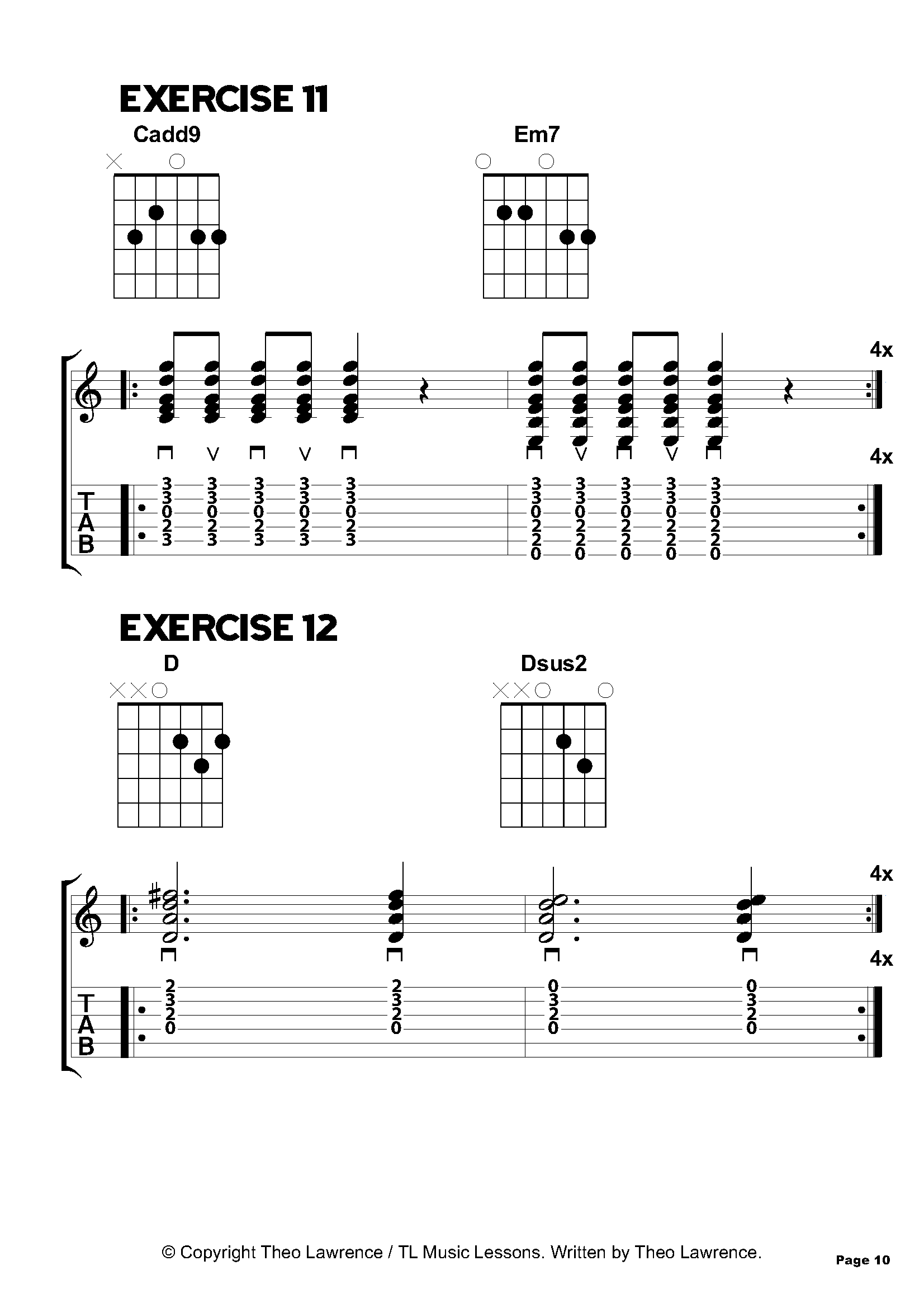
Exercises 11-12 – Inside The Book: 50 Chord Exercises for Beginners

These two guitar chords exercises are featured in the book 50 Acoustic Guitar Chord Exercises

On this chords exercise sheet, we will be working with four chords: Cadd9, Em7, D and Dsus2.

Exercise 11

Cadd9 and Em7 are 2 very popular open chords, and are used in particular a lot on pop covers using a capo.

The strumming is DUDUD rest, DUDUD rest.

The counting is 1+2+3+(4), 1+2+3+(4).

Exercise 12

D and Dsus 2 are also used a lot on songs using a capo but they are also very common in rock songs.

The strumming is Down 2 3 Down, Down 2 3 Down.

The counting is 1 (2 3) 4, 1 (2 3) 4.

Video Lesson


Watch on YouTube

← Exercises 9-10
Exercises 12-13 →
Buy The Book →

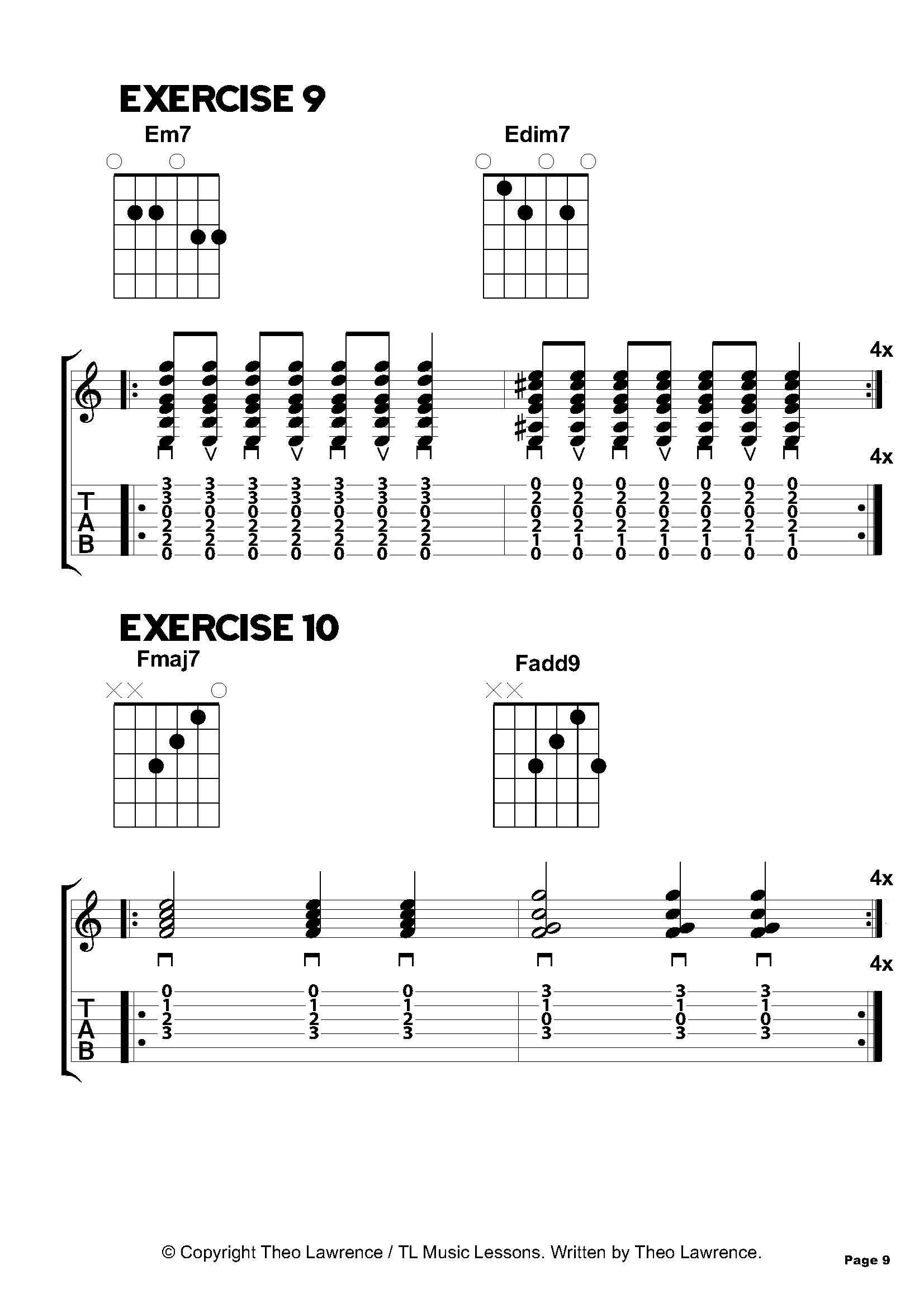
Exercises 9-10 – Inside The Book: 50 Acoustic Guitar Chord Exercises for Beginners

These two guitar chords exercises are featured in the book 50 Acoustic Guitar Chord Exercises

On this chords exercise sheet, we will be working with four chords: Em, Edim7, Fmaj7 and Fadd9.

Exercise 9

Whilst we don’t usually play diminished chords at beginners level, this one is not very difficult because it is an open chord, similar to an A7 chord shape with an added finger.

Counting:
1+2+3+4

Exercise 10

Fadd9 is a moveable chord. We sometimes forget about these simple moveable shapes and get stuck playing only barre chords and power chords. Move it up 2 frets and you have Gadd9. Two more frets up and you have Aadd9. Incase you were wondering what an add9 chord is, it’s a full major chord with an added major 2nd or major 9th note added (major 9th and major 2nd are the same notes, but major 9th is an octave higher.

Counting:
1 2 3 4

Video Lesson for Exercises 9-10


Watch on YouTube

← Exercises 7-8
Exercises 11-12 →
Buy The Book →

Exercises 7-8 – Inside The Book: 50 Acoustic Guitar Chord Exercises for Beginners

These two guitar chords exercises are featured in the book 50 Acoustic Guitar Chord Exercises

On this chords exercise sheet, we will be working with three chords: A, A7 and Dsus2.

Exercise 7

The first strum is worth 2 beats. You can see that the note is not coloured in and it has a stem, so that makes it a minim, worth 2 beats (also known as a half note because it lasts for half of the bar). This is followed by two cotchets, which are 1 beat each. Here is the counting that you should use for this exercise (strumming on the parts in bold font).

1 2 3 4

Exercise 8

The rhythm for this exercise is almost the same as exercise 7. All we do is add an up strum after beat 3. Here is the counting that you can use to help:

1 2 3 + 4

Video Lesson for Exercises 7-8

← Exercises 5-6
Exercises 9-10 →
Buy The Book →

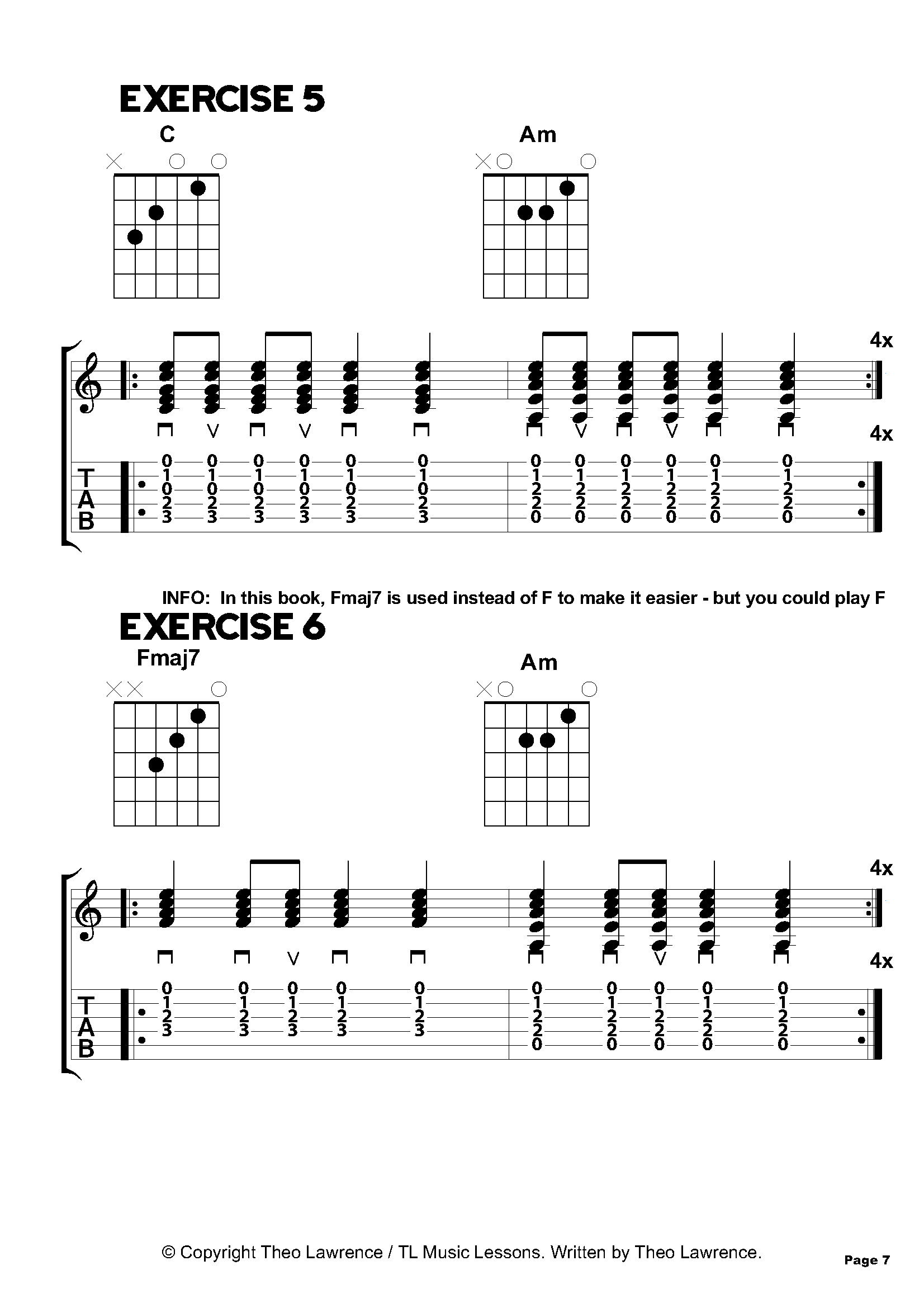
Exercises 5-6 – Inside The Book: 50 Acoustic Guitar Chord Exercises for Beginners

These two guitar chords exercises are featured in the book 50 Acoustic Guitar Chord Exercises

On this sheet, we start to work on strumming rhythms. Exercise 5 uses C and Am chords and the rhythm is down up down up down down. Exercise 6 uses F and Am chords and the rhythm is down down up down down. On the video I show you how to practice these using a metronome. You could use this sheet and follow this video for a quick 5 minute lesson on practicing the C, Am and F chords, which are fundamental to learn and practice on the guitar.

← Exercises 3-4
Exercises 7-8 →
Buy The Book →

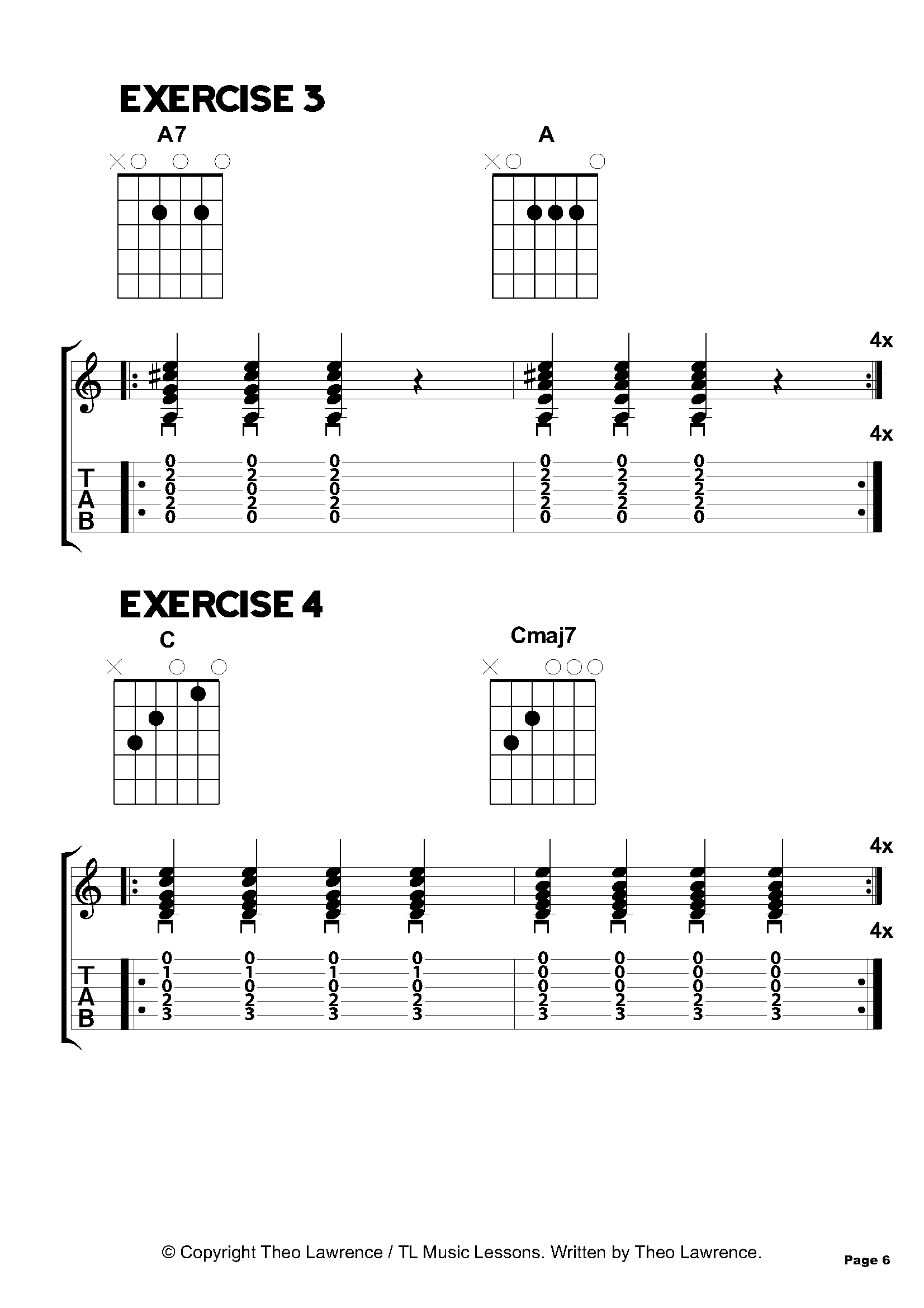
Exercises 3-4 – 50 Acoustic Guitar Chord Exercises – Beginners & Grade 1-2

These two guitar chords exercises are featured in the book 50 Acoustic Guitar Chord Exercises

Here are 2 beginners guitar chord exercises using A7, A, C and Cmaj7. There are very simple rhythms in each exercise. Use the video below to help you with knowing how to count them.

← Exercises 1-2
Exercises 5-6 →
Buy The Book →

Exercises 1 and 2 – 50 Acoustic Guitar Chord Exercises – Beginners & Grade 1-2

Here we have 2 guitar chords exercises for beginners. The chords are Cmaj7, Am7 and Am. The first exercise has single strums, lasting for 4 beats, and the second exercise has 2 strums per chord, each lasting for 2 beats.

Here is a video demonstration:

Exercises 3-4 →
Buy The Book →

Beginners Rock Guitar Skills Book

Buy Now →

Free 6 page pdf preview
(click the buy now link then the preview button at the top right)

  • Guitar tab & sheet music
  • Learn the basics of rock guitar
  • 40 rock guitar skills exerecises
  • Learn with an acoustic or electric guitar

This rock guitar skills book is aimed at ages 7-12, who have learned a little bit about how to read and play guitar already, although teenagers and adults could use this book too as a way into learning rock guitar. Their knowledge needs to be very basic, enough to be able to read basic guitar tabs and to be able to push down on the strings to play notes cleanly. Towards the end of the book, the difficulty level rises and the guitarist will need to be able to play chords and to count and play rhythms with rests.

Other books (before/after/similar)

For complete beginners, I would recommend starting with one or more of these books first: First Guitar Book – Easy Reading

Beginners Guitar Chords Book (Easy Reading)

These books are at a similar level, and could be learned before, after, or instead of this book:

Beginners Classical and Fingerstyle Guitar
50 Acoustic Guitar Chord Exercises Ebook – Basic Beginners & Grade 1-2

For the next level up after this book, you could try:

27 Guitar Chord Exercises Grade 1-2 – Book 2
10 Acoustic Guitar & Ukulele Songs – Volume 1 (Audio & Sheet Music)
6 Rock and Blues Play Along Backing Tracks

People that might find this book useful

  • Beginner Guitar students of any age group, particularly from ages 7-12 if the student has already started at a young age.
  • Guitar teachers can print the book or single sheets for their students.
  • Guitar students that want to learn the basics of rock and metal guitar.
  • Parents may be able to teach their children with this book.
  • Some guitarists may be able to teach themselves with this book, especially if they have some reading knowledge.


Topics covered in this book:

  • How to read the notation
  • Warm Up Sheet with scales
  • Single String Riffs
  • Basic Riffs with Power Chords
  • Power Chord Riffs with rhythms and counting
  • Riffs with palm muting
  • Basic Rock Chords with rhythms
  • Riffs and patterns using scales such as the minor pentatonic scale
  • Chords with Picking


Final Thoughts

This is my 10th guitar book covering beginner levels and I have used my knowledge and experience of this along with my 12 years experience of teaching, to create a niche book that I think will suit so many young guitarists learning how to play rock guitar, at a basic level. Many of which will be learning on a ¾ size acoustic guitar, and that is perfectly ok. They are very easy to transport into school for youngsters and there is no messing around with amps and leads. Perhaps this book could be used by a teenager or adult too as an open door into the world of rock guitar at a very basic level.

\m/ Enjoy! \m/

Guitar Chords for The Christmas Song by Nat King Cole

I learned this song and recorded the guitar backing for this video recently and I would like to share the guitar chords with you, and also promote the youtube videos that I used to learn the song.

So for this version, I transposed the guitar chords up 4 semitones (up 4 frets) so that it fitted the vocalist’s range.

Below are the untransposed chords for the original version. As they are all barre chords, they were easy to move up 4 frets without a capo. There are no chords shown for the instrumental part, as this is skipped.

Abm7b5 – Gm7b5 (slide) (xx5666 slide to xx4555)

Dbmaj7 Ebm7

Dbmaj7 Ebm7 Fm7
Gbmaj7-Fm7-Ebm7
Dbmaj7 Abm7-Db9
Bbm7 B9
Dbmaj7 B9
Dbmaj7 Gm7-Gb7
Fmaj7 Gbm7-B9sus4
Emaj7
Ebm7-D9

Dbmaj7 Ebm7 Fm7
Gbmaj7-Fm7-Ebm7
Dbmaj7 Abm7-Db9
Bbm7 B9
Dbmaj7 B9
Dbmaj7 Gm7-Gb7
Fm7-E9-Ebm7-Ab13

Dbmaj7

Abm7 Db9 Gbadd9 Gb
Abm7 Db9 Gbadd9 Gb
Gbm7 B9
Emaj7
Bbm7 A7 Ab7

Dbmaj7 Ebm7 Fm7
Gbmaj7-Fm7-Ebm7
Dbmaj7 Abm7-Db9
Bbm7 B9
Dbmaj7 B9
Dbmaj7 Gm7-Gb7

Fm7-E9-Ebm7-Ab13

Dbmaj7 (and/or jingle bells tune…)

E+B Strings:
13 / / 13 / / 13 16
9 11 13

And here are the briliant videos I used to learn the song: