All That Jazz: How to Get Started Playing Jazz Guitar

Photo credits: Marius Masalar and Katie Montgomery.

Guest post by Know Your Instrument.


Eager to begin your jazz guitar journey but don’t know where to start? You’ve come to the right place to get the top tips for jazz guitar beginners. Here we’ll discuss the things you need to do first when you set out to become a jazz player.

Ready? Here we go!

Get the basics down

We’re talking about guitar basics. If you’re going to be playing jazz, it’s a must for you to already be able to play the guitar, and play it well. If you are confident in your playing skills, have a good mastery of chords and scales and have a repertoire that includes a few jazz standards (‘The Girl From Ipanema,’ ‘My Funny Valentine,’ and ‘Fly Me to the Moon’ are a few examples), then you’re ready to focus on jazz music.

If you’re not quite there yet, then we suggest getting more practice time in. Supplement your learning with more songs from various artists so you can further develop your ear – and your playing style – for jazz music.

Get a good guitar

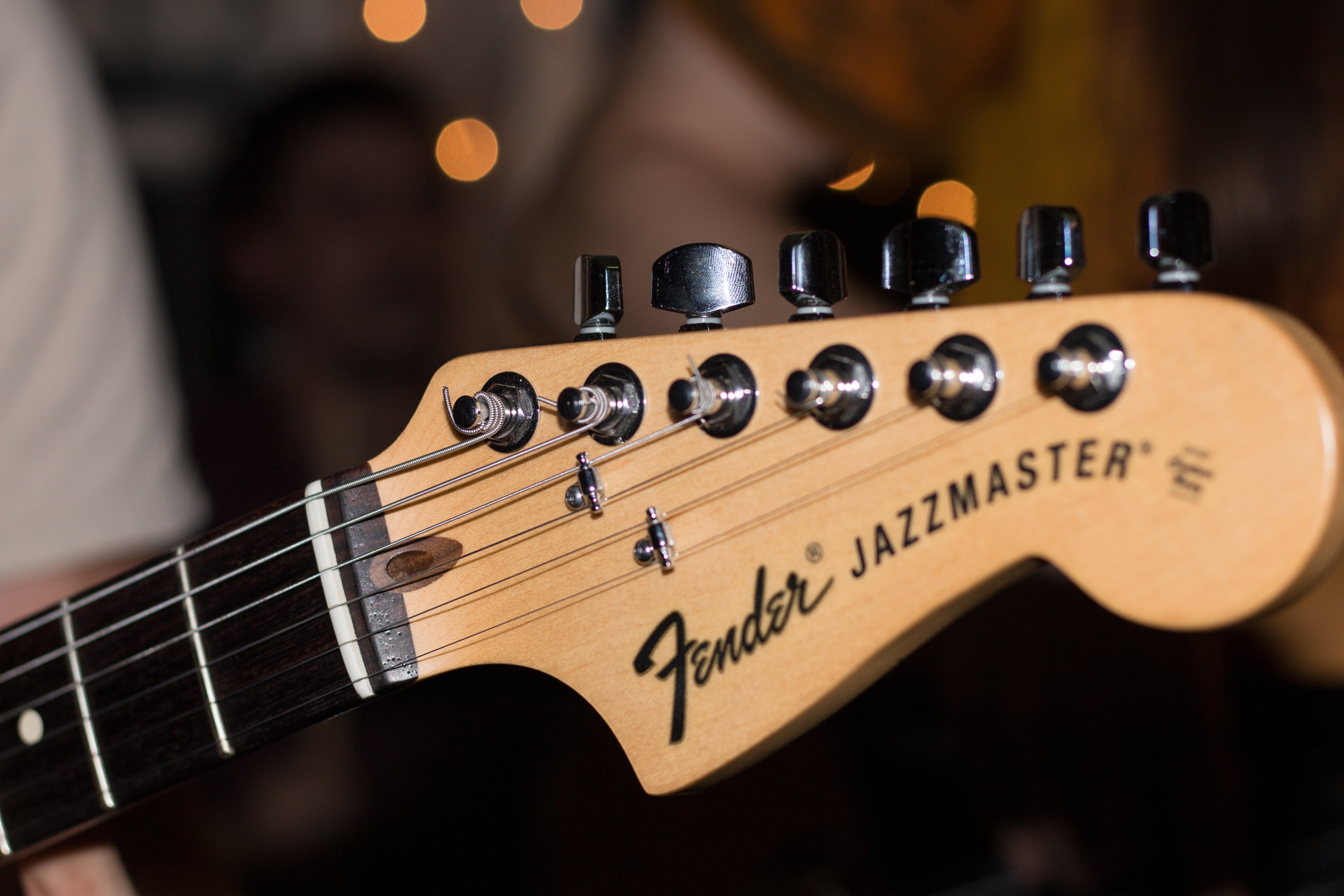
While you can definitely get a good jazz sound from a standard solid-body electric guitar, if you really want a really nice jazzy tone then you’ll have to get a guitar that’s designed for playing jazz music. Solid-body electrics are built more for rock, but there are those like the Fender Jazzmaster that’s really built for jazz.

Of course, nothing beats semi-hollowbody and hollowbody guitars when it comes to making jazz music. Some of the best guitars for jazz are of these body types. Check out the Gibson ES-335, Epiphone Sheraton II-PRO and the Ibanez Artcore AS73, which are all semi-hollow, and the Epiphone Emperor Swingster, which is a hollowbody guitar. For budget-conscious beginners, the Epiphone and Ibanez models come highly recommended.

Learn to read music


Legendary jazz guitarist Wes Montgomery couldn’t read notes but he didn’t really have to, being the fretboard genius that he was. Unfortunately, many of us don’t have the same natural, innate ability to create melodic lines and navigate our way across the fretboard without the aid of music sheets.

So, unless you have Montgomery’s talent, reading music is a skill you must learn to become a good jazz guitar player. This skill is a plus too if you’re looking to teach guitar or compose your own music in the future.

Expand your repertoire

Once you’ve started to listen to more jazz tunes and read music, you can now increase your repertoire and really learn to play jazz. Start with songs you like – learn to play the melody first and then the chords. Break down each section and get it right before moving on to the next.

The more you listen and play, the more you will be able to internalize the rhythms, melodies, harmonies and the various song forms in jazz music. You won’t simply be imitating or memorizing jazz standards, you will actually be expressing jazz. This will not only help you in doing improvisations but also in becoming a better jazz guitarist overall.

Final Word

The most important thing you need to do when you start learning jazz guitar is to develop a thirst for knowledge. Keep on learning and honing your playing skills and technique. Be conscious of what you still need to know and improve on to become a better player and work on it. Practice regularly and soon you’ll be able to improvise with ease, play sophisticated solos and express your own musical voice. Good luck!
Connection Between Guitar Fretboard And Piano Keyboard

  • How are guitar fretboard and piano keyboard related?
  • Will it be easier for guitarist learn piano notes or pianist learn guitar notes?

Today, our guest Neil from Sublimelody.com brings us a visual guide to answer two questions above.

Let’s get started.

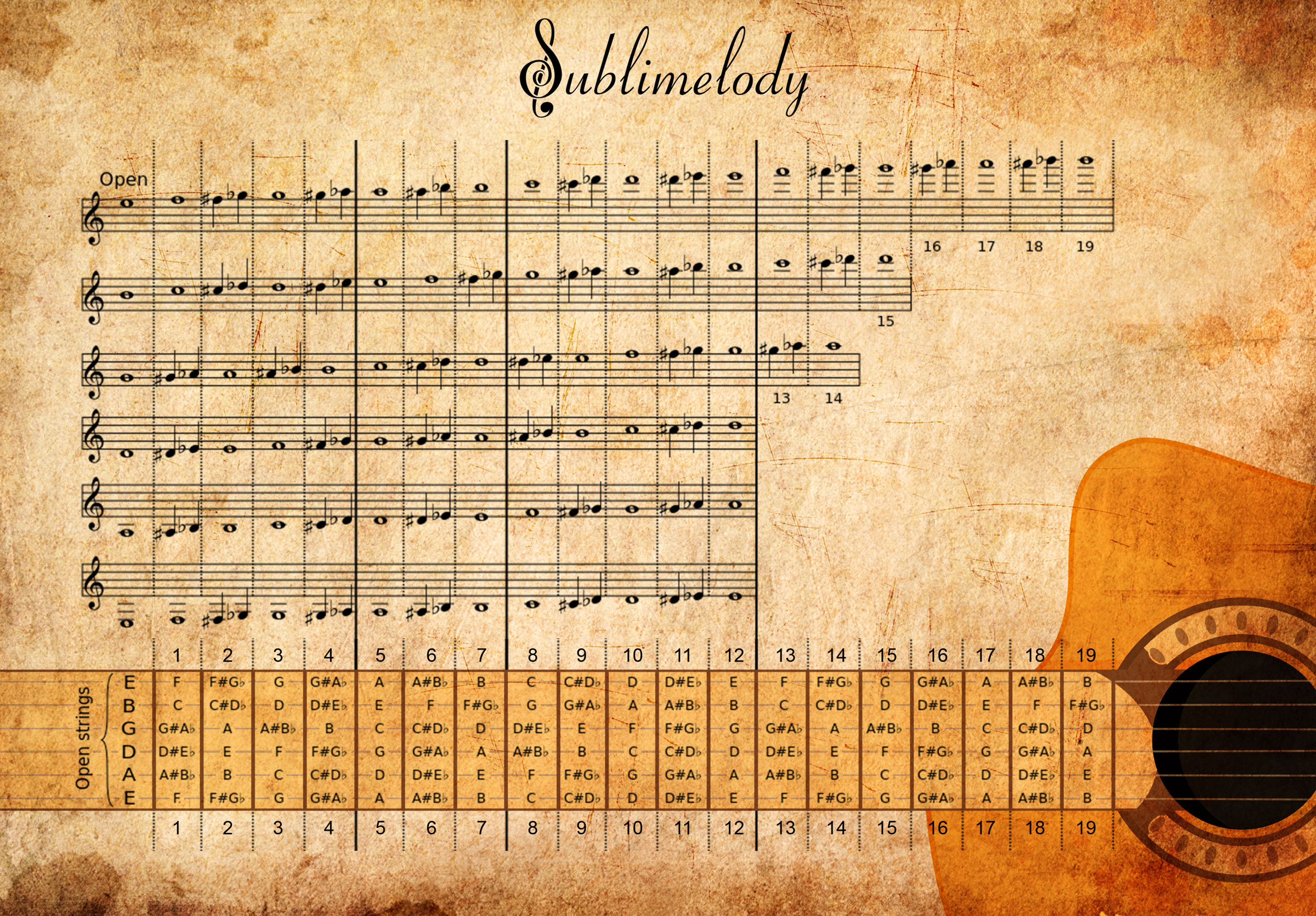
1. Music Notes And Fret-Strings On The Guitar Fretboard

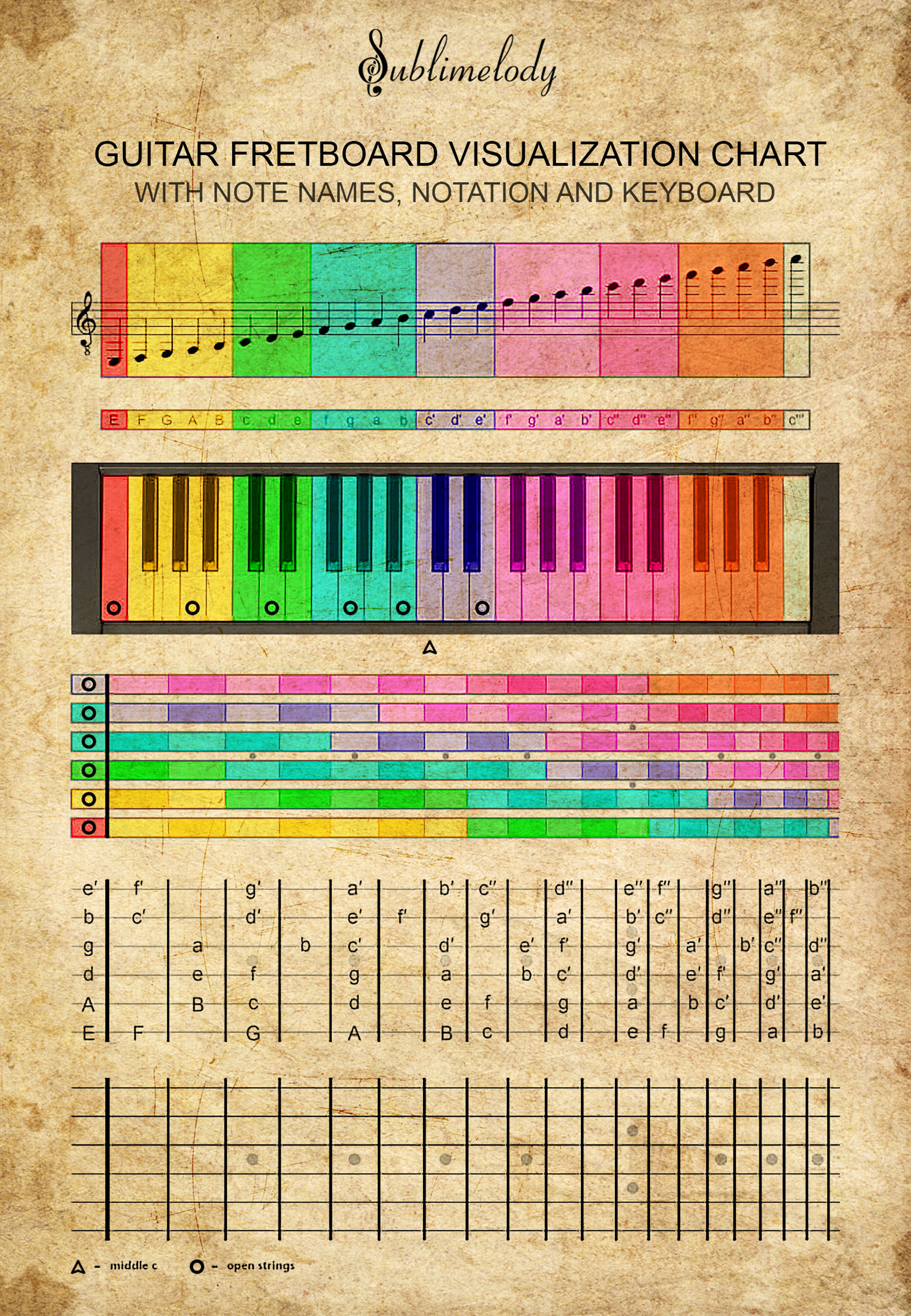
The diagram below shows you the connections between music notes and their corresponding string-frets on a standard classical guitar fretboard.

As you already know, we use the treble clef in guitar sheet music.

Each music note on the sheet music often has two or more corresponding string-frets on the guitar fretboard.


We call the string numbers by standard order. From the bottom to the top of the diagram above:

  • E (on the bottom) is the 6th string
  • A is the 5th string
  • D is the 4th string
  • G is the 3rd string
  • B is the 2nd string
  • E (on the top) is the 1st string


Let’s see how we can use the chart above to read music note and its corresponding string-frets:

Where is this note on the fretboard (G4)?

Look at the diagram above, we can see its positions on the fretboard are:

  • 5th string and 10th fret
  • 4th string and 5th fret
  • Open 3rd string


It’s not so hard, isn’t it?

Well, from a pianist point of view, it’s a bit complicated to learn guitar notes. Since to play the G4 note, we have 3 positions to choose from.

And each string is like a mini-piano-keyboard. Therefore, we have 6 keyboards!

Now, let’s move to the next section to see how music notes and piano keys are connected.

2. Music Notes And Keys On The Piano Keyboard

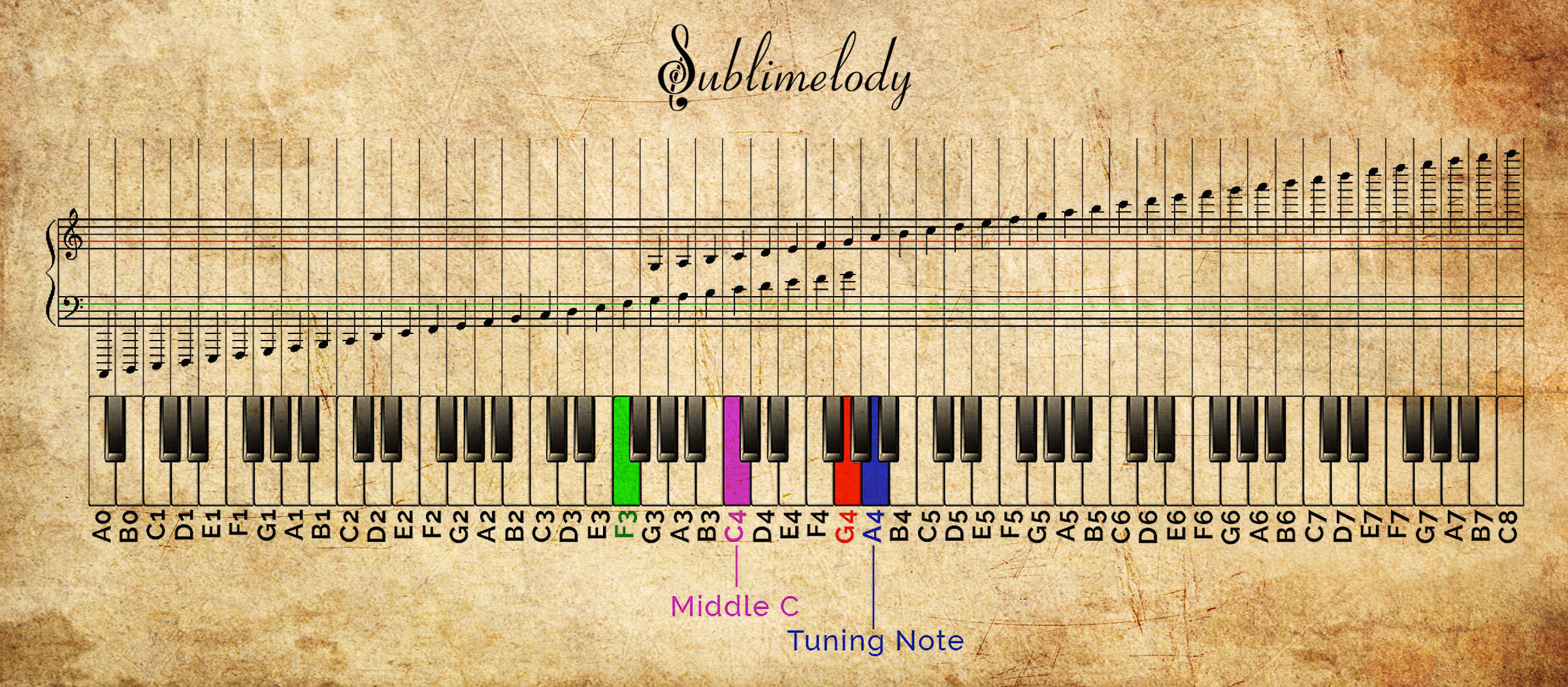
The diagram below shows you the connection between music notes and piano keys.

It may seem complicated at first, but if look closely, you will see that’s pretty simple.


From a guitarist point of view, a piano keyboard is just a string of a guitar. Each piano key is similar to a guitar fret.

The difference is the this “piano string” is much longer and presents wider pitch range than a guitar.


So, learning piano notes seems pretty easy for a guitarist.


Also, you may wonder what is the name of the clef below the treble clef. It’s the bass clef.

In piano, the left-hand plays notes on the bass clef and the right-hand plays notes on the treble clef.


If you want to learn more about reading piano notes and piano keys, and how to do sight-reading fast without memorizing a bunch of facts, click here to visit the visual guide from Sublimelody.


3. The Connection Between The Guitar Fretboard And The Piano Keyboard

Combine 2 diagrams above, and we have the following illustration:

Now, I guess you’ve got the point how music notes, piano keys, and guitar string-frets are connected.


And that’s it for my guide.


If you have any question about this guide, please visit sublimelody.com to get in contact.

Dynamics

Here is a list of dynamic markings you might encounter in drum sheet music. This list will be updated as more dynamic markings are thought of, and will start out as a basic list of fundamental dynamics notation.

  • pp (pianissimo = very soft/quiet)
  • p (piano = soft/quiet)
  • mp (mezzo piano = medium quiet / medium soft)
  • mf (mezzo forte = medium loud)
  • f (forte = loud)
  • ff (fortissimo = very loud)
  • a wide version of this shape: < (crescendo = gradually getting louder)
  • a wide version of this shape: > (diminuendo = gradually getting quieter)
  • > these arrows above the notes are accents, which indicate that you play loud on this note only.

Understanding Notes and Rests in Music Notation – Reference Sheet

Get Free PDF Download →

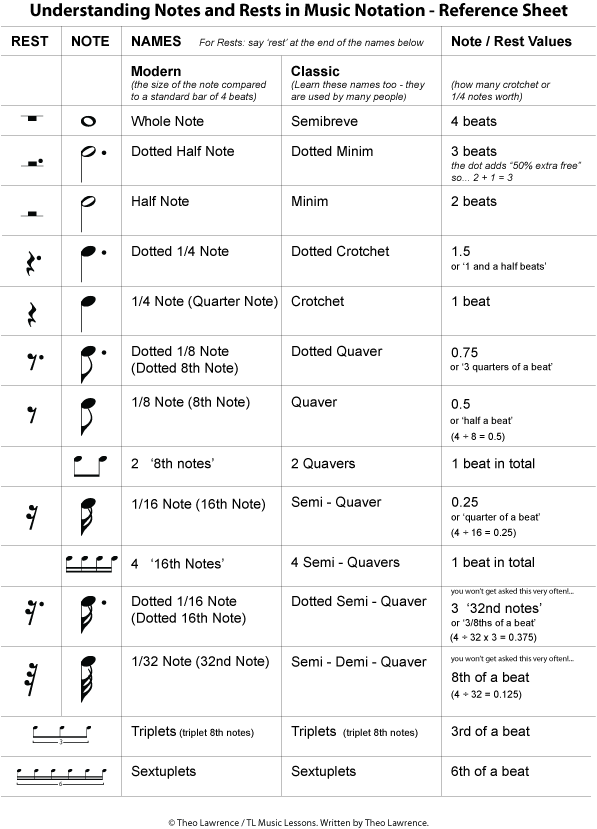
This is a very useful sheet that will help students of most instruments that read music. The sheet includes images or rests and notes, and their modern or classic names, and also note values and rest values.

This can be useful as a reference sheet for students to keep on your computer, phone or tablet, or you can also print it out and stick it on the wall or keep it somewhere handy.

Music Teachers are welcome to download this and print it for their students.