‘Sun Shines Through The Window’ – Blues Play Along Track – Rhythm Guitar, Lead Guitar, Bass, Ukulele, Drums and Vocals

Listen to the track at 90bpm:

70bpm:

60bpm:


Download the MP3 file – Sun Shines Through The Window (Full Speed)

Download the Guitar Pro 7 file – Sun Shines Through The Window

LEAD GTR – Sun Shines Through The Window – PDF Sheet Music
RHYTHM GUITAR – Sun Shines Through The Window – PDF Sheet Music
UKULELE – Sun Shines Through The Window – PDF Sheet Music
BASS GUITAR – Sun Shines Through The Window – PDF Sheet Music
LYRICS – The sun shines through the window – TXT File

This song has been written as an educational piece for Drums, Guitar, Bass and Ukulele. I made it for my students to learn and I am sharing it online for everyone else too. I created the piece in Guitar Pro 7, which is a great way to learn and practice this because you can mute insruments and change the speed and even change parts if you like.

This blues song is played straight, without swing. There are drum beats and fills in the piece in keeping with the blue style. You could solo the drums and bass on it’s own to practice locking in with the bass – making sure the bass drum syncs up with the bass guitar when ever they are played together.

12 Bar Blues

The pattern of the 12 bar blues usually follows a pattern of chord changes. The pattern of bars where the main chord changes are is this: 4,2,2,1,1,1,1.

The pattern below is clearer. It uses roman numerals to show which chord in the diatonic chord sequence that is being used.:

I / / /

IV / I /

V IV I V

Lyrics

I wrote this song originally for just the instruments, but I thought it would be good to write some lyrics in case there are any singers out there that would like to sing along too. I have a rough idea of how it would go in my head, but I’m no singer, so you’re on your own!

VERSE 1

The sun shines through the window
And I’m stuck inside the house
It’s half past 1 in the afternoon,
And the day is going fast

I’m tryin to make things work
I’m tryin to make things rhyme,
But there’s harder times ahead,
And I’m running out of time.

I can’t see when this will end
All my plans are on their head
But the sun keeps shining through
Takin’ away those blues

VERSE 2

The sun shines through the window
And I’m stuck inside the house
It’s half past 2 in the afternoon,
And the day is going fast

I’m tryin to make things work
I’m tryin to make things rhyme,
But there’s harder times ahead,
And I’m running out of time.

I can’t see when this will end
All my plans are on their head
But the sun keeps shining through
Takin’ away those blues

VERSE 3

The sun shines through the window
And I’m stuck inside the house
It’s half past 3 in the afternoon,
And the day is going fast

I’m going to make things work
I’m going to make things rhyme,
But there’s harder times ahead,
And I’m running out of time.

I can’t see when this will end
All my plans are on their head
But the sun keeps shining through
Takin’ away those blues

About the lyrics

This song and it’s lyrics were written during the Covid-19 corona virus and it’s about having your job taken away and having to rebuild and adapt before you get into financial trouble. Many people will be in this situation with governments being very slow to offer financial support. I hope learning and playing this song can give some enjoyment to people in this strange time of crisis.

Send in videos of you playing this song

I will add your videos to this page if you record yourself playing it. Please get in contact.

Drums

Head over to learndrumsrforfree.com to get the files for the drums.

Premium Download: 6 Rock and Blues Play Along Backing Tracks

This song is featured in the Play Along Backing Tracks series with Blues and Rock pieces. You can purchase the sheet music and backing tracks here:
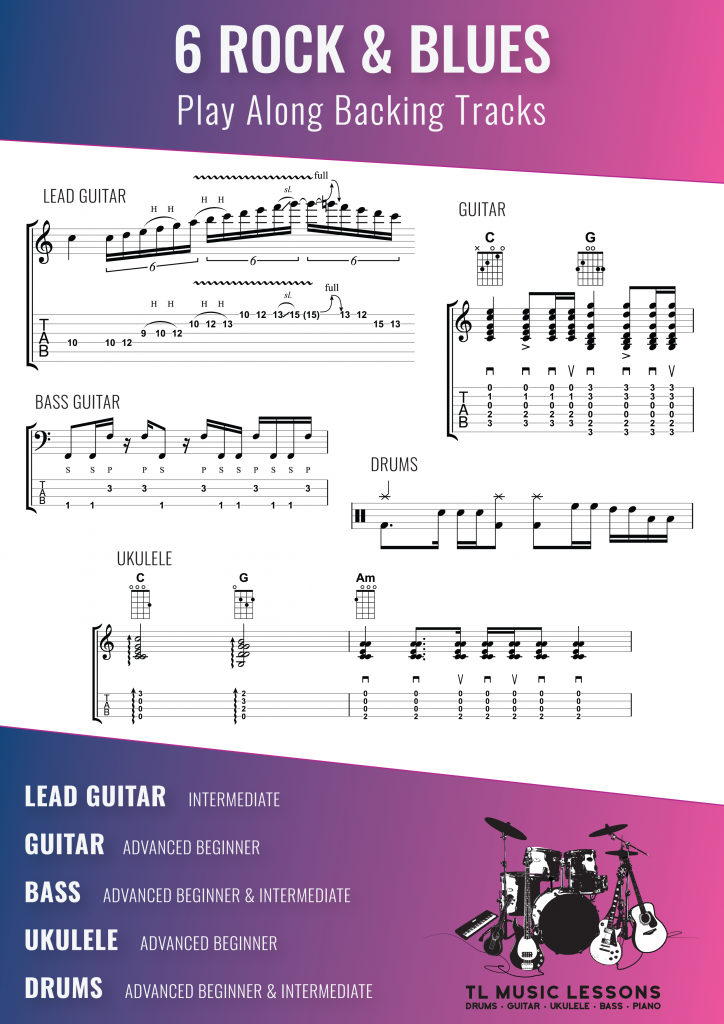
6 Rock and Blues Play Along Backing Tracks

Dynamics

Here is a list of dynamic markings you might encounter in drum sheet music. This list will be updated as more dynamic markings are thought of, and will start out as a basic list of fundamental dynamics notation.

  • pp (pianissimo = very soft/quiet)
  • p (piano = soft/quiet)
  • mp (mezzo piano = medium quiet / medium soft)
  • mf (mezzo forte = medium loud)
  • f (forte = loud)
  • ff (fortissimo = very loud)
  • a wide version of this shape: < (crescendo = gradually getting louder)
  • a wide version of this shape: > (diminuendo = gradually getting quieter)
  • > these arrows above the notes are accents, which indicate that you play loud on this note only.

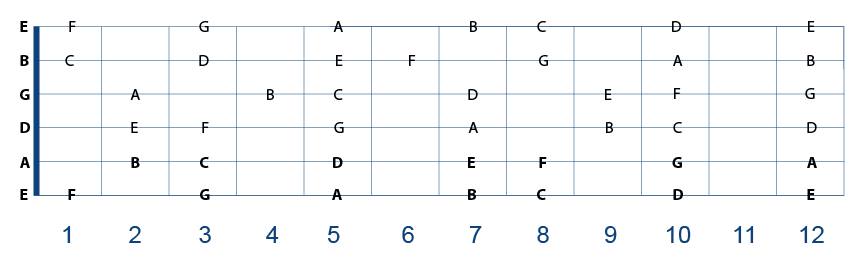
Notes on the Guitar Fretboard on all of the strings – Quick Reference Sheet for Grade 3+

Rockschool Syllabus:

You will need to learn the main notes on the E and A strings to get by in Rockschool, in particular from Grade 3 onwards because they will be needed to play barre chords and scales in the correct places. It is beneficial to understand how sharps and flats (# and b) work from Grade 3, and by Grade 5 you might struggle without this knowledge.

RGT Syllabus:

You will need to learn the notes on the E and A strings including all the sharps and flats in RGT Grade 3 because they will be needed to play barre chords and scales in the correct places. By Grade 5 you will need to have some understanding of all the fretboard notes including sharps and flats, and at least the ability to quickly work out any note on the fretboard in your head if you don’t remember it.

Sharps (#) and Flats (b)

1 fret higher is a sharp, or 1 fret lower is a flat. So fret 2 of the E string could be either F sharp of G flat (F# or Gb). They are both the same note. Try not to get confused with this at first, because you don’t need to understand why until Grade 5.

Remember This:

“SHARPEN UP” +1 FRET
“FLATTEN DOWN” -1 FRET

Chord inversions, Slash Chords, Alternative Bass Notes – A quick explanation

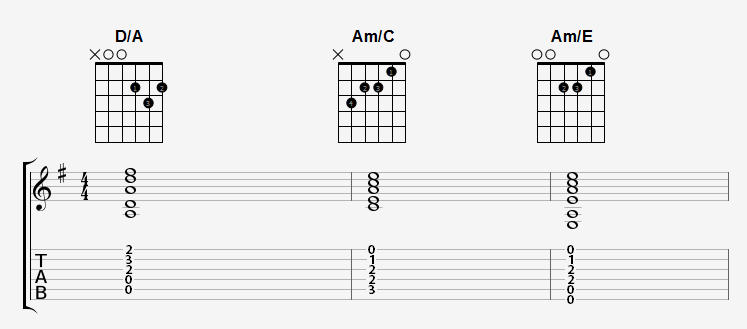
You may have seen chords like Am/C or G/F#. You may have just learned the chord without understanding it. You may have panicked and not played it.
Here is a quick explanation of how it works

The first part of the slash chord is the main chord being played. Some of the slash chords add a lower note, and some take away the lowest notes and replace them with the second part of the slash.

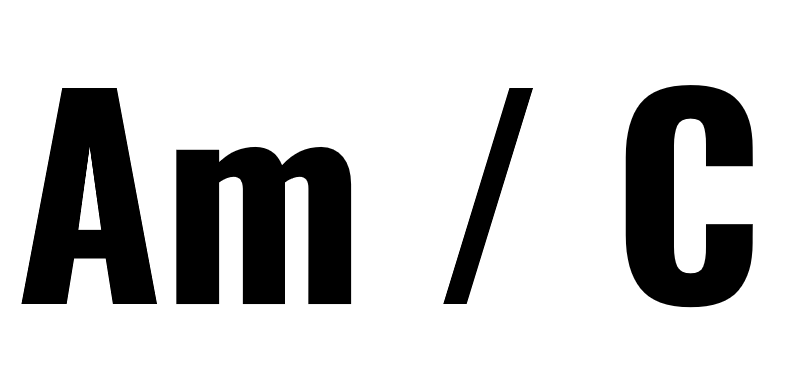
For example, on Am/C, it’s mainly the Am that’s being played, but with an added C note. In this case, the ‘A’ root note is not played, because you will play the C instead.

In another example, for D/A, you are mainly playing a D chord, but you also play the A string as the root note, so in this case no notes have been removed.
Is it an inversion?

An inversion is when you use one of the notes that make up a chord (eg. C E G = the C chord), and place one of those notes as the lowest note (e.g. play the low E string and you get C/E).
When is it not an inversion?

When you add a note that’s in the same key, but wasn’t in the chord initially. For example, G/F# is not an inversion; it’s just called a slash chord with an alternative bass note, because the regular G chord is only usually made up of the notes G, B and D. An inversion of G would be G/B or G/D.
Further Reading

There is some quite good info here that shows you various chords: http://www.scenicnewengland.net/guitar/chords/slash.htm


Relative minor and relative major theory summary

Natural minor scales consist of 7 different notes, and the same goes for major scales.Some major and minor scales have the same notes as each other, but start on different notes, making them different key signatures. These are relative keys. For example, the C major scale uses all the same notes as the A natural minor scale. On the piano, only the white keys are used for these two scales. For C major, you would start on a C and play ascending notes up to the next C, using only the white keys. For A minor, you would do the same but starting and ending on an A note.

  • C major scales have these notes: C, D, E, F, G, A, B, C
  • A minor scales have these notes: A, B, C, D, E, F G, A
  • Notice both scales use the same notes, but start on a different note.

‘A minor’ (also known as ‘A natural minor’), is called the “relative minor” of ‘C major’, because they are related in terms of using exactly the same notes. Or you could say, C major is the relative major to A minor. Sometimes these can be used in the same song because they fit together. For example, ‘Run’ by Snow patrol plays in the key of A minor for the verses, but then bases the chorus around the C major key, and it works because all the notes and chords in both keys use exactly the same notes, but are just centered in a different place.

Accents

Accents are where you play notes or chords a bit louder. It enables the dynamics for a section to stay the same, but highlight certain notes as being a bit louder. They are used by all styles of music, and are a good way to add dynamic rhythm. For example, to make a driving rock groove, you could play 8th notes (1 + 2 + 3 + 4 +), and accent only the numbers. Heavily accented notes can be used for stabs, or ending notes.

Accents are displayed on sheet music as a right arrow > symbol, or as an upward arrow for a heavily accented note.

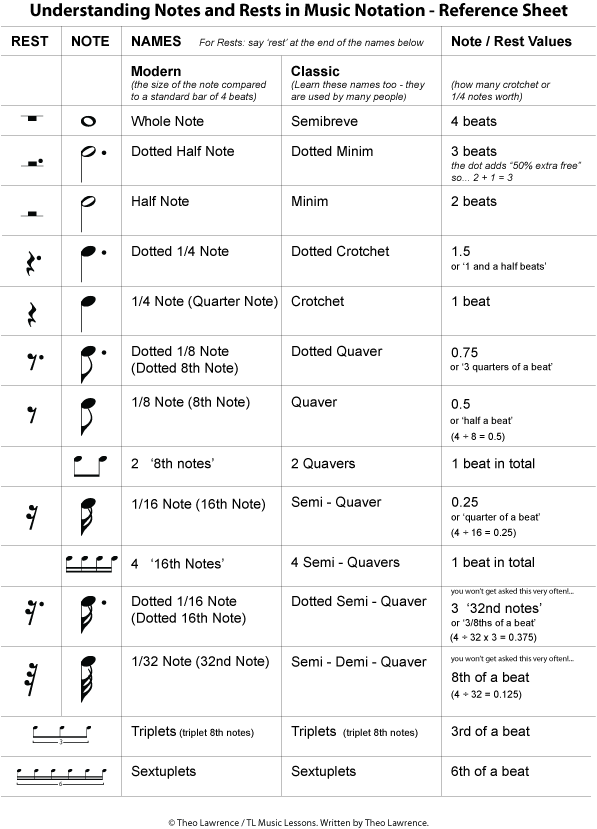
Understanding Notes and Rests in Music Notation – Reference Sheet

Get Free PDF Download →

This is a very useful sheet that will help students of most instruments that read music. The sheet includes images or rests and notes, and their modern or classic names, and also note values and rest values.

This can be useful as a reference sheet for students to keep on your computer, phone or tablet, or you can also print it out and stick it on the wall or keep it somewhere handy.

Music Teachers are welcome to download this and print it for their students.

Subdivisions, Time Signatures and Cakes

Subdivisions is a general term that we usually use to describe various notes that are shorter than one beat, such as 8th notes, triplets, 16th notes, and all the rest. 1 beat crotchets (quarter notes) can be divided into halves to make quavers (8th notes). These 8th notes (quavers) can subdivided into 16th notes (semi-quavers) by halving them again. The largest note in music without using ties is a semibreve (whole note), lasting 4 beats. Everything smaller than this is divided up again and again, which are subdivisions of the initial division. 2 beat notes are an equal division of the 4 beats. Technically, I think anything smaller than this is a subdivision because it has been divided up more than once.

Lets use a simple cake example of how subdivisions work…


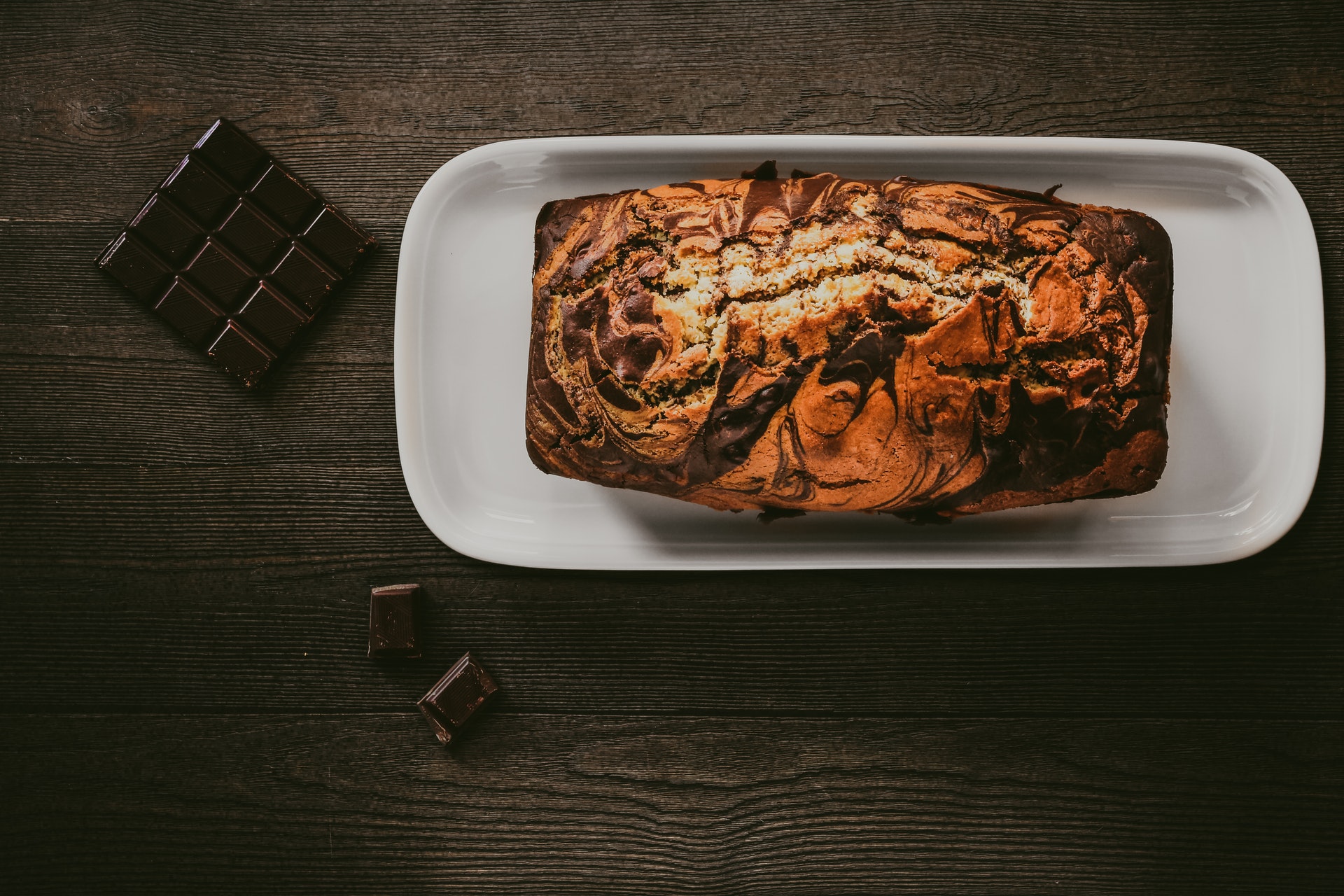
Subdivisions Cake Example

  • Imagine you have a rectangular cake weighing 4kg (whole note / semibreve), and you have 1 table to put them on to sell. The table represents 1 bar of music.
  • Cut this cake in half down the long length to make two shorter rectangles weighing 2kg each (half notes / minims)
  • Divide this up into quarters and you have 4 x 1kg square cakes (quarter notes / crotchets) sitting on the table.
  • If you cut these up again to sell as individual portions, you are making subdivisions. Cut up the first cake in half and they would be 500g each and be 8th notes (quavers).
  • Cut up the second cake into half, and then half again and you would have 4 pieces at 250g each. These would be 16th notes (semi-quavers).
  • For the 3rd 1kg cake, cut it into 4 250g pieces again (’16th notes’) and then cut each of those portions in half again – what are you left with?
  • That’s 8 pieces and they would be 32nd notes (semi-demi-quavers).
  • If you cut every one of the 4 cakes on the table into ’32nd notes’, how many pieces would there be on the table?
  • There would be 32 pieces of cake.
  • How many beats make up a standard bar of music (how many 1kg cakes did we put on the table)?
  • 4
  • So in music when you see a 4/4 time signature at the start of a piece, the top 4 means how many cakes, and the bottom number means how many cakes they were cut into. There would be 4 x 1kg cakes = 4kg
  • So, in a 6/8 time signature, that would mean there are 6 x 8th note cakes on the table (500g for each cake). 6 x 500g cakes = 4kg.
  • In a 3/4 time signature there would be 3 x 1kg cakes = 3kg. So here, the table has less cake on it! This is the same as saying there are 3 beats per bar (3 cakes per table).
  • In a 2/4 bar how many 1kg cakes?
  • 2
  • in a 7/8 bar, how much does the total amount of cake weigh?
  • 7 x 500g = 3.5kg (3 and a half beats worth of crotchets / quarter notes)

Root Notes

Questions about learning root notes and why comes up a lot by guitarists.

In this article, I will attempt to answer some questions you might have about root notes, and hopefully encourage some people enough to spend time to learn them.

Learning root notes might sound like a lot of work, but I recommend that you learn them as you go, for example, learn the root notes of an A major barre chord shortly after learning the shape.

Don’t try to learn all the root notes for everything in one go, as that would probably get a bit boring! Instead, you could read through this to pick up the main points, and perhaps check back here when you learn a new barre chord or scale to refresh your memory if you need it.

What are root notes?

Root Notes in Scales

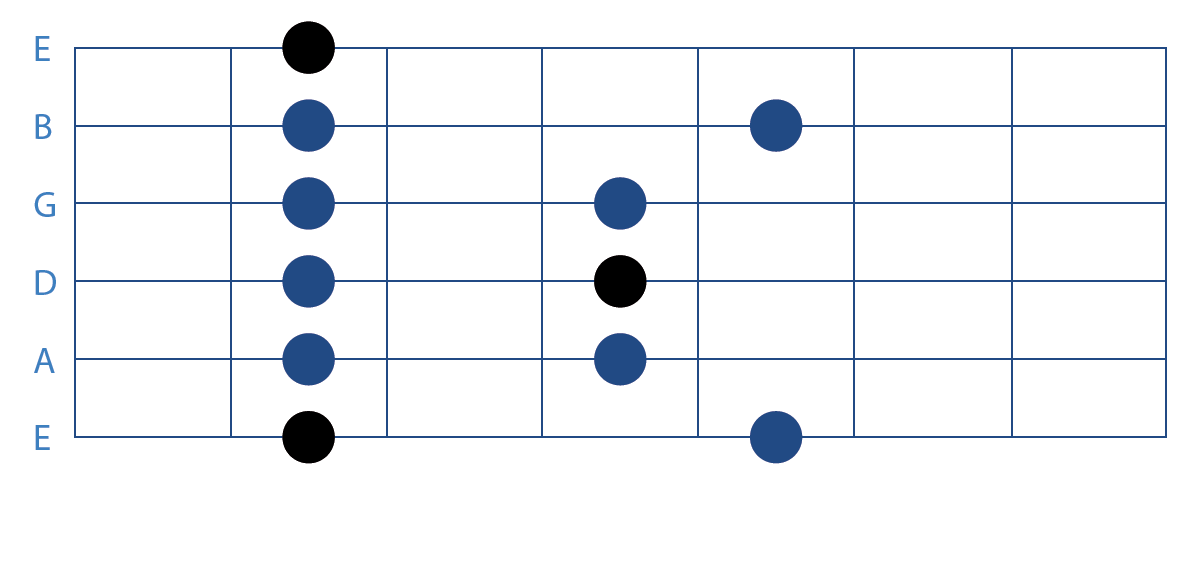
In scales, the root note is the first note in the scale. This is also the root note of the key of the song. In a 2 octave scale, there will be 3 root notes: The first note in the first octave, the first note of the second octave, and you normally end on the 1st note of the 3rd octave.

These are important to know because when you are soloing, it’s often a good idea to resolve to the root note at the end of the solo.

Another good thing for knowing the root notes, is that you could start soloing half way through a 2 octave scale, by starting on the second root note. In RGT grade 5 and above, you actually are required to know many scales in this way, by playing 1 octave scales in 5 positions. They are all actually the same notes,but played starting on various root notes. So here you will be forced to learn the root notes! The idea of this is useful: to be able to play the same riff all over the guitar neck but a acheive different tones, or be able to apply different techniques such as hammer ons or slides in different places that you couldn’t in others.

Root Notes in Chords

Major chords are made up of 3 notes (a root note, and two others). Almost always, the first note in any chord is the root note. The root note of an A chord is A. The root note of an E chord is E. Easy.

In standard major and minor barre chords on the E string, there are 3 root notes in total. This is the first note, last note, and the one that you hold down with the little finger. Knowing where root notes are in other chords, and how they are constructed is usefull for picking out those notes if you want to, or for creating variations of the chord. If you want to find out more, do a quick search on here, or on google, for ‘chord construction’.

Root Notes in Arpeggios

Knowing the root notes in arpeggios is similar to learning about chord construction, because an arpeggio is basically the notes that make up a chord in chronological order, played for 1 or more octaves. For example:

  • a C major barre chord is made up of the notes C E G.
  • the order that these notes are played in on fret 8 of the E string is actually C G C E G C when you use the major barre chord shape on the E string.
  • The 2 octave major arpeggio shape on the E string would be played on fret 8 as well so it’s in C. The notes would be in order though, so they would be C E G C E G C. Knowing where the root notes are (the C’s) is helpful for starting the arpeggio half way through, or making your own custom arpeggios.