5 Movable 1 Octave Scale shapes in 5 keys – 25 Scales – PDF

Free PDF:
5 Moveable 1 Octave Guitar Scales in 5 different keys

Free Guitar Pro 7 File:
5 Moveable 1 Octave Guitar Scales in 5 different keys

All scales in 5 keys: G, A, B, C, D

5 Major scales
5 Major Pentatonic scales
5 Minor Pentatonic scales
5 Blues scales
5 Natural minor scales

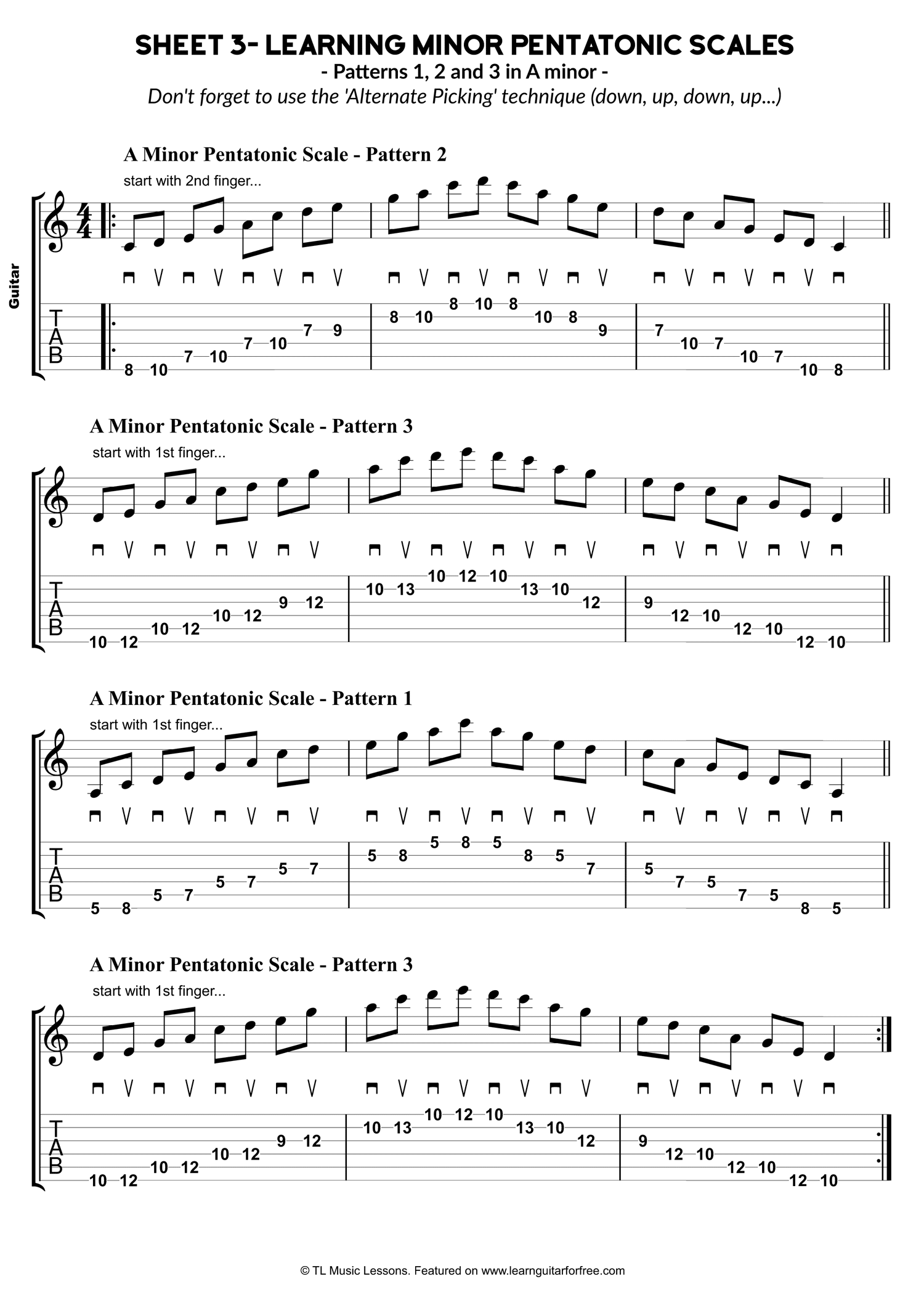
Sheet 3 – Learning Minor Pentatonic Scales – A minor – Patterns 1, 2 and 3

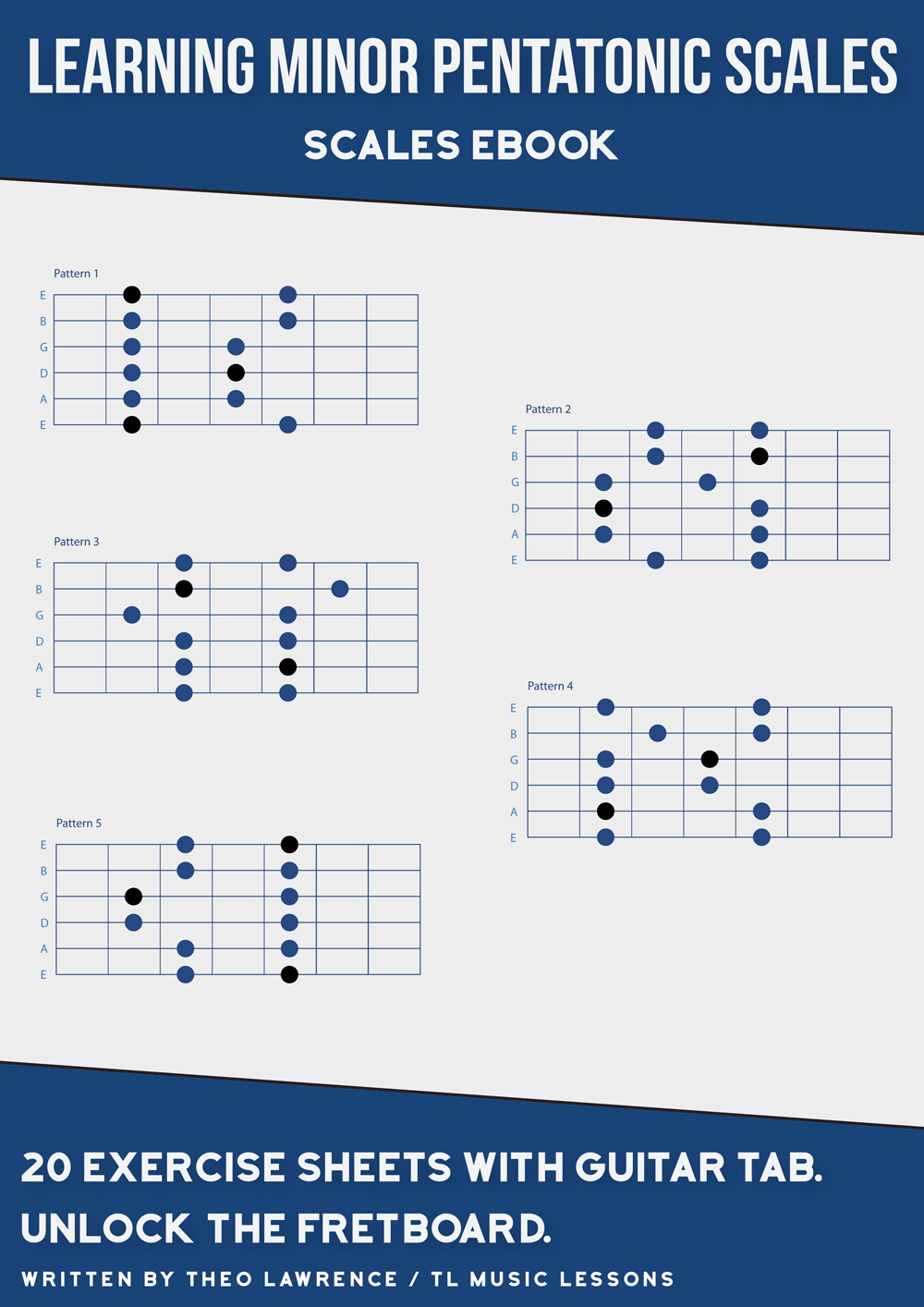
This sheet progresses on from Sheet 2 and is part of an ebook called Learning Minor Pentatonic Scales.

Just like we did in the last sheet, you will be working on patterns 1, 2 and 3 but this time, 2 frets higher in the key of A minor.

More Sheets in the series…

← Sheet 2


Related (Premium): The sheets in this series are from a 25 page PDF ebook: Learning Minor Pentatonic Scales
Sheet 1 – Rock Riffs – Bass Guitar

I’ve finally got another bass guitar student! I teach so many weekly guitar drums and ukulele lessons but I haven’t had a bassist to teach in 2 years. This is an example of why bands find it so hard to find a bass player.

This new student is a complete beginner on bass so I’m rebooting some of my old bass guitar lesson prep ideas and applying it to the new ‘Easy Reading’ designs I have been making for guitar and ukulele, which have really helped with teaching beginners.

Here is a sheet with 4 rock riffs for bass guitar. It uses notes from the E minor pentatonic scale. It’s all fairly easy and ideal for beginners. Keep repeating each exercise for a while and get into a groove before moving on. If you are really keen, try playing in time with a metronome. For many complete beginners though, it will be a matter of playing through each riff slowly.

For the complete beginners, read from left to right and play each number as it comes up. So on Riff 3, the sequence would be 0 0 3 3 0… 2 0 2 0 2 0. The top line is the 1st string, and that’s the thinnest string on the bass. The strings are numbered 1-4 on the left hand side.


Update, Jan 2019: I now have 3 bass students, which I’m really pleased about, so I hope to post more bass exercises soon on the website.

(PREMIUM) – Learning Minor Pentatonic Scales – PDF Ebook

Buy Now →

Contents

2 – Contents
3 – Introduction
4 – The 5 Moveable Scale Shapes
5 – Exercise Sheets 1 – 13
18 – Full run through of all 5 scale shapes in various keys
24 – All possible A minor pentatonic scale positions covering the whole neck

Self published in 2018 by TL Music Lessons.

Introduction

People that might find this book useful

  • Guitarists wanting to learn how to play guitar solos and improvise along with songs.
  • Guitar teachers can print the book or single sheets for their students.
  • Guitarists can teach themselves how to play the 5 minor pentatonic scales by following the book. The aim is to be able to do this from memory by the end of the book in various keys.
  • Guitarists on Grade 3 and above will find the scales useful for soloing. The 5 scale shapes are required for Grade 5, and for some syllabuses they are required for Grade 4.

About the book

This minor pentatonic scales ebook is a compilation of 9 years of preparation work teaching guitar to a wide range of abilities. After trying many ways of teaching scales to students and moving them on to improvising and soloing, I have developed this exercise ebook to really get to grips with these 5 scale shapes. If you follow the whole ebook and spend time on each sheet there is a strong chance of being able to use these scale shapes from memory for improvising and soloing.

I recommend spending about a week’s worth of practice on each sheet in the book. Really focus on that sheet for 3 or 4 practice sessions. It’s going to take you 20 weeks to do that, so you might want to move through it quicker, but I recommend doing that as you progress further through the book. Start out slow and then once it starts to click and you get used to the shapes then you can spend less time on each sheet. Make sure to follow the repeats on each sheet, which usually say to repeat the sheet twice. You are welcome to play more than twice though, or don’t do the repeat if you only have a short time to practice.

The finger suggestions are a guide to what I recommend to my students. There are different ways of playing the scales so it’s ok to do what works for you. Just don’t use 1 finger for all of it! Younger players think it’s faster at first, but it’s really not in the long run. I remember one student that I had to battle with for ages to agree to use more than 1 finger on her scales and then after a few weeks of practicing with all the fingers, she found it funny because it was much quicker and easier than using just one finger.

The guitar tab sheets have been created using Guitar Pro 7 and the scale shapes and cover were created using Adobe Illustrator.

Guitar teachers can use this ebook in their own teaching and they are welcome to print physical copies for their students.

Free Previews

  • Click the Buy Now button below and then click ‘Preview’ at the top right of the product image
  • There is also a series of free posts featuring some of the minor pentatonic scale exercise sheets.

Buy Now →

Sheet 2 – Learning Minor Pentatonic Scales – G minor – Patterns 1, 2 and 3

This sheet progresses on from Sheet 1.

In this sheet we introduce the 3rd minor pentatonic pattern. This pattern appears twice in the exercise. We are trying to learn it but at the same time we will try and build relationships between the 3rd shape and the 1st and 2nd shapes. Make sure to go around the sheet twice to complete the exercise. This can be revisited many more times. I would spend at least one week’s worth of practice time focusing on one sheet at a time in this series, rather than rinsing all the sheets in one go.

When learning the minor pentatonic scales (and most other scales too), it is important not to view them as boxes that you get stuck in when playing guitar solos. There are 5 shapes and the sooner you get used to linking them up and not lingering on one shape, the better. The scale shapes are a tool for navigating guitar neck and it’s useful to start linking up the shapes so that you can move from one shape to another seamlessly.

The ultimate aim is to be able and to be comfortable moving between shapes, regardless of how many notes you have played in the scale. The aim is not to play up and down each scale and seamlessly to the next, it’s to be so comfortable with moving between shapes that when you start playing guitar solos, you can move between the shapes without needing to follow the full scale. So, for example play a few notes of Shape 1, and slide up to shape 2 and play a couple more, and maybe quickly switch up to a combination of notes on shapes 4 and 5.

When you are comfortable, stick on a song in the given key and try playing the scales along. Then try improvising some melodies, or maybe some guitar solos if you are ready, using a combination of the 2 scale shapes. Try doing these along with some music. Use songs in the key of G minor to play along with.

More Sheets in the series…

← Sheet 1
Sheet 3 →


Related (Premium): The sheets in this series are from a 25 page PDF ebook: Learning Minor Pentatonic Scales
Sheet 1 – Learning Minor Pentatonic Scales – G minor and A minor – Patterns 1 and 2

When learning the minor pentatonic scales (and most other scales too), it is important not to view them as boxes that you get stuck in when playing guitar solos. There are 5 shapes and the sooner you get used to linking them up and not lingering on one shape, the better. The scale shapes are a tool for navigating the guitar neck and it’s useful to start linking up the shapes so that you can move from one shape to another seamlessly.

The ultimate aim is to be able and to be comfortable moving between shapes, regardless of how many notes you have played in the scale. The aim is not to play up and down each scale and seamlessly to the next, it’s to be so comfortable with moving between shapes that when you start playing guitar solos, you can move between the shapes without needing to follow the full scale. So, for example play a few notes of Shape 1, and slide up to shape 2 and play a couple more, and maybe quickly switch up to a combination of notes on shapes 4 and 5.

So, with this sheet, we are starting with Shape 1 and 2 in G minor and we hope to achieve the first goal of getting used to 2 scale shapes back to back and hopefully starting to remember the shapes as we move them both up 2 frets into the key of A minor. Repeat each exercise 2-4 times regularly until you are comfortable and fluent. You can revisit these exercises at any time – they will always be useful.

Make sure to use 1 finger per fret, because each scale shape only spans 4 frets. That way you will play them quicker in the long run. Don’t waste time thinking you will be faster with 1 finger only because you will soon be faster using all 4 fingers after a bit of practice. Also, use the ‘alternate picking’ technique (down, up, down, up) as written.

When you are comfortable, stick on a song in the given key and try playing the scales along. Then try improvising some melodies, or maybe some guitar solos if you are ready, using a combination of the 2 scale shapes. Try doing these along with some music. Use songs in the key of G minor for the first exercise (first 2 lines), and songs in the key of A minor for the second exercise (lines 3 and 4).

More Sheets in the series…

When you have spent at least few practices on this sheet and start to recognise the shapes a little bit, try moving onto Sheet 2:

Sheet 2 →


Related (Premium): The sheets in this series are from a 25 page PDF ebook: Learning Minor Pentatonic Scales

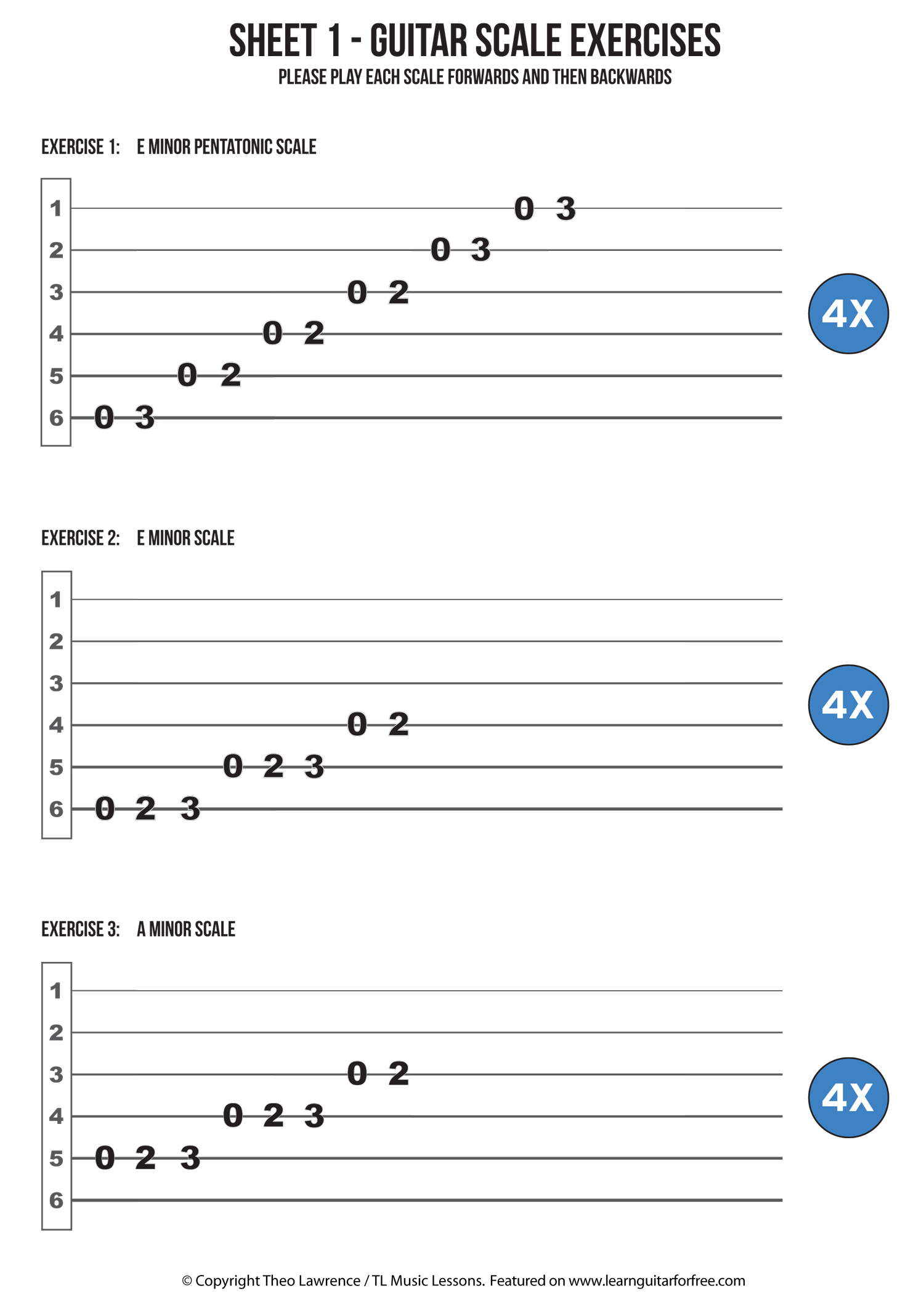
Sheet 1 – Easy Reading Guitar Scale Exercises

Over the last 9 years of teaching guitar I have noticed young beginners in particular struggle to get to grips with reading guitar tab, but it’s sometimes any age. They get confused over which string the top line of the tab is. Usually they think it’s the 6th string at the top because it’s at the top of their guitar when they look at it, and they find it hard to get over this being the other way around at first!

Also, students often get distracted by other things on the sheet music and often ask questions like; “what does TAB mean”, “do we play 4/4 at the start?”, “what do these notes mean? (pointing to the notes above the tab), or say things like “the numbers are too small”, “I keep getting lost” (again with regards to the numbers being small and getting lost because they have taken a while looking down at their instrument trying to find fret 3 on the 4th string, for example).

So as a teacher I decided to create a range of sheets like this one to make both my life easier and to help my students get to grips with reading tab quicker for playing scales, melodies and exercises. I have created the sheet using Adobe Illustrator. I intend to post more of these sheets and similar ones for playing chord progressions, and I will release one or two ebooks based on these. There will also be ukulele ones.

How to read the sheet

  • On exercise 1, read all 6 strings at once from left to right.
  • You will play in this order: Play the open string (that is the 0) on string 6 and then press down on fret 3 of the 6th string and then play that string to make the note.
  • Then in a similar way play 0 2 on string 5, then 0 2 string 4, 0 2 string 3, then 0 3 on string 2, then 0 3 on string 1.
  • Next, do all of this in reverse.
  • Finally, repeat all of this a further 3 times so that you will have been around 4 times in total.
  • Play exercise 2 and 3 in the same way.

Related: This sheet is featured in the premium ebook First Guitar Book – Easy Reading.
Related: Sheet 1 – Easy Reading Ukulele Scale Exercises.