A Full Motion PC Monitor Arm can help you to read sheet music on your computer

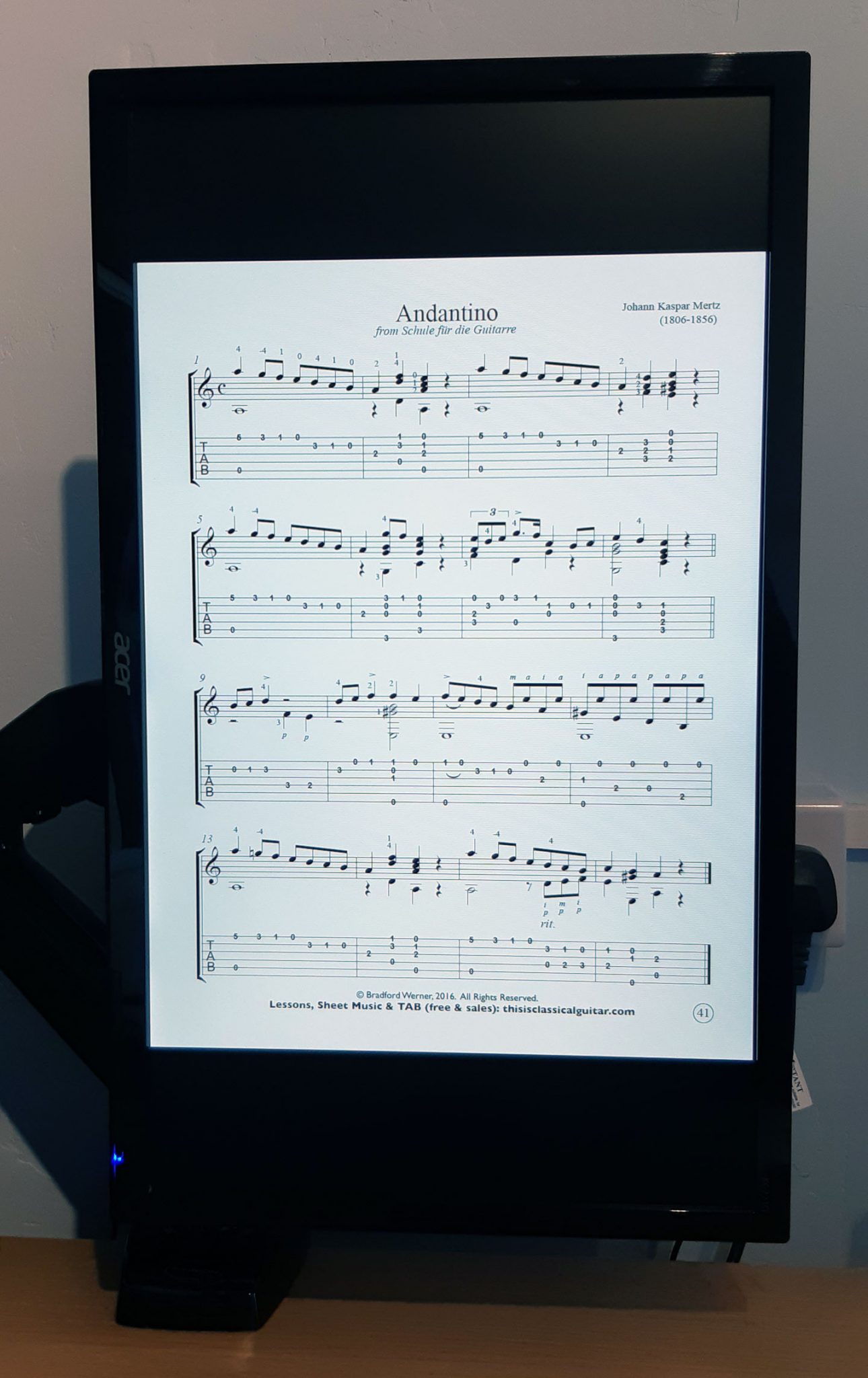
Today I installed a Full Motion PC Monitor Arm to my desk so that I can rotate my PC screen to read sheet music easily.

As I have been doing more teaching from home, and also have had more time to practice my instruments, I have been getting increasingly frustrated when reading music, because in Landscape mode it involves a lot of scrolling. You have to scroll much more frequenly than if the screen was in portrait mode.

I asked my techy gamer friend which one she has in her setup that I have seen, and she said to get this one, so I did.

Moving the monitor and benefits

I can now move the screen into portrait and load up a guitar book pdf and play away. You can go into full screen mode (Ctrl+L) and then press the down arrow key to move to the next page. Or you can use one of the other viewing methods without full screen mode and that way you can see a bit of the next sheet, and then press the down arrow to scroll or PgDn button to jump lower, or use the mouse.

To move the monitor, you can grab the screen and twist it around to make it portrait or landscape, or anything in between. You can also tilt it forwards and backwards and also move it left to right so that it can face someone to your left or right. This I think will come in very handy, because when I have been doing skype lessons on drums, I have been dragging my monitor around to face the drums, so this will be much easier, as you ust move it and then it stays in that position, so no screwing etc to move it.

How to change from Portrait to Landscape

To change the screen orientation to portrait in windows 10, you can right click on the desktop and click ‘Display Settings’ and change it there. My graphics card doesn’t allow the hotkey to change it annoyingly, but most people can change the screen orientation by clicking Ctrl+Alt+arrow keys.

Other Uses

The arm will help in lots of other ways too, like moving the screen so I can see it from the floor for workouts. I have been using the office to do home workouts from centr.com (unleashed and the da rulk masterclass have been enjoyable) and some others like Shona Virtue’s Fitness Programme after purchasing a cheap 8kg kettle bell from Aldi (was a rare find as weights were scarce).

I’m sure it will come in handy for positioning the monitor for gaming too, with a particular interest in F1 games.


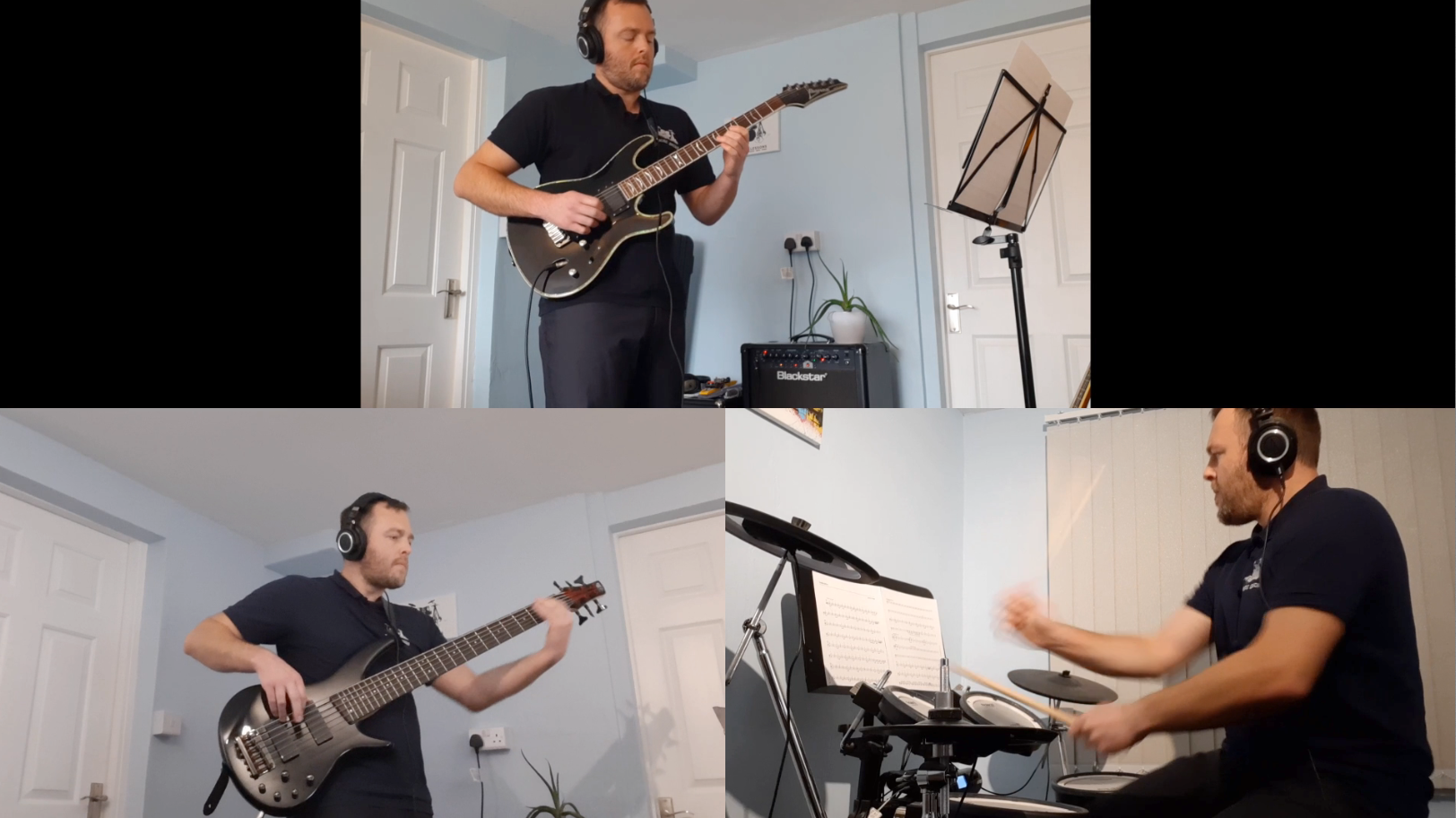
Guitar Drums and Bass performance of ‘Indecisive’ – Rockschool Grade 3 Piece

Many of my students have learned this piece and passed their exams. It’s an enjoyable piece to play with lots of energy and it’s deceptively hard to perform the whole song without mistakes.

The videos were recorded using a phone camera and a Zoom HD1 microphone.

I think these performances would get a fairly good mark out of 20 in an exam. Maybe 19 out of 20 each. I think the guitar performance was probably the strongest out of the 3, as there were small misakes in the others. But overall, I hope this is a good demo of the song and a good chance for students to see how the songs are played by each instrument, and give examples of the type of solos you could play in the song.

How peripatetic music teachers can keep working if the schools close

Here in the UK the schools are still open and it’s business as usual but last night I sent out an email asking if parents would be up for skype lessons and the response has be overwhelmingly positive. I’ve made a rule that a parent or guardian must be there for the lessons.

I have been teaching skype lessons successfully for over 3 years, and I currently have a skype Drummer that has just taken her Grade 5 drum exam. All the parents need to do is download the Skype app on their smart phone for free and the calls are free.

If we don’t do the skype lessons, I have to refund the missed lessons on the next invoice, so it’s not worth relaxing at home when I could keep some of the work going for the ones that still want to keep the lessons going.

This gives me hope for when we have snow days, or flooded days, if this works.

It’s starting to be heart warming to see people respond in positive ways, like the italians singing in their balconies, and this morning seeing a singer who’s first european tour has been cancelled, doing a live social media tour, it is just inspiring.

Stay safe and stay positive 🙂

Portable Keyboard for Practicing Piano: What to Look for?

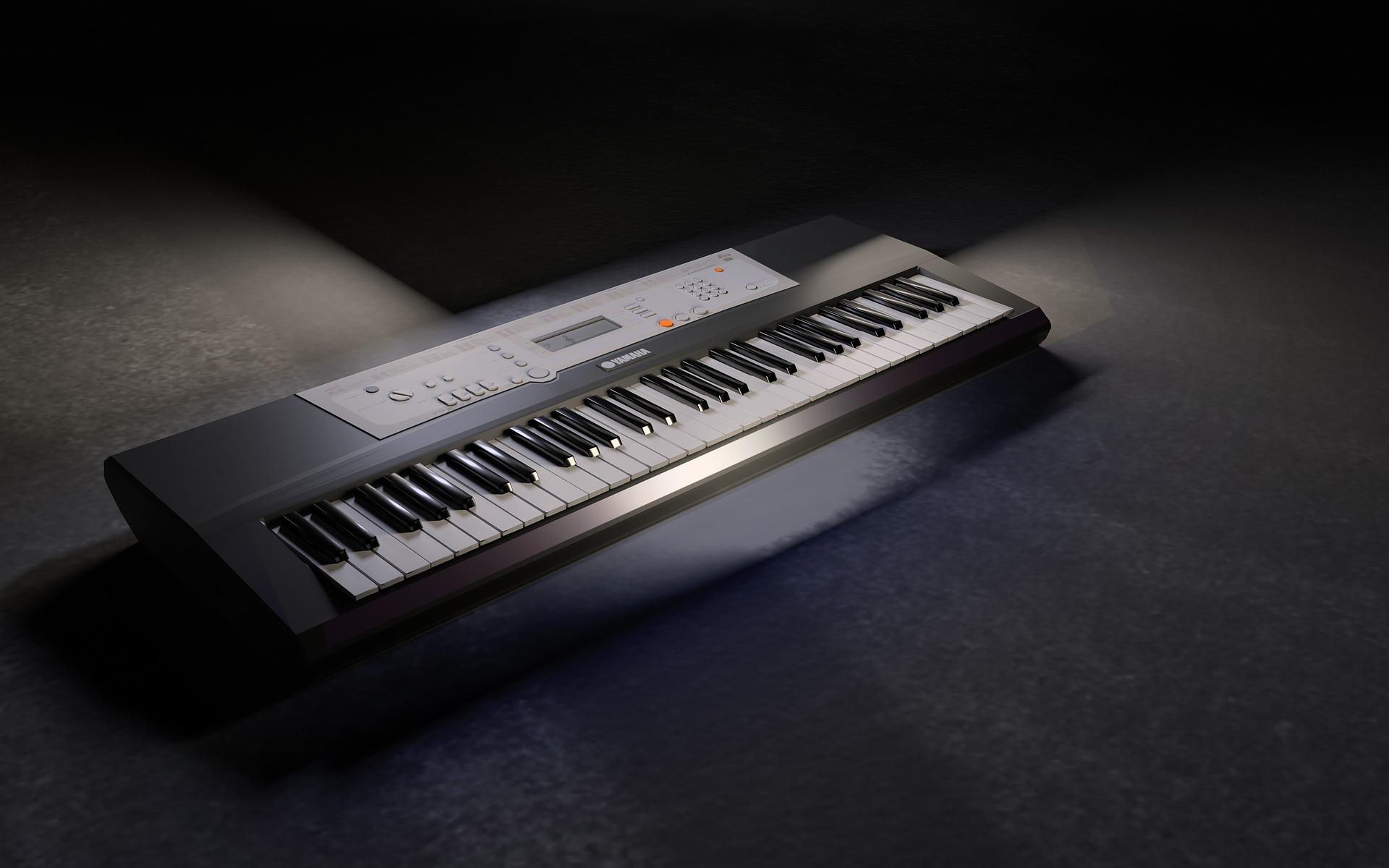
Image by PIRO4D from Pixabay.

In cooperation with consordini.com.


One of the biggest disadvantages of playing the piano is that you can’t throw it in a case and take it with you. This is why many pianists use portable keyboards for practicing piano.

A keyboard you can carry with you at no great inconvenience is wonderful, but it comes with very obvious compromises.

First, let’s talk about the glaring advantage, it’s portable! There are a lot of reasons that make having a portable keyboard an appealing option.

A common choice of keyboard for performers is the Nord Stage 3, it can be moved but it’s very heavy. Similar keyboards/synths have the same issue, Yamaha MOTIF, Roland Fantom, they are all heavy.

Many musicians choose to save these kinds of keyboards for gigging and take something much lighter to rehearsals.

You might be going on a trip that doesn’t involve performing at all but still want to practice piano. Even at home don’t underestimate the value of a portable keyboard.

If you have a busy household, finding a quiet spot to practice piano can be difficult. Having something you can move from room to room quickly and easily might be your only way.

For these reasons and many more, a portable keyboard is a very desirable option.

What it really comes down to is the question what do you need it for? Depending on your needs there will be acceptable and unacceptable sacrifices.

Sound Quality

Before even thinking about the obvious things like size and weight, let’s talk about sound.

If you are buying a portable keyboard primarily for practice, then the price will likely be a factor. High-end keyboards with amazing sounds tend to be heavy. Cheaper portable keyboards don’t tend to have the same quality or range of sounds. If you want it mainly to practice alone this won’t be as big an issue for you. But if you are using it for group rehearsals then it’s a different story.

In a group setting, you need to consider how much the actual sound affects the practice. For example, a song with a very specific synth sound may not feel the same with another sound. So, you have to consider both the positive and negative impact on your rehearsal time.

I should also be clear that you can get lightweight, portable keyboards with amazing quality and range of sound. That’s if you are happy to pay a higher price.

My first suggestion would be to consider sound quality versus price. This should help you figure out where you can and can’t sacrifice.

Number and Weight of Keys

Assuming the main purpose of the keyboard will be to practice the piano, then the number and kind of keys are very important. What I mean by this is using a piano sound more than say a synth or organ where weighted keys aren’t an issue.

The lowest number of keys I would consider worthwhile is 49 or 61. Anything below 49 really limits what you can practice. For practicing scales, modes and, harmony, 49 keys are absolutely fine. For practicing specific pieces, for example, classical music, you may run out of octaves fast. I would suggest 61 keys allow for a much wider range of use.

Most portable keyboards will have touch sensitive keys but not weighted keys. If you are practicing material where expression and feel are important, this will be an issue.

If you perform on weighted keys then the inconsistency between practice and performance could do more harm than good.

Graded soft touch is a term that you will hear often with portable keyboard keys. It means the keys gradually get heavier from low to high. Overall this offers a light feeling of weight in the keys but not quite semi-weighted.

Graded soft touch keys are often an acceptable compromise when you want to keep the weight down.

Overall Weight of the Unit

The overall weight is the biggest positive for a portable keyboard. The total weight of the keyboard is determined by the two factors we just covered, number and weight of keys.

The more keys you have, the longer the keyboard, the heavier it is. In the same fashion, non-weighted to semi-weighted to fully-weighted keys adds to the overall weight at each step.

Potential Options

In the 49-key range, all keyboards will be lightweight but there are some other things to consider. Many keyboards of 49 keys or less don’t have full-size keys, they have smaller, shorter keys. This is something I’d strongly avoid when practicing piano.

One example of 49 full-size keys is the Casio CTK-240. This keyboard has 100 built-in sounds, 100 rhythms and it’s very lightweight (6.2 lbs). If you just want a keyboard that makes a piano sound and can be taken anywhere, this is worth a look.

At 61 keys there are plenty of options, the Yamaha PSR range has been a mainstay in this category for decades. Here are a couple of options:

Yamaha PSR-E363: A portable keyboard with 61 velocity sensitive keys. It has over 500 built-in sounds, including some of Yamaha’s trademarked sounds usually found in more expensive keyboards. The PSR-E363 costs approximately $180 and weigh around 10 lbs.

Casio CTK-3500: 61 two-stage velocity sensitive keys with 400 built-in sounds. The CTK-3500 costs approximately $130 and weigh 7.4 lbs.

To give you something else to think about, if you have a laptop you can also consider MIDI controllers. You can get 88 semi-weighted keys, like the M-Audio Keystation for around $200.

So, 88 keys mean a longer keyboard, more awkward and less portable but it’s very, very light at 17 lbs. It comes with premium virtual instruments that will beat the sound quality of any of the other keyboards I mentioned above.

Summary

Whatever keyboard you choose it’s always going to be a trade-off of qualities. Sound vs weight vs key action vs price, naturally when one factor changes it alters the others.

Think about exactly what you want from it, prioritize your needs then find the best compromise.


Find more articles like this at consordini.com
Connection Between Guitar Fretboard And Piano Keyboard

  • How are guitar fretboard and piano keyboard related?
  • Will it be easier for guitarist learn piano notes or pianist learn guitar notes?

Today, our guest Neil from Sublimelody.com brings us a visual guide to answer two questions above.

Let’s get started.

1. Music Notes And Fret-Strings On The Guitar Fretboard

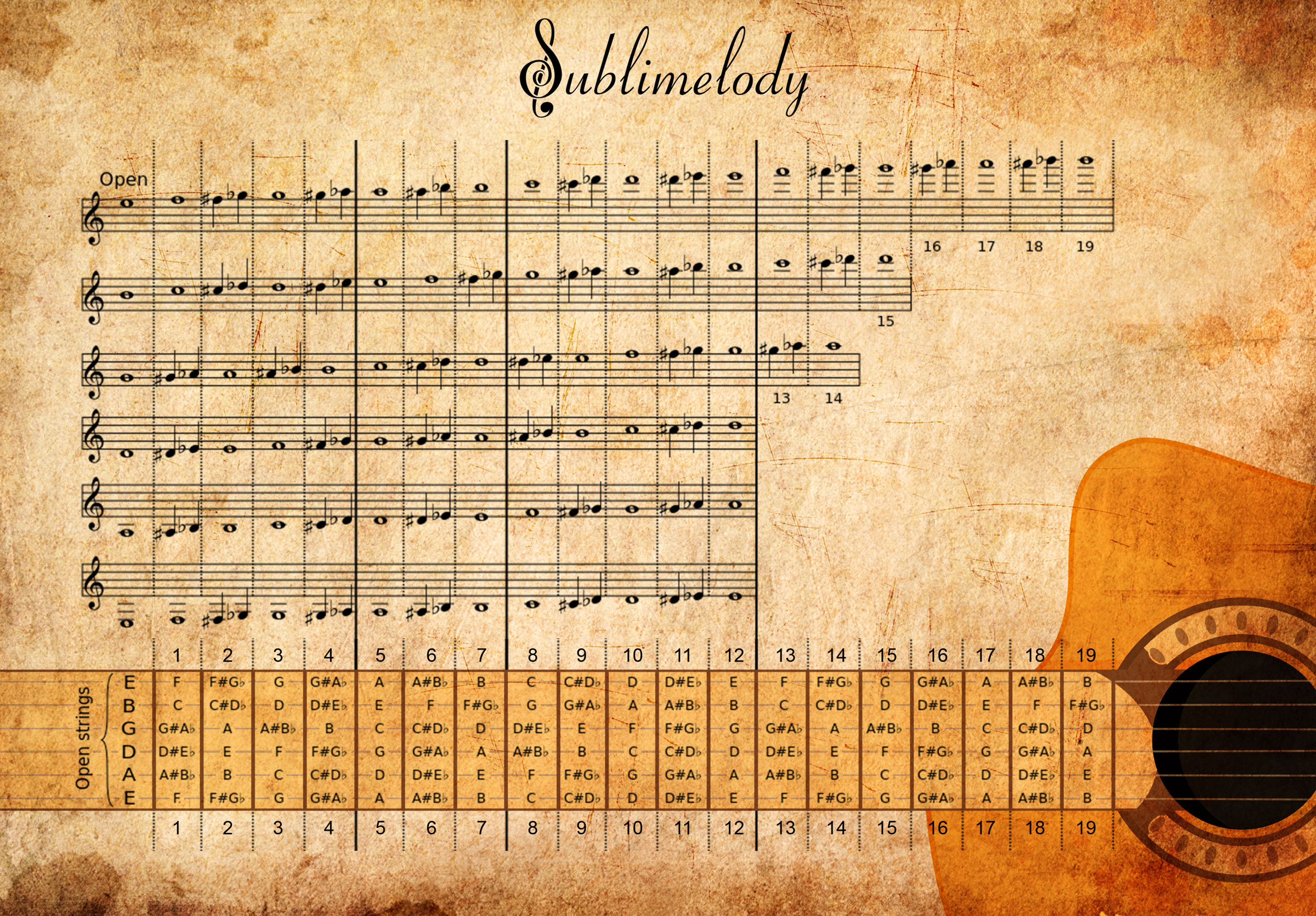
The diagram below shows you the connections between music notes and their corresponding string-frets on a standard classical guitar fretboard.

As you already know, we use the treble clef in guitar sheet music.

Each music note on the sheet music often has two or more corresponding string-frets on the guitar fretboard.


We call the string numbers by standard order. From the bottom to the top of the diagram above:

  • E (on the bottom) is the 6th string
  • A is the 5th string
  • D is the 4th string
  • G is the 3rd string
  • B is the 2nd string
  • E (on the top) is the 1st string


Let’s see how we can use the chart above to read music note and its corresponding string-frets:

Where is this note on the fretboard (G4)?

Look at the diagram above, we can see its positions on the fretboard are:

  • 5th string and 10th fret
  • 4th string and 5th fret
  • Open 3rd string


It’s not so hard, isn’t it?

Well, from a pianist point of view, it’s a bit complicated to learn guitar notes. Since to play the G4 note, we have 3 positions to choose from.

And each string is like a mini-piano-keyboard. Therefore, we have 6 keyboards!

Now, let’s move to the next section to see how music notes and piano keys are connected.

2. Music Notes And Keys On The Piano Keyboard

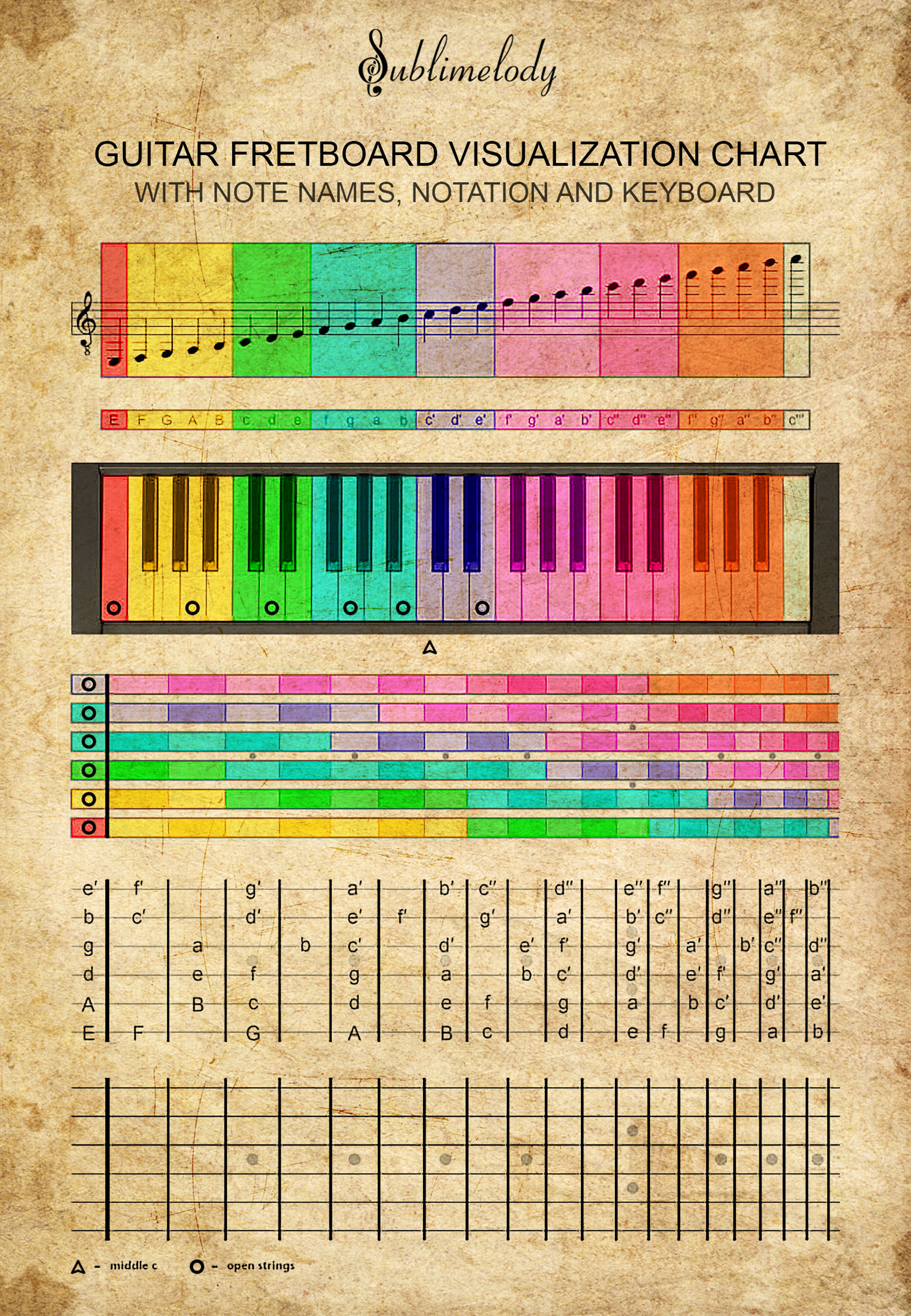
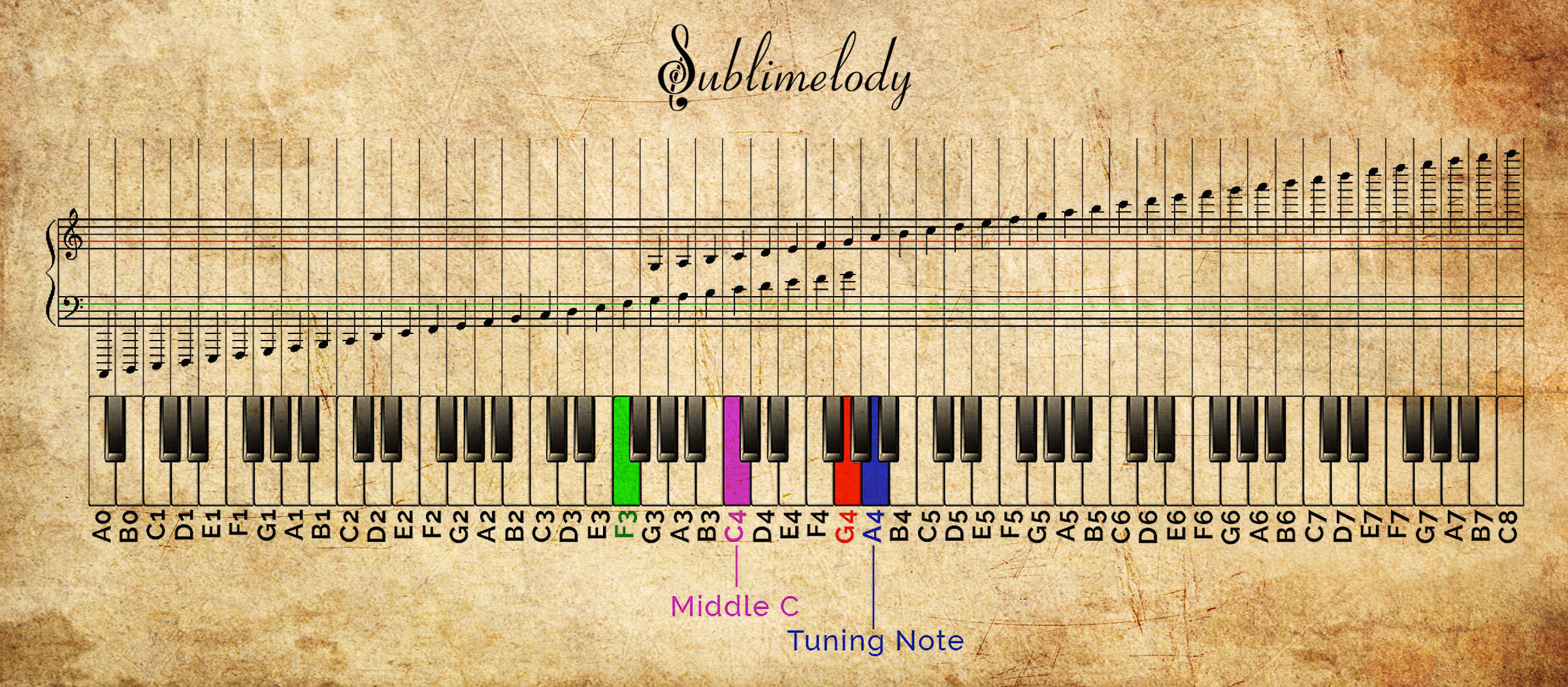
The diagram below shows you the connection between music notes and piano keys.

It may seem complicated at first, but if look closely, you will see that’s pretty simple.


From a guitarist point of view, a piano keyboard is just a string of a guitar. Each piano key is similar to a guitar fret.

The difference is the this “piano string” is much longer and presents wider pitch range than a guitar.


So, learning piano notes seems pretty easy for a guitarist.


Also, you may wonder what is the name of the clef below the treble clef. It’s the bass clef.

In piano, the left-hand plays notes on the bass clef and the right-hand plays notes on the treble clef.


If you want to learn more about reading piano notes and piano keys, and how to do sight-reading fast without memorizing a bunch of facts, click here to visit the visual guide from Sublimelody.


3. The Connection Between The Guitar Fretboard And The Piano Keyboard

Combine 2 diagrams above, and we have the following illustration:

Now, I guess you’ve got the point how music notes, piano keys, and guitar string-frets are connected.


And that’s it for my guide.


If you have any question about this guide, please visit sublimelody.com to get in contact.

Silent Night in C – Melody and Chords – Guitar, Ukulele, Piano, Violin, Flute

Photo Credit: Alice Popkorn

This song is also featured in the Christmas Songs Ebook for Guitar, Ukulele and Lyrics.

Silent night is one of the best Christmas songs for beginner guitarists to play chords with, for both guitarists and ukulele players.

Silent night is a public domain Christmas song.

The sheet music contains the guitar chords and ukulele chords for the song, along with sheets for the melodies too. There are also versions for piano, flute and violin.

There are only 3 chords needed: C, F and G.


Guitar Melody

Ukulele Melody

Flute / Violin Melody

Piano Melody & Chords (Left and Right Hand)

Guitar Chords

Ukulele Chords

PDF – Easy – Silent Night Ukulele in C
PDF – Medium – Ukulele Chords with Strumming – Silent Night in C