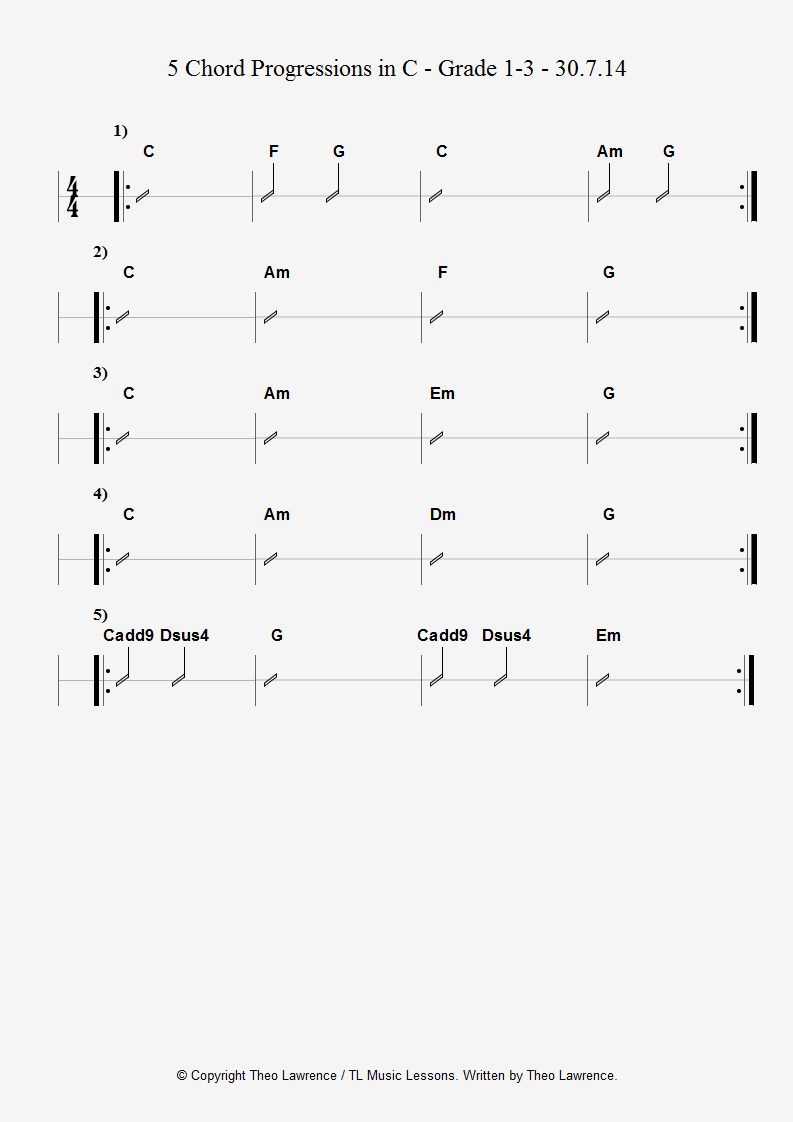
5 chord progressions in the key of C major.
You can use open (grade 1-2) or barre chords (grade 3).
You can improvise your own rhythms and you could also try various tempo and dynamic changes.
A blog to help with learning and teaching Guitar, Ukulele, Bass Guitar and Piano. Written by Theo Lawrence / TL Music Books.
5 chord progressions in the key of C major.
You can use open (grade 1-2) or barre chords (grade 3).
You can improvise your own rhythms and you could also try various tempo and dynamic changes.
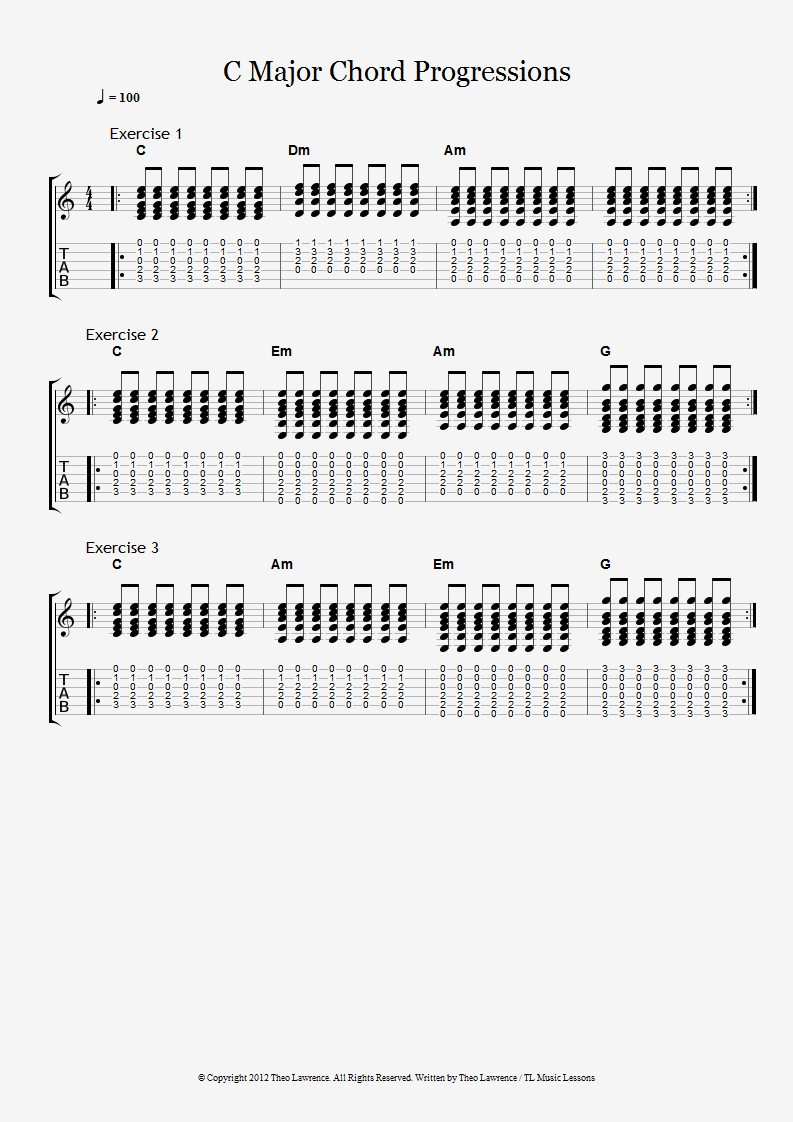
Here are some exercises to work on your picking technique, and for learning how to arpeggiate chords.
feel free to repeat the chord progressions for as long as you like, or just play through once.
Before we get started, let’s just run through all the chords that will be used.


Play 4 down strokes starting on the big E string, then 4 up strokes starting on the little E string.
Play 4 down strokes starting on the A string, then 4 up strokes starting on the little E string.
Play 3 down strokes starting on the D string, then 3 up strokes starting on the little E string. The rhythm here is “1 + 2… 3 + 4….”, which is like “quick quick slow, quick quick slow”.
The same as bar 3.
For the following arpeggiated chord progressions, they are played in the same sort of way to the first one, so I won’t display the step by step info again for these.


Accents are where you play notes or chords a bit louder. It enables the dynamics for a section to stay the same, but highlight certain notes as being a bit louder. They are used by all styles of music, and are a good way to add dynamic rhythm. For example, to make a driving rock groove, you could play 8th notes (1 + 2 + 3 + 4 +), and accent only the numbers. Heavily accented notes can be used for stabs, or ending notes.
Accents are displayed on sheet music as a right arrow > symbol, or as an upward arrow for a heavily accented note.
An ostinato is a repetating pattern, phrase or motif within a piece of music. For example, a short repeating guitar riff is an ostinato.
More info on Wikipedia: http://en.wikipedia.org/wiki/Ostinato
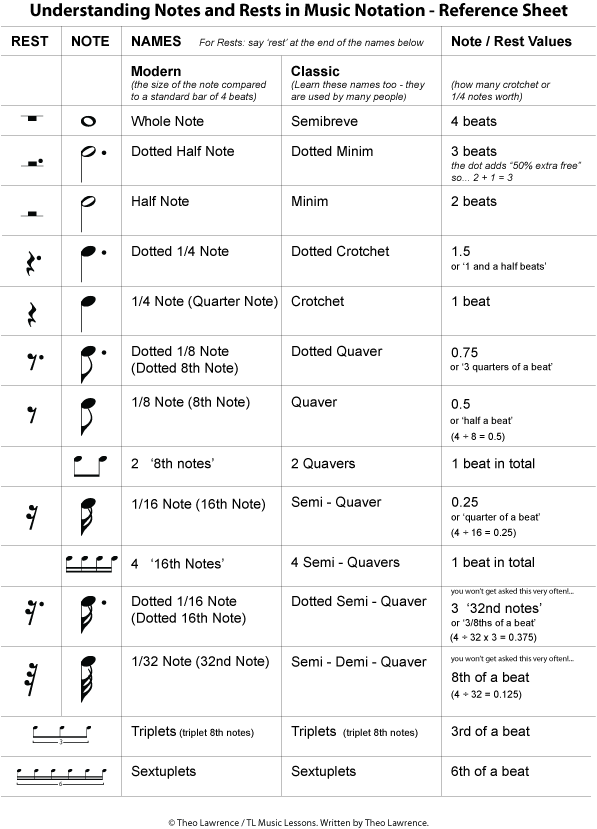
This is a very useful sheet that will help students of most instruments that read music. The sheet includes images or rests and notes, and their modern or classic names, and also note values and rest values.
This can be useful as a reference sheet for students to keep on your computer, phone or tablet, or you can also print it out and stick it on the wall or keep it somewhere handy.
Music Teachers are welcome to download this and print it for their students.
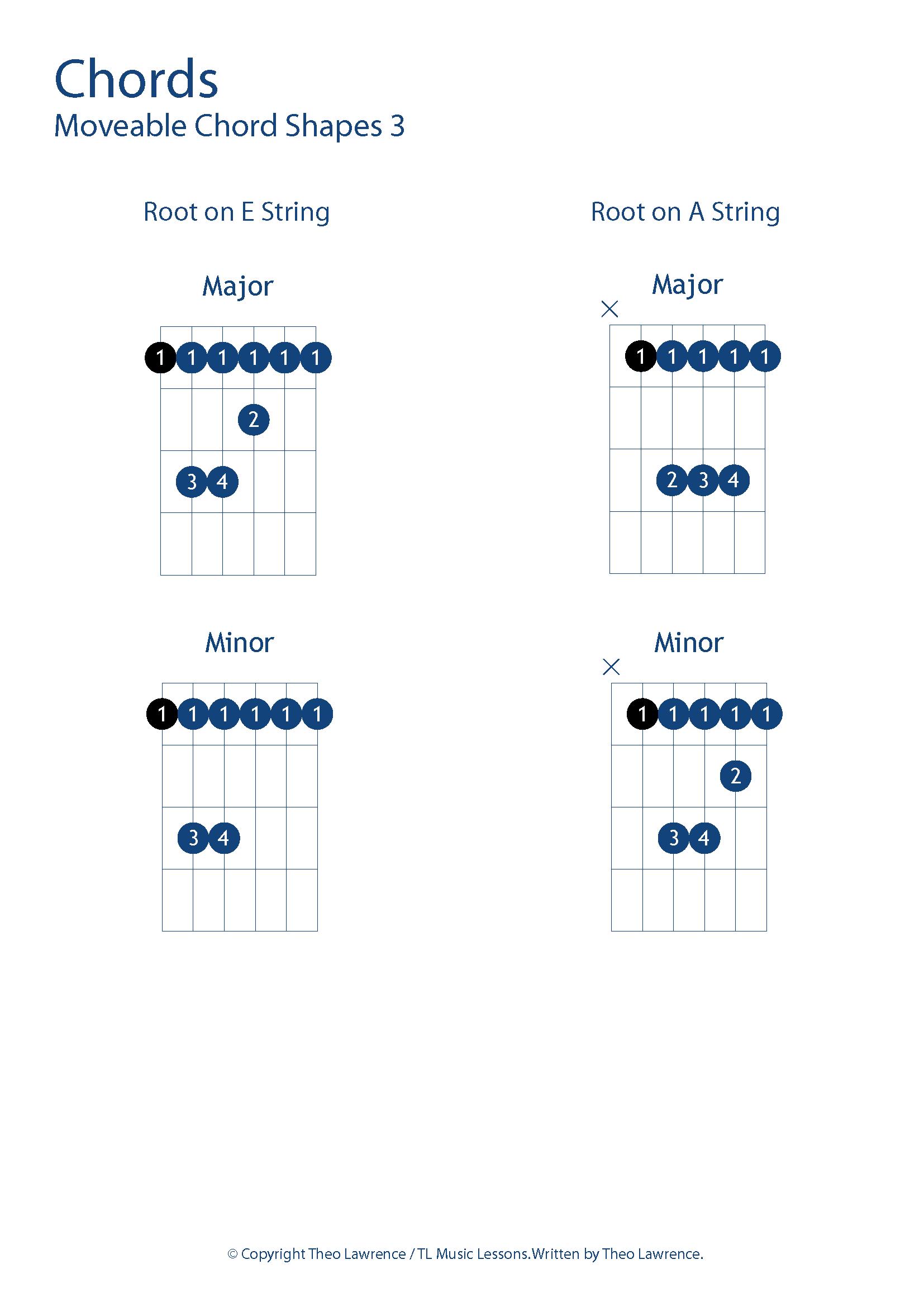
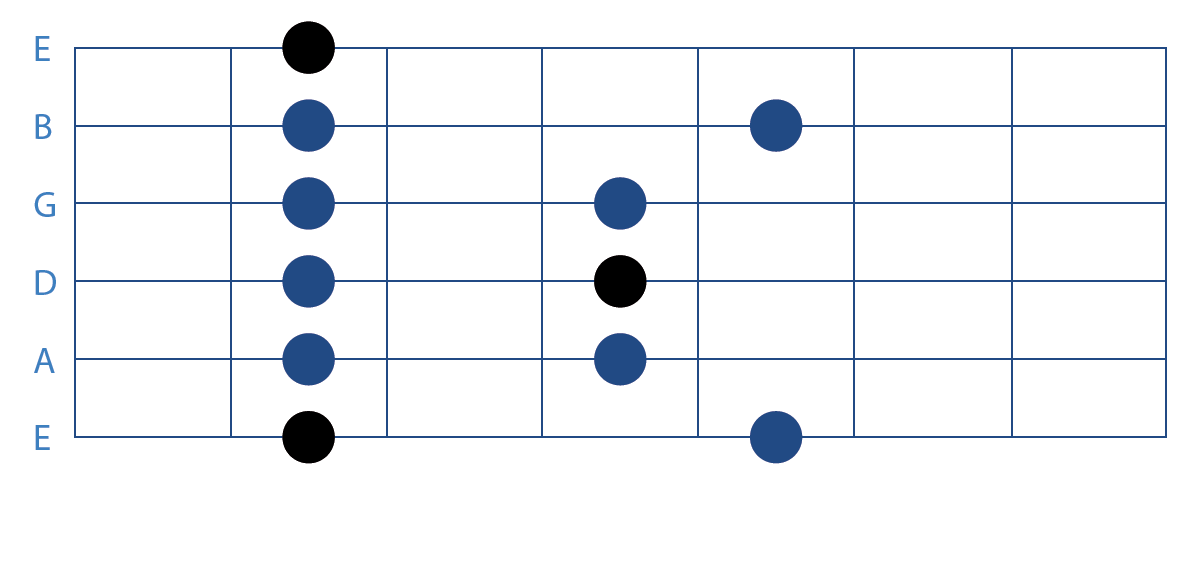
This printable PDF is a nice looking printout of the 4 main barre chord shapes you need to learn for Grade 3 guitar.
Each shape is moveable, so with these 4 shapes, you are able to play any major or minor barre chord on the guitar. For example, play the first major shape on fret 3 of the E string, and that will be G major, because the root note will be on G. The root note for each chord is shown on the sheet as black circles. So, if you want to play a C minor barre chord, use the bottom right chord on the sheet (the minor shape with the root on the A string) and match up the root note with fret 3.
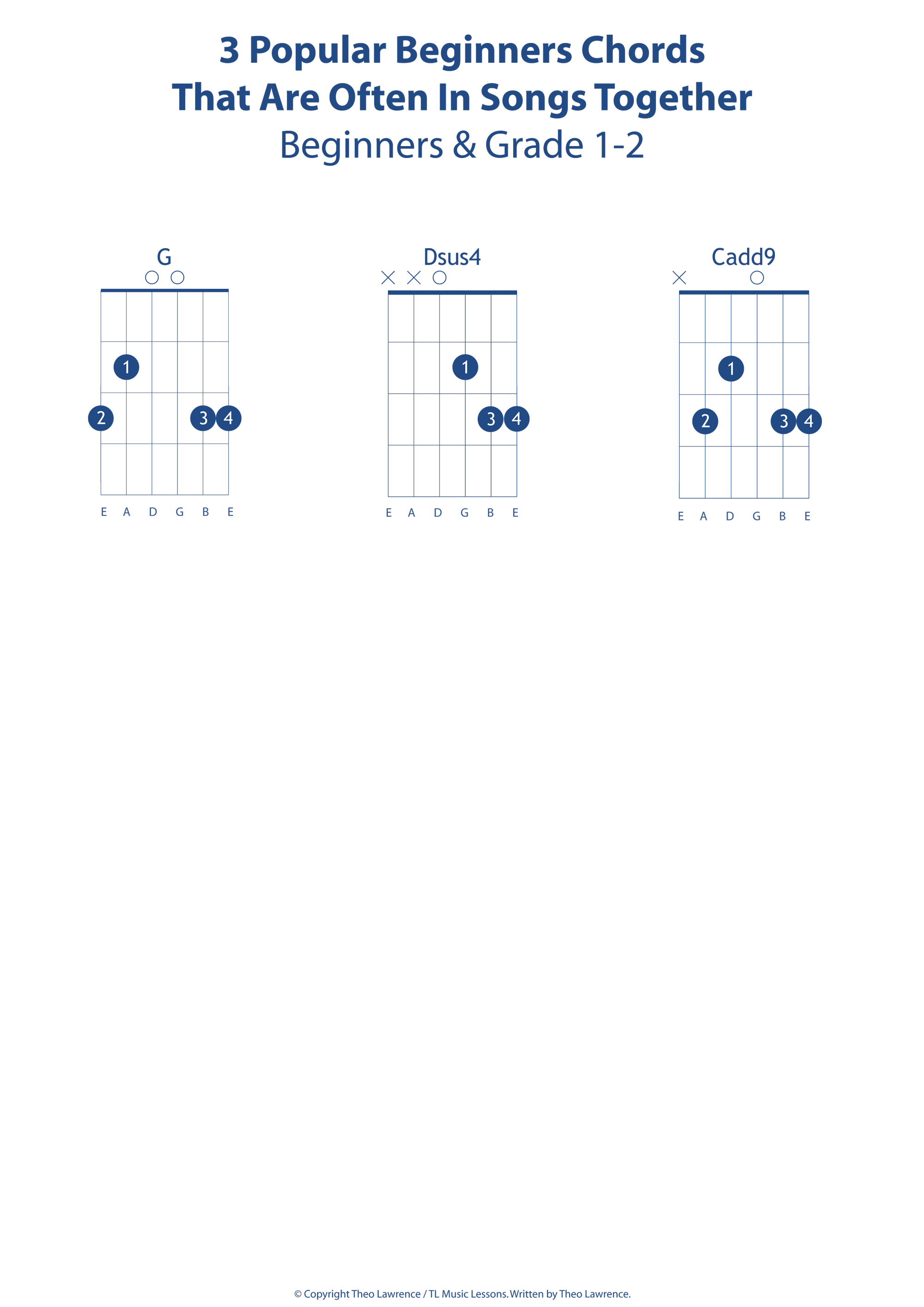
The chords Cadd9, Dsus4 and G, all fit together nicely in terms of changing chords easily, and have therefore become a popular choice for songwriters to use together in songs. This is obviously only a bonus though, as more importantly they also sound great together, in any order really.
Another more common chord that fits nicely with these chords is the Em Chord. In addition, the D Chord will also fit with these chords.
The G chord is still technically G, and referred to as G. When I wrote this sheet, I referred to it as ‘Custom G’ when teaching it to my students so they differenciate between this and the normal G Chord. However, since writing the sheet, I have decided to teach this chord to beginners as standard because most players find it less of a finger stretch.
Here are a few songs that use these chords:
You will find more by googling “G Cadd9 Dsus4” (include the speech marks to target the search to include all the chords).
Subdivisions is a general term that we usually use to describe various notes that are shorter than one beat, such as 8th notes, triplets, 16th notes, and all the rest. 1 beat crotchets (quarter notes) can be divided into halves to make quavers (8th notes). These 8th notes (quavers) can subdivided into 16th notes (semi-quavers) by halving them again. The largest note in music without using ties is a semibreve (whole note), lasting 4 beats. Everything smaller than this is divided up again and again, which are subdivisions of the initial division. 2 beat notes are an equal division of the 4 beats. Technically, I think anything smaller than this is a subdivision because it has been divided up more than once.
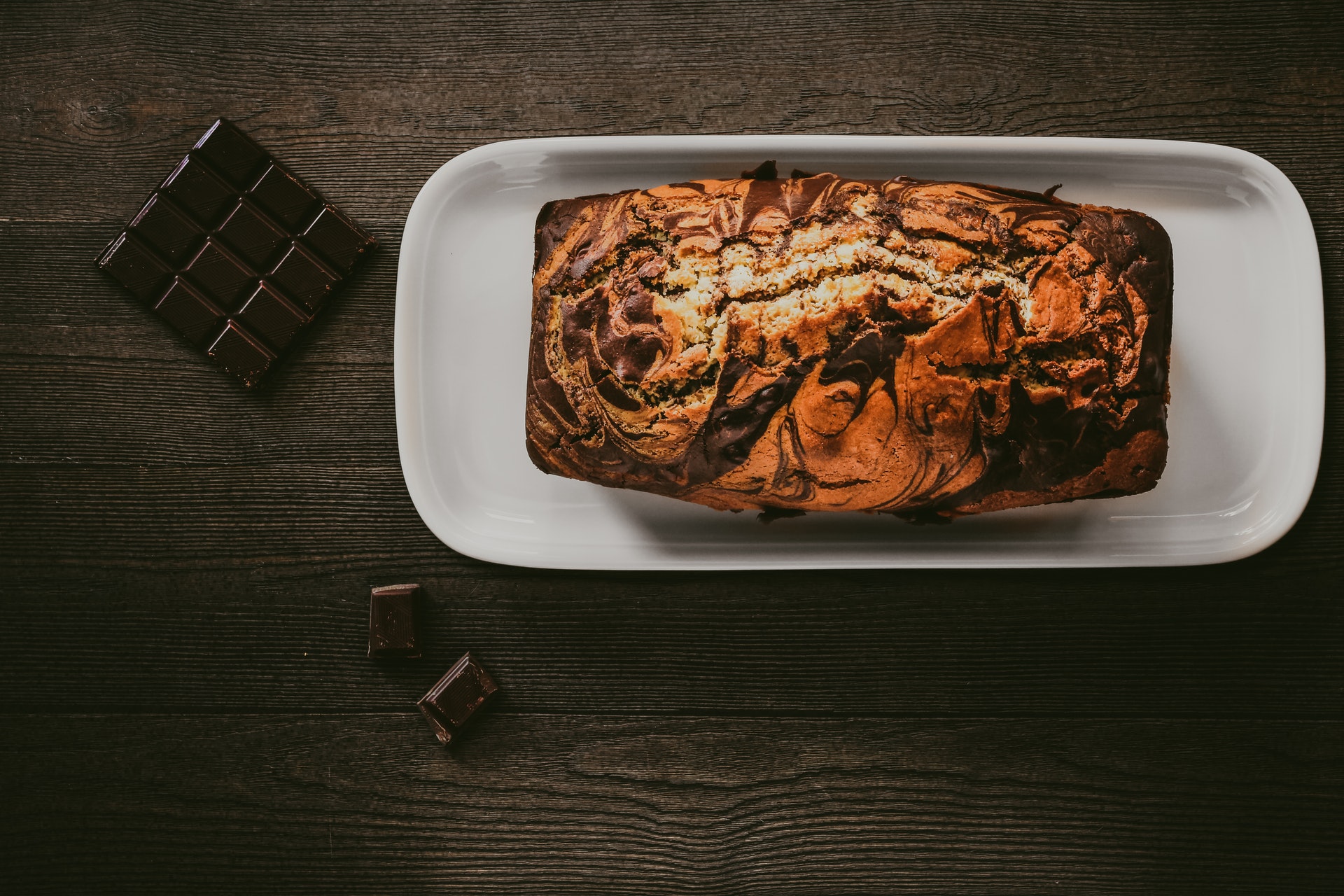
Lets use a simple cake example of how subdivisions work…
Questions about learning root notes and why comes up a lot by guitarists.
In this article, I will attempt to answer some questions you might have about root notes, and hopefully encourage some people enough to spend time to learn them.
Learning root notes might sound like a lot of work, but I recommend that you learn them as you go, for example, learn the root notes of an A major barre chord shortly after learning the shape.
Don’t try to learn all the root notes for everything in one go, as that would probably get a bit boring! Instead, you could read through this to pick up the main points, and perhaps check back here when you learn a new barre chord or scale to refresh your memory if you need it.
In scales, the root note is the first note in the scale. This is also the root note of the key of the song. In a 2 octave scale, there will be 3 root notes: The first note in the first octave, the first note of the second octave, and you normally end on the 1st note of the 3rd octave.
These are important to know because when you are soloing, it’s often a good idea to resolve to the root note at the end of the solo.
Another good thing for knowing the root notes, is that you could start soloing half way through a 2 octave scale, by starting on the second root note. In RGT grade 5 and above, you actually are required to know many scales in this way, by playing 1 octave scales in 5 positions. They are all actually the same notes,but played starting on various root notes. So here you will be forced to learn the root notes! The idea of this is useful: to be able to play the same riff all over the guitar neck but a acheive different tones, or be able to apply different techniques such as hammer ons or slides in different places that you couldn’t in others.
Major chords are made up of 3 notes (a root note, and two others). Almost always, the first note in any chord is the root note. The root note of an A chord is A. The root note of an E chord is E. Easy.
In standard major and minor barre chords on the E string, there are 3 root notes in total. This is the first note, last note, and the one that you hold down with the little finger. Knowing where root notes are in other chords, and how they are constructed is usefull for picking out those notes if you want to, or for creating variations of the chord. If you want to find out more, do a quick search on here, or on google, for ‘chord construction’.
Knowing the root notes in arpeggios is similar to learning about chord construction, because an arpeggio is basically the notes that make up a chord in chronological order, played for 1 or more octaves. For example:
A tonic chord is the same chord name as the key of the music.
For example: If the song is in E major, the tonic chord has to be E major. You can also have other chords in a song with the key of E major, chords like A major and B major, but these would not be the tonic chords.
Becoming a guitarist in a musical theatre orchestra is no easy feat. The guitar is one of the most popular instruments that people learn and there are huge numbers of very proficient guitarists in the UK, many of which are vying for very few guitarist vacancies.
Performing in a musical theatre orchestra is very different to performing as a solo classical guitarist and classical training is not deemed necessary. You will need a good degree of skill but you also need to be able to learn pieces quickly and the ability to read music is essential. You also need to be able to play with other musicians which is a skill in itself. The best experience you can have if you are considering trying out as a musical theatre guitarist, is to spend as much time playing as many songs, with as many people, as possible.
The styles of music that you may be asked to play will range hugely, from rock to reggae, from classical to jazz. Flexibility is the best trait you can possess. Because of this, many guitarists in theatre orchestras do not have classical training. If it is your goal to become one then don`t spend hours and hours practicing Segovia but rather spread your practice time over as many styles as possible.
Another important point to bear in mind is this – being the guitarist in a musical theatre orchestra will not make you a star. If you are looking to be famous then you should start a band and write popular music, then, if you are good enough, you might just make it. Even the best classical guitarists in the world are virtual unknowns. Only guitarists like Eric Clapton or Keith Richards become household names.
Nor will you be the star of the orchestra itself. In an orchestra, everyone is equal and the guitarist is nothing special. In fact, as the guitarist you may find yourself with nothing to play for long stretches of the performance. This is another skill that you will need, the ability to concentrate for long periods of time and the patience to wait for your time to play.
If flexibility is the best trait to have to get on as a professional guitarist then a close second is doggedness. You will most likely need to audition for many jobs before you land one and you will need to either already have, or quickly develop, a thick skin to deal with rejection after rejection. However, it`s not all doom and gloom. Once you have a few jobs under your belt you become much more appealing to musical directors looking for a guitarist. As you gain more and more experience you should find work more and more easy to come by.
The key point is that it isn`t the most talented musicians that make it. Yes, you do need a certain amount of talent but it is determination and flexibility that really matter.
Rates of pay vary depending on the size and location of the theatre. A guitarist in a large London theatre is likely to receive more money per performance than in a small, provincial one. Orchestra members in popular theatres in large towns and cities may be contracted and paid a salary whereas touring performances, or small town theatres, will usually pay per performance on a self-employed basis. It is hard to make more than 20,000 per year as a professional guitarist and many subsidise their income by giving guitar lessons and performing as session musicians for recording artists.
Chords Used:
C, Dm, Am, Em, G
The rhythm is played with straight 8th notes using either downstrokes or alternate (down/up) strokes.
Use these 3 exercises to practice some of the basic beginners chords.